
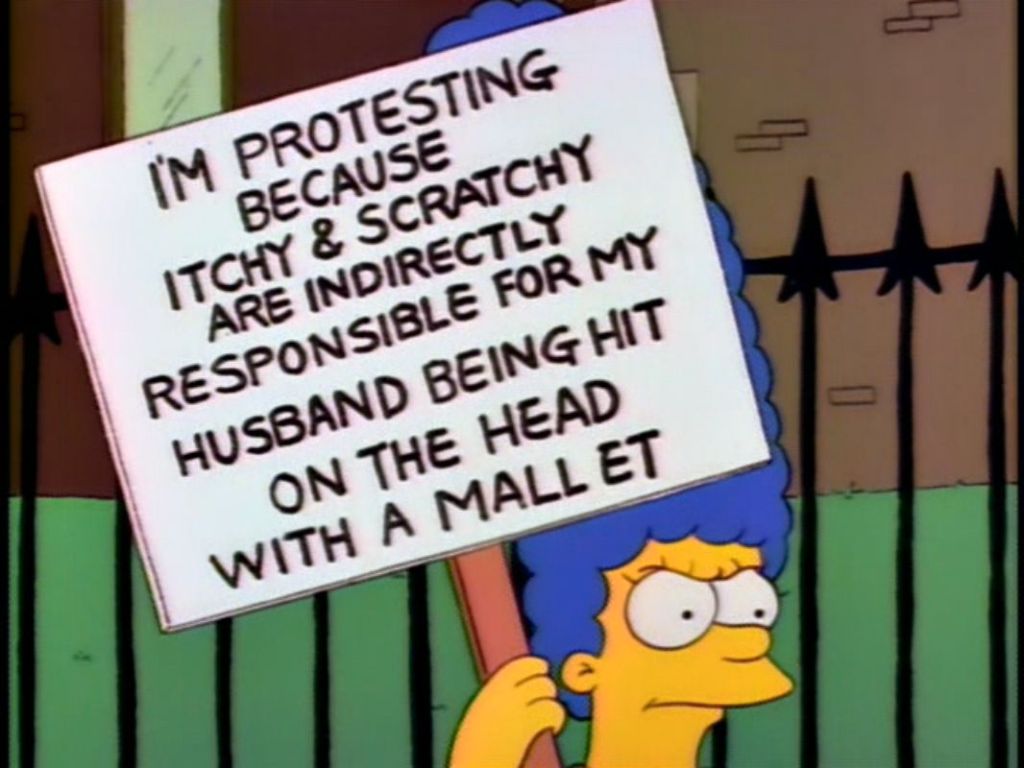
I know that cartoons like The Simpsons are only fiction, and that because of this, using it to illustrate a point isn’t always helpful. The person writing them can write in any lesson that they want, including those that may not work in reality, but can work in a fictional setting anyway, by nature of being a fictional work.
Still, an old cartoon can make a point that puts things into perspective, and that perspective might be much needed.
Also, using cartoons to illustrate a point is fun, and can hold the attention of those who grew up with the same cartoons.
You may remember an old episode of The Simpsons, titled Itchy and Scratchy and Marge. In the episode, an infant character Maggie strikes her father Homer with a mallet, leaving the child’s mother Marge perplexed as to why Maggie would do such a thing. Later, she sees an episode of a cartoon, Itchy and Scratchy.
Itchy and Scratchy is an in-universe parody of a real-life cartoon Tom and Jerry, but with a stronger emphasis on graphic violence, and airs as part of a program called Krusty the Clown, which is enjoyed by Marge’s other children, Bart and Lisa. Interestingly, while Lisa normally abhors violence, she adores Itchy and Scratchy with the same enthusiasm as Bart.
Having watched the cartoon for herself, and seeing little Maggie attempting to stab Homer with a pencil, Marge makes a mental connection, and decides to take action.
As the episode progresses, Marge eventually builds a coalition, which successfully convinces the writers of Itchy and Scratchy to write a non-violent episode. Predictably, this causes viewers of Krusty the Clown to lose interest, resulting in them playing outside, instead.
For Marge, this appears to be a victory. However, the episode doesn’t end there. The curators of a famous work of art were on a tour which would take them through Marge’s home town of Springfield.
Marge believed the work to be a masterpiece. However, the coalition she was previously a part of objected to it, by reason of it being a depiction of nudity. Thus, there was a new conflict driving the plot, as Marge contested the coalition she herself was instrumental in forming, while being criticized for her alleged hypocrisy for opposing the artistic depiction of violence, while defending an artistic depiction of nudity.
In the end, Marge won out again, and Marge and Homer got to see the statue for themselves at an exhibit, where they expressed a desire for their children to also see it for themselves, possibly through a school field trip.
There are numerous takeaways that a person could come away with after watching this episode. But the one I would like to focus on is the main theme, which concerns the freedom of expression in practice.
Due to the ironic nature of how the characters in The Simpsons are written, it can be difficult to determine whether the characters learn lessons which may be apparent to viewers.
Marge initially disregarded the principle of free expression, apparently taking a position which favored her own interests. Rather than properly instructing her own children, she opted for convenience, insisting on entertainment media which she saw as having less potential for negative influence.
But when a work of art was to arrive in town which she regarded as a masterpiece, she defended it, against the objections of the cadre she had previously sided with.
The undertone of the episode illustrates to viewers that protecting free expression doesn’t just mean protecting expressions that one prefers, it also means tolerating the presence of expressions that may not appeal to one’s sensibilities. Otherwise, one risks being seen as hypocritical, as Marge did.
Also relevant to today, one can notice that the coalition that Marge helped form didn’t stop with the art she didn’t like, it continued with the art that she did like. That’s how it often goes with such collectivist groups, they can develop in ways that’s difficult to predict, and they often develop desires which are well beyond what they may have initially expressed.
 Magnetricity