
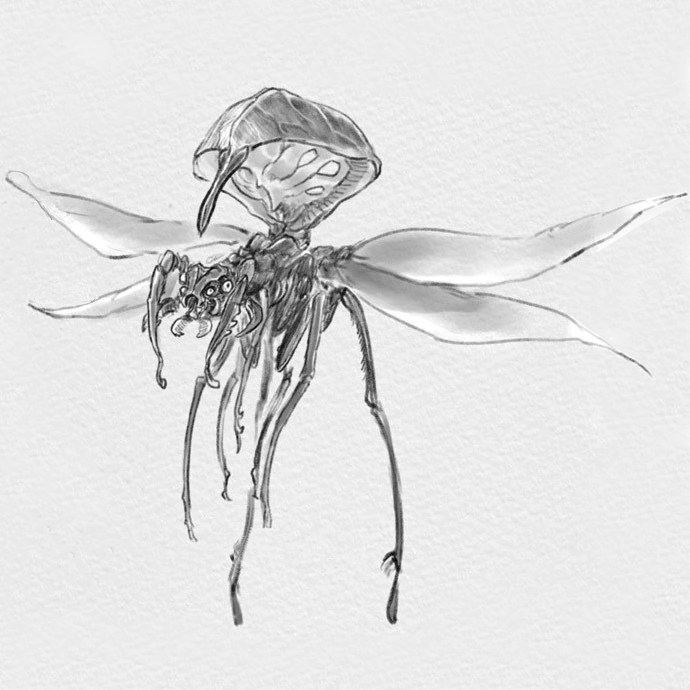
If you hate bugs, get ready to hate them even more.
Pictured above is what’s called an amaranthine deceptor. It’s a fictional insect from Made In Abyss. Its deal is that it inhabits the 6th layer of an environment called The Abyss. They imitate leaves, which makes them difficult to detect without careful attention. They won’t travel too far away from their nest, and spend much of their time just sitting on plants, resembling leaves.
The problem comes in when they receive a signal to attack. When this happens, they immediately swarm the area, attacking any critter that they can, trying to force themselves into any opening, such as their mouths. Once embedded, they live inside their host as parasites, slowly feeding on flesh, and trying to delay the death of the host so they can continue feasting on a living meal. Eventually, the host dies.
Though the bugs live in the 6th layer, they posed a problem when a number of them made a nest in the 4th layer. The party of protagonists had a brief encounter with them at the beginning of the film, Dawn of the Deep Soul, and haven’t been in a hurry to encounter more of them, since. Their danger classification is five stars (absurd).
“Okay,” you might be saying, “but those bugs are made up. If something like that actually existed, wouldn’t more people know about them?” If that’s what you’re wondering, then get ready to have your day ruined.
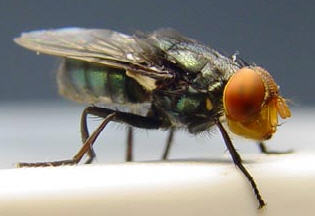
Pictured here is what’s called a cochliomiya hominivorax, also simply known as a screwworm. What’s its deal? When a pregnant female screwworm sees an open wound on a warm-blooded mammal, it goes for it, laying its eggs in the wound. It can lay hundreds of eggs at a time.
Oh, in case you’re wondering: Yes, humans are warm-blooded mammals.
When the eggs hatch, the larvae begin feasting on the surrounding flesh, burrowing deeper as it does, which is where it gets the name “screwworm”. Currently, the only option for treating a screwworm infection is surgery, which involves removing the little abominations, often one at a time.
At this point, the next question I imagine you have is, “Where do these monstrosities live, so I’ll know to stay away from them?”
At one point, they were common in the American southwest. But then, they migrated to the southeast as infected livestock were shipped. In the 1960s, Americans decided that they were tired of their buggy bullshit, so they released a bunch of lab-raised sterile male screwworms into the wild, causing females to bear unviable eggs. As a result, the screwworms were driven down to Central America, where they were no longer our problem.

Personally, I would have consented to their complete eradication, but it was still a job well done. There was a small outbreak in 2016 among endangered deer in Florida, but the outbreak was eliminated in 2017.
But now we’re talking about them, again. Why is that? Because there is a confirmed human case in the state of Maryland, and the victim is a traveler from El Salvador.
Screwworm populations have been monitored, and have become an increasing concern as they’ve been migrating steadily North, and have migrated as far as Mexico since an outbreak originating in Panama in 2023, which happens to be when unchecked mass migration was in full swing during the Biden administration.
But a human case as far North as the state of Maryland comes as a shock. Sure, we can release more lab-raised sterile male screwworms to fight back. But I don’t want those things coming back here, at all.
Because we’ve established that screwworms can make it to the US via infected travelers, aren’t they another compelling reason why unchecked mass migration is a horrendously bad idea?
 Magnetricity