I’ve been seeing Frieren come up from time to time. A friend recently recommended it to me, so I decided to make some time to watch the anime.
Two days and 22 episodes in, I think I can say I get the general premise, and can comment on the controversy surrounding it.
First thing to point out is that Frieren: Beyond Journey’s End is a work of fiction. Because I recognize it as such, it doesn’t inform my morality. If a work of fiction were to attempt to teach a moral lesson, it could teach any lesson that the author might want it to, and the scenario could be written to present it in a favorable light, regardless of what the reality of the matter might be if a person were to attempt to put it into practice.
Entertainment is supposed to be entertaining, and that’s all it has to do to justify its existence. The idea that entertainment must have a moral value is generally propagated by busybodies who don’t trust other people to think for themselves. If children are taught that entertainment is merely to entertain and not to inform moral perspectives, they could watch shows like South Park and Family Guy and still become a moral child (though those probably might not be your first entertainment choices for your child). It’s not a bad idea to instill the proper perspective to prepare them for the inevitability that they’ll come across these shows, or shows like them.
Otherwise, if your child comes across a cartoon that extols the virtues of pushing old people into mud instead of helping them across the street, there’s no telling how they’ll take it. There’s no substitute for proper parenting.
As obvious as this is, lazy parenting that failed to instill a proper perspective on entertainment has resulted in a new generation of busybodies that have become everyone else’s problem.
Based on this framing, you might guess that Frieren is Ren and Stimpy on PEDs. Nope. Frieren is about life, mortality, and friendship from the perspective of a person who, being an elf, would be likely to outlive the humans around her by many centuries. While the story takes place after another story has already concluded, it still succeeds in conveying a compelling and beautiful narrative, which is at times exciting.
So, what’s the problem?
The problem is, some people are taking issue with the portrayal of a fantastic race, called “demons”, as being evil.
For clarity, the demons in Frieren are not the mind manipulating spiritual beings that are often featured in religions, they’re more like the tieflings in Dungeons and Dragons in that they are humanoids with horns. But while the tieflings might be capable of morality on an individual by individual basis, the demons in Frieren are irredeemable psychopaths with no understanding of human desire for friendship or family, and have learned human language to the end of using it to manipulate. Which, concerning the abuse of language, makes them sound like the propagandists in the corporate mainstream information media.
I was aware of the controversy before watching Frieren. But what surprised me was just how little screen time was given to the topic of the morality of demons. The impression that I got was that demon morality was a contrivance designed to convey that Frieren’s original journey was strongly justified.
This is in addition to the antagonists being called demons, and the point was labored that they were incorrigibly wicked and that tragedy was the long-term consequence of any attempt to co-exist with them. Could the point have been more strongly conveyed?
However, for the busybodies, this is just the problem. Because as they see it, fantastic racism is still racism, and they can’t bring themselves to trust the rest of us to think for ourselves. But in coming to the defense of these fantastic psychopaths, these same busybodies are showing that they’re just the kind of people who, if they were to live in Frieren’s fantastic setting, would fall for the demon’s honeyed words.
At this point, you might have guessed that it’s primarily leftists who are raising an issue with Frieren. Yep. It’s leftists again.
And, right on brand, they want everything, including every form of entertainment, to bend the knee to their worldview, even anime and manga. Because when it comes to cultists, the usefulness of anything is measured by its utility for propagating the cult’s ideology.
But the problem isn’t just that the left seeks to subvert entertainment and transform it into a vehicle for their worldview. The left is also waging a long war against the traditional morality that derives its principles from natural law. To this end, they seek to undermine basic ethics in favor of a new set of values that is disconnected from reality and ignores the second order consequences of their own unwise behaviors.
It’s part of the reason why the left can’t meme. Memes are shortform communication delivered with an understanding of what’s considered normal, so that humor can be found in a variation from expectations, much like a punchline in a joke. Take the old cat meme, “I can has cheezburger?” For most viewers, the expectation is that a cat can’t employ language, but if it could, its syntax and spelling would likely be poor, as it is in the meme. However, if the meme were to have been presented by a vegan, and thus someone with a left-wing fringe ideology, they might include a disclaimer that they don’t condone the cat’s request, or they might object to even sharing the meme on principle.
Leftist memes tend to be wordy, and there’s a reason for that: the leftist meme is part of a deliberate attempt to redefine normalcy, and to this end, they don’t want there to be any possibility that the meme could be misinterpreted, especially in a way that may defeat their ideology.
The verbosity it would take to redefine expectations does not lend itself to shortform content. But it also reveals something about leftists: that their ideology is more important to them than whether you’re amused or entertained.
When you know this, it’s easy to see why leftists have a problem with Frieren. The rest of us have basic understandings about morality which don’t need continual reiterating. Among the points we consider axiomatic: Immorality is corrosive to families, communities, societies, and nations. Some cultures are incompatible with other cultures. There are people who make it difficult to live peacefully.
If you understand these things, then the way that Frieren handles the demons in its world shouldn’t challenge you. However, leftists feel threatened by Frieren, because the narrative of Frieren supposes a morality that hasn’t imbibed on a toxic dose of outgroup empathy.
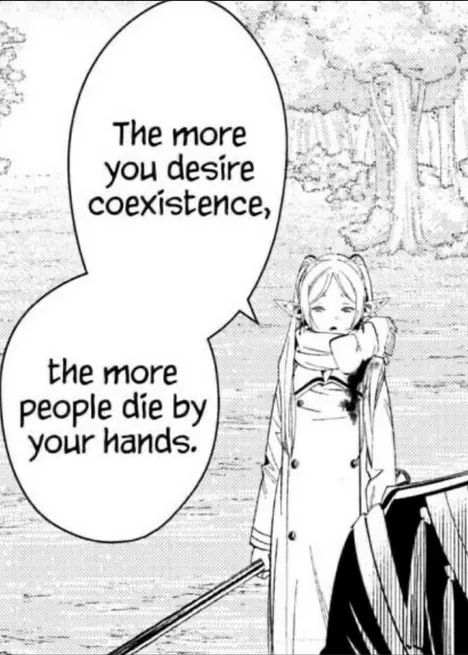
Frieren has frequently been accused of saying that coexistence with certain people is impossible. The following panel is often pointed to, which is probably the most controversial in the manga:
It has often been said that Frieren said that you can’t live with certain people. The words she used are different in the panel above, but they carry the same implication.
For clarity, here’s the surrounding context (being manga, panels and word bubbles are ordered from right to left):
While Frieren might not have used the phrase “coexistence with certain people is impossible”, it’s plain to see that this is a sentiment that she would hold, and she illustrated this while addressing a demon who was okay with sacrificing lives in an attempt at coexistence, showing that those lives were less meaningful to him than his endeavor.
However noble the demon’s stated endeavor may have sounded, it’s undermined by his inability to comprehend the value of life. It’s the old “making an omelet by breaking a few eggs” line of reasoning.
But however one might interpret Frieren’s words, it remains that the Frieren manga and anime are works of fiction. Any lesson, moral, or social statement that they make, whether expedient or not, should be viewed in that light.
After all, the main point of entertainment is to be entertaining. If leftists had their way with it, entertainment would be turned into propaganda.
And that’s one of many reasons why they must be resisted.













 Magnetricity