I’ve pointed out before that one of the reasons why Americans are so susceptible to propaganda is because they haven’t been taught to recognize it. It’s a sad side effect of having an establishment that insists on propagandizing them. For the people who propagandize them to teach them to recognize propaganda would be a self-defeating endeavor.
So, there are people running amuck on social media, beguiling the less based Americans by influencing them, easily using translators to create the appearance that they reside in the same country as they do.
And in some cases, they’ll wear the pretense of Christianity as a skinsuit, knowing that there is a high potential to deceive people by taking on the appearance of their religion.
But these people tend to give themselves away in some subtle ways. And once you know what they are, it’ll become far more easy to notice them.
The first giveaway is huge to the point that I’ve decided to place it first, so it will be less likely that you’ll miss it. And it’s important that people know about it, because we see a whole lot of this on social media.
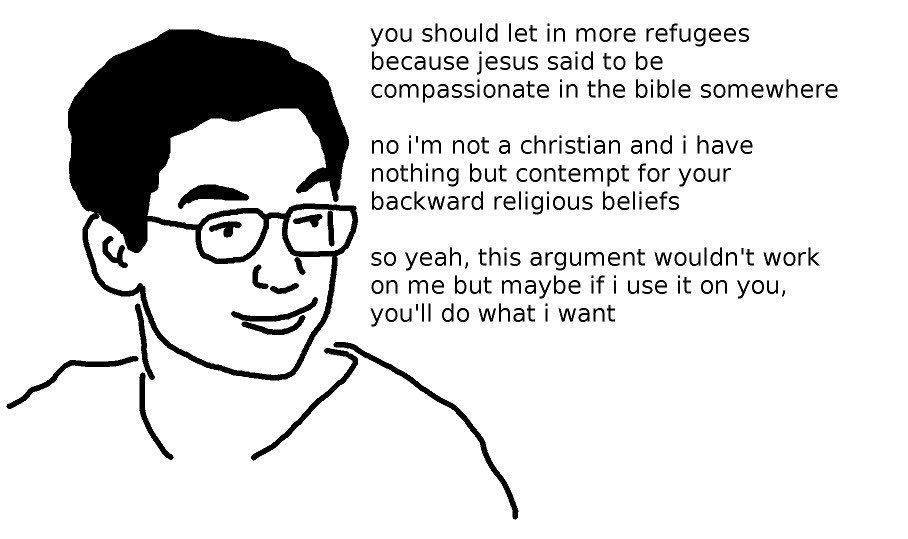
It’s an eagerness to try to use Biblical sounding teachings in an effort to try to get you to do what they want. This is huge, and a massive giveaway, because it says a lot about where the faker’s mind actually is, spiritually speaking.
In their thinking, religion is about manipulating people. And the value of a religion to them is in how they can use it to get other people to do what they want. It’s particularly ironic if they call any other religion a cult, because a cult leader thinks exactly the same way that they do.
One topical example is when they present the verse in which the Israelites are told not to vex foreigners. This is usually presented with an implication, which does a lot of work, that Christian societies are supposed to accept unchecked mass migration and open borders. Conveniently, it absolutely ignores every verse which expresses that anyone who travels to the land of Israel is expected to assimilate, to the point that they are expected to observe the weekly Sabbath, and the penalty of death for certain sins also applies to them.
Why leave out such important information? For one thing, they might not actually be aware of what the Bible says. Another possibility is that they know what the Bible’s teachings are outside of the verse that they present, but don’t want you to come to any conclusion besides the one that they want you to come to.
In either case, they’re not someone whom you would want to turn to for advice on how to run a Christian society, or make serious decisions on how to run your life or your household. And that they don’t know their Bible very well might just be the giveaway that they might not actually be a Christian.
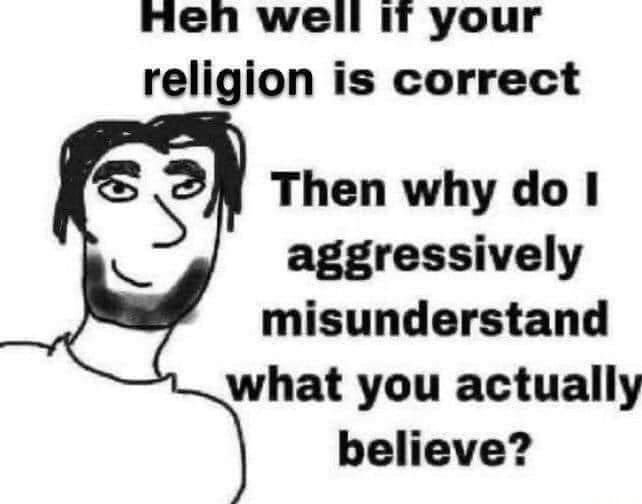
And there are a lot more forms of this. A lot more. A lot of it comes down to, “be nice, because your religion says so” or “give me stuff, because of how you probably misunderstand a verse”. It’s easy to see through the agenda, and you’ll be less likely to fall for it if you have an understanding of your Bible.
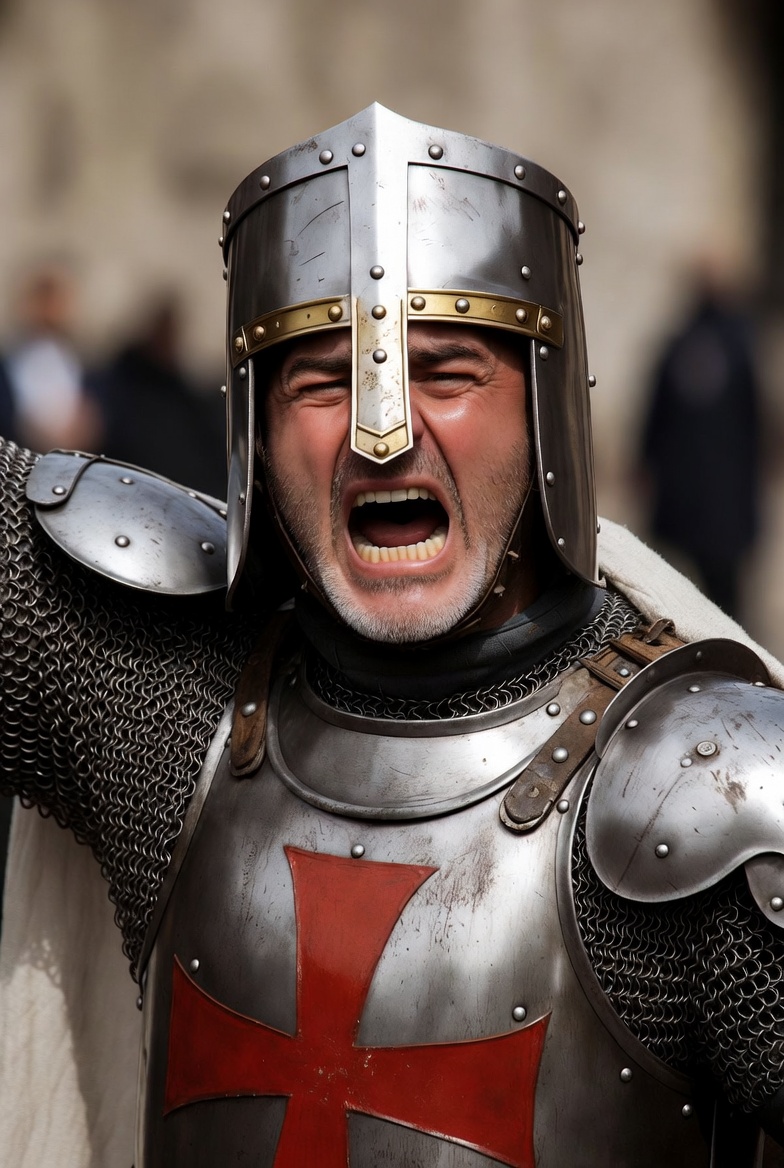
The next giveaway is in how they use the imagery that’s often associated with the Crusades. If you’re a Christian, then you probably view the Crusades in the same way that I do: It was unfortunate business, but ended up being necessary in order to prevent the world from being plunged into spiritual darkness. And some Christians present the imagery that’s associated with the Crusades to try to get a rise out of Muslims, because they know that the Islamic world is still pretty bitter about them.
But, suppose a Muslim wanted to attempt to take on the appearance of Christianity. Oftentimes, they would attempt this by taking on the imagery of the Crusades.
Initially, one might think that they would be repulsed by the thought, as this would seem offensive to Islamic sensibilities. And it would be. After all, the Crusades were a conflict in which Christianity, after enduring centuries of Islamic oppression where two-thirds of the Christian world was conquered, started fighting back, and took back Christian lands in mere decades.
And yet, Muslims who want to take on the appearance of Christianity would take on the imagery of the Crusades. But why?
It’s because the Crusades were the one aspect of Christian history that Muslims can better identify with. Islam is, at it’s core, a supremacist ideology that is obsessed with military expansion. While Muslims may hate the Crusades because they were one way that the Christian world fought back against the Islamic world, they don’t disagree with it’s methods, and it’s something that they wish that they could have instead done to Christianity, if given the chance.
In Islamic thinking, the value of a religion is in its ability to take over the world through conquest. So, while Muslims hate what the Crusades did to them, they still appeal to their sensibilities. If they were to attempt to mimic Christianity, it’s natural that they’d gravitate towards what most appeals to them.
Another giveaway is Jew hatred. And this is a strong one, because hatred towards the Jews by Christians is rare, and has no Biblical justification for it. And considering that it’s the background of Jesus himself, it would be completely irrational.
However, for Muslims, it’s coded into their religion, to the point that the typical sincere Muslim is obsessed with it.
In fact, if it’s a simple litmus test to see whether someone is a fake Christian that you want, try to pivot the conversation to Jews in any way, and see how long it takes for them to start sperging out.
Again, there’s no Biblical justification for hatred towards the Jews. However, for fake Christians, deviant theology tends to favor hatred for the Jews, and much of it is pretty irrational and in stark disregard for clear Biblical teachings that don’t leave any room for misinterpretation.
Oftentimes, they’ll point to the Jews that called for the execution of Jesus, and Pilate’s response to them. Those Jews insisted upon it, to the point that they’d be willing to accept the guilt for their children, and their successive generations after them. And Pilate “washed his hands” to proclaim his innocence of what he was about to do.
The problem is, this ignores the clear Biblical teaching that each person is accountable for their own sin. Pilate was guilty of what he did, regardless of his own insistence of innocence. And the crowd of Jews didn’t have any ability to cast guilt onto their descendants for what they themselves were guilty of.
The fact is, a person doesn’t have any ability to cast guilt for their own actions onto another human being, as if to gather all their guilt into some kamehameha wave so someone else is guilty instead. The idea that a person could is counter to Biblical teachings about how sin and guilt is handled, which Christians have applied to how they handle justice for millennia.
In fact, it’s a basic Christian teaching. So basic, that if someone claims to be Christian and doesn’t get it, they either don’t understand the Bible very well, or they aren’t actually a Christian, at all.
But that’s not all that they either overlook or just ignore. They also tend to downplay that Jesus himself was Jewish. In fact, he could probably be called the most Jewish man who ever lived. The first of the four gospels makes the point that he was a physical descendant of King David. And out of all Jewish people who ever lived, he was easily the most famous, and it’s not even close. And when you know that Moses was not Jewish (he was a Levite), you know that Jesus has no competition in that regard.
What’s more, Jesus’ followers were almost exclusively Jewish. He had as many as thousands of them following him around at one point. And of his many Jewish followers, he chose 12 of them to be his disciples. And later, Paul would be Jewish, too.
If it weren’t for Jews, you wouldn’t have Christianity. And Christians know that. So when someone says that they’re Christian and hates Jews with a passion, they’re showing their hand. Oftentimes, it just comes down to someone trying to use your religion to manipulate you into doing what they want. And you’ll be less likely to fall for it if you have a strong Scriptural understanding.
While there are other ways that fake Christians make themselves evident, those are the big ones. What one can look out for is whether they appear in a manner that’s suspiciously image focused, or they get some basic things seriously wrong, particularly in ways that they wouldn’t if their understanding of the Bible were consistent with someone who has actually studied it with the intention of properly understanding matters that it teaches.
I might come back and add more some other time.

















 Magnetricity