
 The moment you realize that only the first two letters of that rebuttal are necessary.
If smugness had an official webcomic, that webcomic would be Vegan Artbook. The sheer amount of arrogance we are dealing with here would take Satan aback.
Vegan Artbook is about a group of vegans and their interactions with non-vegans. Those interactions boil down to how vegans are such great human beings, and how non-vegans are the cruelest, stupidest, most short-sighted monsters that the artist can imagine.
You could attempt to contact the artist directly and let her know that she’s wrong, her positions are all oversimplifications, many of her “facts” are misleading, and throw numerous scientifically-supported facts firmly grounded in nutrition, biology, and physiology, with supporting documents from reputable sources that can be checked with Google Scholar, etc. Then you’d read a few of her comics and come to understand that she’s aware of these facts, and just doesn’t care. If she cares enough about what you have to say, she’ll draw a caricature saying it which will usually have squiggly arms, buck teeth, acne, or whatever she can think of that would make you seem like a monster. Then she’ll honestly wonder why her webcomic has critics.
To her credit, however, she actually does delete some of her comics if someone can succeed in convincing her that making them was a terrible idea. Here’s one that was edited:
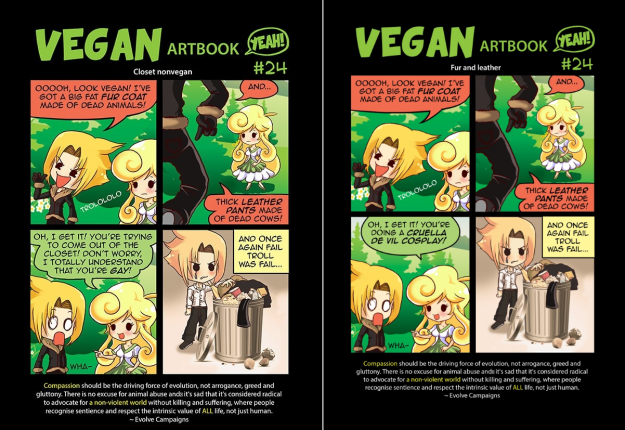 Old, left. New, right. Can you spot the difference?
Or this one, which was deleted from her page altogether:
 Gather around! Vegan Artbook is going to teach us what a straw man fallacy is.
So, let’s not give up on the artist altogether. Let’s keep going! With enough persuasion, she may just delete every single one of her comics, and finally come around to being a decent, normal human being! But let’s not get our hopes up.
Vegan Artbook does have a cast of characters, but calling them characters is unfair to any other comic that has characters and to the definition of the word “character”. While there are different personages with distinct appearances, each of the protagonists are mouthpieces for the artist’s agenda with no deviation in the slightest. There’s a girl named Dolly that starts out as a meat-eater, but shortly into the comic, she changes sides and loses any aspect of her character that differentiated her from the rest of the protagonists, besides the color pink.
The antagonists are portrayed as varying degrees of insane, and they usually only serve as faces to say whatever argument that the artist feels like arguing against on that day, whether it be a ridiculous straw man argument or something that the artist doesn’t realize sounds reasonable and rational. But by the end of the page, they’re usually reduced to being unable to argue further, often by the counter-argument the artist wanted to convey or some quick zinger.
The art in Vegan Artbook seems competent at first blush. It’s so cute, that I just wanna huggle the entire cast, even as they call me a vicious monster! But then you realize how wrong you are for liking it because Priya went to the Ctrl+C then Ctrl+V school for webcomic art. Because of this laziness technique, she only has to draw each character once, and if she gets it right the first time, just modify the facial expressions, and it’s smooth sailing from then on out.
While most webcomic artists improve with time, the art style in Vegan Artbook is one of the few to have actually gotten worse. While her earlier comics were vibrant and colorful, Priya’s latest comics (which star a self-insert, tending Vegan Artbook towards Sonichu territory) are done in a monochrome with brown. This is somewhat reminiscent of old sepia-colored photographs, but is entirely inappropriate for a webcomic done in a Sanrio style. I’m puzzled as to why she would choose to do this. My guess is that the artist thinks that this is somehow more eco-friendly, but that would only matter for the printed books in her online store (which are still printed with bright colors), not for something transmitted as data and displayed on a monitor, which uses no ink or trees.
Then, with no warning, the comic hits you with gore. Some panels are filled with photographs of gory images that the artist uses to show just how ugly the production of meat is. This comes with no warning for those who happen to be reading her comic at work, which can actually make her comic a disservice to the careers of its intended audience. As you could probably imagine, some of the images used are discredited photographs that were once used in PETA propaganda.
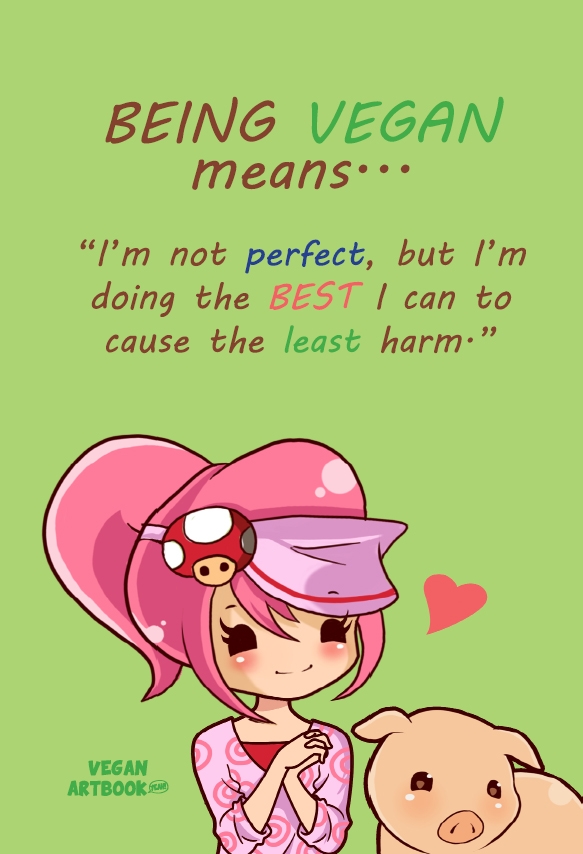
For most of this review, my focus was on the webcomic itself. But for a moment, I’d like to indulge by taking on the author’s philosophy, seeing as it takes center stage in her comic. Like many SJW comics, not every page of Vegan Artbook is a comic page. Some pages are “splash pages” or “pin-ups” that convey distilled smugness. The following summarizes the purpose of the author’s personal philosophy pretty well:
Vegans and vegetarians alike bloviate about how it’s their mission to limit suffering, harm, or whatever they choose to call it. When you talk to one enough, you’ll find that that’s what their position pretty much comes down to. However, their entire endeavor is self-defeating, which becomes obvious when you make the following observation:
Suffering is an intrinsic part of life.
Think about it. You suffer day after day. You suffer because some jerk cut you off on the highway. You suffer because you slave away with MS Office in a cubicle for 8 hours a day working with people who have no idea what you do and therefore assume that you have no value. You suffer because congress votes your constitutional freedoms away while shooting down any solution that could make anything any better for the rest of us. You suffer because your teenage children think that they know better than you, even though you’ve been around at least twice as long as they have, and they’ve spent half their time alive soiling their undergarments. And none of this is unusual.
Then you look at livestock. They never have to worry about paying the bills or having their property repossessed. They never have to worry about starving, or being hunted by natural predators. They have it well until the day that they’re slaughtered and made into someone’s food, which is done with a manner that’s quicker and far more humane than a natural predator would. Livestock have it so well.
In spite of this, the suffering of livestock matters more to vegans than the suffering of their fellow human beings. This is what makes them so reprehensible. But there’s more to it. They say that they’re in it to limit suffering, but they always draw the line when things get too difficult for them.
There are two things that vegans could do if they really wished to limit suffering. I wouldn’t even bring these ideas up if it weren’t clear that I disagree with them (which I do). I bring them up because I want to make it known just what veganism and its underlying philosophy leads to when followed to their shared conclusion. Here they are:
- Stop procreating. Throughout a person’s life, even if they’re vegan, they consume plenty of resources, including the indirect deaths of numerous insects, small mammals, and other animals that are killed in an effort to bring these resources to you and your children. This includes the numerous rodents that are directly or indirectly killed as a result of grain harvesting.
- Taking your own life. If you do this, you’ll immediately stop consuming natural resources and stop causing indirect deaths that make vegan diets possible. Also, numerous insects and microbes get a free meal, so there’s that.
I could also bring up the possibility of going on a shooting rampage, but some vegans would probably actually consider it, and it’s not necessary to go that far to point out how morally moribund that the vegan philosophy is.
But I don’t just dislike Veganism for what it becomes when it’s followed to it’s conclusion. I hate it because it propagates through dishonesty. Veganism makes more vegans by preying on the under-informed, including those who are unaware of the necessity of iodine and B vitamins in neurological health, resulting in the brain damage of those who adhere to the vegan diet, and starting a vicious cycle which makes the vegan’s victim more likely to accept anything that they say.
Vegan Artbook lies to you all over the place to try to sell you veganism. That’s why this comic upsets me so much. Vegans themselves should stop and reconsider what they’re doing. If it’s necessary to lie to get people to accept what you’re trying to sell them, perhaps you shouldn’t believe it, either.
Take the comic’s opening salvo:

It’s a popular belief that Calcium is all that’s needed for strong bones. Calcium’s absorption into the body is aided by vitamin D, vitamin K, and magnesium. All of the above vitamins and minerals are in milk. This makes milk pretty much ideal for bone health.
Now, look how that comic is numbered. Yep, this is Vegan Artbook number one. That’s the artist’s commitment to research and starting strong with statements supported by facts.
Oh, by the way, Priya actually compares meat-eaters to Hitler. You know, the most infamous vegetarian in human history?
And there’s more. Lot’s more. This review could have easily turned into a point-by-point rebuttal of every stupid and naive claim that’s made in Vegan Artbook. But then it would be super-long and not really be much of a review. Still, it bears mentioning, considering that Vegan Artbook is one of those webcomics that is made with the intention of teaching, in which case it matters all the more that she gets the facts right. It doesn’t help that her idea of teaching is to repeatedly call everyone who disagrees with her stupid until they stop.
And speaking of stopping, I’m going to stop this review and give the webcomic its score, which is a the-reason-I’m-ending-this-review out of ten.
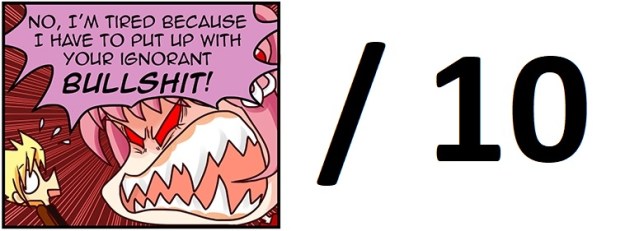
Which would be a 0.8 out of ten. A person can only take so much of this. Besides, I’m going to head out and see whether spite makes hamburgers tastier.
UPDATE: It does. The fact that I get vitamins from it that vegans only get from BS sources if at all is icing on the cake. Carnivores have more fun.

 Magnetricity