Category Archives: Video games

My opinion of cheating in Pokemon

In Pokemon, cheating is huge. And it’s a very sensitive topic. On one side, you see people saying that it devalues the game, and on the other, you see people making excuses for it because that’s what they do. Being someone who plays Pokemon, I have an opinion of cheating, and it’s not really favorable.

If you hack your games but don’t connect to online competitions or trade online, then this might not apply to you, because what you’re doing doesn’t really have an impact on online competitions or what people get in trades. If you’re ruining the game for anyone, it would only be yourself, but you probably have your own reasons for doing what you do. It’s not like you’re trying to trick anyone into thinking you’re putting a lot of effort forward or using illegitimate means to gain a competitive advantage. Competitive cheaters, on the other hand, are different.

Most people don’t need an explanation of just how obvious it is that when a competitive environment is governed by rules and regulations, when participants circumvent or attempt to defeat those rules in an attempt to gain a competitive advantage for themselves, that’s unfair for those of us who played by the rules. Such cheating isn’t just defiant to the established rules of the competition, it disrespects the efforts of those who play by the rules.

Therefore, when a Pokemon video game competition forbids pokemon or save files that have been obtained or modified with an external device or outside normal gameplay, to enter such pokemon or games with such save files into competitions would be considered cheating. Obvious.

So obvious, in fact, that it can be quite surprising how far cheaters go to insist that they’re not cheating.

Of course, they don’t want to be called cheaters. That’s a very unpleasant-sounding word. It implies what they pretty-much do. So you’ll see some of them try pretty hard to explain why they think that what they’re doing isn’t cheating. Similarly, people who lie don’t like being called liars, even though that’s what they’re going. If they’re outed, they lose the advantage that they’d gain from their cover-up.

In some cases, you might hear something like: “It’s not like I’m giving myself something unobtainable. I’m just saving myself a little time.” Is that so? So then, if you make yourself the finest set of competitive battling pokemon that you could raise Xerox, buy a plane ticket and travel to some place like Vancouver so you can participate in Worlds, then get banned from the competition and are turned away, how much time did you actually save? You could have instead bred and raised a team of six competitively-viable pokemon from eggs in just a few hours each to save yourself from being humiliated in front of a bunch of other Pokemon players that don’t even want to look at a cheater.

Yes, obtaining competitively-viable pokemon is easier in the sixth gen games than it ever has been. It only took me a few hours to hatch a 5IV (except SpA) Torchic with Speed Boost and an Adamant nature. Even if it only takes a few hours, hatching a competitively viable pokemon from an egg is a rewarding experience. In sixth gen, it’s so easy to get wild pokemon with high IVs thanks to things such as Friend Safari in XY or Dexnav in ORAS, and use items like Destiny Knot and Everstone so natures and stats are passed on with breeding. Then there’s the fact that pokemon generated in the sixth gen that are in the Undiscovered egg group have a guaranteed 31 in at least three of it’s IVs, which includes legendary pokemon. If someone still cheats up pokemon for themselves just to have some that are competitively viable, just how lazy are they?

Some cheaters complain that if they have to play fair, then they’d be at a disadvantage compared to players that put more time into the game. That actually sounds like an opportunity to learn a life lesson. If someone puts more time into something, then they’re more likely to be better at it. Professional athletes spend hours most days of the week conditioning themselves so they’d perform well when it comes time to play. A student who studies for an hour every school day is more likely to do better in exams. If you think it would be fun to raise pokemon, you’d spend time doing it. If Pokemon is your favorite game, then why not play it?

Cheating has become so widespread, that some players have felt justified in doing so because there are so many other players that do it. That’s some faulty reasoning. If a player is one of the thousands that might be turned away from a single event for bringing a cheated pokemon, they’ve still been turned away. Some that cheat might be getting away with it because they are using a hacked pokemon that can pass the checks. But that doesn’t make that pokemon legit, it means that the player discovered a way to get around the system.

It might seem like I’m explaining why cheating is wrong to a bunch of kids. I remember seeing numbers representing disqualifications for a single competition by division, and the highest number of disqualifications was for the Masters division, which represents the oldest Pokemon players, with over a thousand disqualifications. It might be that the numbers were skewed more towards the Masters division because there may have been more participants in that division. However, that’s a huge number of grown-ups turned away for cheating that should have known better. Considering that Pokemon has what is easily the biggest eugenics simulator that gaming has to offer, one would think that grown-ups would be more interested in learning the rules so that they don’t come off as unfit.

I posted a couple days ago that stricter hack checks are going to be implemented for Rating Battles and Battle Competitions. It wouldn’t be surprising if the same checks would be in place for Worlds this year. Depending on how strict these checks are, there might be quite a bit of drama from players that are sent home because they were found to have something ineligible in their party.

Does Nintendo have a plan for curbing developer laziness?

oldnintendoseal

Lately, there has been a lot of speculation about Nintendo’s NX console. This reminds me of the speculation that surrounded one of their previous projects, code-named Revolution, which turned out to be the Wii.

In both instances, Nintendo was having a weak console generation, and there has been speculation as to what kind of innovation they’d come up with next. In Wii’s case, the system didn’t disappoint, except in several notable areas:

  • The processor on the thing didn’t come close to the kind seen in Xbox 360 or PS3, though that didn’t prevent games like Metroid Prime 3 from running well on it,
  • Some people didn’t like the name Wii, and
  • Game developers largely treated the system as a dumping ground for miscellaneous shovelware and shallow, gimmicky experiences.

Recently, SquareEnix suggested possible support for the NX, which might even manifest in the form of a couple entries in the Dragon Quest series. There would be very little to worry about when it comes to SquareEnix. However, not every video game company out there is as committed to producing quality products.

In fact, the epidemic of low-quality shovelware is something that’s pretty widespread across various platforms, PC included. There have been botched releases that should have been relatively straight forward, such as a recent port of a Batman game to PC, or various broken games that game developers aren’t fixing because they already have gamers’ money.

There was a similar situation in the ’80s, just prior to the gaming crash of that time. Game makers were rushing low-quality, licensed products to consumers eager to buy them. One of the most famous of these was E.T. the Extra Terrestrial, famous for having so many unsold copies, that they were buried in huge quantities in a landfill in Arizona. Why were so many licensed games winding up in landfills? Because gamers were becoming jaded with the steady stream of over-hyped, low-quality products.

This is why, in the ’80s and early ’90s, the Nintendo Seal of Quality was such a big deal. That seal was Nintendo’s way of saying “We’ve reviewed this product and determined that it is a functional and enjoyable product that’s worth your money.” In some cases, one might wonder how a game managed to get Nintendo’s Seal of Quality. However, by encouraging game makers to strive to attain this seal on their products, Nintendo encouraged a level of quality in games that, otherwise, gamers had little guarantee of. There were no review sites such as MetaCritic or even GameFAQs back in the ’80s. That assurance of quality meant something to gamers.

Nintendo’s NX console is coming up, and there are probably many shovelware developers out there eagerly waiting to pile on their underwhelming digital refuse. Perhaps something like the Nintendo Seal of Quality would be an effective measure to protect gamers from wasting their hard-earned money on games that hardly work.

For such a thing to be effective, Nintendo would have to be discerning concerning what games are made for their system. They would have to be more stern than just being glad that some third party developer is making games for their system. They’d have to have what it takes to say “No, this product isn’t finished yet. Continue to work on it, and maybe we’ll review it again.” If Nintendo themselves were to once again take a stand to encourage quality in games, gamers would regain respect for Nintendo in a hurry. Because gamers do see that there are a few things wrong in the gaming industry.

Does the gaming industry have issues? Yeah, there are a few:

  • Rushing products to market for the gamers eager to buy it, ready or not,
  • Abusing DLC, in some cases charging money for content already on the game disk,
  • Games that can only be played online,
  • Not repairing buggy and broken games, even with simple updates.

There are more. It seems like some game makers are pushing the limits of what they can get away with. But if they keep it up, gamers might end up becoming much more cynical about something that should be about having fun. Yeah, fun. Did we forget that that’s what playing video games is about?

Would Nintendo stand up for gamers by encouraging quality games from game developers? It wouldn’t be the first time that they did. But it’s certain that they continue to encourage sales of their own game systems by making quality games, themselves. That makes it very easy to be a Nintendo fan. That alone might be the strongest case for buying an NX. Whether third parties put much effort forward on NX games remains to be seen.

There’s a reason why Nintendo has as much respect as they do. They put a lot of effort forward. Satisfied customers tend to become return customers. If another gaming crash occurs, Nintendo would be very likely to survive it, because many gamers trust them.

The N-Box: Nintendo planning it’s own “Loot Crate”-like service

Surprisingly, Nintendo is getting into the business of offering a subscription-based goodie service similar to Loot Crate, a service that ships a box of goodies to subscribers on a monthly basis.

To get an idea of what Loot Crate is about, go to YouTube and search for “Loot Crate unboxing”. Many such videos feature people pulling items out of these boxes, enjoying the surprise that comes with opening one of these things. Watching one while expecting a Loot Crate in the mail might spoil the surprise, however.

I think the appeal of Loot Crate is for people who know that they’d want a bunch of pop-culture stuff to fill up an otherwise empty bookshelf with conversation pieces, but they aren’t sure what it is they want to buy, but they wouldn’t mind paying someone to determine for them just what it is they get. A lot of it is just toys that would probably sit on a bookshelf, be looked at from time-to-time, but otherwise not really be a big deal. Loot Crates usually come with a T-shirt, and sometimes some posters, which could come in handy for covering ugly bodies and ugly walls. Each month, Loot Crate shipments have a different theme, such as cyborgs.

As weird as some Loot Crate items may be, Loot Crate seems to be generally a good value. Sure, some of the items seem like excess inventory that’s been sitting in warehouses, and a service like Loot Crate may just be a way to sell it off, but about $14 a month isn’t a lot to ask for some of the stuff that you get. Even if some of it is meh. Like shoelaces, pins, decals… You might have had times that you’ve been to Gamestop, saw a mint tin with a design that you liked, but then saw the price tag and decided that you didn’t want to spend something like $4.99 for something like that. One might even feel inclined to hold off on impulse purchases, allowing Loot Crate to supply them with miscellaneous stuff.

So, Nintendo is getting into that with their upcoming monthly N-Box. I like that. For those who like Nintendo, this might still mostly be stuff that a person typically wouldn’t find a use for, but in themes that would be easy for them to appreciate.

There’s already a lot of speculation concerning possible contents, perhaps the most attention-getting would be exclusive Amiibo figures. There are people that are fanatical about those things. Including exclusive Amiibo figures would generate some guaranteed sales for Nintendo (and inspire more fights between determined collectors). Perhaps also they could include some accessories such as custom styluses and perhaps also some plushes.

Loot Crate does monthly themes; such a thing would be easy for Nintendo to do. Perhaps one month they could do a Mario themed box, and another a Pokemon themed box. They could do boxes to promote their new IPs, such as Splatoon. It’s easy to imagine them also doing a Luigi themed box, which would makes some fans happy (the ones that think it wasn’t enough that Nintendo declared a “Year of Luigi”).

For collectors, something like this might be a dream come true. Contents exclusive to early N-Boxes could end up becoming collectors items, especially if exclusive Amiibo figures are included.

Right now, the pricing of the service is unknown. But currently, the service has only been announced for the UK. I’d like to see Nintendo make this available to the United States.

Stricter hack checks coming for Pokemon, what it might mean for those who don’t hack pokemon

A news story just posted on Serebii.net indicates that the Pokemon Global Link is going to implement stricter checks to determine whether pokemon used by players have been hacked. According to the story, if you are caught with a modified save file or modified pokemon, you could be banned from Rating Battles and Battle Competitions.

If I could make a suggestion, I would like for the Global Trade Station (GTS) to be included in these stricter hack checks. For players that don’t use hacks, hacked pokemon are often acquired from the GTS, often accidentally on the part of the non-hacking players from players that hack them. In fact, that can bring up another problem.

It is possible for players to use hacked pokemon while unaware that they’re using them. Again, non-hacking players may be unaware that a pokemon that they’ve received from the GTS may be hacked. Ordinary players may not know what makes a hacked pokemon, or perhaps the hacked pokemon has been hacked in such a way that even experienced players wouldn’t be able to tell it was hacked with close inspection, but whatever filter used by the Global Link could detect it. It would be pretty sad if someone who doesn’t hack pokemon were somehow penalized because they unwittingly used a pokemon that’s been hacked.

While applying stricter checks may keep hackers out of Rating Battles and Online Competitions, it would be nice if they’d also apply to the GTS to keep hacked pokemon away from players that just aren’t interested in them. While using the GTS, I’ve gotten some pokemon that have obviously been hacked. Among these are a Celebi and an Arceus that resemble legit event pokemon, except they’re missing ribbons that they’re supposed to have (unless there’s some way to remove ribbons from pokemon that I’m not aware of). While it’s nice to have rare pokemon, when they’re not the real deal, it’s not as satisfactory to have them. I’ve also gotten a shiny Latios and a shiny Latias from GTS, with competitively viable natures and perfect IVs. Some might say that’s a strong sign they were hacked, but it’s hard to confirm it for sure.

This might open old wounds to bring up, but official pokemon hack checkers haven’t been flawless. For example, was Nintendo not aware that it was possible for players to obtain a shiny Jirachi from the Pokemon Colosseum Bonus Disk? Yet, shiny Jirachi was banned from being transferred from gen 5 games to gen 6 games through Poke Transfer.

Considering this, one could see how ordinary players that don’t hack may be concerned. They could be penalized through no fault of their own. Looking at how the GTS has historically been managed is another cause for concern: it seems as though the GTS is set up in such a way that it can run somewhat stably without much need for moderation, if any. In this condition, the otherwise automated system is influenced by the users themselves, who may, at their discretion, respect the desires of those who put pokemon up for trade or devise means to circumvent restrictions.

Long story short, I like that stricter hack checks are being implemented, but I’d like to see such a thing apply to the GTS. What’s more, I’d like to see some care implemented in how punishments for violations are enforced. I don’t want to see players blocked who simply weren’t aware that the pokemon they brought with them were hacked. I’d also like to see the filters consistent with what’s actually been made available. If those who make the Pokemon games could use a little help, it might not be a bad idea to refer to Serebii’s event database. It’s pretty comprehensive.

And while I’m making suggestions, I wouldn’t mind seeing the restrictions against trading pokemon with certain ribbons lifted. The ribbons in question might be part of what make the pokemon special, but they shouldn’t prevent a player from doing what they’d otherwise do with pokemon, and it would make it much easier for players to obtain certain pokemon who haven’t been to certain events.

How these stricter checks will affect hackers, and for that matter, those who don’t hack, remains to be seen. Perhaps they will change the game for the better, but if mistakes are made, they might just upset the fans more than before they’d be implemented.

Nintendo president offed by Freemasons (says conspiracy nutcases)

It doesn’t take long using social media to find some pretty spurious takes on recent news. This includes some conspiracy theories, which are pretty much intellectual junk food. As vexing as it may be, some conspiracy theories can really take off.

There’s a new one that’s going around, and if you’ve read the title of this entry, your palm might already be on your face. There are conspiracy theorists going around on social media saying that the recently deceased president of Nintendo has been offed by Freemasons.

Aside from being laughable, this conspiracy theory is also disgusting. The guy has only been dead for a few days, and a bunch of people with a tenuous grip on reality are attempting to use the tragedy to bring attention to themselves.

The position of the conspiracy theorists is that Satoru Iwata, during his presidency of Nintendo, enacted several contradictory policy changes that weren’t in line with the agenda of the Freemasons, who supposedly are exerting their influence on the video game industry. That sigh of disgust probably came from you.

There are several points that these conspiracy theorists bring up that they actually think support their position, and here is one example:

  • The Japanese name of Atari, founded by Freemasons, means “to hit the target”, indicating their goal of wanting to control the Japanese game industry.

One thing that can be learned about Freemasons from Google searches and poking around on “truth seeker” Geocities pages is that they like hiding their agenda in plain sight, typically by using symbology that’s been highly-publicized in films and books. If they’re that confident that their plans will succeed, then why has Atari, their supposed key player in the game industry, had so many commercial failures since the video game crash of the ’80s? Are we to really accept that a company that’s so sophisticated that it can carry out a hit on the president of a multi-national tech company (which happens to be an industry leader) is simultaneously so inept that it cannot produce a commercial success of it’s own?

These guys are already off to a pretty bad start, but there’s more:

  • Atari’s goal was to keep the Japanese people lazy and stupid, and Satoru Iwata resisted this.

Then they failed. Japan is easily one of the most industrious nations in the world today, with an economy second in strength only to the United States. Anyone who thinks that the typical Japanese man only sits around playing video games and reading manga are in for a surprise when they visit a place like Saitama for the first time. And again, are we really supposed to accept that Atari can carry out a hit on one of the most influential men in the tech industry, when it would be far more conductive to their supposed mission to address and overcome their commercial failures? One would think that if a company’s mission is to keep people addicted to video games, they’d be less about trying to bring attention to themselves by assassinating people known all over the world and more about knowing how to make a decent video game. Because at this rate, it would be far too easy for some overweight Loose Change enthusiast living thousands of miles away to expose their entire operation by using their Twitter account.

Another one:

  • Nintendo initially refused to reduce the price of the Nintendo 3DS, but then cut the price by 40% about 6 months after it’s release.

Satoru Iwata then cut his own executive pay in an effort to maintain Nintendo’s stock value, and the 3DS would go on to become one of Nintendo’s fastest-selling and successful gaming systems. Do I even have to explain why the position of conspiracy theorists on this matter are logically inconsistent? If you want a video game company to be highly successful, why would you have a problem with someone who makes moves that are highly beneficial to that company? Iwata was president of Nintendo when the Wii and Nintendo DS hit the market, and those were among the best selling game consoles ever. They each sold over a hundred million units. Iwata obviously wan’t attempting to sabotage the game industry.

  • Nintendo stated that their software production outside of Japan went up, when it has actually been going down.

And apparently being wrong about something justifies calling for a hit on a company president.

There’s more, but I think I made my point. Conspiracy theorists are ridiculous, and so is the idea that Nintendo’s president was killed by Freemasons working for Atari. As opposed to cancer, which we still don’t have a cure for (though they probably have quite a few conspiracy theories about that).

Conspiracy theories don’t take a lot of mental energy. It typically involves a person spending hours reading other people’s ideas, then thinking themselves enlightened and having figured things out for themselves. To demonstrate how easy it is to imagine up a new conspiracy theory, here’s a new one: The government and the Illuminati have been propagating conspiracy theories for decades to occupy people of substandard intelligence. How’s that for a paradox conspiracy theory?

If more people would have instead expended into medical science the kind of energy that they’re putting into circulating stupid conspiracy theories, we might have actually developed a cure for cancer by now.

Metroid Prime Federation Force: What was Nintendo thinking?

metroid prime federation force samus metroids

For a long time, Metroid has been one of my favorite game franchises. Growing up, I actually made friends because of Metroid games. The games themselves were excellent expressions of interactive art. They starred a lone hero exploring an alien world. Metroid games weren’t divided up into levels. Rather, the player could explore the alien world at their own pace, collecting power-ups that increased mobility and endurance as they did so, making it easier to defeat strong enemies and making previously off-limit areas accessible. In the year 2000, there was a controversial announcement that a new Metroid game would be made with a first-person perspective. Players were initially skeptical, but the Metroid Prime games turned out to be among the most critically-acclaimed Nintendo IPs.

After a while, Metroid game releases became scarce. During this slow period, Metroid Other M was released, which was controversial for several reasons, but was still generally a good game. One might have assumed that Nintendo wouldn’t make another Metroid game unless they could really wow with it. Metroid has a coolness appeal, and players enjoy exploring alien worlds at a pace that they set.

What has the Metroid franchise been doing lately? Check out a recently-released trailer for Metroid Prime: Federation Force:

What was Nintendo thinking?

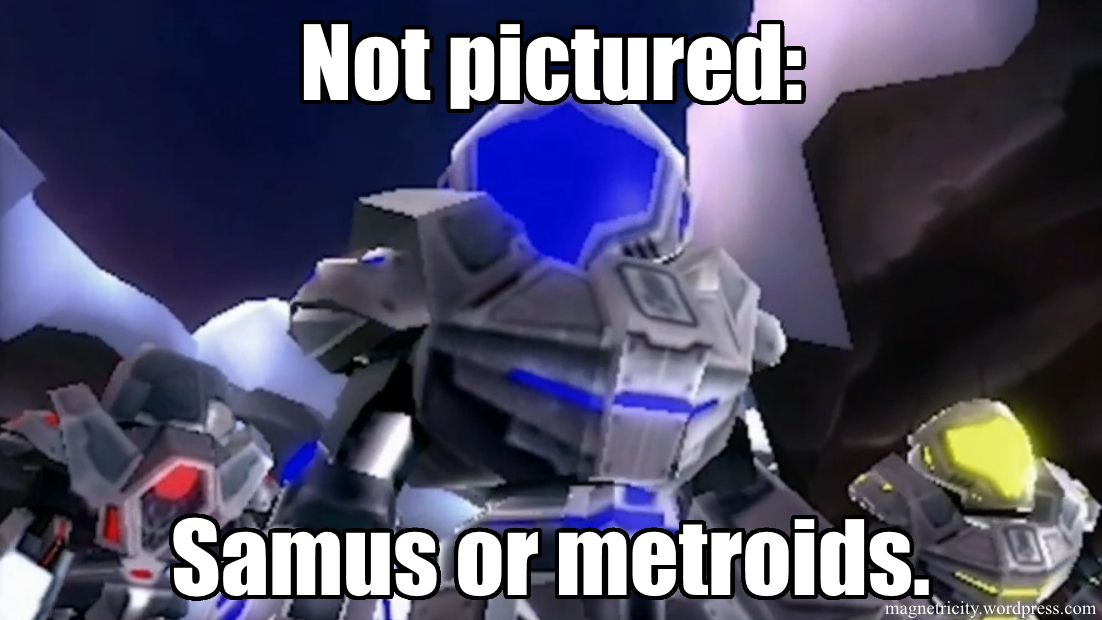
What we see is a trailer for a four-player shooter game that doesn’t have Samus or Metroids in it, but the name Metroid was slapped on it anyway.

This game stars four Federation troopers. You know, those guys that get killed in Metroid Other M? There’s a reason why troopers are depicted without their faces in IPs like Star Wars: you’re not supposed to care about them. Troopers are an archetype of disposable character that get killed in large numbers and no one bats an eye. In Metroid Prime Hunters, the different playable characters at least had individual aspects beyond what color they were. It’s like in Metroid Prime Federation Force, you’re being challenged to care less about the main characters.

To make matters worse, the troopers depicted aren’t the sweet-looking ones seen in Metroid Prime 3 or Metroid Other M. Instead, these troopers have the composition of lego men. It’s an ironic thing: at this year’s E3, Sony showed off an HD remake of Final Fantasy 7; the original version of which had polygon models that looked like they were lego characters. Nintendo took something gritty and realistic like Metroid and did the opposite. At least when Nintendo changed the graphical direction for The Legend of Zelda: the Wind Waker, the game still starred Link. Where is Samus in Federation Force? And for that matter, would we really want to see what they’re doing with her?

Also, Metroid Prime Federation Force is being packaged together with Metroid Prime Blast Ball. Which, once again, doesn’t seem to star Samus at all. When you think Metroid, what do you think of? Do you think of sports? No? Me neither.

Again, what was Nintendo thinking? Here is one guess:

Nintendo manager: What are you working on there?
Former Metroid staff member: I know that you didn’t want me working on Metroid games since Metroid Other M, but I have this neat couple of pet projects here that have a Metroid theme. One is a soccer variant, and the other is a game starring lego versions of Federation troopers.
Nintendo manager: They look terrible. Get back to work. I have a meeting to go to.
Later, at the board meeting…
Nintendo director: Metroid fans have been begging for a new game. E3 is coming up real soon. Do we have a game or two that we can slap the Metroid name onto and hastily throw a trailer together for?
Nintendo manager: YES SIR!

You know that Nintendo really messed up when, right after the announcement, the first result for a Google Search for “Metroid Prime Federation Force” is a petition to have it cancelled. If you’re interested, here is a link to that petition. You can sign it to try to send a message to Nintendo that this isn’t the kind of Metroid game we want. I don’t think it would make much of a difference. Nintendo is probably determined to release this game, not caring much about fan objections that it doesn’t look like a Metroid game. If they release it, and it fails, they’ll probably take it as a sign that we’re not interested in Metroid games anymore, and they’ll probably just stop making them.

That’s why I’m happy that there are projects such as AM2R. The way things are looking, the ones who remember what Metroid games are really about are the fans. While Nintendo is making shooters about impersonal characters in multi-player battles, the ones that can really be counted on to make games in the true Metroid fashion are players themselves.

UPDATE (6/18/2014): In an interview with Kotaku, Nintendo’s Kensuke Tanabe revealed some features of MPFF, including:

  • Samus will make an appearance, and
  • You will be able to see metroids in a certain mission.

This doesn’t change the fact that I was disappointed with what I saw. The game looked bad for a DS title, it doesn’t look like a 3DS title with a concept that’s been around for 10 years. If it’s been in development for even half that time, I’d wonder just what they were doing.

Samus making an appearance doesn’t make MPFF a Metroid game any more than it makes Super Mario RPG or Kirby’s Dream Land 3 Metroid games. If Nintendo wanted us to know that Samus and Metroids were in MPFF, why didn’t they just include them in the trailer instead of having someone from Nintendo say so in an interview on the second day of the E3 trade show? It looks like Nintendo knows that the fans don’t like MPFF, and they’re doing damage control.

I’m seeing comments appear calling those who signed the petition to have MPFF cancelled entitled or crybabies. I don’t think the petition will make much of a difference, Nintendo will probably release the game anyway. If someone wants to express disappointment or even issue a complaint with Nintendo because the game looks like a waste of the silicon it was printed on, that’s up to them. When (and if) the game is released, the vote that will really matter is the votes that we make with our money. I might play it, but that’s going to be far more likely if, by the time it’s released, it looks much more like a Metroid game than what I saw in the sad excuse for a trailer that Nintendo showed for it (and for that matter, it would have to look much more like a professional product).

There are those who passionately white knight this game, but I don’t see much point. Even if it were revealed without the Metroid name, it would still look like a seriously sub-par FPS game that looks several generations behind even 3DS launch titles. Think that’s a harsh assessment? Look at just about any 3DS game, and compare it to what we’ve seen so far from MPFF. Nintendo’s 3DS can do much better than PS1-level visuals. Take away the Metroid name, there still wouldn’t be much to defend. As it is, it may be one of the biggest mistakes that Nintendo has ever made.

UPDATE (6/23/2015): The petition is only a week old and has over 20,000 signatures.

UPDATE (6/25/2015): The backlash against Metroid Prime Federation Force has gotten to the point that it’s caught Nintendo’s attention. Nintendo of America president Reggie Fils-Aime has responded:

“Look, we know that fans want a straight Samus Aran game,”

Sounds like we’re off to a good start, right?

“We also know that the best way to launch a game is to surprise and delight them, to give them a launch date, in an environment like this let them play it versus what other companies do, which is to announce a project that you may not see for five, six years. It’s just not the way we do things.”

Oh no? We don’t have a launch date for MPFF. As for letting us play it, was it even playable at E3? I mean outside of the Treehouse meeting where the press watched Nintendo staff play it. Was that what you meant? It’s nice that Nintendo announces projects that they’ve already been working on for years, so that you have something to show with your announcements. But did you really mean to suggest that Federation Force has been in development for years? Because it doesn’t look like it.

“Remember when that art style was first shown. The uproar from the Zelda community was intensely negative. If there had been social media then, there probably would have been a petition to make that game go away.”

Reggie, you’re the president of the American branch of a huge tech company. Did you really not know that there was social media back in the year 2002? Does “Friendster” ring a bell? How about “Xanga”? Or SixDegrees.com, or Classmates.com?

Do you know why there was an uproar over the art style of Wind Waker? Because it was inappropriate. It went against the image that the public had of The Legend of Zelda. There are people who have never played it because the game looked ridiculous to them. That means that this endeavor:

“(We) will also push the envelope in developing something that we know is high-quality and that we know will deliver in the marketplace.”

…May very well be rendered self-defeating.

Image matters. Those who dismissed Wind Waker as silly missed out on a high quality game. That’s not just their loss, it was also Nintendo’s. This is because they didn’t buy it. Making games that gamers aren’t likely to buy doesn’t seem like a good business practice. And if feedback has been an indication (and it usually is), MPFF isn’t going to do so well.

“We know the community wants to see a straight-up Metroid game. We know it.”

Thank you. That says a lot: it’s an indirect admission that MPFF is not the game we were waiting for, and it indicates that you do understand, at least in part, what we are expressing. What it means to me is that the Metroid franchise might not end on the sour note that is MPFF.

When it comes to introducing sequels and new entries in IPs, there is such a thing as taking too big a risk. Metroid Prime Federation Force is an example of a big risk being taken, and it didn’t go over well. I’d think that Nintendo would understand that some amount of predictability is a good thing. Imagine if, after years of not seeing a new Pokemon game, Nintendo announces a Pokemon racing game. Or if, years after not seeing a new Legend of Zelda game, a Zelda tennis game was announced. There’d probably be rioting. It’s been years since seeing a new Metroid game. Is it unreasonable to ask that the next one stars Samus Aran?

A Metroid sports game? What was Nintendo thinking?

Will PS Vita be Sony’s last handheld?

Handheld gaming platforms have been some of my favorites. Because of this, I like seeing handheld gaming platforms succeed. And they are, if one is looking at Nintendo’s 3DS and mobile platforms.

However, not every gaming platform does well, and one such example is the Playstation Vita.

It’s predecessor did well. In fact, people were ready for the Playstation Portable to take the world by storm. I remember, after hearing that Sony was working on a handheld gaming console, one magazine predicted the end of Nintendo’s dominance of portable gaming. While this doesn’t seem unusual for a guy expressing his opinion, what was unusual was that it was being expressed in a review for Final Fantasy Tactics Advance for the Gameboy Advance. (By the way, if you’re wondering what a magazine is, it’s like an iPad made of trees.)

Of course, that didn’t happen. Nintendo released the Nintendo DS, and it outsold the PSP by far. However, the measure of a console’s success isn’t necessarily expressed by it’s sales numbers, but Nintendo clearly dominated handheld gaming, to the point that just about anything that competed with Nintendo handhelds didn’t stand a chance. Remember the NeoGeo Pocket Color? It was a very interesting system, but there wasn’t much marketing for it, and there wasn’t much of a variety of games. The Wonderswan handheld did okay in Japan. It had potential, but it wasn’t released in America.

So Sony, the company that upset Nintendo’s dominance of console gaming, was coming to handhelds. As people saw it, if anyone could put a dent in Nintendo’s dominance of handheld gaming, it would have been them. The PSP did very well due to a combination of marketing and the awareness of the Playstation brand. At the time the PSP launched, sales of the Nintendo DS were slow, so it looked like a possibility that Sony would release Nintendo’s grip on handheld gaming, as they did with console gaming. However, Nintendo DS’s software library improved, while things were more steady for the PSP. The DS ended up selling about twice as much as the PSP.

However, Sony still did something very significant. Even if they didn’t become the leader of the handheld market, when a game system sells over 80 million units, it’s usually considered a success.

Again, a console’s success isn’t necessarily expressed by it’s sales numbers. Sony didn’t have to become market leader to come away with a major victory: demonstrating that they had what it takes to compete with Nintendo, and take away a significant share of the market.

Even so, PSP’s story also had it’s downs. Sony sold it’s systems at a loss, with the strategy of recovering losses with software sales. This isn’t an unusual strategy. Console manufacturers have been doing this for a while, and they have been staying competitive. In the PSP’s case, however, the handheld initially cost far more to produce than the MSRP, and around the time the PSP launched, Sony’s gaming division was losing money, and the company overall was having financial troubles.

When the PS2 launched, the DVD was a new media format. A significant part of the PS2’s initial success was the fact that, for many people, the PS2 was their first DVD player. When the PSP came around, however, Sony had the idea that people would want to watch movies on their proprietary UMD format that (as far as I could tell) only played on PSPs. That didn’t work out. However, the PSP went on to sell millions, doing very well in a market that was dominated by Nintendo. Later, Sony released the PS3 with the ability to play BluRay disks. Some bought up PS3s because it seemed to be a better value than new BluRay players at the time (even though a new PS3 cost about $600 at the time it launched!). However, BluRay didn’t take off very well, and neither did HD DVD (which the Xbox 360 supported), it would seem that this was because the two had the bad timing of having to compete with streaming and digital downloads. This was likely another determining factor for the Wii’s success: the Wii wasn’t expensive due to lack of a DVD, BluRay, and HD DVD movie player feature, and owners could just use Wii to watch YouTube or Hulu on their TV.

When the PS Vita was revealed, I could tell that it wasn’t going to do well. Yeah, it did have what it takes to succeed as a handheld game console: a meaty processor, game cards instead of a disk drive, internal and removable memory, and some high-profile games. However, it just seemed like it wouldn’t do well.

For one thing, I didn’t like their proprietary memory cards (memory sticks?). Did Sony have something against SD cards? Even Nintendo’s 3DS had a slot for SD cards, even though that was unexpected. Therefore, I could swap files between my computer and a 3DS easily. I don’t know whether Sony did release a Vita memory card adapter for PC. Considering that they’re a huge media company, it’s hard to imagine that they would want to prevent a person from swapping files between a Vita and a PC.

For that matter, there wasn’t much marketing for Vita outside it’s launch period, and even that wasn’t very pronounced. That was a problem considering that Vita looked so similar to the PSP, that aside from some slight difference in dimensions, a casual observer wouldn’t see much difference. This was also initially a problem for the 3DS when it was new, but when the 3DS’s price dropped, gamers were much less hesitant to buy one. And when the 3DS XL model was introduced, the 3DS took off. Vita’s price wouldn’t drop until the next year. As a result, Nintendo’s 3DS ran circles around Vita, and by the time Vita’s price dropped, Sony had already dropped the ball.

Nintendo 3DS and Sony PS Vita are very different, so why compare them? Because they compete, so the success of one may depend on it’s ability to take a large part of the other’s base away. This has been a problem for PSP considering that many PSP owners also had 3DS systems, but the same wasn’t always true the other way around. Therefore, there were a lot of PSP owners out there that may not have viewed their PSP as their primary portable gaming system. Mobile gaming became huge during the PSP and DS’s lifetimes, and many gamers, if they had to choose two portable gaming platforms, would choose a mobile platform and a Nintendo platform. This seems to be the case again as 3DS and PS Vita compete.

Me, I had actually gone a while having forgotten that there was a PSVita. Later, I saw that they were still available for purchase at Gamestop, and I saw that Sony was still going at it. There still doesn’t seem to be a lot going on with the PS Vita, however.

It’s been over three years since the PS Vita has launched, and the system has only sold about 10 million units worldwide. That’s not very good.

So, will Sony continue to bother with handhelds after this? It would seem that Sony is considering a redesign of Vita, perhaps a minor version 3 revision. E3 is just next month, and perhaps it will be announced there. However, it doesn’t seem likely that Sony is doing another handheld soon. Sony has been in financial trouble for a while, and it might be that they’re cutting back on projects that have been costlier for them.

Will things turn around for the PSVita? I don’t know. The market for video games has been very fickle. But one thing that seems consistent is Nintendo’s success in portable gaming, and that’s likely to continue. That doesn’t mean that Sony couldn’t be profitable in the area of portable gaming, but they’d have to improve their strategy quite a bit. They’re not doing very much to market Vita, though it could help them a lot. Perhaps they could also benefit from a clearer focus, competing with either Nintendo’s 3DS or mobile gaming, and in so doing possibly winning a few sales in the process. As it’s doing now, however, it’s like the PSVita is barely there, not making much of an impact.

Considering how it’s been performing, perhaps it would be better for Sony to just let the PS Vita go, and instead focus on their next project.

Pokemon Omega Ruby and Alpha Sapphire: My impressions

Over the last several weeks, I’ve played some Pokemon Alpha Sapphire, one of the two newest installments of the Pokemon series. If you’re a Pokemon fan, you might already have at least one of these two games, so you probably don’t need a review to tell you that you’d like this game. Actually, this is less like a review and more like my own impression of Pokemon Alpha Sapphire, the one that I’ve played.

So, you might be thinking of asking, “Is this the kind of game that anyone would like, even someone like Adolf Hitler?” Let me tell you something about Adolf Hitler: Adolf Hitler was a Nazi. In fact, he was the biggest Nazi of them all.

just say no

There are bound to be people out there that don’t like Pokemon ORAS (short for Omega Ruby and Alpha Sapphire, which is like a tongue twister to say). However, I think it’s a pretty well-made product.

Yes, ORAS is a remake of Ruby and Sapphire, and while there’s a real element of nostalgia to it, so much was added to the experience that it could hardly be called the same experience as the originals.

For one thing, the presentation is very similar to that of Pokemon X and Y, which I don’t recall meeting very many complaints. The overworld map generally has an overhead perspective, as do caves and buildings, with some exceptions. Generally, this aspect of the presentation has improvements over X and Y, which seems natural, considering GameFreak has had more experience with dynamic perspective since it was first implemented in X and Y. Like X and Y, it’s the presentation in the battles that really shines. Each of the pokemon models are well rendered and animated, with a cel-shading effect that makes the battles look almost like the Pokemon anime. GameFreak did very well with this in X and Y, and that they took the same approach in ORAS is a decision that seems pretty sound.

Perhaps the biggest issue for Pokemon ORAS is the balance of gameplay, though this issue wasn’t nearly as severe was it was in Pokemon X and Y (where it took a long time to get the third badge, and after you did, you could get a mega pokemon, and the badges generally came in rapid succession). Much of the lack of balance with X and Y came from the fact that once a player could use mega evolutions, they could sweep most of the rest of the game with ease. In ORAS, there is a little more balance with mega evolution, but the way it was introduced was pretty odd. About midway through, the player receives a legendary pokemon that wasn’t available until the post-game in the originals, and it could mega evolve. The player doesn’t have to battle it, either. It’s not broken like either of the Mega Charizards, but it’s still a very strong pokemon.

Like the originals, though, once you capture Kyogre or Groudon, you’re set until the post-game. Pokemon ORAS takes this further, though, by allowing the player to access their newer, stronger “Primal Reversion” forms, which allow what was already a couple really strong pokemon to hammer most of what the game can throw at them.

For the most part, though, if you’ve played Pokemon before, you already have a good idea of what to expect from ORAS, but that doesn’t mean that it doesn’t deliver an excellent experience. In fact, there are many standout aspects of ORAS compared to the originals. For one thing, there’s much more character development. It’s a little surprising, but it would seem that the main character you don’t choose (from between Brendan and May) becomes a somewhat romantic interest as the game progresses, in a manner similar to Shauna from X and Y. Characters such as Matt and Tabitha are far more interesting and well-defined (rather than being the generic Admins they were before), and Archie actually turns out to be quite an interesting character. The character of Wally is also much further explored (and he gets a pretty sweet battle tune).

Many Pokemon players consider the real meat of the game to be the post-game, when new areas become accessible, and the flow of the game is not limited by a plot. In ORAS, there is a bit of an extension which occurs after the initial victory over the champion in the form of the Delta Episode. The Delta Episode is an additional scenario which adds more to the story of the Hoenn region, mega pokemon, and Rayquaza. A lot can be said about the Delta Episode, and among those things is that there is a lot of dialogue! But there is also a lot of character development, particularly for Steven.

Pokemon ORAS is a game which seems like it was made with the fans in mind. One could imagine the following exchange having taken place between GameFreak and a Pokemon fan:

Fan: Wouldn’t it be cool if we could fly on a pokemon around a 3D map of Hoenn?
GF: I agree. Let’s call that “soaring” and put it in ORAS.
Fan: I think it would also be cool if it were easier to get a pokemon with high IVs, such as through chaining or something like that.
GF: I agree.
Fan: Wouldn’t it also be cool if hatching eggs became easier because there was a long path to ride a bike on?
GF: Why don’t we make a circular path that can be traversed by only holding down one direction on the plus control pad?
Fan: I think that it would be sweet if Rayquaza got a mega form that didn’t need a mega stone, and was much stronger than it had to be.
GF: Okay. It’ll be interesting to see what competitive communities such as Smogon do about it.
Fan: And a bunch more mega evos would be nice.
GF: Agreed.
Fan: And it would be cool if one of the event pokemon became obtainable in-game.
GF: Why don’t you play ORAS and find out which one?

Yeah, there are new mega evos, which has had a real impact on the competitive scene. Also impacting the competitive scene is a new set of move tutors. Some pokemon seriously benefit from this, such as Greninja, which gets low kick to answer Chansey, and Gunk Shot. Another nice touch is that obtaining pokemon through Dexnav allows the player to encounter pokemon that know egg moves. There are also a lot of legendary pokemon to obtain in this game. For competitive players, there’s a lot to like in ORAS. But if a person plays competitively, they’d probably want a copy of Omega Ruby or Alpha Sapphire, because at least until next year they are considered to be the definitive Pokemon games.

It’s obvious that a lot of effort went into Pokemon Omega Ruby and Pokemon Alpha Sapphire, and the result is that they turned out excellently.

10 out of 10

Get a life? Give me a break.

How many times have you heard this one? You’re playing a video game, and someone tells you to “get a life”, whatever that means. When they say it, they’re making a value judgement towards what you happen to be doing as a diversion, as though you don’t do anything different with your life. Putting aside that someone can make that same crass assessment towards any medium with which a person can choose to preoccupy themselves, the assumption is that you don’t accomplish much of anything else, and this person knows what you do with every given moment of your time.

When I was a kid, I went to school for eight hours a day, and chores were waiting for me when I got home… from my part-time job. Therefore, free time was precious to me, and I earned the right to not be judged for watching TV, listening to the radio, watching a movie, or (dare I say) playing a video game. If I got my homework done, first.

It’s funniest when I get this from a stranger in an online game. Once they’ve lost an online match, they’ll default to the go-to ad hominem when you’re dealing with gamers: “get a life”. The assumption being, I live in my mother’s basement with little or no work and I’m only good at this game because I’ve been playing it for 16 hours a day. Therefore, I need an intervention so that I don’t have to play on the same server you play on and beat you at your favorite game. Of course, they’re playing the same game, so they’re not saving face.

Most of the time, when someone tells you to “get a life”, the life they have in mind is to immerse one’s self in whatever media that they find preferable. Usually, it’s books. Works of fiction involve escapism through immersion into the fantasy world portrayed in the narrative. Which makes it different from video games, how? And some will try to tell you that books are somehow less violent. Have they heard of The Hunger Games? It’s a bestseller.

And yes, some mothers will complain that their children started displaying bad attitudes after playing violent video games. News Flash: video games have had ratings for about two decades. It’s every parent’s job to monitor what media gets into their home. The responsibility for your child’s upbringing, including the media that they are exposed to, falls on you. Not the media. Don’t complain when it’s your own fault.

Here’s the thing: video games aren’t exactly new media. They’ve been around for at least four decades in one form or another. Over three-quarters of American homes have a video game system in them. In the world I grew up in, video games were harder to find, and interest in them came with it some sort of stigma. Nowadays, distance from interactive entertainment places one’s self at risk for social isolation. If you’re the kid who doesn’t like video games, you’re weird. If your parents don’t let you play them, you’re unfortunate (and often invited to other people’s homes to experience what you’ve been missing).

Me? I sometimes play games as a diversion. The only thing that prevents me from calling it a hobby is the same thing that prevents me from saying the same thing about books and movies: enough people do it, that it’s not unusual. It’s nothing noteworthy anymore. I can probably call soldering my hobby. Even though I don’t devote as much time to it, not a lot of people do it. But video games are played by enough people that it doesn’t necessarily need to be declared as a hobby. It’s almost to the point that someone could ask a stranger which video games they play; you probably won’t be told that they don’t play video games.