Each year, this blog posts a picture which, in the eyes of myself, describes the year accurately, sometimes edited, and sometimes not. However sardonic it may be, I think we can all appreciate that humanity has made it as far as we have without reducing ourselves to irradiated primal components over things like economic strategy.
I think we all know that QAnon Shaman is going to take the honor this year. But before we get to that, let’s take a moment to appreciate just how zany this year has been. After all, this year wasn’t just crazy in a way like standing at a safe distance and laughing at the insane thing that some celebrity as done. This year’s craziness affected every single one of us in one way or another.
As we recap, know that I’m not even going to bother listing everything crazy about this year, as writing up such a list would take at least another year.
Thousands of protestors flooded the U.S. Capitol building, resulting in the people being represented therein for the first time in over a century.
After a nearly-two-decade military campaign, President Biden surrendered Afghanistan back to a bunch of hairy men who believe that pedophilia is normal, abandoning both equipment and American people in the process.
In the highly-publicized Rittenhouse trial, a jury helped millions of morons to come to the conclusion that if someone with an assault rifle is running from you, chasing him and attacking him is a bad idea.
Twitter banned a standing President of the United States from their platform, even though he didn’t do a damn thing wrong.
After months on end of the uniparty calling the lab-leak hypothesis a “conspiracy theory”, U.S. intelligence released a 2-page declassified report calling “laboratory-associated incident” a plausible source of Covid-19.
A huge container ship ran aground in the Suez Canal, disrupting trading for much of the world.
Anthony Fauci gives hope to the least of us as he demonstrates that a slow-witted, narcissistic ass-wipe can hold the highest-paid government office.
NASA launched its Double Asteroid Redirection Test to determine whether we are currently capable of protecting earth from an asteroid collision, showing that science can be used for something other than marketing useless garbage to gullible cretins.
The ultra-left are so obsessed with getting you vaccinated, that they threatened your job over it. Because nothing says that they want to protect you quite like threatening to turn you into a homeless drifter that eats garbage out of the gutters. Thankfully, the courts are succeeding so far in blocking that bullshit.
With all that said, here is the image that describes 2021, depicting the most honest man to stand at the house podium:
I don’t know about you, but I miss the days when conspiracy theorists were wrong about stuff, and mainly just went on about a flat earth and space aliens. But now that the left is so insistent that the idea that there are reptilians in government is a harmful and dangerous conspiracy theory, that gets me to thinking. Streisand Effect, and such.
As in, the adversarial figure mentioned in Bible prophecy as being a ruling power that’s the enemy of the saints.
Pictured above is the statue named, “The Guardian of International Peace and Security”. It’s said to be a mixture between a jaguar and an eagle, but it looks like an artistic representation of the beast described by the Biblical prophet Daniel, and again in the book of Revelation.
Here is Revelation 13:2:
“And the beast which I saw was like unto a leopard, and his feet were as the feet of a bear, and his mouth as the mouth of a lion: and the dragon gave him his power, and his seat, and great authority.”
Revelation 13:2
According to the above verse, the beast is supposed to be like a leopard. Here is a picture of a leopard:
There’s one more claw than the statue, but notice how the claws are exposed, as they are on the statue? Seems like the statue’s paws seem more like a bear than a cat. A cat’s claws are retractable, but they have to spread their claws to expose them.
A lion’s mouth is similar to that of a jaguar, but is conspicuously wider, which can also be said about the statue.
Finally, the verse says that the beast got it’s authority from the dragon. As it so happens, the statue looks dragon-like, with wings and spiky ridges starting from the top of its head, and going down along it’s back to the tip of its tail.
Considering how well this fits the Biblical description of the first beast of Revelation 13, some might wonder whether it’s a fulfillment of that prophecy. Personally, I suspect that it isn’t, considering that it’s apparent that the descriptions of the beasts in Bible prophecy were intended to be allegories for the attributes of ruling powers.
Because the descriptions of the beasts are among the better-known Bible symbols, I suspect that the design of the statue was a deliberate move, and was intended to communicate that the U.N. is well aware of their adversarial relationship with Christianity, and is yet another method to communicate to the Christian world that they do not have their values.
Considering what else Revelation 13 has to say about the first beast it describes, it’s interesting that the U.N. would decide to display such an adversarial figure:
“And I saw one of his heads as it were wounded to death; and his deadly wound was healed: and all the world wondered after the beast. And they worshipped the dragon which gave power unto the beast: and they worshipped the beast, saying, Who is like unto the beast? who is able to make war with him? And there was given unto him a mouth speaking great things and blasphemies; and power was given unto him to continue forty and two months. And he opened his mouth in blasphemy against God, to blaspheme his name, and his tabernacle, and them that dwell in heaven. And it was given unto him to make war with the saints, and to overcome them: and power was given him over all kindreds, and tongues, and nations. And all that dwell upon the earth shall worship him, whose names are not written in the book of life of the Lamb slain from the foundation of the world.”
Revelation 13:3-8
Considering that it says, “it was given unto him to make war with the saints, and to overcome them:”, the statue might be the U.N.’s way of saying that they don’t want to be friends with Christians. What’s more, Revelation continues, “and power was given him over all kindreds, and tongues, and nations.”, the statue may be the U.N.’s way of saying that they aspire to achieve total domination over global affairs. Which wouldn’t be terribly surprising, considering their behavior as of late.
Interestingly, Revelation 13 mentions a second beast, and here is a link to the chapter so you can read it. Interestingly, the chapter culminates in a warning for us about a system of identification for all people, down to the individual level, without which a person would not be permitted to participate in commercial activities (verses 16-18).
As much as I could speculate that the artists Jacobo and Maria Angeles were trolling the U.N. to have the statue displayed completely unaware of the symbolism involved, even a person who never bothered to read a word of the Scriptures with any intention other than to smugly criticize them should be familiar with the symbolism, as it is one of the most recognizable symbols in the cultural frame of reference of many (perhaps most) U.N. officials. That’s why I suspect that its prominent display outside the United Nations building in New York City was in deliberate consideration of the symbolism.
The officials who understand the symbolism may actually find the display of the statue funny, but I suspect that many people of Christian background, such as myself, do not. But if their choice to display the statue wasn’t for humor, that might indicate some different problems.
The global leadership that’s in power today does not have the same values as the people that they govern, and we didn’t need some statue to tell us that.
We’d all have a better shot at peace and security if the United Nations would collectively shut their mouths and leave the rest of us be.
Jussie Smollett’s acting career wasn’t that great to begin with, so it’s not too surprising that his trial performance didn’t go over that well.
Disgraced actor Jussie Smollett has just been found guilty on 5 out of 6 counts related to his attempt to stage a hate crime against himself for publicity. This is the latest development in a saga in American politics wherein Americans pay close attention to the legal aftermath of a couple years of lockdowns and violent leftist protests, and the aftermath of it all.
During the trial, the evidence against Smollett just kept piling up, and Smollett kept adding extraneous details to his defense, such as that he was engaged in adult activities with his own attackers. Which doesn’t lend much credence to the idea of a hate crime. But if that’s how it went down, it would suggest that his role in Empire wasn’t his only performance that disappointed.
The verdict was a welcome change of pace after years of MeToo accusations, some of which were baseless, and goes to show that a false accusation won’t always prosper.
Right now, if there’s anyone who should be looking on with concern, it would be Alec Baldwin, as the outcome of the Smollett trial illustrates that a person’s fame doesn’t guarantee that they get off scot-free, and he should take particular interest in Smollett’s upcoming sentencing. If Smollett gets the maximum sentence for his own crime, that might not bode well for Baldwin.
Considering that Jussie had staged a hate crime against himself for his own benefit, the outcome is something to consider. Because he’s now a convicted felon, he could potentially lose years of his own freedom, he is no longer allowed to vote, may no longer legally own a gun, and he’ll have a difficult time travelling internationally. He didn’t gain very much at all.
Though that might stand to change if one of the left’s more prominent figures grants him opportunities by reason of his symbolic status. If that would be the case, it would be their business. But putting aside how appropriate it would be for one liar to join forces with another, the prominent leftists would do well to watch their backs, considering Smollett’s track record of throwing his partners under the bus when plans fall apart.
Hopefully, this outcome will serve as a deterrent to anyone considering replicating Jussie’s crime. The U.S. has enough problems as it is, we don’t need anyone creating any fake problems that make matters worse, just for one man’s selfish benefit.
Now that that chapter of the saga is over, it might not be a bad idea to turn scrutiny to Don Lemon, who provided information to Smollett himself regarding a police investigation, which is a clear conflict of interest considering that Don Lemon himself was covering the Smollett trial. Don Lemon’s integrity is definitely on trial, as a journalist cannot be counted on for impartiality when the journalist has involvement in the story, or stake in the outcome, for that matter.
As we all know, the left doesn’t trust us to think for ourselves, which is why we see so many self-appointed misinformation experts helping the political establishment to assist us on the way to their conclusions.
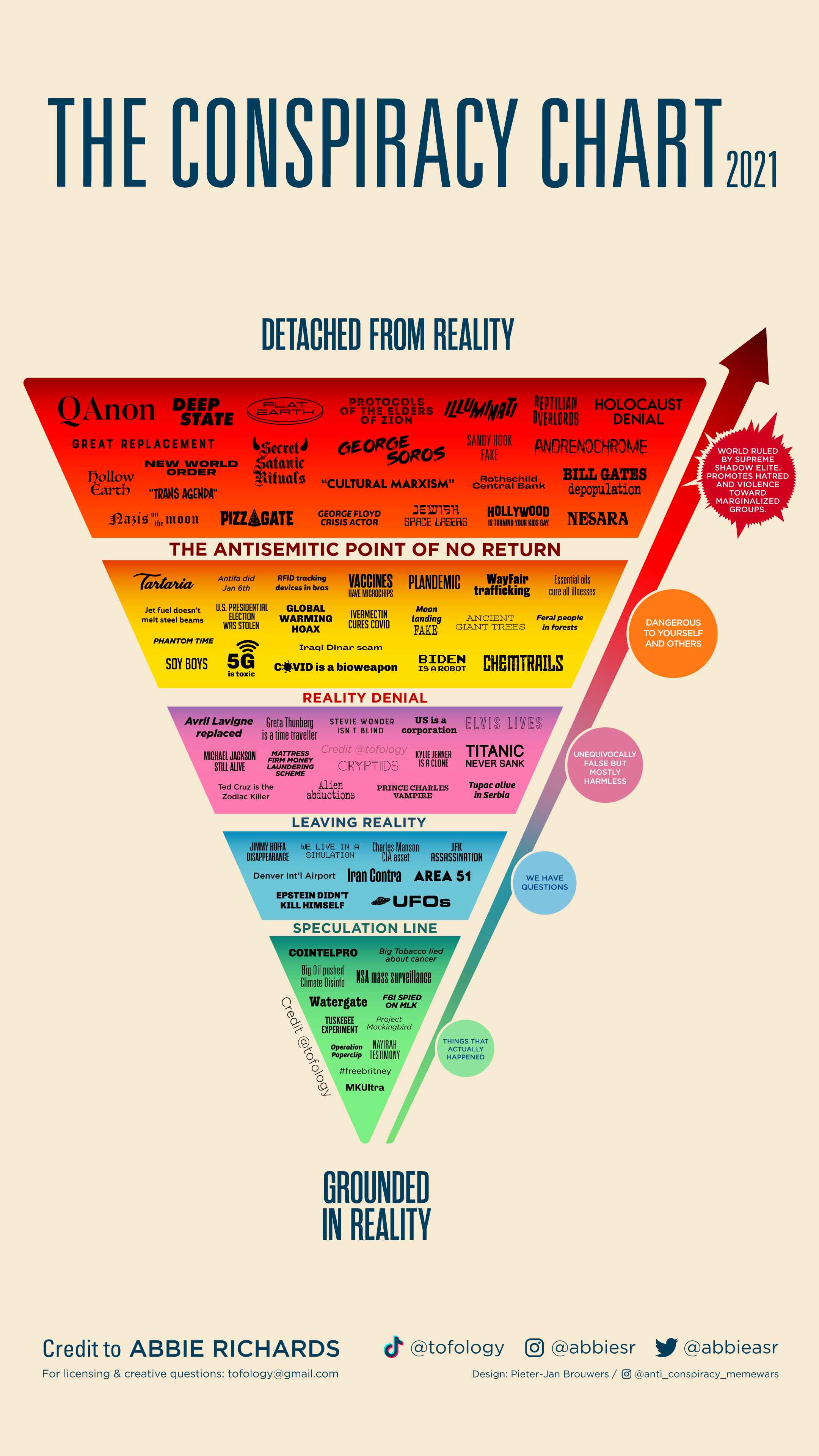
To this end, misinformation expert Abbie Richards has decided to make a conspiracy theory tier list, just like all those cool YouTubers who tier things like animals for viability:
Conspiracy theories are everywhere and people don't understand how harmful they are.
I made the original Conspiracy Chart over a year ago. An update was long overdue. This is the 2021 version. pic.twitter.com/c8STog1JUW
Yes, I linked to the tweet that time. If you’re wondering why I sometimes post a screengrab instead, it’s on the chance that these kinds of posters develop a flash of self-awareness needed to comprehend this type of content as the cringe that it is, and they attempt to memory-hole it, in the hopes that the internet would ever forget.
For your benefit, here’s the full chart:
Part of what makes artistic expressions such as the above as fascinating as they are is because they reveal more about the artist than anybody else. It doesn’t take long browsing the chart to see where Abbie Richards stands in regards to various issues.
What’s fascinating is what she considers to be dangerous. While some of the above can be classified as harmful misinformation, nearly all of it, including the upper tiers, is mainly just the stuff of old men yelling at clouds, and disheveled men meandering about at parks and rambling semi-coherently because they forgot to take their meds.
But what’s especially deafening about the above chart is the conspiracy theories that the chart omits, such as the idea that Trump colluded with Russians to win the 2016 Presidential election, or that the January 6th Capitol protest was an organized attempt at an insurrection. What makes those conspiracy theories actually dangerous is that they are believed by legacy media pundits, political elites, and their corporate interests who peddle these same conspiracy theories as facts, in spite of the same being defeated by both thorough investigation and basic observation.
Also interesting is the use of the phrase “Antisemitic Point of No Return”, which implies that each of the conspiracy theories above it were intrinsically anti-Semitic, and that the chart maker is so vindictive that if you’ve considered any of them, then as far as she’s concerned you cannot be reconciled back to reality.
As you probably already know, the inventers of conspiracy theories usually ram-rod anti-Semitism into them because it’s practically a meme at this point. Any conspiracy theory can be made anti-Semitic with an arbitrary implication that Jews were somehow involved, which is often what happens with them. Considering how clever conspiracy theorists present Jews to be, it’s interesting that there aren’t more Synagogues around. One would think that with all that they supposedly have their hands in, Jews would have a greater ideological stranglehold on the world.
Okay, closing paragraph. On this blog, I make fun of the stupid things that people do. As you can imagine, the work of finding new material is not hard. So, thanks, Abbie Richards, for providing the low-hanging fruit.
Developer: ILCA Publisher: Nintendo, The Pokémon Company Genre: Turn-based RPG Rating: Everyone Platform: Nintendo Switch
“Old fans would not want us to mess with their good memories… but there is no point in just redoing the same thing, right?”
GameFreak President, Pokémon HeartGold and SoulSilver
It’s plain to see what approach was taken this time around. Because as it is, Pokémon Brilliant Diamond and Shining Pearl (hereafter BDSP) may be the most predictable game I’ve ever played. At this point, the Pokémon franchise has pretty much cornered the market on those who like their games completely non-surprising.
Let’s go, Brandon!
This review almost saddens me to write, because I had some fond memories of the original Diamond and Pearl. It seems I’m far from the only one, as gamers have been calling for Sinnoh remakes since the well-received Omega Ruby and Alpha Sapphire. While nostalgia is a selling point for Pokémon remakes, the previous remakes cultivated an expectation of an upgraded experience, not simply a retread. Up until the Let’s Go games, the remakes were usually done in a style similar to the most recent core Pokémon games at that point, and they usually included tweaks to the gameplay, and elements that weren’t in the originals. Considering this, it should be understandable that the Sinnoh remakes would have the same approach. But it wasn’t the case for BDSP.
Pokémon Diamond and Pearl were really early to the whole smart watch dealie.
I often start reviews with a brief, non-spoilery synopsis of the game’s plot, but in this case, it’s easy enough to guess the story direction for BDSP. A trainer starts out in a small town, and after picking from among three starter pokémon, the trainer embarks on a quest to obtain 8 gym badges, with intermittent interruptions from a team of bad guys, culminating in a showdown with the Elite Four, then the Champion. The story is the same as it was for the originals, so if you’ve played Diamond or Pearl before, then BDSP will have pretty much no surprises for you.
When it comes down to it, BDSP are almost straight ports of Diamond and Pearl, with some elements from Pokémon Platinum, but some upgrades to the production values.
But not by much.
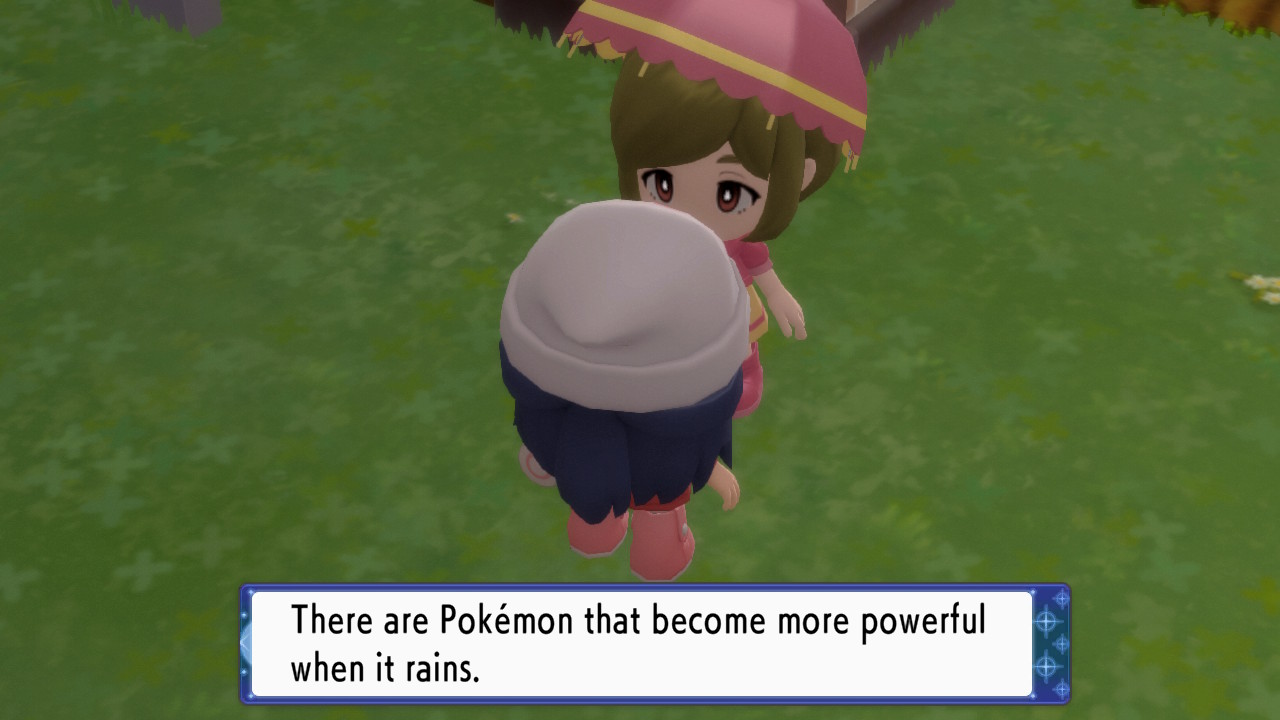
For some reason, ILCA decided to go with a chibi graphical style for the overworld models that are reminiscent of Nendoroids.
Believe it or not, this was already a thing.
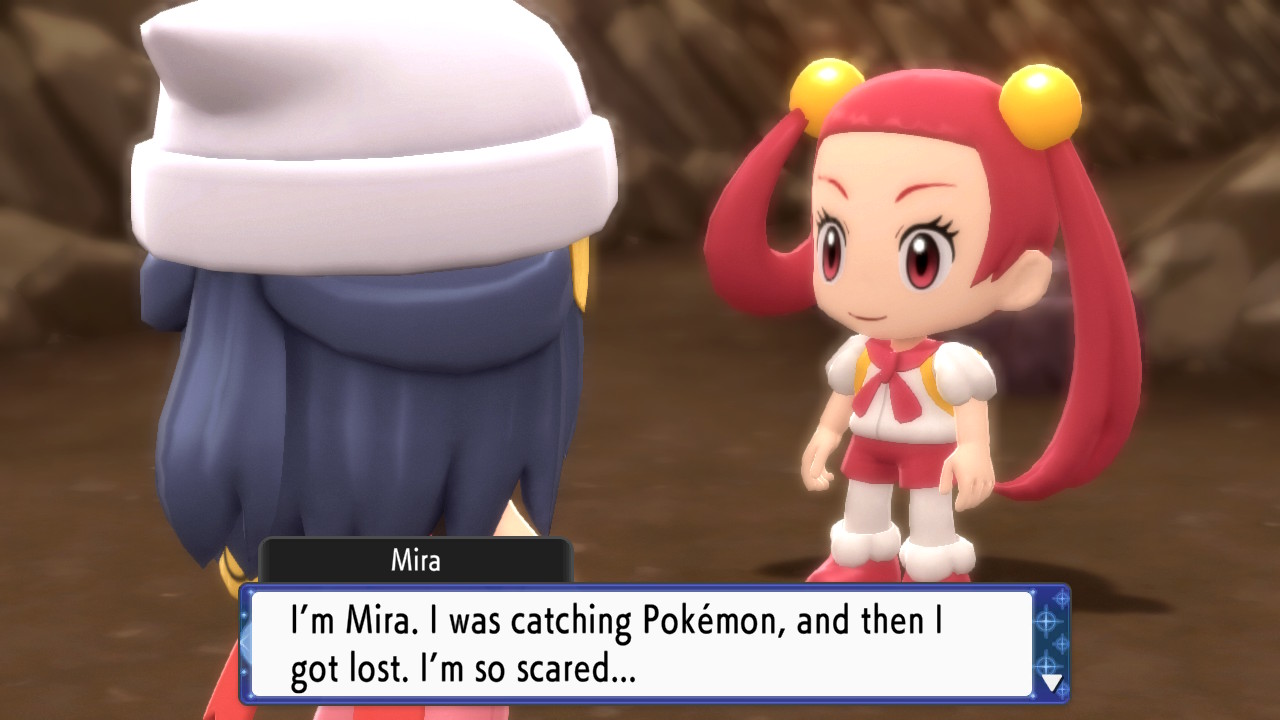
I was initially skeptical but open-minded about this, but in execution, these chibi Nendoroid models leave much to be desired, especially when the games do a dramatic zoom-in, which happens often.
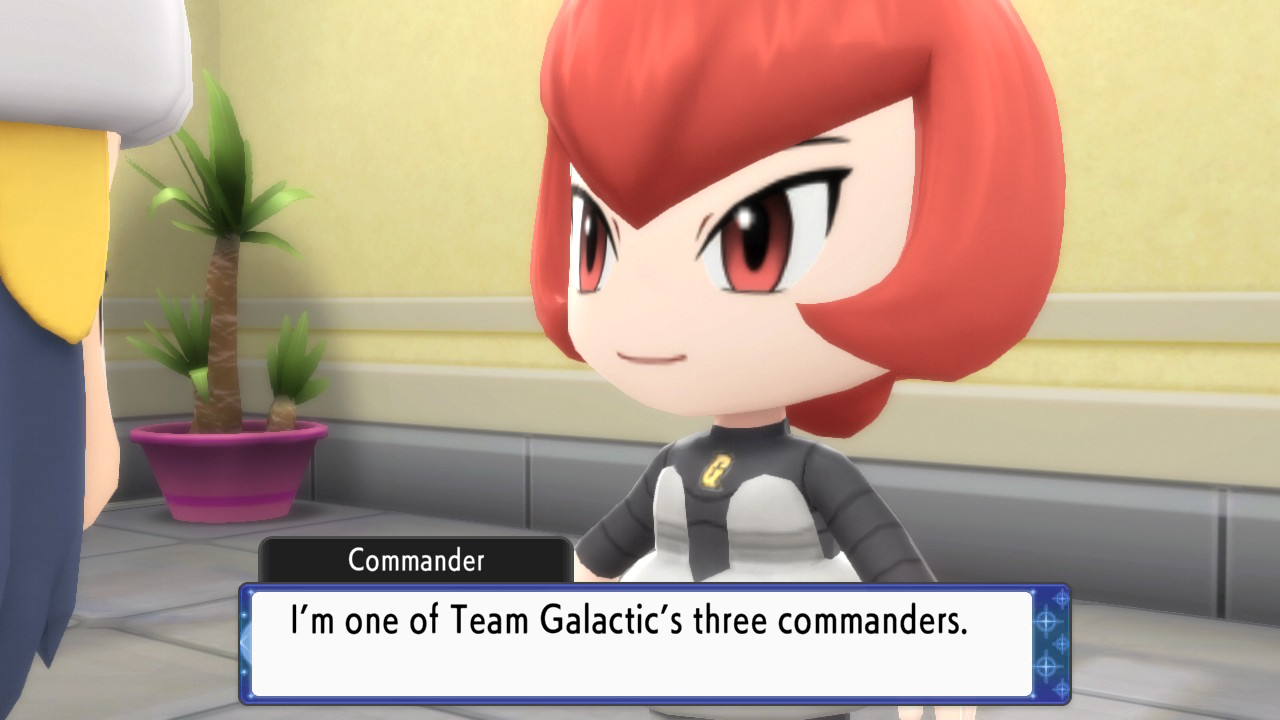
Watch out, here comes Team Galactic to teach you some respect!
When these extreme close-ups happen, the jaggies and aliasing on these character models becomes really apparent, and the result is so cringy that I’ve found myself wishing that ILCA didn’t bother with them.
Interestingly, ILCA is short for ”I Love Computer Art”.
She’s not the only one.
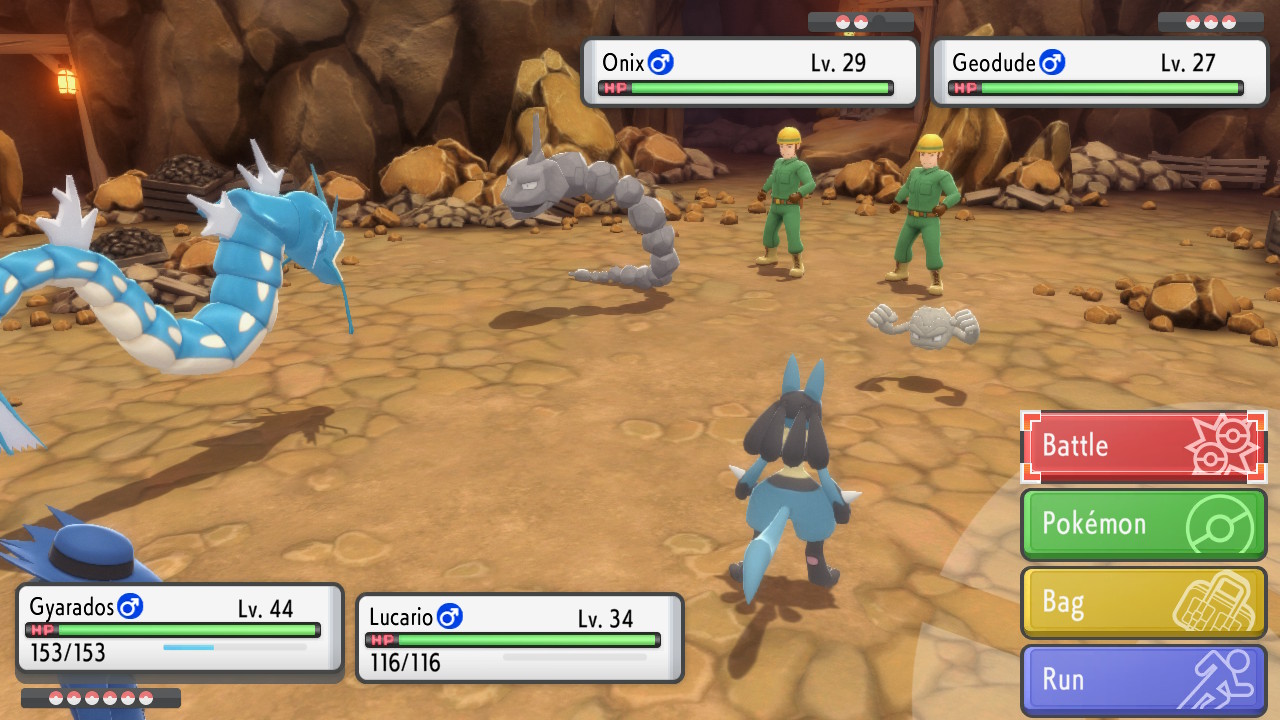
The music tracks are on point, and while that’s normally a great thing, that brings up the question of why two different aspects of production so starkly differ in quality. This dissonance becomes more apparent when you see that the in-battle scenes look current-gen, complete with proportionate anime-style character models. Why couldn’t they have done the whole game with these models?
This is not Sword or Shield.
I’m going to come right out and say it: BDSP seem incomplete. To the point that I actually closed the game to check to see that I was playing with the day one update, which I was (1.1.1). It’s hard to believe that this was a full-price professional product, let alone the latest core installment to the single highest-grossing intellectual property of all time.
Smol Gyarados.
Yes, that following Gyarados is undersize, and that seems intentional. But for some reason, it spawned on that thin log. Who else is looking forward to what the glitch hunters are going to find?
As far as gameplay goes, BDSP is pretty much a classic-style turn-based RPG. There was less call for that to be messed with than anything else, so maybe it’s not bad that ILCA didn’t do much to tamper with it. Each turn, attacks are selected, then the pokémon take turns executing their attacks, with the ones with higher speed getting priority. There are many complex gameplay elements that can alter the flow of battle, and many players formulate their strategies based on these. Usually, a player that can exploit an opponents type weaknesses will have a significant advantage, but different offensive and defensive stats introduce an element of complexity that sometimes makes the best play unclear. As is the case in most installments in this series, the flow of battle can change drastically due to a variety of buffs and debuffs.
But hey, you may have already known how to play Pokémon already, especially if you’re in this game’s target audience. Even if you don’t, getting though most of the game will be pretty simple, especially now that the EXP system rewards all pokémon in the party, not just the one that did the battling. Yes, like just about any other RPG.
If you’re great at competitive Pokemon, college may not present you with much of a challenge.
I know that I’m not being greedy when I say that I wish that ILCA did more to mess with the experience that I remember. The Hoenn remakes did include soaring, which wasn’t in the original, and the Let’s Go games had mega evolution. Would the addition of a similar mechanic to a Sinnoh remake have been too much to ask?
I enjoyed the Sinnoh Underground in the originals, and I’m happy with the experience this time around. I’m okay with how relatively little they’ve messed with the experience of digging up treasures. What’s more, there are mini-biomes in the underground which, upon their discovery, increases the variety of pokémon available to the player. If players find, catch, and use pokémon that weren’t part of the typical walkthrough of the originals, that counts as a somewhat changed experience, right?
I suspect that the nurse was the one that polished the floor.
It’s really hard to imagine who I’d recommend this game to. If someone is already a Pokémon fan, then they’ll likely have already played Diamond, Pearl, or their original remake, Platinum. If someone is one of the people left who haven’t, BDSP isn’t likely to impress them. If someone is such a Pokémon fanatic that they’re determined to buy them anyway, they’re not likely to change their minds based on anyone’s recommendations.
So, who is this game for? It’s really hard to say, which factors well into Pokémon Brilliant Diamond and Shining Pearl’s score of 6 out of 10.
Remastered music, updated graphics, and some gimmicks that don’t do much to the core experience. There’s your TL;DR.
The idea that Pokémon is a childish game has been around for quite some time. It’s a superficial observation, which does hold up to an extent. But some of the themes of the Pokémon games are quite a bit darker than they get credit for.
Let’s examine some of the themes of each generation of games, one at a time.
Generation One (Kanto) Shows how casino gambling can be used to fund genetic engineering experiments which culminate in a psychotic, telekinetic battling machine.
While Team Rocket were certainly the bad guys in raiding the corporate offices of Silph Co., let’s not forget that Silph was developing a proprietary PokeBall that bypasses the will of a Pokémon and guarantees its capture.
Generation Two (Johto) Team Rocket cut off the tails of Slowpoke to sell for profit.
Later, in what can be called a TI’s paranoid delusion having come to fruition, electromagnetic waves were employed that literally drove certain creatures within its area of effect berserk. If all you know about Team Rocket is the buffoonery of Jessie, James and Meowth, you’re not getting the whole story.
Generation Three (Hoenn) We get to see both sides of the climate change extremes.
With the Hoenn remakes (Omega Ruby and Alpha Sapphire) came a postgame episode that showed all of Hoenn being threatened by an impending meteor impact. The Devon corporation proposed teleporting the meteor to an alternate dimension, where it would strike a different Hoenn region in a different timeline, instead. Yeah, for an alternate Hoenn region, it could have been death from above, with no warning and no way to respond.
Generation Four (Sinnoh) Hoo, boy. This one is a whopper. Where to begin?
The bad guys resemble a sci-fi cult. Like many cults, the group exists for the aspirations of its leader. Cyrus doesn’t share his true motives with the rest of Team Galactic, which involves wiping out the entire universe then replacing it with an emotionless universe governed by Cyrus. Grandiose, much?
In the anime, Cyrus meets his end when he’s killed by Giratina. If you don’t know what a Giratina is, it’s a Lovecraftian monstrosity that was banished to a different dimension for it’s violence. Considering what animals in this world do just to stay alive, to be so violent to end up banished to another dimension for it is quite a feat. And judging from the condition of the Distortion World, Giratina might not have learned its lesson.
Generation Five (Unova) The theme of this one is philosophical, but goes to show that the popularity of an idea can cause people to give up something that’s clearly to their benefit to keep. Behind it all is a cultist who stands to benefit from everyone else giving up their Pokémon, and he actually came up with a plan to change society, first through persuasion, then through peer pressure. When his plan fell apart, he pretty much went insane, even as far as railing against his adopted son, and not accepting that he lost.
In the sequel game of gen 5, the bad guy attempts to murder the main character.
Generation Six (Kalos) Are you sitting down? You might want to. The bad guy wanted to wipe out all humanity, except for whoever happened to be in his little team, with the Malthusian reasoning that there wasn’t enough resources to go around. Like many who think like that, he’s as enthusiastic as he was because he fantasized about being the one to manage all the world’s resources.
In the anime, Lysandre became one of the few humans to have been killed by a Pokémon, when he was killed by Zygarde (Bonnie’s friend Squishy shared in the guilt). It’s hard to imagine anyone shed a tear for him, but Malva might have. She was Lysandre’s girlfriend, and a TV anchor. So yeah, in Kalos, a Malthusian infiltrated the tech industry and the mainstream information media. Sounds familiar, doesn’t it?
Generation Seven (Alola) As much as I’d like to say that things cooled down since gen 6, gen 7 depicts a monolithic corporation endangering two universes for selfish reasons. Then there’s all that Lillie had to go through. That poor girl watched as her family was torn apart in slow motion, beginning with when her father disappeared, then her mother went insane looking for the ultra beasts, then her brother ran away from home. Lusamine’s obsession was with Nihilego, a jellyfish from another dimension that can control people and make them go berserk. In the original Sun/Moon, Lusamine ended up in an intermittent coma due to the cells of Nihilego remaining in her brain, and Lillie went to Kanto to search for a cure. Some of this was redacted in Ultra Sun and Ultra Moon, perhaps because the writers thought they went a little far. If Lillie grows up to be normal it’s going to be against some pretty steep odds.
The Ultra variants of Sun and Moon have a postgame story where Giovanni enlists the bad guys from different regions, except these ones came from different grimdark timelines where those bad guys succeeded in their plans. Considering how screwed up some of their plans were (see above), that’s a lot to contemplate.
Generation Eight (Galar) The bad guy imprisoned a cosmic dragon, and slowly tore it apart, one fragment at a time, to continually extract energy from it. By the time the player encountered the thing, it was nearly a skeleton of its former self. What’s more, the bad guy was willing to risk a catastrophe for the entire Galar region, just to solve an energy crisis that would have been centuries away from being significant.
Having said all this, Pokémon is not really a super-edgy franchise, as these dark elements don’t do anything to subvert the main theme, which is about the connections that one can form as they meet people who share their interests. But to dismiss Pokémon as being merely childish is to demonstrate how easy it is to hide an edge behind a disarming exterior.
Developer: Twilight Frontier Publisher: Phoenix Genre: Fighting Rating: Teen Platform: PC, Steam, Sony PS4, Nintendo Switch
The characters in Touhou are just about everywhere nowadays, to the point that it’s getting to be impossible to escape from them. Now, an official installment of the Touhou franchise has come to Nintendo Switch, this one in particular from among the fighting games in the series.
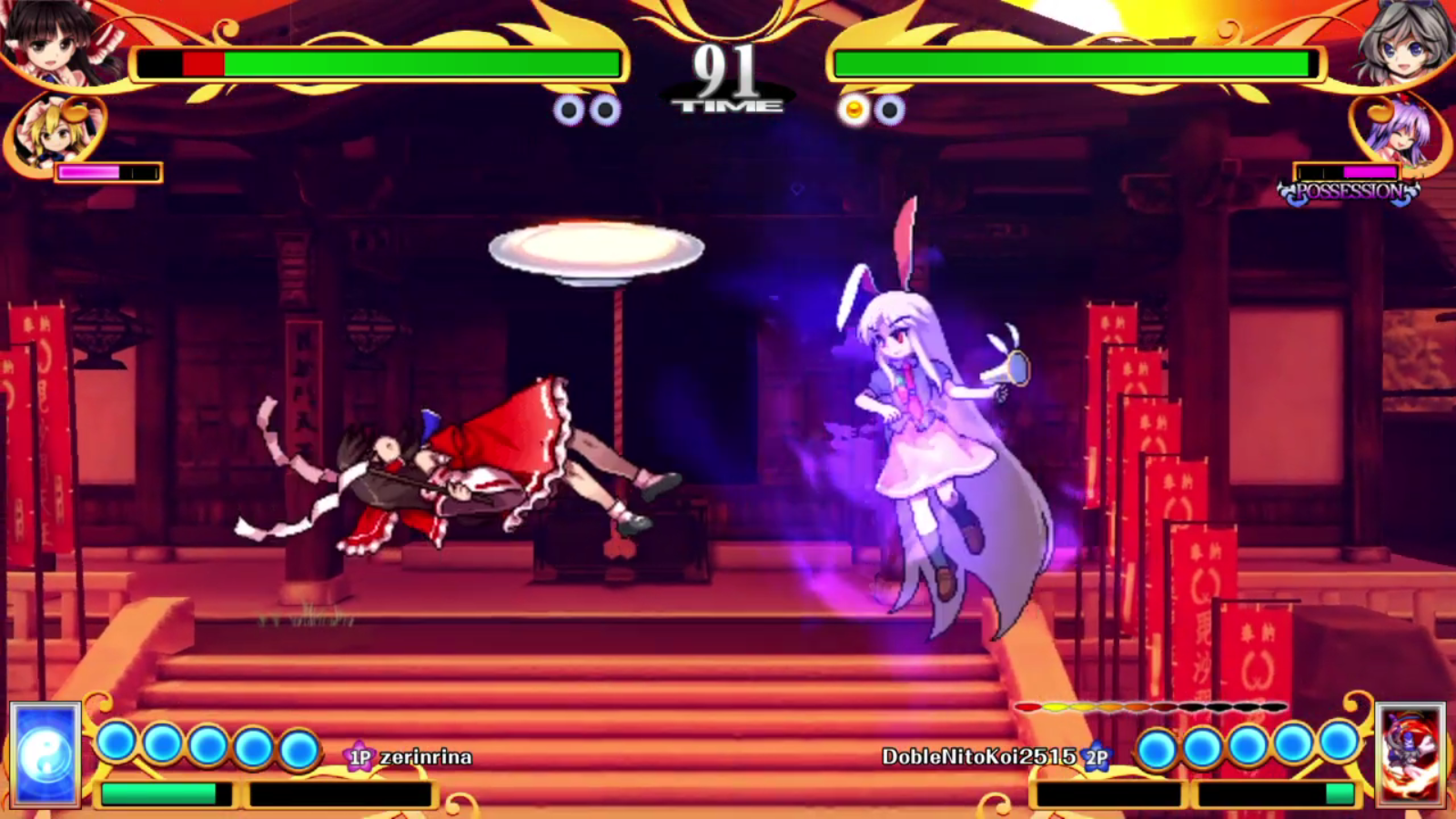
Touhou Hyouibana: Antinomy of Common Flowers follows the adventures of Reimu Hakurei and a handful from among her many, many acquaintances as they investigate a strange phenomenon known as “perfect possession”, which allows a pair to swap places with each other at will, even in the middle of a fight. It’s basically an in-universe explanation for the tag battle mechanic. It can be really hard to be the fourth wall in Touhou, sometimes.
As you might imagine, some more ambitious characters are using perfect possession to gain more power, using it to their advantage in matches. But the story mainly revolves around a pair of tricksters who have found a way to misuse perfect possession as a way to amass wealth for themselves, and effectively become an unbeatable tag match. Complicating matters is that the very use of perfect possession has unintended consequences for a parallel universe known as the “Dream World”.
Sorry, I didn’t find Cirno in this one.
The story mode has you selecting a duo and following their quest over the course of a few relatively-simple battles (difficulty may be adjusted, depending on whether you’re a super-soldier or drunk). At first, there is only one story, but as the story progresses, more stories become available, perhaps even a few at a time. The game calls its overarching story “bittersweet”, which is fitting, as even completing a duo’s story segment may result in setbacks that are a part of the narrative.
If you’re not already familiar with Touhou, you may be taken aback by the sheer amount of lore surrounding each of the characters. It’s not necessary to know what motivates the game’s handful of characters, as you can just half-pay-attention to the story and focus on winning matches. However, some in-game bios would have been nice to provide some background on these characters, which may have helped to better appreciate the story. An example in which this might have helped involved a cameo of Kaguya. If the player knew that Reisen was Kaguya’s pet rabbit, that may have helped the player to better understand the interaction between the two.
What are you looking at?
But it’s the gameplay mechanics that make it a game, and for AoCF, they mostly hold up.
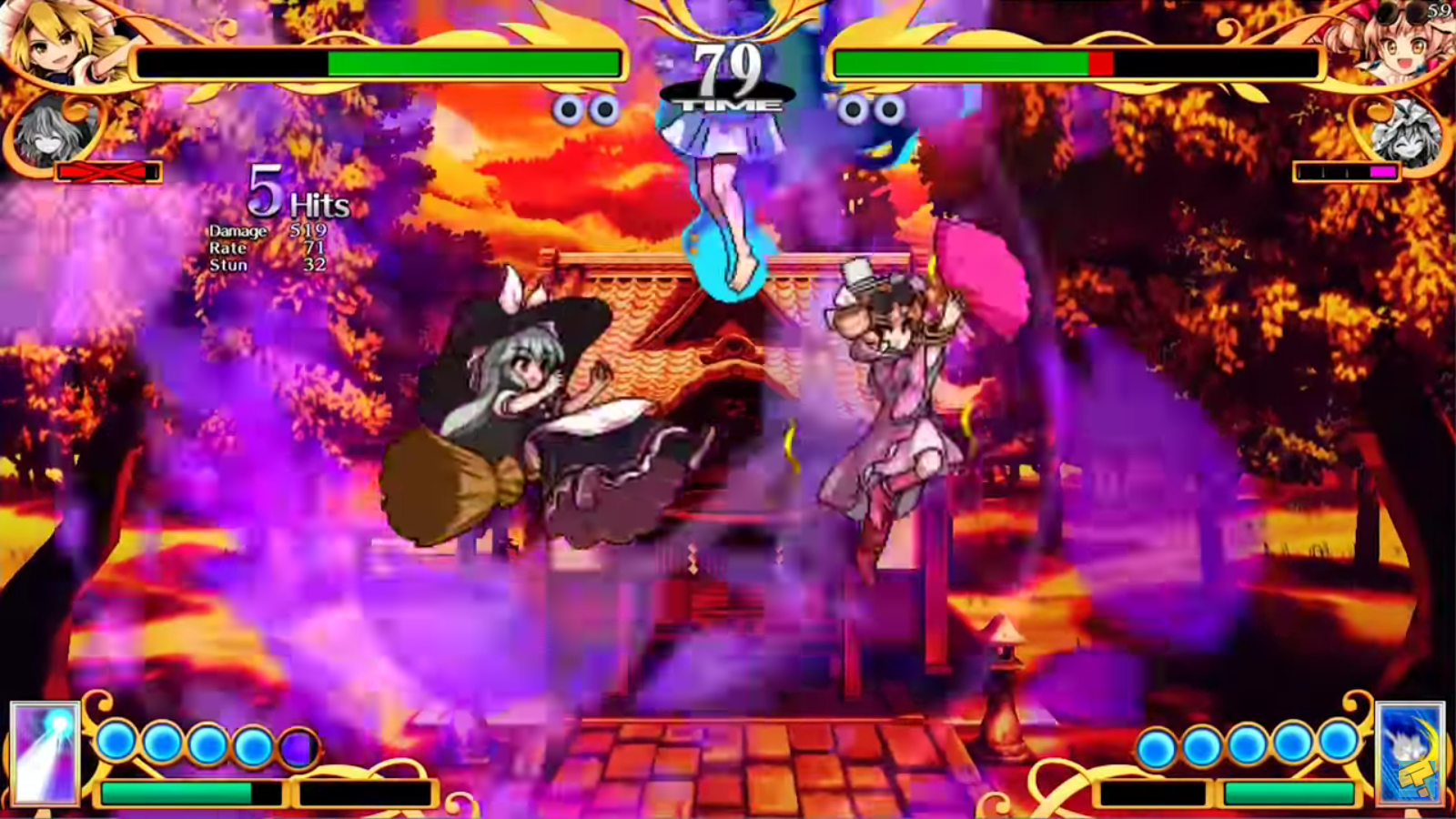
In concept, I think the idea of anime waifus throwing bright, colorful attacks at each other sounds brutally awesome. In execution, however, most in-game matches come down to finding out how to cheese the opponent to take their health bar down, at which point they’ll move on to the next phase, which usually takes a different strategy to defeat. While that may make matches against story opponents highly predictable, it seems as though the game intends for players to find the right cheese strat for each phase, and the match usually ends before the process gets too old. Which is clever, in an odd sense.
While this is a tag team game, I found myself going through most battles with just the Master of the pair, just fine. One in-game opponent switches things up by using a special bullet that doesn’t affect the Slave of the combo, which is one way the game encourages the use of the perfect possession mechanic.
Jyoon and Shion may be the bad guys, but they are enviably cunning.
The characters in Touhou fly. What this means in this game is that the battles don’t take place on the ground, but in the air. Instead of jumping, when the player presses up, the character floats up, but then returns to the same horizontal point she originated from. Pressing down works in the same general principle, but with a downward movement, instead. Avoiding projectiles in this manner can be tricky, though a mid-air hang can be achieved through the use of certain attacks. In many cases, it’s better to use a barrier to block attacks.
The controls are pretty simple, with a basic principle that carries over for each character. There’s a button for basic attacks, which can be expressed differently based on the direction held. The same goes for a special attack button, but characters also have super-strong attacks which are usually pretty broken, but is limited in use depending on whether a meter has filled to a certain point. There is also a defensive shield, which may be the best choice against attacks that seem nearly impossible to avoid.
In non-story matches, players are free to choose their own combination of characters, rather than what the story calls for. It’s probably best to pick the character duo that would most effectively complement each other’s abilities, but I can imagine that many players would just pick their favorite characters and team them up, regardless of how well they’d perform. Which is something I could identify with.
It’s quite a shame that the fighting mechanics weren’t polished to a higher degree, because this game is great in just about all other areas. For one thing, the sprite art and portraits are crisp and clean anime-style art, and as far as that goes, it’s just right. The music is… well, it’s Touhou music. Of course the music is great. I’ve had at least a couple of these songs on YouTube playlists before even playing this game, they’re that charming.
Yukari just found a place to crash.
One potential gripe is that the English translations have numerous errors. But hey, if you like campy anime-style games, you were forgiving of that kind of thing to begin with.
Did I feel like I got my money’s worth with Antinomy of Common Flowers? In a word, yes. The game is flawed in ways that I’m aware of, but it’s still a satisfying game to play which, for many players, may be welcome as a guilty pleasure. Or, more than that, something to bust out at parties which might amuse the guests.
Touhou Hyouibana: Antinomy of Common Flowers gets a score of 6.5 out of 10.
Don’t worry about it if you still don’t know what the name means.
A YouTuber by the handle Coach Red Pill is having a black pill moment. In one of his newer videos, dated October 8, he suggested leaving western counties while you still can, citing the rise of the authoritarian left. While he is astute in his assessing their control of the major institutions and how the checks and balances have all but disappeared from this republic, I can take issue with his idea that the way to properly handle this development is to flee to some third-world country in an effort to escape the surveillance state, and it’s increasingly systematic suppression of dissent.
While I disagree with him, he still has an interesting opinion, and if you have about 14 minutes of time, it’s worth giving it a listen. For your convenience, here it is, embedded:
While the failure on the part of the American government to recognize basic Americans’ freedoms, and the wild flit towards authoritarianism to contain a mere case of the sniffles is indeed a tragic thing to endure, one can hear Coach’s suggestion to flee to a pallet-jack home in a country such as Argentina (or Ukraine, where he apparently shot his video), and ask, “Is this really what you managed to come up with?”
Seriously, is that it? To just run? After all that careful thought, to run off and surrender what ground you were standing was the best you could come up with?
Look, I know that it hurts to be punched, or to be beaten with bike locks. I also know that the left has a near-endless supply of unemployed losers to carry out violent activism as foot soldiers, all while being virtually indemnified by corrupt left-wing prosecutors. But when our own culture is being suppressed in an accelerating rate, to flee the battle comes off as little more than timid self-preservation.
While I recognize the desire to see the left “snap out of it” and recognize that they’ve been going too far, that becomes far less likely to happen when the very people who should be serving as a check to their power surrenders the ground they should be standing.
Stand your ground. This is where the battle is being fought, and where it will be won. Or lost.
But if you were to run off to some place that hardly has running water, what makes you think that whatever peace you find will be anything but temporary? The left’s flit towards extremism isn’t merely a local event, it’s global. If the people who stand the best chance of fighting back were instead to just run off somewhere, there soon won’t be a place where one can flee.
Right now, the enemies of truth, freedom, human intellect, and individual liberties have just about any advantage that one could possibly think of: control of information through corporate media, social engineering through advertisers and social media, extensive psychological profiles on each one of us, surveillance with drones that can monitor a pedestrian from miles away, tremendous amounts of wealth through garnishing the paychecks of most people who work, the list goes on and on.
But the greatest advantage that they could ask for is an opposition that’s willing to flee when sufficiently demoralized. After all, if the police who disagreed with authoritarianism were the only ones who were to resign from the force, we’d only be left with authoritarian police, and the trend would only be expected to accelerate.
Sometimes, the battle looks tough. I get that. As enthusiastic as we may have been when we took up the fight, we’re bound to run into days in which we don’t feel like fighting it. There will be times when it looks like the enemy has an overwhelming advantage, which has a lot to do with the fact that they’ve presented themselves that way. However, the outcome of a conflict isn’t always apparent in the moment. Need I remind you that in the days of American independence, the British had a world-spanning empire?
Right now, the battle is here, and this is where you’re needed. But if you’re just going to turn coward and run, don’t be surprised when we don’t take you back. After all, what father, perceiving the difficulties of providing for his family, would simply run off and abandon them when things get hard? Would anyone have pity for him? In the same way, if someone were to run off when things got hard, would it be accepted of him if he were to thank us for the easy times?
But if he’s really serious about it, Coach Red Pill is free to run off to some Pacific island or somewhere to set up “Freedomistan”, if he’s really just up for his own self-preservation. Who knows, if a bunch of Trump supporters were to somehow claim some mound in an otherwise Sharia state, they might butterfly effect their way to some bastion of freedom that resembles the one that they abandoned.
No matter how prevalent the forces of bullshit become, natural law remains in effect. It’s because of this that we have the expression, “play stupid games, win stupid prizes”.
The Malthusian movement has been losing steam, as countries are experiencing birth rates that are falling below the replacement rate. This is a disaster for aging boomers, considering that for Social Security to work as a scheme for wealth extraction, there actually has to be a certain number of people from whom to extract wealth.
I’ve been aware of the uniparty’s reversal of course for a few months. And, as I expected, there has been inertia, as it could take as long as a few years for programs to be rewritten or replaced or for contracts to expire, and for the culture to shift back to more traditional values.
In light of this, I think we can appreciate the irony of Cambridge’s new position, considering all that they’ve already done to contribute to the problem: They’ve long encouraged women to continually pay into the system (mainly by borrowing tons of money) to further their education and careers, until they are in their thirties, when their fertility starts to decline. Then, when you go to dating sites, you find countless women in their forties with useless degrees, desperate to have children.
But rather than fall on their sword, Cambridge instead subtly changes course, encouraging women to start having children as young as their early twenties, so they’d be more likely to have as many as three children (which is above the replacement rate of about 2.1). Of course, the undertones are highly creepy, but it’s still a sign that Cambridge (and colleges in general) will be transitioning back to more axiomatic values that have been tested and found to have resulted in healthy, successful families and societies throughout the entirety of human history.
While that might sound optimistic, it’s pretty much necessary, considering that the human specie isn’t adapted to anything else.
What would be optimistic is to assume that the uniparty and Malthusianism have learned their lessons. Rather than allowing people to live their own lives and make their own choices, they’re instead trying to manipulate society in an effort to reverse trends, in such a way that allows them to maintain control, and, of course, so they can die rich. It’s about power and money to these guys, as evidenced by the fact that they’re changing course to pursue them.
Well, “tough nuggets” is what I’d have to say, if I could decide what becomes of them. Let them know what it’s like to only have enough money to barely get by from month-to-month, hardly able to pay the bills. Just as they’ve been doing to me. They’re the ones that actually deserve it.
Developer: Mercury Steam Publisher: Nintendo Genre: Platformer, Exploration Rating: Teen Platform: Nintendo Switch
After having spent years as an urban legend, Metroid Dread has finally dropped, which goes to show that it’s going to take a lot more than being cancelled to stop a true warrior.
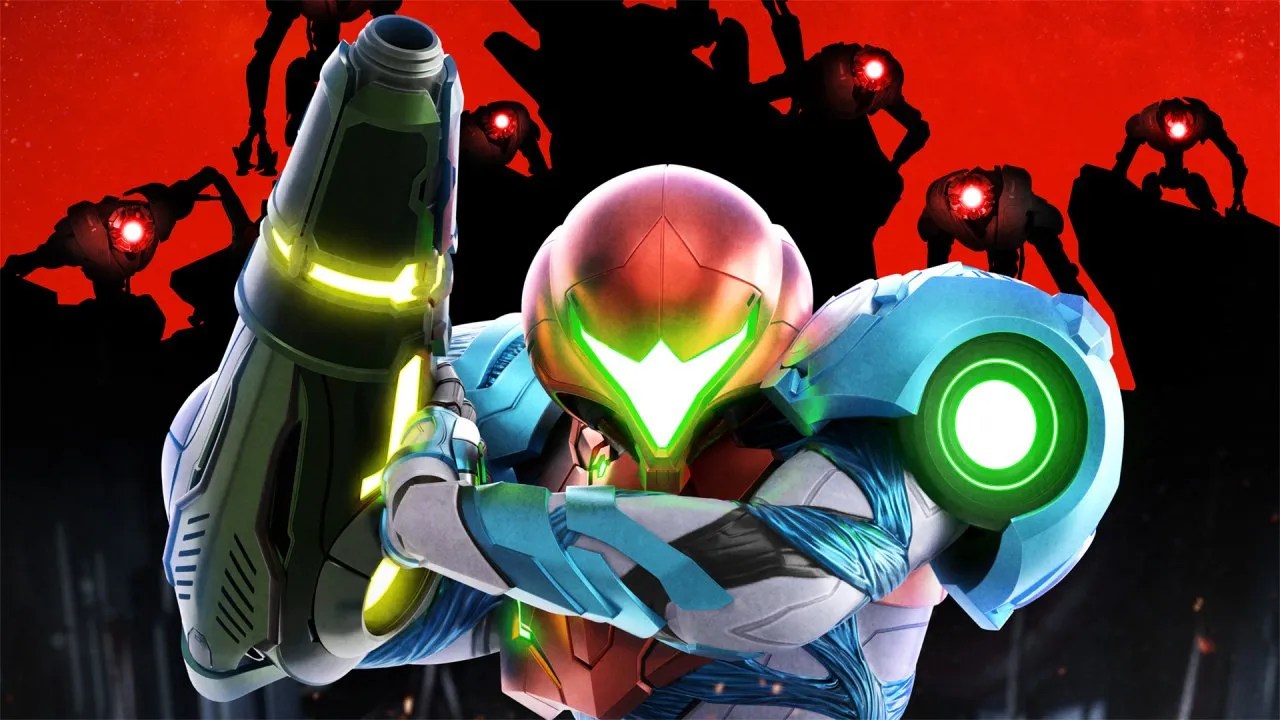
In the long-awaited sequel to Metroid Fusion, and what is currently the last in the series in order of the current timeline, the Galactic Federation has dispatched a group of E.M.M.I. robots to the planet ZDR to investigate a strange transmission. However, when contact with the E.M.M.I. has been lost, Samus goes to ZDR to investigate, fearing the possible return of the dreaded X parasites.
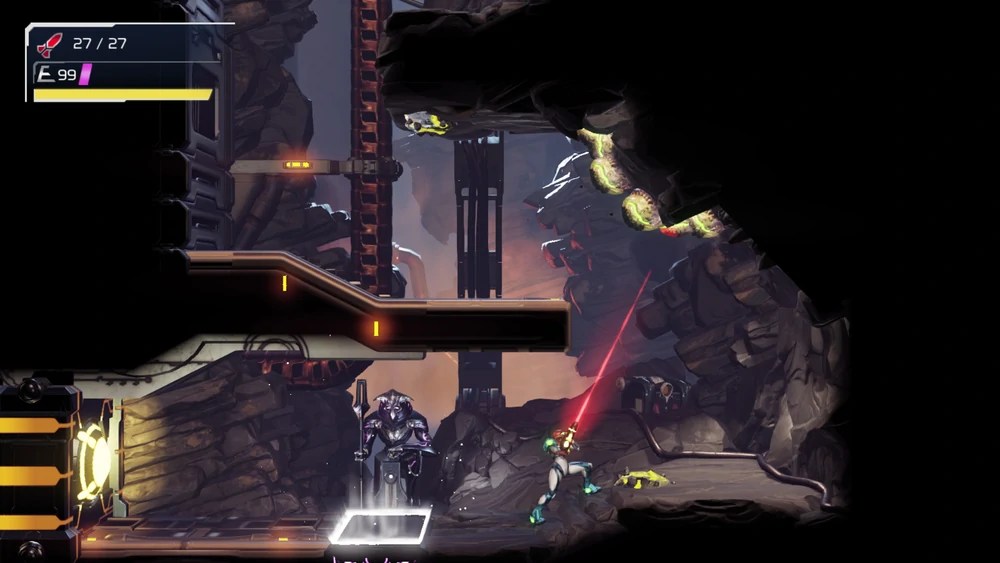
During the investigation, Samus encounters a Chozo warrior, and is quickly overcome in battle. Mysteriously, the battle has resulted in Samus being without most of her abilities. In a reversal compared to the rest of the series, rather than starting the game from Samus’ ship and descending into the caverns of an alien world, Samus instead starts at the bottom of the remnants of a civilization, and must ascend to the top in order to escape alive.
Matters become far more complicated with the fact that the borderline-indestructible E.M.M.I. have gone rogue, and will hunt Samus down if she goes anywhere within their coverage areas.
If you’re in this spot, you don’t wanna miss.
So, that’s the story, but how does the game actually play? That’s where it gets even better.
Like most Metroid games outside of the Prime series, Metroid Dread is a 2D platformer set in huge, interconnected areas that main character Samus Aran explores autonomously. Most areas have multiple branching paths, with very subtle (if any) clues as to which path would take Samus to either a major confrontation or an upgrade to her mobility. Even dead ends may provide opportunity to discover power-ups such as permanent expansions to her missile-carrying capacity, so players have incentive to explore ZDR’s huge caverns, for the treasures that await them. Even getting lost may have its rewards.
Initially, Samus’ techniques are limited. But as she picks up major upgrades to her mobility (such as improved jumps and the series-staple Morph Ball), more functions are mapped to the control scheme. While the controls get complex by late game, the gradual implementation of Samus’ abilities helps to keep players from being overwhelmed by the amount of techniques.
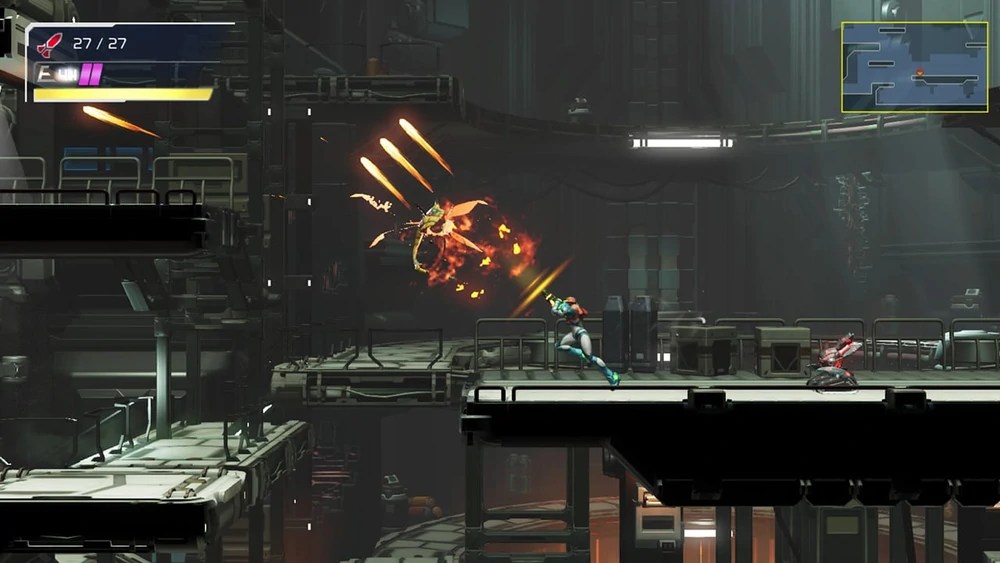
Samus does start the game with some useful abilities that remain helpful throughout. One of these is a slide that allows her to go under narrow openings, which acts as a convenient alternative to the Morph Ball when in a hurry. Another helpful ability is when Samus aims with a laser pointer, allowing her to fire in any direction. Samus has to be standing still to do this, which makes sense, considering that in real life it’s usually easier to aim with precision when standing still. During boss fights, this usually means taking the risk of standing still if it means possibly getting in more accurate attacks.
Ride that slide!
I’ve noticed early on that Missiles are usually better to use during boss fights than charged beam attacks. I remember that in some previous Metroid games, the opposite was true, and I liked spamming charged attacks. It’s a change I welcome, considering that it’s sensible from a game mechanics perspective for the resource that has the potential to be limited by quantity has higher damage potential. But unless you’ve been missing a significant amount of ammo upgrades and play carelessly, you should have plenty of missiles for most boss fights.
Metroid Dread may provide a lot of abilities, but that doesn’t mean it holds the player’s hand. It’s expected of players to pick up on acquired abilities quickly, and if players can recall them late in the game, that might make some difficult boss battles go a lot smoother.
That brings us to the next point: Metroid Dread is not an easy game. Even on the normal difficulty, players of average skill level can expect to take multiple attempts on bosses before finally emerging victorious. I remember that there was at least a couple times in which I had taken a few attempts on a boss, so I decided to make attempts where I mostly just performed evasive maneuvers, with minimal attacking, in order to practice at avoiding the boss’s attacks. That helped, as subsequent attempts mostly went a lot smoother.
Comparisons have been made with Dark Souls in terms of the difficulty of the boss battles, so victory against most bosses aren’t something that’s just handed to you. Beating the bosses in Metroid Dread is a matter of skill, and when a boss is overcome, it feels like an accomplishment.
Run, girl!
But the bosses aren’t the only things in this game that bring the tension. In Metroid Dread, there’s a total of seven E.M.M.I. running about. Each of the E.M.M.I. has an assigned area which it doesn’t leave, but because you’ll have to run through these immense areas to proceed, Samus will have to confront them.
When you come across an E.M.M.I., there’s usually nothing you can do except try to avoid being noticed, and when you are noticed, you pretty much have to run and hide. What’s more, these things are scary intelligent, and usually come along to investigate where they hear sounds.
If an E.M.M.I. catches Samus, it’s usually Game Over. Yeah, there’s a brief quick-time opportunity to escape it’s clutches, but because it’s so hard to time, just touching an E.M.M.I. usually means having to retry. But thankfully, Metroid Dread is generous with restarting the player just outside E.M.M.I. areas and boss doors, so the player can make another attempt right away if they so choose.
In exploration platform games, colloquially known as Metroidvania games, a significant part of the experience is the sensation of movement. And thankfully for the chief genre-namer, movement in Metroid Dread is a joy. Samus responds with just the right combination of realism, momentum, and lack of hesitation to controller input. And what’s more, there’s a sense of power to her many mobility upgrades, to the point that by the end of the game, it really feels as though nothing is missing from Samus’ arsenal.
It’s not polite to point.
What’s more, none of the upgrades unbalance the game. There’s no one upgrade that’s perfect for every occasion, but they usually come with a sense of freedom that comes with knowing just how it can be used to overcome an obstacle that rendered previously encountered passageways and power-ups off-limits. And when you find out that an upgrade that you might not have been thinking much about at the time might make a boss battle much easier, that’s really satisfying in its own sense.
It usually goes that when someone buys a new game, there comes a risk that a game with current-gen visuals compromises with mechanical soundness. However, in Metroid Dread’s case, there is no such compromise, as the game offers tight, rewarding gameplay with excellent production values, all wrapped in the same package. While the platforming is in two dimensions, the environments are rendered in polygonal models. Metroid Dread is far from the first game to do this, but what Dread accomplishes is so rich and atmospheric that it’s a strong argument in favor of upgrading to a Switch OLED if you intend to spend a lot of time playing in handheld mode. There are many little touches here and there which goes to show just how much thought that Mercury Steam put into it. For example, there’s a thin, barely-noticeable haze of display static when Samus is in areas where there is an E.M.M.I. active, which conveys an eerie, unsettling technological sense that something is off.
What the E.M.M.I. can’t see, can’t hurt it.
As much as I’d like to discuss the events in the game, and what they mean for the overarching Metroid narrative, I think the best way to discover them is to play the game for yourself. This is one game that’s a blast to play, so that discovery isn’t likely to feel like a chore to a gamer without a crippling case of ennui.
Now, onto the score. It’s my great pleasure to give Metroid Dread top honors: 10 out of 10.
In times past, Metroid games have been something that one might consider to hold themselves over while waiting for some other big release. With Metroid Dread, the Metroid series demonstrates that it’s deserving of more respect.
















 Magnetricity