Author Archives: Raizen

The Right Way to Play Pokemon: Let’s Go Pikachu

Lets_Go_Pikachu_EN_boxart.png

The game has been out for over a month, so the timing seems right for a teambuilding guide for the theoretical few that are struggling to get very far in Pokemon: Use Pikachu and Win.

Let’s not dance around it: Pokemon Let’s Go Pikachu is an easy game. It may very well be the easiest game in the series with the exception of Pokemon Let’s Go Eevee, its version counterpart. Yes, they actually are easier than Pokemon X and Y. I don’t know why, but GameFreak seems to be on this stint where they feel like they have to compete with cell phone games. Look, if I’m going to spend $60 on a JRPG, I want it to have more more to it than some vapid cell phone app with all the depth of a puddle of rainwater. Besides, cell phone games are free. It’s hard to compete with that.

This guide is about practical team-building choices for those who want to quickly and efficiently power their way through the game. It’s probably better to take one’s time and savor the experience, but some players are in a rush to get to the post-game so they can build a competitive team, even though the Let’s Go competitive scene is pretty much summed up as beat-Mewtwo-and-win. But hey, it’s the player’s choice how they play through a cutesy game about huggem-squeezems.
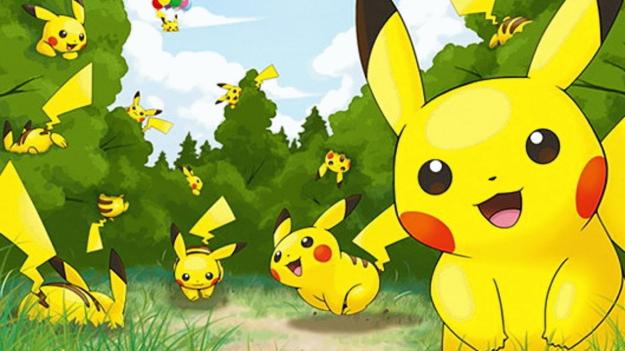
Pokemon-pikachu-hd-wallpaper-background.jpgGet ready to see a lot of this guy.

Obviously, Pikachu is going to be on your team. It’s going to be the strongest pokemon available to you for most of the game, and it’s given to you right from the start. Mewtwo isn’t available until the postgame, but Pikachu can get you to that point.

A pointer for those who insist on having their pokemon perfect: The gender of the partner Pikachu is determined right when you start your save file, and is obvious at that point. If it’s the one you want, go with it. Otherwise, just reset. For nature, that’s determined when you enter the grass and encounter it, and you see its nature when you receive it in Oak’s lab. This would be the only partner Pikachu you get in a save file, so if its nature or gender matters to you, take the opportunity to soft reset for it. Its IV will be flawless, so don’t worry about that.

You’ll also have the choice of which trainer to play the game as. If you’re wondering who the girl is this time, here she is:

Lets_Go_Pikachu_Eevee_Female_Trainer.png

Her name would be Elaine (Ayumi, for the elites). I suspect that she’d be the highly-popular choice. But you can also choose to play as the boy if you want to. Not that there’s anything wrong with that.

The partner Pikachu can pretty much get you through the game. It’s over-the-top busted for most of the playthrough, and because EXP is distributed evenly among all team members, don’t be afraid to lean heavily on Pikachu while catching a few other pokemon for backup.

For one thing, the partner Pikachu has better stats than other Pikachu you can capture. It’s almost like starting the game with a Raichu. Better yet, you can start to chain Pikachu at Viridian Forest at the game’s outset. You start with piles of Pokeballs, so you can actually get a pretty decent chain going. If you do this, you’ll gain plenty of EXP, and as the chain continues, you’ll get Pikachu Candy. This candy will increase each of the partner Pikachu’s stats by 1, and as you give Pikachu more of them, this can really add up. You can also gain plenty of Quick Candy by chaining Pikachu, which is another perk.

You can increase Pikachu’s advantage by chaining various pokemon, such as Caterpie for Health Candy, and Oddish for Smart Candy, to name some early-game examples. It’s really not necessary to go for lots of these candies to breeze through the game, however. I mostly ignored candies as I played through, and didn’t really have any problems. This game won’t do much to challenge you, and if you exploit the games deeper mechanics, it will be easier still.

Playing with partner Pikachu seems like it’s just for fun, but increasing friendship with Pikachu makes it perform better in battle. For one thing, it can sometimes just shrug off status conditions, healing them on its own. It can also sometimes hang in there with 1 HP remaining when something would have knocked it out, giving you the opportunity to heal it up with a potion. Its critical hit rate increases, too. Not only that, if you play with Pikachu often, it can sometimes use a special move in battle that does more damage if it’s friendship level is higher, or can give a stat boost to a teammate if you (for some reason) have a different pokemon out.

One would think that Pikachu would have problems with Brock, but Pikachu can learn Double Kick at level 9, giving it a super-effective edge against the Rock types he uses. Double Kick remains a useful move for a while, but mind the fact that Rock types usually have high Defense stats which might offset the type advantage somewhat.

At Cerulean City, you’ll find a move tutor in the Pokemon Center that can teach the partner Pikachu Zippy Zap. Pikachu would already likely beat Misty as it is, but Zippy Zap is a useful priority move. What this means is that it goes first unless a faster opponent also uses a priority move. Also, this move has a 100% critical hit rate, so it does double damage, and it ignores defense stat buffs. That’s insane. And with a base speed of 120, Pikachu is likely to outspeed everything you come across (it helps that Electric types can’t be paralyzed).

Once your friendship level with Pikachu is high, you can get a Raichu outfit at the Pokemon Fan Club in Vermilion City. You might not be able to evolve the partner Pikachu into Raichu, but you can at least deck it out in its merchandise. And you get a Raichu outfit to wear, too.

The Celadon City Gym is Grass type, which resists Electric moves. This would normally be a problem for a Pikachu, but the partner Pikachu can learn a strong Flying move in the same town’s Pokemon Center. Floaty Fall is a better move than Fly because you don’t have to wait for the next turn for it to work, and it can make the opponent flinch. Two for flinching.

To get into Celadon Gym, you have to show the woman in front a cute pokemon. I tried it, and yes, Raichu can get you in. Because of course it can.

raichu heart.JPGAdorable.

What’s more, partner Pikachu can also learn a strong Water move, Splishy Splash, so it will have an option to sweep the gyms on Cinnabar Island and Viridian City.

Most of this guide is about how OP the partner Pikachu is, and how most in-game opponents don’t stand a chance against it. But what if the unthinkable happens and Pikachu gets hit with two critical hits from strong Ground moves in a row? When that happens, it helps to have some pokemon as backup. I’ve selected a couple suggestions that can help with some opponents that Pikachu might have to attack more than once to KO.

129Magikarp.png

While it might seem like a joke, Magikarp can evolve to a Gyarados at level 20. Gyarados can hit hard with strong Water moves, and with its secondary Flying typing, it will be immune to the Ground moves that Pikachu would be weak against. You can obtain a Magikarp early on if you buy one from the Magikarp salesman at the Pokemon Center at the base of Mt. Moon. The guy is supposed to come off as a conman, but obtaining a Magikarp that early on is actually a pretty sweet deal. Because party pokemon gain EXP from captures and from Pikachu’s battles, it wouldn’t take long to get a Gyarados just by having Magikarp hang around in your party.

050Diglett.png

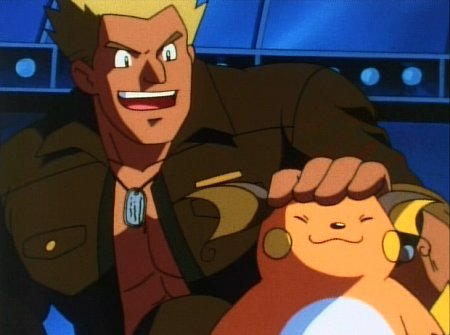
Pikachu can beat Lt. Surge. But if you want to be sure, you can catch a Diglett at Diglett’s Cave. I kinda feel bad for Lt. Surge. A pokemon that can beat his gym with ease can be obtained in mass quantities just outside of town. You might even be able to find and catch the evolved form, Dugtrio, instead. It’ll be able to carry it’s weight through most of the game, so it’s a nice catch. It’s mainly for getting you Lt. Surge’s gym badge with ease. You can also get his autograph, while you’re at it.

I like Surge’s taste in pokemon, by the way.
raichu_sketch006a

The other three pokemon on your team is really a matter of personal preference. There are no HMs in this game to worry about, so you can add some favorites to your team or try a pokemon you might not have considered.

142Aerodactyl.png

The main reason to add Aerodactyl to your team is so you’ll have a pokemon to help you fly in the sky in the post-game. Charizard or Dragonite can also do the job, but Aerodactyl is the easiest to come by (just take the fossil from Pewter City to the research facility on Cinnabar Island).

026Raichu.png

It’s hard to disagree with having a Raichu following you around, and this game really brings out its cuteness. If you’d like, you can trade a Kantonian Raichu for an Alolan Raichu in Saffron City and give that one a try. It might be hard to trade a Raichu away, but you’d be getting a Raichu in return.

I’m having a hard time thinking of a sixth pokemon for a playthrough of Let’s Go Pikachu. Pikachu can get you through the game. Arcanine looks awesome, and riding it around is fun, so give that one a try if you feel inclined.

One might ask whether there’s a pokemon that can be brought in from Pokemon Go to make the game easier. Mewtwo, maybe? Pokemon Go Park is available late in the game (Fushia City), and the pokemon you get from it aren’t very high leveled and wouldn’t really break the game in the same way that the partner Pikachu has been up until that point.

If you have the Pokeball Plus accessory, you’re in for a really easy game (more so than it was already). If you put a pokemon in it at the start of the game and take it for a long real-life walk, it’s likely to gain piles of levels when the pokemon returns from the stroll (it doesn’t actually leave the game). You can use this to make the partner Pikachu even stronger than it has to be. The partner pokemon is actually the default option. If the event Mew is still available to you and you go for that, you can have a level 1 Mew early on. But it won’t remain level 1 for very long if you return it to the ball and take it for a decent walk.

151Mew.png

Mew has high base stats across the board, and can learn any TM in the game. You’re free to ponder the implications of that.

So there you have it, now you know how to beat one of the easiest games on the market. If you somehow found a way to lose a battle against an in-game opponent, please let me know how you did it in the comments below.

I actually lost my first attempt against Raichu Master Charlotte. The master trainers don’t mess around.

Stop complaining about learning math.

One of the most annoying things that I hear in an academic setting is someone asking a math teacher “when am I going to use this in life?”

It’s even worse when the math teacher doesn’t seem to have an answer for them, or they don’t seem to want to answer. The teacher has a perfect opportunity to explain their efficacy to society and at the same time smash one of the stupidest and most persistent questions in the history of academia by answering it with a set of well-made observations, but they don’t take it. It’s a tragedy.

The reason people ask this question is because they’re not in the mood for something that doesn’t give them an immediate dopamine rush, and they feel justified in dismissing something abstract, the application of which isn’t immediately evident to them. They’ll happily play complex JRPGs on their phones wherein they manipulate multipliers to give a statistical advantage, but when it comes to learning basic algebra, it suddenly becomes a chore. Then, afterwards, they’ll brag to one another about how bad they are at math because for some reason that’s something that they’re proud of.

You don’t learn math in school because someone is going to make you use it in your theoretical job, you use it to prove that you’re not an ignoramus. As a potential employer sees it, if a person is good at math, they are good at following procedures and solving problems, which is pretty much what math is. As hiring managers see it, if one applicant knows integral calculus and the other is a D student that barely passed high school algebra, and they’re both asking for the same pay, he’ll pick the one that’s not a doofus, even if the job doesn’t require the use of calculus.

The fact is, knowing more advanced math makes you more competitive.

When a person asks when they’re going to use the math that they’re learning, what they’re demonstrating is that they don’t have much insight as to how competitive they’ll have to be in a job market where having a college degree doesn’t guarantee one a well-paying job shortly after graduation.

People who think that math is boring simply don’t know about the history of math. You may have heard about the Pythagorean Theorem, it’s the geometric formula that goes something like this:

a2 + b2 = c2

The Pythagoreans were a gnostic cult, which means that they believed that there was an advantage to be had in keeping certain information secret. If the Pythagoreans had it their way, they’d have kept the formula to themselves. They actually killed someone after one of their members leaked the formula to someone who wasn’t in their sect. Knowing this, it’s kind of hard to want to credit the Pythagoreans with this formula, as they would have left us to try to figure it out on our own.

So yeah, someone actually died over this. And now a bunch of disinterested kids are doing what they can to get out of learning it because they think it’s boring and they don’t comprehend how being better at math can make them more money in just a few years.

People say that they like science and technology because they want people to think that they’re smart, but when it comes to learning the math that scientists, engineers, coders and technicians must learn, they’re suddenly reduced to being mere hapless witnesses staring at the dry-erase board in the front of the classroom with glazed-over expressions.

If you think you’re so smart, prove it, and learn some math.

The Agony of Paper Towel Dispensers

This might seem at first blush to be yet another E/N post about something that doesn’t really make a difference. But when you’re in a public restroom, when the stakes are high over sanitary conditions, it matters more that paper towel dispensers work properly.

For some reason, it seems like I’m the only one for whom these dispensers will work. The ones I’m talking about look something like this:

2493_mechanical-towel-dispenser.jpg

You see it, right? It says right on these machines that you’re supposed to pull down on the paper towel with both hands. When done right, the next one loads, and that’s one less surface in an unsanitary restroom that we have to come into contact with. But hold on, the one in the picture uses an illustration instead of words. So, there’s even less of an excuse to mess this up.

Yet, people still do. Oftentimes, some meathead will go in, do his business, then after washing his hands he’ll yank down on the towel with one wet hand, tearing away at the towel, and leaving the next guy with the onus to turning the knob to get the next towel to dispense.

We don’t want to turn the knob. It’s usually a moist germ farm which, upon contact with it, would necessitate washing one’s hands again.

Why even install mechanical paper towel dispensers in the first place? Why is so much mechanical complexity even necessary for something as simple as providing paper towels? You know what would be a lot more efficient? Just leaving a stack of paper towels on a shelf. It would be a snap to just take one, and it would be much easier for the janitorial staff to replace them. Sometimes, the best solution to a problem is the easiest one.

And no, I don’t want to dry my hands with those blow driers. You know which ones I mean, they’re the ones where you hit the button with your elbow to get it to run for a few seconds. They also have the motion activated driers, but you’d have to nearly touch your hand to the machine to get them to work. Then you’d have to rub your hands beneath them for about a minute-and-a-half, then maybe they’ll get dry, but not likely from the air supplied from the machine itself, but from the friction of rubbing your hands together.

The makers of those blow driers must know that they’re junk, because they went an made an “improved” version: the jet drier. Those ones blast your hands so hard that you can see an indentation from the air blowing from the machine as you put your hand under it. Is all that force really necessary? I don’t want to get stretch marks just from drying my hands.

If it’s really worth getting your hands dry, then sometimes it’s worth sacrificing a few trees. I know that the pretext is saving the environment, but when I’m in a public restroom and my hands are wet, it’s paper towels that get the job done right.

I know I’ve been doing a lot of complaining lately, so I think it’s about time I present a solution: to spread those paper towels around. It goes like this: If you see a public restroom that uses garbage mechanical dispensers or those smug air driers, make note of it. Then, next time you visit the establishment, take some paper towels with you and set them out. It might be somewhat inconvenient, but you’d be making public restrooms slightly more bearable for the rest of us.

“Good morning” is your opinion of the morning.

When it comes to greetings, “good morning” is among the worst. To understand why, you’d have to do as I often do: analyze things more than necessary.

For one thing, it doesn’t wish well to the recipient. It hardly even acknowledges their existence outside of the very fact that the statement was directed towards them. What it does acknowledge is the time of day, and the speaker’s opinion of it.

What makes it potentially insensitive is that “good morning” doesn’t even consider the opinion of the hearer. How would you know that that person’s morning was good? What if it wasn’t? What if that person had to rush their daughter to the emergency room in the middle of the night, and after a couple suspenseful hours, discovered that she had cancer? Is it a very “good morning” for him?

Sometimes, mornings suck. Not every morning is great for everyone. I know what someone might say in response: “But I wanted them to feel appreciated, like someone is happy to see them. Is it wrong to make someone know that someone really cares about them?” If that’s what you mean to say, then say that. The main deterrent to doing so would be that it would take more words than a banal acknowledgement of the time of day. Sometimes, something that’s worth doing takes effort. Do you actually care?

Stop abusing communication with ritualistic blurbs. If you have an intent, learn to properly express it.

Sometimes, you’ll see someone at work that makes a point of saying “good morning” to whoever they deign to. There’s someone like that where I work, and he said “good morning” to me. Out of legitimate concern? No, to fish for reciprocation, because when he didn’t hear me say “good morning” right back, he started mumbling something while trudging off. To give you an idea of the kind of self-centeredness that would take, there have been god-emperors that have not felt entitled to an obligatory salutation.

By the way, when someone says “good morning” to me, I usually say “good morning” right back. Sometimes, when you respond in kind, that’s just what it takes for someone else to realize how silly they sound, and they know to feel embarrassed.

I know I sound like I’m making a big deal out of something that really isn’t one, but there was something that happened recently that got my gears grinding. One time, when it was early in the morning, I was approaching a gas station to use their restroom. As I did so, someone sitting outside spoke a loud “GOOD MORNING” at me. I suspected that she worked for the gas station, so I didn’t pay it much mind. After entering, the man behind the counter also directed a loud “GOOD MORNING” at me.

At that point, I suspected that it was made a company policy to direct insincere greetings at random strangers, and for a moment, I pondered just how glad I was that my job didn’t have me work with the general public.

But then, I tried opening the restroom door, but it was locked. There was a sign on the door saying that it was locked early in the morning for some reason.

What gives? They wish me a “good morning” with all the false enthusiasm that they can fake, but they don’t care enough about my health and well being to leave the restroom open for me? If you won’t extend to me the courtesy of using your facilities to relieve a sore bladder, then why should I care what your opinion of the morning is?

At that point, I actually considered going out back to take a leak there, but that idea was quickly decided against when I discovered a police car stationed in a nearby vacant lot, in line of sight of the back of the gas station. So, they keep the restroom locked, and an officer is ready to swoop down on anyone who would go out back? Seems like entrapment to me.

I really don’t know why so many people like telling me that the morning is to their liking. But they are welcome to their opinions, even if an opinion that is overly general and not even grammatically proper. The correct way to express the opinion would be “It is a good morning.” Upon saying this, the listener would be put in a position to ponder just what informs the speakers opinion as to what makes a morning good. Perhaps they think it’s a good morning because they don’t like rain, and it’s not raining. But, agriculturally speaking, rain is necessary and therefore good to have. A farmer might have preferred to have more rain, so their land would be more profitable. Not everyone has the same opinion.

One could say the same thing about “good afternoon” and “good evening”. It’s the same half-hearted ritualistic greeting, just different times of day. For some reason, mornings are easier to pick on. I suspect that that’s because there’s a caffeine deficit to tend to.

Just for kicks, here is a list of things that can make my morning better:

  • Having my coffee, eggs, and toast prepared. Especially coffee.
  • My second mug of coffee.
  • Video games.
  • More coffee.
  • (redacted)
  • Another cup of coffee.
  • Catching something rare in Pokemon Go.
  • Another cup of coffee at around noon.

These would improve my view of a particular morning. Not that I’d feel obligated to share an unsolicited opinion of it. I certainly wouldn’t expect random people walking down the street to care what that opinion would be.

An image to describe 2018

The year 2018 wasn’t all bad. It’s too bad that the misinformation media is stuck on Stormy Daniels, long after she issued a confession back in January saying that the affair with Trump never happened. But hey, why would the progressive news outlets let something like facts stand in the way of their ratings trips?

If you’re one of the few people who still bother with the corporate information media, then this image describes 2018 for you pretty well:

stormy daniels with unibrow.png

If you’re in the corporate media, you probably don’t read this blog, or anything that doesn’t conform to your worldview. But to the media outlet people reading this, please understand: The American public doesn’t really care about Stormy Daniels. The culture of yes-men and occupy-whatever demonstrators that you’ve surrounded yourselves with might tell you otherwise, but the American public at large, those of us who live on the surface, go to work, and live paycheck-to-paycheck, don’t care about Stormy Daniels. We don’t. It’s time to move on. It has been, for a very long time.

We’ll see what 2019 brings, but I suspect that it will be the “current year” yet again.

Why Raichu?

raichu smile.png

Raichu has long been my favorite pokemon. People who have known me long enough usually figure it out. I’ve even been asked the question, “Why Raichu?” I think it’s about time I answer that question.

I’ve also had it asked of me whether Raichu would still have become my favorite pokemon if Pikachu weren’t the Pokemon series’ mascot. Would I have noticed a pokemon like Raichu if it didn’t receive so much reflected attention from Pikachu? I don’t know, it’s hard to say. But we don’t live in that timeline, so we really don’t have to give it much thought.

Raichu is appealing on so many levels. It’s both cute and tough at the same time, which is something that’s very difficult to pull off. It’s a very aesthetically-pleasing pokemon.

When I first saw Raichu, it was in the episode of the Pokemon anime, “Thunder Shock Showdown”. That episode introduced Raichu as the prime pokemon of the gym leader, Lt. Surge. Being Pikachu’s evolved form, Raichu had a clear statistical advantage that would make it a challenge. Eventually, Ash’s Pikachu did defeat Raichu, providing an explanation for the victory that was satisfying and at the same time had some truth to it from a game mechanics perspective. It was the first gym badge that Ash truly earned, without question.

raichu_sketch006a.jpg

The episode made Raichu out to be a formidable opponent, a challenge that would be difficult to overcome. Which is why it was a change of pace when we saw another Raichu in a future episode which was friendly with Pikachu. It was an early example of how different pokemon of the same species can have a different personality.

What Raichu represents is a kind of realization of one’s potential, a coming-of-age where a person becomes what they would develop into. While some get romantic about the world we live in, the fact is, we have to develop strength in order to soldier on. Those who choose to flounder about, content with what they’ve achieved so far, tend to be left behind. A desire to realize their potential is one of the reasons why children look forward to the day that they’ve grown up.

Having said that, there is a metaphor for a careful upbringing in that a Pikachu can learn some speed-based moves by level that a Raichu that was evolved too soon would not have access to.

It’s the tendency of people to look at the past through rose-colored glasses. We tend to remember our own childhoods as idyllic, even if they might have been every bit the struggle for survival that our adulthoods may be. We remember clean environments and being under the care of our parents, and we felt loved. But the fact is, we live in a world that acquiesces to decay, and when we move outside of the shelter of our parent’s care, we take up the battles that they’ve been fighting, and we must continue to develop strength, as time will continue to move forward, whether or not we make the effort to keep up.

The Pokemon anime shows us how some of Ash’s pokemon prefer not to evolve, which was an apparent decision by the show’s writers to maintain the appeal of those pokemon at their lowest stage of growth. In the show, this is acceptable, because it’s only intended for entertainment, and in entertainment, it’s okay for the characters to maintain consistency in such a manner. But, in reality, stagnation is often rewarded with failure.

1484032488-3214bb8e28a979d1e3e0fe9b6cab30f5.jpg

Having attended the Pokemon TCG League a while back, I’ve made a few friends. They were some great people, and they were a blast to play with. But I do remember that one of them in particular continued to live with his parents into his late twenties. While he had a responsibility to make a better attempt to live up to his potential, his parents were enablers who were more interested in seeing him remain so that they may continue to have a child at home. Though I encouraged him to come out of his comfort zone, he wasn’t interested in living up to his potential, and his parents preferred that he didn’t. He preferred to remain a Meowth long past the point that it would have been far more practical to become a Persian.

Some might see evolving a Pikachu into a Raichu with a connotation of corruption, seeing it as an induction of change into something that loses its popular appeal and may even be more brutish and inelegant. I disagree. In a sense, it’s like the realization of maturity. Part of what it means to be a trainer is to bring out your pokemon’s potential.

While there is more to like about Raichu, I think that’s sufficient to share for now. Strength, coolness, cuteness, and a connotation of realized potential are what makes Raichu a standout pokemon to me.

By the way, in case anyone is thinking of asking, yes, Alolan Raichu also counts as a Raichu. Because it is one!

raichu pancakes.GIFPancakes!

Pokemon Let’s Go Pikachu! and Pokemon Let’s Go Eevee! might already be available in your part of the world by the time you read this. Is there a generation one pokemon with meaning to you?

Smoking is stupid.

There are a lot of smells that I hate. One of them is cheap laundry detergent. They add abrasive smells to them to make people think they are making their clothes cleaner, to the point that they’re so strong that they slap people in the face. Then people start wondering why they start breaking out, and there’s suddenly this epidemic of chemical sensitivity that leads to the purchase of “free and clear” products without the eye-watering smells.

476416.jpgThe kind of thing you should have gotten to begin with.

You might not actually have “sensitive skin”, it might be that your body has had enough with the cheap-o laundry detergents, and it’s trying to tell you to stop.

Another smell that I detest is most perfumes. I don’t know where women got the idea that wearing perfume made them more attractive. They didn’t get that idea from me. The problem is marketing, which is behind a lot of stupid purchases. To make matters worse, people get used to the smell and think they need to use more for the same effect, while the rest of us are overwhelmed by their eye-watering stink.

I know I said “most” perfumes, because some aren’t that bad. But that’s not intended as an escape clause so you can still wear your perfume on the chance that you’re not wearing the kind of trash that men actually have a problem with. If you want to smell clean, take a shower and stop covering up whatever smell you’re trying to hide.

What was it I was going to write about? Oh yeah, smoking.

Smoking is stupid, and people need to stop doing it. Even people who smoke say that they want to stop doing it, but they find it hard because they have an addiction. The fact is, nearly everyone recognizes smoking as addictive to begin with, with labels on the packaging itself serving as warning. If the packaging on the product that you consume contains a warning from the Surgeon General telling you that it can kill you dead, then maybe you shouldn’t have consumed it to begin with. But people are so short-sighted that something so obvious didn’t serve as enough of a deterrent.

People talk of addiction as a disease, now. Except that it isn’t, and those with addiction can stop using this victimhood platitude. Real diseases don’t require constant purchases in order to be maintained. If anything, they usually lead to the purchase of products in attempts to cure them, or at least alleviate their symptoms.

If you want to stop smoking cigarettes, just stop buying them.

I know how addiction goes, it makes you really want to do something. I know that some might be thinking, “That’s easy for you, because you’re not addicted to cigarettes.” The reason why I can put it into practice is because I have self control. Here’s the thing: you can decide not to do something, even if you really want to do it, and it’s better for your character if you realize that your self-control benefits you or society as a whole.

There are so many deterrents when it comes to smoking, but there are also many incentives to not smoking, like having more money. The median price of a pack of a certain brand of cigarettes including tax by state is around $7 (source), which was a lot more than I expected. If a person smokes a pack a day, they are flushing $49 a week down the toilet, or $210 a month.

I don’t know about you, but I wouldn’t mind taking home $49 more a week in pay. With that kind of money, a person could buy a brand new video game every ten days. It would also help if you want something to eat besides macaroni and cheese.

I wouldn’t care so much about whether other people smoke if it weren’t for the smell that came from them when they did it. But their problems become everyone else’s, and complaining about it on some web page is a more pro-active solution than just “dealing with it”.

Speaking of, it’s ironic that when someone says “deal with it”, what they mean is just the opposite, which is more like “just shut up and take it”. I’m not going to just take it, because when I recognize a problem, I do something about it. And when that problem is you, you’re close to wishing you were someone else.

Smokers “deal with it” by going outside to smoke, because they know that no one else likes the way they smell, and they are being considerate of other people. Just kidding, they go outside because it’s a rule, and they don’t want to be punished for breaking it. Most restaurants don’t have smoking sections anymore, because they weren’t enough of a solution for the rest of us. So, outside with them. But when they go outside, they position themselves right by the door, so the wind blows their smell inside. Where there’s a way to defeat the intent of the rules that are in place, people can be counted on to find a way to do so.

Worse yet, the smell clings to just about everything that smokers go near, ruining the smell of clothing and even the upholstery of your car. It would be nice to go home to get away from it, but that’s hardly likely if you live in an apartment building, because when you open the windows to let in some fresh air (actual fresh air, not just spraying canned smells), there’s a chance that someone is smoking just outside, and it blows right in.

Because natural selection isn’t acting quickly enough on smokers, tobacco companies add various deadly chemicals to their products, because apparently tobacco companies don’t like smokers, either. Here are a list of a few common additives:

  • Acetone – An industrial cleaning agent
  • Ammonia – a household cleaning agent
  • Arsenic – a poison found in pest control products
  • Carbon Monoxide – an odorless toxic chemical
  • Lead – a toxic metal that causes neurological damage
  • Naphthalene – a toxin used in pest control products
  • Nicotine – an addictive additive conductive to growth of tumors
  • Tar – used to pave roads

This is the point where you realize that trying to get someone to quit smoking is like trying to convince them that huffing arsenic is a bad idea. It’s obvious to most of us why it’s a terrible idea with no benefits to speak of, but you’ll occasionally come across someone who will hear it and, taking another puff, would say “Yeah, so?”

In that case, what you’re up against is the sheer force of stupid. I encounter it frequently. Stupid drives with less care in the rain instead of more, views lottery tickets as an investment, thinks RAM is something you can download, makes financial decisions based on daily horoscopes, and pays to use YouTube. And stupid smokes.

Smoking is stupid.

The False Narrative of Electronics Technology

I’ve attended a 2-year trade school majoring in Electronics Engineering Technology. It’s been a couple years since I’ve graduated with honors, and even though it pains me somewhat to write this, I feel as though it might benefit someone if they are considering majoring in the same thing:

I feel as though I’ve been sold a false narrative concerning Electronics Technology.

There is a noticeably wide disparity between what students majoring in the subject expect in terms of earning potential and the reality that awaits them after they’ve walked across the stage.

I admit that I’ve read about it somewhere online, but largely chalked it up to someone making some poor choices with their degree. But after having had experience with several employers, the disappointing wages that I’ve seen discussed seem consistent with what I’ve seen out in the field.

First, the expectation. I know that a lot of people see the word “engineering” in the title of the program and assume that the degree prepares the student for a career in electrical engineering, wherein it’s not unusual to make around $90,000 a year right out of college, possibly even more. That’s some buy-a-car-and-own-a-home money, right there. Of course, it’s reasonable to be skeptical that someone would rake in that kind of dough right after graduating with a 2-year degree; Electrical Engineering is far more challenging and is a 4-year degree (that’s not unusual to take 5 to 6 years to finish).

A more realistic expectation would be to have the understanding that Electronics Technology prepares one to work as an Electronics Technician, and for how difficult the coursework is, one might expect to make something like $50,000 a year right out of school.

Was that what you were expecting? Here comes the disappointment: the typical hourly rate for an Electronics Technician is from $16 to $20 per hour.

That’s it. Around $34,000 a year. I know someone who makes that kind of money as an automotive technician, and he doesn’t even have a college degree.

That’s a disappointing amount of money considering the kind of hard work it takes to get a degree in EET. While most people are put off by the more complex math and only take the algebra courses needed to graduate high school, Electronics Technology has you learning whole new numbering systems. While most people are happy just to have a computer with a high clock speed, Electronics Technology has you learning about computing architecture and networking. Are you ready to learn about the alpha and beta ratings of transistors (and then not likely use this information in your job)? The trigonometry course that’s required isn’t like high school trig; on the college level, it’s a whole new ball game. I even went beyond and took a calculus course. From what I can tell, even engineers rarely have to use derivatives and integrals.

And for what? To make just a few dollars more than a new hire at an upscale gas station? Even now, I’m barely getting by in an apartment, and currently don’t have a car. I didn’t just get a super-hard degree, I did so with honors. Something seems wrong, here.

I’ll give you an idea of just how hard it is to be an EET major. There are majors in the college that graduate about 25 out of the 25 students that enroll in them as freshmen. Other majors seem to do well at retaining their students. For EET, it’s different. It’s not unusual for freshmen to drop like flies in the first month of the first semester. It’s likely that only around half of freshmen make it to the second semester. They often fail out due to poor grades, or withdraw because it turned out much harder than they imagined.

If you’re curious, those that stick around often make fun of those who don’t make it. Even those who withdraw within a month of the first semester are joked about as far in as year two.

It seems that only about a third of freshmen make it as far as the second year. Those that do usually make it to graduation. It’s not that the coursework is any easier, but those who make it to second year demonstrate the diligence necessary to see it through to the end.

Their reward? They become qualified to make 16 Snickers bars an hour at some place that can fire them for forgetting to plug in their static strap. Of course, they’re being taxed, so they’d be taking home less than that.

I know that the market decides the value of one’s skills, which is a highly nuanced topic, but how is it that something that’s so hard to become qualified to do pay so little money?

Don’t get me wrong, I do like my job. Still, there’s something disappointing about getting into a sort of “smart-guy” field and getting really good at it only to discover that there’s not as much money in it as you thought. There’s a false narrative surrounding Electronics Technology, which one would expect a school’s guidance counselors to feed into, but is self-enforcing by the expectation that if something is really hard to do, the outcome of accomplishing it must be much more desirable. One lesson that one can learn from this is that a more difficult path doesn’t necessarily mean the rewards are greater.

Knowing this, would you still major in Electronics Engineering Technology?

What’s In a Thinking Man’s Bug-Out Bag?

I’ve learned about bug-out bags a few years ago, and I took interest in them because they appealed to a sense of survivalism and emergency preparedness. Since then, I’ve had time to think about the kind of things that would be best for a bug-out bag.

But then I got to thinking: What kind of emergency would a person be most likely to face? If one were to consider most bug-out bag configurations that are easy to find on survivalist websites, it would seem like people have an unrealistically high expectation of having to go on an emergency camp out, or be on the run from law enforcement.

Think about it: If law enforcement decided to come after you, how would you be able to determine this before the moment that they show up on your doorstep to make an arrest? How would the intent to come after you be telegraphed if the most practical course of action they could take is to ensure that you’d have the least amount of warning to escape with a few things to spend a few days in the woods? And considering how persistent they can be, in the event that you escape through a window or something, you’d be buying yourself a few days at best (assuming that they don’t anticipate that you’d pull such a thing and station someone in your back yard).

So, it doesn’t seem like there’s much point to entertaining a paranoid fantasy of a life on the run. Here’s a cool idea: if what you’re doing is highly illegal and can get you into loads of trouble, you’re probably better off not doing it.

A more realistic thing to prepare a bug-out bag for is a disaster of some kind. This can be something like an earthquake, flood, or fire. Or perhaps you’d benefit from having one around in the event that you have a falling-out with someone you’re staying with. Stuff happens.

If such an emergency were to come up, where would you be most likely to go? Into the woods for a while where you cook some wild animals and eat some berries? Not likely. The place you’d be most likely to go would be a friend’s or relative’s house, provided they have room for you.

That being the case, the kind of bug-out bag that you’d be more likely to actually get a use out of would be one that’s filled with some supplies for short-term living at someone else’s place. With this in mind, I’ve assembled a short list of items that are generally a good idea to keep in a realistic bug-out bag, which can be called The Thinking Man’s Bug-Out Bag.

Suggested items for The Thinking Man’s Bug-Out Bag include:

  • A change of clothes

Or two, if you can find room for it. If all you have to wear is what’s on you, things can get kind-of awkward on laundry day. And laundry day might end up happening kind-of often.

  • Several day’s supply of socks and underwear

Having just a few day’s supply of clothes will be easier to stretch when you can at least change your undergarments. That might not sound ideal, but remember, you’d be making do with a little you brought with you in response to an emergency.

  • Some bedding

Comforters and pillows might take up a bit much room in your bag, but getting some sheets in there should be easy.

  • An extra charger for your phone

Your host probably doesn’t have the kind of charger you’d need for your phone, so it’s not a bad idea to keep an extra in your bag.

  • Some cash and quarters

This might be the most versatile thing you can keep in your bag, as there might be a situation that comes up in which you’d think “It’d be nice if I had…” With some cash in your bag, you’d be able to buy it. Whatever amount of money you decide to keep in your bag, it helps to keep it in denominations that are reasonable, as some stores don’t accept one-hundred-dollar bills. Quarters can come in handy if you’re in a place where the laundry is done in a laundromat.

  • Toothpaste and toothbrush

Where you go might not have an extra set of dental hygiene products.

  • Body wash, trial size

When we’re talking about limited space, it’s a good idea to consider versatility. Body wash can be used as soap, and can be used to wash hair. If you can find it in a trial or travel size, that would make it even better for your bug-out bag. Some stores have a section for travel-size items, so it might be a good idea to add some of those to your kit, as well.

  • Bottled water

It might take a little time for you to get where you’re going. It wouldn’t do for you to get dehydrated on the way there.

  • A little shelf-stable food

It wouldn’t do to starve, either. What you add is your choice, but mind the expiration dates. Also, be sure that the food is either ready to eat or you have the means in your bag to immediately open, prepare, and consume it. To pack canned food but no can opener would be self-defeating. If you need a dish or utensils and don’t bring them, eating your food might be a challenge. But something requiring no preparation like granola bars would usually do just fine. Beef jerky is also a great choice.

  • A notebook and writing utensil

If you’re in an emergency situation or getting situated in new surroundings, you’ll likely have a lot of information to take down. If you have what you need to write down things like addresses, appointments, and contact information, you’d be well-off. You’d also be glad that you packed it if you happen to like sketching or journal-keeping.

  • A replacement laptop and charger

In the event of a fire, you probably won’t have time to get your expensive gaming rig out the door. Wherever you end up going, it’s likely to have wi-fi and you’d probably benefit from using it. A laptop would be great if you stay wherever you end up going long-term. If your laptop has important files such as a copy of your resume, you’d be pretty well-prepared. If a laptop seems a little expensive to add to your emergency kit, or you’re running out of room, you can at least keep a flash drive with some important files in there.

  • A mini First Aid kit

Emergency situations are usually highly-dangerous, so it’s not a bad idea to have the means on hand to tend to minor scrapes and bruises.

  • Rain gear

It might be raining when disaster strikes. Having a poncho or umbrella in your bag can keep you and your emergency kit dry.

This bug-out bag should be easy for the average person to assemble, because it consists of items that people usually have around the house, and it’s relatively easy for a person to head to a store and pick up a few items to complete it. This is the kind of bug-out bag that people would benefit most from having, as it concerns the most realistic emergency scenarios that a person can face.

Is there anything you’d add to this bug-out bag?

Let’s be honest about millennials.

For a while now, it seems as though the millennial generation has been the butt of many jokes, even among social commenters who fall into the millennial category. You’ve likely heard a few of these jokes yourself; that they are entitled or want a gold star just for participating.

However, I’ve yet to actually meet in person someone from the millennial generation who lives up to the stereotypes that surround them. To put this in perspective, I’ve recently graduated from college, where I was surrounded by millennials that had ample opportunity to live up to the stereotypes in question. The fact that the school I attended was a two-year trade school may have been a factor, but it remains that I didn’t meet there even one millennial that lived up to the stereotypes. I know that I’m speaking from my own experience, but I think the sample size was way more than sufficient to say that the stereotypes about millennials were highly over-exaggerated.

I think it’s about time to make some honest observations concerning millennials.

For one thing, the very designation of “millennial” is arbitrary, and not very well-defined. From what I can tell, a person is considered to be a millennial if they’ve been born from sometime in the early 1980’s to early 1990’s. The precise timing is not agreed upon, but that’s the general idea. However, the idea that a person who is born before a precise point in time would have different values than a person who was born after that point in time would ignore the fact that a society’s trends concerning values tends to shift gradually, often in response to slow changes in culture and other conditions, such as economy.

Even though the use of the term “millennial” is vague and can apply to a potentially wide group of people, I’ll continue to use this term in this analysis, as it can still be helpful in making observations concerning generalities.

When millennials are criticized, it’s often by baby-boomers that grew up in different economic conditions, and seem to have the expectation that if an approach similar to what worked for them once-upon-a-time were to be applied today, it would consistently yield identical results. Such a position would be entirely ignorant of the changing conditions of the economic climate, and is in stark denial of the challenges that millennials have to deal with.

For one thing, you’ve probably heard it said that “a college education doesn’t count for as much as it used to.” What baby boomers assume this to mean is that there isn’t much point to pursuing a college education. After all, they were able to get their careers started without the aid of a college degree. But what this really means is that those who choose to forgo a college education stand less of a chance.

Consider how much stricter the educational requirements are to start a successful career. My grandfather was able to get his life together, and he didn’t even need a high school education to do it. My father didn’t obtain a college degree, but he didn’t need one. A person today who is getting started usually requires a college education to get things going, and they’re expected to have one. What’s more, a college degree is no guarantee of success.

If anyone has spent a significant amount of time searching for a job lately, the following might just be a lot to take in. At one point, finding a job was easy. If a person really wanted a job, all they had to do was walk down into town to a few businesses and ask for work. It wasn’t unrealistic for a person to be hired by the end of the day. A person may be expected to present some personal information, but usually not much. A person might have to fill out a job application, but it was okay for them to not be filled out completely if you didn’t have all the information, and mistakes could be easily overlooked.

This was a few decades ago, but this was a pretty accurate description of the conditions that your parents and grandparents had to find work in.

Now, compare it to today. Nowadays, if you walked into a store and asked for an application, you’d get laughed at, because nearly every employer has you apply online. They’ll seldom have a paper application to give you, and if they did, your application might end up in a filing cabinet labelled “Only if the federal government makes us”. They expect you to apply online, and they’ll think you’re weird if you insist on writing on trees.

If you have a felony conviction, it’s pretty much an automatic bar to employment. I know that the applications say otherwise, but that doesn’t mean that the application is telling you the truth. You’re expected to tell the truth on the application, but that doesn’t mean the application will do the same for you. And if you trying leaving a felony conviction off your application, the company is likely to perform a background check, so they’d find out about it and reject your application. This is a one-strike-and-you’re-out system.

Not only that, you’re expected to have a resume. The resume is to be well-formatted and filled with buzz-words that are designed to catch the attention of the automatic filters when submitted electronically. Never heard of those filters? Then most of your online resume submissions were likely never even viewed by human eyes. Online resume submissions can be expected to pass through filters that seek out buzzwords and education credentials to ensure that the people applying for a position are actually qualified, and not just wishful thinkers who pad out their attempts at career changes with “hard working” and “willing to learn”.

I know that they do this from experience. I learned assembly programming in college, which means that I can program in assembly-level language for microcontrollers. Most employers in the field of electronics seem impressed by this. However, after adding this to my resume and uploading it to a couple job search websites, I started to get invited to interviews for the position of “Assembly Worker” at factories. This certainly isn’t the same thing as assembly programming, and I decided to let the recruiters know. I ended up in an email exchange between two recruiters for the same company, and was CCed an email that contained a copy of my resume. The occurrences of the word “assembly” in the resume were highlighted, indicating that they were a hit in their automated searches.

They didn’t read my resume to determine what I could actually do. The only reason they even saw my resume is because of a buzz word that made it through their filter. The sobering truth is, it’s getting to the point that resumes need to be deliberately optimized to game the system to give the applicant the best chance of landing a job.

And if the resume is actually seen by a human being, you’ve only cleared the first hurdle. One general manager at a store I used to work at was fond of telling his employees that there were over 200 applications for every available position.

All this for what? A position that pays either minimum wage or maybe a few dollars above it. That’s America today.

When you consider this, it’s easy to see why so many millennials seem gung-ho about a socialist revolution. They’d be wrong about it, but at least it’s understandable why they feel that way. Your grandfather may be happy to proclaim the benefits of capitalism, but that’s because capitalism actually worked for him, and benefited him well. If you’ve ever wondered why older people value hard work so heavily, it’s because they were brought up in a time when hard work had far move obvious and immediate benefits. In fact, in their day, if a person was able to get any full-time job, they had stability and were considered to be pretty well-off.

This contrasts pretty heavily with today, where two guys working full time might be able to hold down a rented apartment.

Speaking of housing, it’s assumed that millennials aren’t interested in buying houses. This isn’t because they don’t want houses, it’s because houses are pretty difficult for them to attain.

The millennials reading this might be shocked, but at one point, it was reasonable for a person to be able to buy a home. It wasn’t just “maybe a few people could do it”, but “reasonable for most”. And I don’t mean renting it, I actually mean buying it. As in, you own the home, and the land around it.

What changed is the housing market. People bought up properties with the intention of reselling them for a profit. While it’s not hard to blame them for doing this, the process repeated enough times that the prices for homes have gotten very high, well outside the finances of most millennials. Finances are what determines whether someone can buy a home, and we’ve already examined what a horrendous dumpster-fire the American job market is. In summary, the means are reduced, coming by them is more difficult, and homes are more expensive.

This is the kind of environment that millennials have come into. While they may be loathe to admit it, their parents have some blame to take. The parents of millennials have largely accepted fad parenting that is, for some reason, afraid to either discipline or instill realistic expectations in their children.

Many millennials have had parents that have told them that they can be anything that they want to be. Not only that, the frequent coddling and failure to discipline has set these children up to be poorly prepared for the real world. Worse yet, they quickly become depressed and disillusioned when they fail to live up to their parents lofty expectations. It certainly doesn’t help that they’re being incessantly mocked by various pundits and media outlets for failing to gain a foothold in a world with little in the way of opportunities.

The parents of millennials got while the getting was much easier, and seem to believe that their successes are easily repeatable, enabling them to be highly judgemental when the next generation doesn’t perform just as well, overlooking that conditions are much worse.

The responsibility for the upbringing of a child falls squarely on the child’s parents. This is an axiom that has held up throughout history, as it does today. Yet, baby boomers and their parents grew up in the world of rapidly-advancing convenience, and as a result have developed the mentality that many of life’s inconveniences will be alleviated. Tragically, they seemed to have included child-rearing as being among those inconveniences that they’ve left for others to tend to.

As too many people see it, the upbringing of a child can be left to the education system. The education system, on the other hand, saw the upbringing of children as the responsibility of their parents. For a while. Increasingly, the education system has taken the stance that if they’re going to be left to teach children values, the values being taught were going to be their own. This became increasingly tragic as the education system steadily became co-opted by those with left-wing viewpoints, who view traditional values as being “old-fashioned” and tending towards obsolescence.

Eventually, the millennial generation ended up being experimented on by being fed a slurry of ridiculous ideas that are pretty much insane. At the risk of facing academic consequences, students felt an obligation to either comply or keep their mouths shut. To the credit of millennials, more and more of them seem to be coming to recognize these ideas for the madness that they are.

While it’s sad that millennials have developed the way that they have, it’s more surprising still that they’re being relentlessly mocked for developing in the manner that they were brought up, and for failing when the odds are stacked against them. It’s great that many of them are starting to come to, picking up the tatters of their lives and getting things together.

What’s more, there seems to be high hopes for what’s called “gen Z”, the also-poorly-defined generational group that comes after millennials. This largely has to do with the fact that gen Z is apparently more values-oriented than their predecessors, seeing what’s wrong with their approach and deciding to avoid the same mistakes. It’s not necessarily a “values as a counter-culture” deal, either. Gen Z really seems to have an interest in doing better than those before them. In a sense, gen Z also has the odds stacked against them, as they’re actively resisting an establishment that teaches that sexual perversion and gender confusion are normal. But this makes their perseverance all the more commendable.

If we were to take an honest look at millennials, we’d see them as being the victims of a culture that was cultivated by their predecessors. The best thing that they can do is what many of them are coming around to, and that’s to realize that they’ve been led in the wrong direction, recognize that the values that they’ve been ridiculed for were not their own to begin with, and determine to do better going forward.

And if baby boomers start to get too arrogant, just remind them that they were the generation that gave us hippies.