Author Archives: Raizen

Things to Know Before Going to College (Part 2)

This is the second part of a series on things to know before going to college. The first part dealt with some pretty broad topics. This part starts to deal with some more specific matters.

6. Rock that GPA!

Colleges often require that their students maintain a Grade Point Average (GPA) at or above a certain level in order to stay enrolled. Usually, the minimum GPA is something like 2.0. Therefore, the higher your GPA, the better off you are.

What’s more, colleges have a different standard for a passing grade. While high schools generally consider a D- (60%) a passing grade, colleges generally consider a C (72%) a passing grade. A C- would not be a passing grade!

Oftentimes, students start out the semester by taking it relatively easy, thinking that they don’t have to work really hard until later, or that they’ll make up for it later. Don’t fall into that trap!

Instead, the beginning of the semester is an excellent time to put in a lot of effort. This is because semesters usually begin with easier material in classes. This makes it much easier to get As on those assignments and tests earlier on. So go for those easy As and rock that GPA!

There is an added benefit in that the early material in classes is foundational material, an understanding of which would make it easier to succeed later in the semester. All the more reason to go for it early on.

7. Don’t game the system as a “career student”.

While I’ve seen the term “career student” used in different contexts, what I’m referring to here is also called a “perpetual student”. A career student is one who games the system and puts off graduation so they can kick it up as a student for as long as they can get away with it, effectively putting off having to make payments on a massive debt that they accumulate as time goes on.

Their objective is to hang around, eat the food, and not worry about rent. To this end, they usually withdraw from courses as the deadline approaches so they can re-enroll the next year.

These students are despised by pretty much everyone else. The professors don’t like them because they know what they’re doing, students don’t like them because they’re an insult to those of us who are out to better ourselves, and both groups don’t like them because the seat that they’re taking up could instead be used by someone who is serious about what they’re doing.

Eventually, their game catches up to them. In time, they’re going to have to graduate, at which point they’ll have a huge debt to deal with, and they’ll have to explain to curious potential employers why it took them 4 years to earn a 2 year degree.

Don’t let it be you.

8. Textbooks are ridiculously expensive.

There are numerous jokes about how expensive textbooks are. For example, here’s one:

Did you hear about the thief who made off with over $500 in merchandise from the book store? He stole a college textbook and a bottle of water.

Those jokes will seem less hyperbolic once you see the prices on these textbooks. They are ridiculous. And sometimes, I suspect that they are as pricey as they are because students pretty much have to buy them. Goes to show what can happen without a free market.

For my first semester in college, six textbooks were required. The least expensive one went for around $30, while the most expensive went for around $200. Altogether, the bill for books came to around $500. And from what I hear, that’s not even as bad as it gets.

For how expensive these books are, you might think that they are of paramount importance, and that we use them in nearly every class session. Not really. Some of my textbooks were barely opened at all.

As you go to school, it’s a good idea to find out what programs exist to help you afford your textbooks. Some colleges have programs that hook new students up with former students so they can buy the books directly from each other. There are also colleges that offer a program where the books can be rented, or even borrowed at no charge.

Some schools have their textbook in their libraries. Don’t count on them to allow you to continually borrow them to meet class requirements, however. My previous school discouraged this.

One time, someone stole my video games. Not all of them, just the ones they wanted. They could have stolen my textbooks and come away with a pretty penny, but they didn’t touch them, even though my books were the most expensive things I owned at the time. Perhaps the thief wasn’t so much interested in electronic engineering as they were in electronic consumerism.

9. Don’t neglect your health.

College is one place where you want your brain to behave optimally. In people who are physically healthy, the brain tends to have what it needs to work well. Therefore, don’t neglect your health when in college.

Generally, you’re better off making better dietary choices where possible. Not only that, it’s a pretty good idea to stay physically active.

It’s tempting to go for plenty of desserts just because they’re offered by the dining hall, and to load up your plate because they don’t limit your portion sizes. But it’s a good idea to mind what you eat. The dining hall offers fruits and vegetables, so it’s on you to choose to eat them. Also, the dining hall isn’t at fault for offering plenty of pudding, it’s on you to not have too much. Also, eat some meat and dairy products. The human body doesn’t synthesize B vitamins, and they’re not in vegan sources. Your brain needs that, so don’t ignore it.

Eating wrong results in stomachaches and other problems that make it hard to do things like sleep. Functioning optimally is better than being a human dumpster.

Also, go out for a walk from time to time. It’s actually a good study habit, as after about 20 minutes of focused studying, a person retains the information better if they spend about the same amount of time walking about trying to recall what they just studied. Not only will you be in better health, you’ll also be a better student. It’s win-win.

Here’s another story. One time, after a long day, I arrived back on campus, only to find that the dining hall was already closed. So I went to the dormitory lounge rooms and checked under cushions for the change needed to buy some instant ramen. Afterwards, I barely had enough to do it. So I bought it, cooked it in a microwave, and ate it. Afterwards, I felt sick to my stomach. That wasn’t what my body wanted. That night, I still felt hungry as I went to bed, and the dining hall wouldn’t open again until 10:30am the next day.

What did I learn? It’s a good idea to get a stash going that has something besides ramen. Or at least some emergency cash.

10. Don’t forget to bring what you need.

Before you go to college, you might want to make a checklist of things that you’ll need when you’re there. This is especially true if your college is located a substantial distance from home. After all, once you’re there, it might be really hard to procure what you forgot.

Colleges usually have a recommended list of items for students planning on moving into dormitories. If you can find and print out such a list, that makes a good starting point. They usually also mention a list of prohibited items, which can help to know.

Here is a list of items I recommend, based on my experience:

  • Quarters – Find out whether you’ll need these to do laundry. If so, try to bring a lot of them. Those M&Ms Minis tubes are just the right size for storing them. Also, keep to yourself that you have them. Otherwise, you’ll see your collection diminish as people hit you up for them.
  • A calendar – Helps you keep track of due dates and important dates, such as for tests.
  • Laundry detergent and dryer sheets – You’ll likely have to bring your own.
  • A locking filing cabinet – Sometimes, people try to steal stuff.
  • A broom and dustpan – Keeps the dorm tidy.
  • Power strip with surge protector – The few outlets you’re given don’t seem to be enough. Bring a power strip. Or two.
  • Extra blankets – You’ll be glad you have these when it slips the staff’s mind that it gets cold during the weekend, and they forget to turn the heat up.
  • Electric fan – Same principle as the blanket, except for when the weather is warmer.
  • A mug – Coffee? Tea? It helps to have something to drink out of.
  • Index cards – Super helpful for many reasons. They make great bookmarks. You can copy your schedule onto a couple and keep it on you for easy reference. You can also keep one on you to keep track of pending due dates. They can be used as flash cards for studying. It’s surprising how useful these things can be.
  • Some tea or something – because water gets boring.
  • A coat and warm clothes – It might be warm when you move in, but winter will come shortly.
  • Paper towels – Accidents happen. Better safe than sorry.
  • Posters or flags – Covers those boring walls. Besides, anime posters rock.
  • A printer – This might appear on your recommended list anyway, but it’s so important that I decided to include it. You’ll have assignments to print up, so this serves you well. Also, remember to bring a stapler.

There might be more, but this is based on my experience. I left some common sense items off because you probably thought of them anyway, as well as items you’d find on a list of recommendations to begin with.

There’s a lot more to know about before going to college. More to come.

Part 1 of this series
Part 3 of this series
Part 4 of this series

Things to Know Before Going to College (Part 1)

College is a wonderful and daunting experience. There’s nothing quite like the freshman year, when things are new and you’re surrounded by numerous unfamiliar faces. Without some good advice, one can find themselves lost in their new environment.

Because of this, I’ve decided to make a list of things to know before going to college which may be helpful to those going for the first time. This list won’t be in any particular order, and it’ll flit about numerous topics and maintain a broad scope.

1. Be careful who you take advice from.

Before even setting foot on campus, you’ll likely be inundated with advice on college life. Much of the advice conflicts, and not all the advice is good. It can be taxing to consider so much advice at once, but it doesn’t need to be.

One principle that I’ve found helpful in determining the value of advice is to consider the qualification of the person who is offering the advice. This requires knowing something about them, but goes a long way in determining whether their advice is valid.

If a person is a school guidance counselor, their college advice is probably really good. After all, they have a position that makes them close to many college students, and in their experiences, they see what works and what doesn’t. Also, if a person has been to college, they’re likely to have insight that would help someone who hasn’t gone yet.

On the other hand, you might want to be a little leery of advice offered by those who have dropped out of school. After all, they didn’t succeed in making it work out, so whatever advice they have to give can be viewed in the light of how it worked out for them. The same goes for people working low-wage jobs. A college degree is intended to help a person’s career; if that person’s career is in the dumps, they might not have good advice to offer. That’s not to say that they can’t offer helpful college advice, but that’s a lot less likely to be the case when it’s coming from them.

You definitely want to be skeptical of advice offered by someone who doesn’t see the value of a college education and has no idea why anyone would go for such a thing. If they hold such an opinion, what would college success mean to them, whether for themselves or for you?

Not only that, there are a ton of “armchair experts” out there whose expertise with the college experience is limited solely to the fact that they know someone who went. Based on reasoning like theirs, a person can be an expert on Japanese culture because they know someone who speaks Japanese, or a person can be an expert on the Jewish religion because they work with a Jewish person. There’s a lot more to expertise than that.

When taking college advice, consider the qualification of the person giving it. That can help you get through the fog and go in the right direction. What about me? I’ve been to college before, and I’ve graduated, so I’m capable of giving some good advice. But if you’re unsure about some of the things you see in this list, it might be a good idea to bring them up with other people, so you get more insight. Taking helpful advice from one qualified source is good. Taking it from several good sources is even better.

2. Learn campus rules. Even if you don’t, they still apply to you!

When going to a new school, it’s a really good idea to learn the campus rules. I know that sounds like a preachy thing to say, but it’s a good policy on the reasoning that even if you don’t learn campus rules, they still apply to you.

I understand the principle of “just use good common sense” holds up pretty well in most places you go, but the excuse of “I just didn’t know” doesn’t hold up as well as people think. For that reason, it’s a really good idea to find out what the rules are. After all, when you know what the boundaries are, and make an effort to avoid crossing them, you’ll be far less likely to get in trouble.

On campuses, there’s usually a rule that smoking should only be done in designated areas. Are dorms designated areas? They usually aren’t. That’s helpful to know before smoking in a dorm, and it’s considered every student’s responsibility to know. If someone says something like “no one told me that rule”, what they’re saying is that they can’t be a responsible student, especially if it’s posted somewhere what the smoking areas are, and that dormitories are clearly not among them.

Schools also have strict no-weapons policies. So don’t bring those. There are places where it’s not clear whether pepper spray or Swiss Army knives are weapons. Play it safe and don’t bring those, either. For a rather severe example, a freshman at a school I went to once brought a katana with him, and carried it on his person. He apparently wanted to live some kind of Bushido fantasy. It didn’t take long for campus security to catch up with him, and he was quickly expelled. True story.

So yeah, learn what the rules are. If you do, you’ll be less likely to run afoul of them. It might be a good idea to reread them from time to time, like once a year. Play it safe.

3. It makes a difference what you go to school for.

This is a point that’s been made so many times by so many people that it’s difficult to say anything on this point that hasn’t already been said. But it belongs on a list like this, so I thought to include it. The point is, it matters what you go to college for, not just that you go to college.

Think about it: college’s purpose is to start you on your career path, or give it a solid boost. If what you go to school for doesn’t result in a fulfilling career, then you’re better off going to school for something else.

In this regard, English majors usually get picked on. It’s not that English majors don’t find fulfilling careers, but they do have a harder time of it than most other majors. Generally speaking, a person is better off not majoring in an elective, unless that elective is Math.

So, what does one go for? The best majors are usually ones that give a person skills to do a job or certain kind of job. And if the job pays better, that makes it a better choice (after all, there are student loans to repay).

A proper mentality is to think about what you want to do for a living. Would you want to be a doctor? A lawyer? An engineer? A programmer? Or something else? Then, once you’ve decided, you pick a major that does a good job of preparing you to do that. After all, college is intended to prepare you for your future job. If what you’re doing in college doesn’t do that for you, then maybe it’s time for you to rethink your approach.

4. Try to determine whether you may be buying into a false narrative regarding your future career prospects.

That point is a mouthful, but it’s important to think about. And it’s not always that someone is lying to students about job prospects; sometimes a student may be misguided about just what their degree does for them because they didn’t do their own research. Sometimes, people do fool themselves.

For one thing, it’s possible for a person to obtain a college degree without understanding the distinction between an undergraduate or a postgraduate, or between an associate’s degree or a bachelor’s degree, or how they can affect one’s job prospects.

I’ve heard of a student who obtained an associate’s degree in Electronic Engineering Technology who, after having graduated, believed that that made him qualified to be an electrical engineer. He even succeeded in finding a job as one. However, he was quickly overwhelmed with problems that he wasn’t prepared to find the solutions to! But, “Engineering” is in the name of the degree, right? Yeah, but an associate’s in that usually prepares one for industrial electrician jobs or working as electronic technicians in laboratory environments, which isn’t exactly the same.

As with the previous point, it’s better to know what you want to do, then determine the major that helps you achieve it. To understand what you want to go to school for and how it affects your career aspects are two points that are very closely related, so I put them on this list back-to-back.

5. Having a degree still makes a difference.

There are too many anecdotal stories out there that try to make the case that a college degree doesn’t make the difference it used to. As these stories are passed on, they have the effect of discouraging younger people from living up to their potential.

In reality, a college degree matters more than it ever has. It makes the difference between having a job that you’d love waking up in the morning to do, and barely getting by with a grocery, retail, or restaurant job wondering whether you’ll ever be promoted to management.

Not only that, a college degree makes a huge difference in one’s earning potential, even considering the increasing expense of student loans. Think about it, what seems like a better deal:

  • Making $50,000+ a year (results vary, do your research), with a debt that one can pay off in only about 10 years, or
  • Making $18,000 a year, possibly for life.

Your student loans go to an investment, not just an expense. While it’s true that student expenses are getting pretty crazy, it’s still a better choice than being broke your whole life.

Contributing to the problem are the stories thrown around, such as that Bill Gates became successful without a degree. Pointing to outliers only demonstrates that there are rare exceptions, and people who buy into them are apparently banking on becoming a rare exception, and in so doing making a terrible gambit.

It may be true that your granddad got by without a high school education, but he grew up in a time when high school educations weren’t needed to get a decent job. It may be true that your dad didn’t get a college education, but he was a child of a different time. Today, the job market is far more competitive than it ever has been, and if a person wants to afford a house, a car, and a family, that usually takes a job that requires a college degree.

You might have heard it said that a college degree doesn’t mean as much as it used to, but the fact is, it’s more important to have than it ever has been!

This is getting to be a bit lengthy, and there’s still a lot more ground to cover. So this is going to be the first of several parts. More to come.

Part 2 of this series
Part 3 of this series
Part 4 of this series
If you can’t identify the real problem, don’t expect a real solution.

love complex

I’ve decided to provide a critical analysis of an article titled “Conservatives will not stop pushing the ‘Pence rule’ as a solution to sexual harassment”. If you want to, you can read the article for yourself. This article mainly picks at the parts that I most feel like arguing against. The article may be a few months old, but that doesn’t mean I can’t still critique it.

For one thing, the title of the article is missing the last word, which, if inserted, would make it closer to correct. If the word “claims” were added to the end, it would come far closer to the heart of the matter.

The author Casey Quinlan opens her article with the following frilly statement:

As stories of powerful men masturbating in front of women, forcibly kissing and groping women, and forcing teenage girls’ heads into their crotch have gained national attention, it’s sparked widespread conversation about how to prevent sexual harassment and assault.

This opening paragraph is almost graphic enough to be a porno. It’s obvious that she’s trying to invoke some pretty strong feelings here. And what better way to spark productive conversation than to drive your audience into an emotional frenzy?

The solution seems obvious: The best way to prevent sexual harassment and sexual assault of women and girls is for men not to sexually harass and assault women and girls.

Because we’re not naive, we all know that telling someone not to do something is no guarantee that they won’t do it. After all, telling someone not to murder isn’t stopping murders from occurring. Therefore, the best we can do is criminalize the undesirable behavior and enforce the law when someone steps out of line.

And I do have some good news for you from the current year! Sexual harassment is already illegal! That means that all we need to do is enforce the law when we determine it may have been broken, and mete out punishments when (and only when) a court of law has determined guilt. Yay, progress!

But wait, there’s more. I’m going to let you in on a little secret: Laws against sexual harassment were written, passed, and enforced primarily by men. If there really were some patriarchy that was out to get women (as many feminists claim), this would not have occurred. Looks like men aren’t your enemies, after all.

But conservatives appear to be less interested in finding ways to teach men how to co-exist with women, who comprise 47 percent of the U.S. labor force, than discussing how best to avoid women altogether.

In particular, conservative writers are increasingly focused on the “Mike Pence rule,” pointing out that Vice President Mike Pence does not eat dinner alone with women who are not his wife and does not go to events where alcohol is being served when his wife is not present. Pence first revealed this detail in a Washington Post article published in March.

Now, this is the heart of the matter right here: That men are starting to avoid women like Casey Quinlan, and they feel as though they are being punished. Not only that, more men are adopting the Mike Pence rule, which was obviously designed so that there’d be a witness in the event that yet another obvious false accusation arises, the likes of which we’ve been seeing on the news on a near-daily basis.

In a sense, the Mike Pence rule is a lot like the “stranger danger” that many of us were taught about as children. It’s a terrible thing to teach a child in any case, as it conditions children to distrust people they don’t know, they’ll lose the desire to meet new people, and their interpersonal skills suffer in the long run. And the type of people it was intended to protect them from are actually very rare. Yet, like “stranger danger”, the Mike Pence rule came to be because there are some messed up people out there.

A slander culture has developed that was intended to snipe the careers of men who were successful, so it stands to reason that men, particularly the more successful ones, take measures for their own protection. It’s an unfortunate side effect of the Pence rule that women sometimes feel that they’re being regarded with suspicion, but it’s amusing to see a left-wing writer complain that this is the case, considering that she’s done her fair share to manufacture the conditions of her own plight.

Casey, on the topic of a piece by writer David French, writes:

French argues that people are sometimes attracted to each other in professional settings, regardless of their marital status. He doesn’t explain why those people, regardless of their gender or marital status, can’t be expected to exercise judgement.

It’s not really surprising that Casey would (mis)use David’s article to prop up the idea that men can’t be bothered to exercise self control, but she brings up the main point in the next paragraph, even if with only a dismissive attitude. It’s as though she doesn’t want to admit what the problem really is.

French goes on to write that abiding by such a rule “protects both sides from” reputational harm, suggesting that high-profile men must always worry about women lying about them.

Do you suppose that perhaps these men’s concerns may be justified? After all, there have been copious allegations of sexual harassment against high-profile men in the last year. Just within the last month, Stormy Daniels and Michael Wolff were both found to have lied about claims of infidelity against president Donald Trump.

It’s as though we were in the middle of a false accusation epidemic.

Of course, it also doesn’t help to train people to be oversensitive to dating requests or mere pick-up lines. I suspect that Casey Quinlan would think it sexual harassment to be called “gorgeous”, though she doesn’t have to worry about very many men directing that at her.


As part of a 2016 survey, women told Harvard Business Review they were worried about retaliation from their harasser or the organization they work for if they reported. Women have a lot of reasons to ignore or downplay harassment, whether it happens to them or someone else because it seen as the price women have to pay for excelling in a male-dominated workplace, according to HBR.

I’m including this in my criticism because this is the worst citation I’ve seen in my life. The page she links to isn’t a study, it’s an article from Harvard Business Review, and it will be one of three article views you’re permitted on that site before having to sign up to read more. The article she referenced didn’t call harassment “the price women have to pay for excelling in a male-dominated workplace”, they called it “a cost to being attractive”. Apparently, Casey Quinlan doesn’t respect her own sources enough to avoid distorting what they’re saying.

The paragraph she referenced contained two links. One of which lead to a Huffington Post article. Did Huffington Post perform the study? No, they were merely discussing a study performed by Cosmopolitan. Yes, the same Cosmopolitan that sometimes takes a break from talking about sex to discuss celebrity gossip. So I followed the link that Huffington Post provided, and finally found the “study”. Except it wasn’t a study, it was an infographic. No information about methodology such as sample selection, variable consideration, or error control. Just a bunch of numbers on a chart which, for all we know, someone could have just made up.

The second link led to a study (yes, an actual study), but to view the study, you have to make an account or at least purchase short-term access. How unreasonable is it to assume that a college student has tons of money to throw around for citations for their research papers? If they’d have the $25 just to view this study, they’d probably put that money towards a month’s supply of ramen.

How is it that Casey Quinlan became a professional writer? When I did research papers in college, if I didn’t properly cite my sources, the professors would have given me a failing grade. They certainly wouldn’t have accepted me making them follow a maze that would maybe lead them to something of value.

If you’re going to cite a study, LINK TO THE STUDY ITSELF.

In any case, if a victim were concerned with the consequences of coming forward with a sexual harassment complaint, why does it seem easier for them to come to the spotlight of information media, rather than the anonymity of law enforcement? It’s law enforcement that would launch an investigation to determine guilt for the crime that had allegedly taken place. What would be the problem with that?

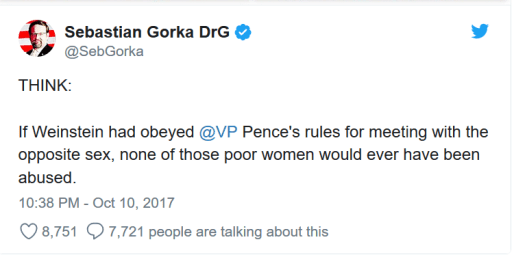
But French is not alone in his focus on the “Pence rule” in the midst of sexual harassment allegations. In October, former deputy assistant to President Donald Trump, Sebastian Gorka, tweeted the alleged instances of sexual assault and harassment that dozens of women say Harvey Weinstein committed could have been avoided if Weinstein simply didn’t meet with women one-on-one at all — referring to Pence’s rule.

From this point, Casey provides several examples of the Pence rule being taken too far. As she was cherry-picking, her ability to detect sarcasm was turned off.

sebastian.png

The subtle suggestion that Sebastian made was that those women were making things up, and if there were witnesses, they’d have had a much harder time getting away with it.

john.png

Stating the obvious in an ironic fashion. Of course, you’d have to tell an SJW that John was using his sense of humor. After all, SJWs selectively take things at face value.

timothy.png

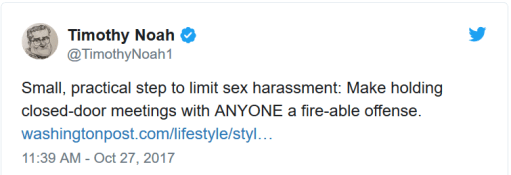
It’s over-the-top and obvious why it’s not a practical solution. That’s an ample hint that Timothy was being sarcastic. Most of you could see that. Casey Quinlan did not.

Not only is it absurd, but it is also deeply harmful to the careers of women in the workplace. When men avoid women for fear of looking “improper” or for fear that they can’t control themselves, they deprive women of opportunities to gain sponsors in their careers and to build better working relationships with colleagues and supervisors.

Casey made it to the end of her article and still didn’t figure out that the Pence rule was crafted in response to something. Until she figures out what, she’s not likely to understand that the whole slander culture that she’s working so hard to enable is backfiring in a big way.

When you start making things up about people, don’t be surprised when they act in their own defense. Also, consider the possibility that things might end up with you not getting what you want. In any game of strategy, your opponent gets to make moves, too.

Anyhow, let’s not be too hard on writer Casey Quinlan. After all, if you offer most writers enough money, they’ll write just about anything.

Michael Wolff is a liar and a coward.

rubber chicken

Michael Wolff, the author of Fire and Fury: Inside the Trump White House was a guest on the Australian morning program The Today Show. However, he walked off the set during a live interview after he was asked a question about Donald Trump.

The question concerned whether Wolff was sure that Trump was having an affair behind the back of his wife while Trump is president of the United States. Here is the question, as asked by interviewer Ben Fordham:

“You said during a TV interview just last month that you are ‘absolutely sure’ that Donald Trump is currently having an affair while president behind the back of the first lady, and I repeat you said you were ‘absolutely sure.’

“Just last week however you backflipped and said I quote ‘I do not know if the president is having an affair.’ Do you owe the president and the first lady an apology, Mr. Wolff?”

It was a valid question. After all, being “absolutely sure” of something and to “not know” about it are two very different things. An irreconcilable contradiction is a sign that something is wrong.

Michael Wolff was put in a very tight spot, with the only means to save face being to find a way out. He hatched a plan: he pretended that the audio equipment was not working. Maybe if he did that, the interviewer would become discouraged, and move on to a question that Wolff was more comfortable with answering.

Too bad his plan didn’t work, as Ben just repeated the question. Running out of options to evade it, Wolff insisted that he still didn’t hear the question, then walked off the set. Afterwards, The Today Show confirmed that the audio equipment was indeed working. When asked to explain his own words, Wolff turned chicken and backed down.

The hard part about lying is remembering what you said.

So, why did Michael Wolff turn from his claim that he was “absolutely sure” that Trump was having an affair? He specified the other party as being Nikki Haley, the US ambassador to the United Nations. However, Haley evidently didn’t like Wolff making up things about her behind her back, and she sharply denied Wolff’s statement.

When you go around making up lies about people, you end up making enemies. Who’d have thunk it?

Slander culture has been dealt another vicious blow, and they set themselves up for it. Perhaps soon, they’ll figure out that their approach doesn’t result in substantial gains in the long run. But I suspect that they’ll have to be shown quite a few more examples of their approach backfiring before they finally get it.

Sources:
Business Insider
The Washington “Democracy Dies in Darkness” Post

Naked Statues Censored in Assassin’s Creed Origins

egypt now with seashellsStill hot for those with a seashell fetish.

Naked statues were censored in Assassin’s Creed Origins. It’s not as big a deal as it sounds, considering that what’s censored is a special educational mode that could likely be used in schools.

Just that in itself is mind-blowing: that Assassin’s Creed could be used to teach students about history. Not that Assassin’s Creed was the first game to try.

mario is missingRemember this one?

While it’s true that the act of censoring the statues seems unnecessary, there are people who are in so big a hurry to decry anything that they see as censorship that they don’t take a little time to look into the story to know what’s really going on. There are some who are making this out to be about Ubisoft caving in to pressure to avoid an AO (adults only) rating, even though the original game received no such rating.

The decision did have to do with ratings, but the ratings would have been for the stand-alone educational mode. The ratings issue had no bearing on the original version of the game, for which the educational mode would just be an optional extension that the player doesn’t even need to download or use. Ubisoft was merely acting to ensure that the mode, when sold as a stand-alone, would be accessible for a wider audience, considering that it may be used in schools.

It’s kind of ironic that a game about ancient Egypt is being praised for its historical accuracy when the game makers insist on removing the nudity, even from the statues. For one thing, the statues in ancient Egypt were likely painted. We know that this was the case in Greece, but the paint peeled off, which is why they look the way they do today. Also, public nudity was very common in ancient Egypt. In fact, persons were not even permitted to wear clothing until the age of 15. Even Pharaoh’s own children were not exempt from this rule. Imagine how well it would have gone over if Ubisoft had gone for historical accuracy in this regard. Also, imagine the money Egyptians saved on back-to-school shopping.

In spite of this, ancient Egypt was actually among the most moral societies in the ancient world. They get a bad rap today because, at one point, the Pharaoh refused to free some slaves that he should have.

Also, contrary to popular belief, ancient Egypt wasn’t the sandy wasteland that it is today. Egypt was actually fertile, particularly closer to the Nile. In spite of this, the Egypt of Assassin’s Creed Origins was sandy and gritty pretty much all over the place, which would lead one to question just how a civilization thousands of years old could thrive so long with such limited potential for agriculture.

So while you might get a nice history lesson from Assassin’s Creed Origins’ guided tour mode, don’t count on it to be entirely historically accurate. Even putting aside the gratuitous seashells.

TWAT News: Student faces expulsion over math sign

root sign.png

The symbol above is called a radical, also known as a “square root”. In mathematics, it along with the radicand represents a number which, when multiplied by itself, gives a product equal to the radicand, the radicand being the number within the radical.

What’s really radical is that police were called and an Alabama student faces expulsion because he made a joke about the radical looking like a gun.

The guy is pretty far from the only one who liked to have some fun with math by making things out to be something else. One example that I think we’re probably all familiar with is what we get when we punch the quantity “80085” into our calculators. Alternatively, one can instead punch in “58008” and look at it upside-down.

A lesser known example is the female appearance of the number one, especially when it’s stylized and placed in parentheses:

congratulations, it's a she.pngHot stuff.

Or this popular example, which takes a little calculus:

integral

This next one is popular among the more metal mathematicians:

sigma.png

Being immature with math and numbers really isn’t anything new, but this would be the first time I’ve heard of someone getting in trouble for it, with even the police getting involved.

This story is being passed around as an example of how people are becoming overly sensitive, particularly as relates to the causes of various left-wing fringe groups. Otherwise, it’s hard to imagine anyone calling the cops over a math symbol.

While most media outlets reporting on this story say that the student’s home was searched, there is a variant of this story going around which states that the student’s home wasn’t searched. It’s not a bad idea to have at least two or three sources of information on news stories, especially if at least one of those sources has an apparent political bias. Though avoiding political bias in the news is nearly impossible, a different perspective can help when otherwise, there’d be another aspect to a story you might have missed.

A student got in trouble over a math symbol. That Was Actually The News.

Vegan claiming to have been cured of breast cancer dies of breast cancer

mari lopez not obama

A YouTube personality named Mari Lopez made the claim to have been cured of her breast cancer, and said that she owed her recovery to her vegan lifestyle.

You could imagine that vegans would jump all over this, considering that they trip over themselves in the rush for any evidence that their hokey diet makes them superior to the general population, with mainstream media outlets enabling them by publishing anything attention-grabbing that doesn’t go against their own narrative. Mari also claimed that her diet cured her homosexuality, but media outlets don’t seem to have much to say as far as that goes.

In a stunning turn of events, Mari’s breast cancer had returned. To Mari’s credit, she did seem to figure something out, because she started eating meat again after her cancer returned. Obviously, her vegan diet wasn’t really doing anything for her, and she might have benefited from the iodine and B vitamins that she would have been missing out on as a result of veganism. Sadly, Mari Lopez didn’t make it.

The show’s co-host, Liz Johnson, was quick enough to throw Mari under the bus. Johnson blamed Mari’s death on her becoming inconsistent with her diet and spiritual life. Also to the fact that she underwent radiation and chemotherapy, which have been helping people to battle and survive cancer for years.

As you’ve probably pieced together by now, their channel was one that peddled all-natural remedies.

Liz also opposed Mari using a microwave to prepare her food, which was something that Liz was against. The idea that microwaves do any more damage to a food’s nutritional value than traditional cooking or somehow makes food worse to consume is another idea that gullible people buy into, but it’s not as virulent a brand of nonsense as veganism, because it doesn’t eliminate necessary nutrients and an entire food group from one’s diet. But it’s still something to watch out for when you want evidence that someone is terrible at thinking for themselves.

While natural remedy sites thrive on the business that they get from morons, there’s more to it than that. I suspect that these sites are so popular because people don’t want to visit doctors. With how expensive a visit to the doctor can get, it’s easy to understand their reluctance. There are people out there that wouldn’t go to the ER with an emergency, as doing so can easily cost a person as much as a year’s wages, and the prospect of making repeated calls to an insurance company to beg them to honor their commitment is more than a little daunting. And through it all, the stress might have an even further negative impact on their health. Then, suddenly, that sewing kit starts to look mighty attractive.

People become so desperate for an alternative that they begin accepting any that is presented to them, including the vegan diet, which is among the most persistent of fad diets. As veganism is criticized, vegans double down on their stance, and they attribute every health benefit that they can imagine to the diet in an attempt to justify it.

Considering this, is it any surprise that there are vegans that actually believe that their diet can cure cancer? And as the recent death of Mari Lopez has demonstrated, it’s not a harmless misconception.

The question at this point is, how many more lives need to be devastated by the widespread misconception that veganism is a healthy lifestyle? And why aren’t more people doing something about it?

Sources:
The Fox News article
The Yahoo News article

No, you can’t make an “authentic” Philly cheesesteak at home.

Menu-PatsSteaks-3077A Philly cheesesteak, easily mistaken for a dirty diaper. (Source: Pat’s King of Steaks)
The Art of Manliness did a piece on how you can make an authentic Philly cheesesteak at home. Being from Pennsylvania, I know that there will be some who take issue with this article. Mainly, with the very idea that an authentic Philly cheesesteak would be something that a person could make at home.

According to Pennsylvanians, the authentic Philly cheesesteak is something that a person can only find in Philadelphia. If the sandwich was assembled anywhere else, it’s not an authentic Philly cheesesteak.

It might seem petty to say that a sandwich is not authentic for having been made in a different location, even though it’s assembled with the same ingredients in exactly the same way, and that’s because it is. To understand this pettiness, one needs to understand the mystique surrounding the Philly cheesesteak.

To Pennsylvanians, there is no such thing as a bad Philly cheesesteak, and they hold the Philly cheesesteak as beyond reproach. If you don’t like the Philly cheesesteak sandwich, then it’s because you didn’t have an authentic one. As already mentioned, authentic Philly cheesesteaks are only made in Philadelphia. If you had one there, and still didn’t like it, then you went to the wrong place.

This provides ample opportunity for the Philly cheesesteak to escape criticism, because there are a number of restaurants in Philadelphia that claim to offer the authentic Philly cheesesteak, and in each case, there is dispute surrounding their claim of authenticity. So, you can’t criticize the sandwich unless you’ve had one from every possible establishment in town, otherwise, there’s at least one place for the fanboys to retreat to to defend their beloved sandwich.

For one thing, I don’t want to have to eat a couple dozen cheesesteak sandwiches before I decide I don’t like them. One should suffice. The fans can instead explain to me just what it is that each of these restaurants do that’s any different from one another, and explain just how that impacts the quality of the sandwich.

But what if you were to lose your mind and decide to go eat at every cheesesteak joint in Philadelphia? Upon completion of this task, do you finally have the right to criticize this sandwich?

Not quite.

There are different ways to order your cheesesteak. Not only that, you’re expected to order it with a proprietary cheesesteak lingo. For example, if you want a cheesesteak with onions, you’d say,

“Wiz wit”

And then you’d feel like a moron, because it’s impossible to talk like that without sounding like one. Decoded, what this means is “with Cheeze Whiz, with onions”.

And no, I’m not kidding. The Philly cheesesteak is made with Cheez Whiz. While you’re mulling over just what tragedy of thinking resulted in a major American city accepting a sandwich made with Cheez Whiz as its representative sandwich, here is the Cheez Whiz ingredients list:

Whey, canola oil, milk, milk protein concentrate, maltodextrin, sodium phosphate, contains less than 2% of whey protein concentrate, salt, lactic acid, sodium alginate, mustard flour, Worcestershire sauce (vinegar, molasses, corn syrup, water, salt, caramel color, garlic powder, sugar, spices, tamarind, natural flavor), sorbic acid as a preservative, milkfat, cheese culture, oleoresin paprika (color), annatto (color), natural flavor, enzymes.

I thought it was illegal to call something “cheese” unless it actually contained cheese, but to Kraft’s credit, they don’t technically do that. They call it “cheez”, which may sound identical, but is spelled differently enough to get around the law and still trick poor people.

Another way to sound like a moron while ordering a sandwich is to say:

“Wiz wit-out”

Which might have made your ears perk up a little, because even though it still sounds like toddler speak, it sounds as though there’s a variant without Cheez Whiz, and a sandwich made with steak and onions sounds pretty decent. The catch is, the “wit-out” part is referring to the onions, so you’d be ordering a steak and Cheez Whiz sandwich.

You can order the sandwich with provolone instead, but the catch is, you’re still going to come across those who will say that it’s not an “authentic” Philly cheesesteak unless the topping used is Cheez Whiz. And they might be right. The most famous cheesesteak stands in Philadelphia order huge containers of Cheez Whiz to slather all over their sandwiches.

The celebrated sandwich of Philadelphia, which you supposedly could not have had unless you made the long journey to that same city, is made with Cheez Whiz. This makes the Philly cheesesteak a paradox sandwich: even if it’s authentic, it’s still not authentic.

If you go to all this effort to have an authentic Philly cheesesteak for yourself, you finally get to say you don’t like it, right? Nope. Even if you’ve consumed every permutation of the set of cheesesteak in the city of Philadelphia and you still say you don’t like it, Pennsylvanians still insist that there is no problem with the Philly cheesesteak. Instead, they’ll say that the problem is with you.

And they’d probably be right. After all, you’d have had hundreds of Philly cheesesteaks just to say you don’t like them.

Don’t play their game. If a Philly cheesesteak fanboy starts going on about how their cheesesteak is great, have them tell you where you have to go to get the right sandwich. If another fanboy is in earshot, they’ll likely disagree about the choice of cheesesteak joint. You’d be surprised how likely this is, because even though not everyone has been to Philadelphia, you’ll find people who consider themselves experts on the Philly cheesesteak everywhere. These experts argue with each other at the drop of a hat, so they’ll be distracted with each other while you make your getaway!

If that doesn’t work, ask him how a Philly cheesesteak is made. You can have fun with this by seeing just how long it takes for the guy to admit that his  sandwich of choice is made with an imitation cheese product. In some cases, they’ll know what you’re getting at, so they’ll try to avoid it for as long as it takes before you drop the fact-bomb yourself. Then you’ll have humiliated his favorite sandwich, and him.

Then you can tell him that you can make the exact same sandwich at home. You just choose not to.

Is Rey from Star Wars a Mary Sue character?

“She’s not a superhero. She’s a normal girl thrust into extraordinary circumstances, so it’s very relatable.”
-Daisy Ridley, presumably talking about Rey

Oh really?

There have been complaints that Rey from Star Wars is a Mary Sue character. While these complaints have been around for some time, they have been gaining traction lately. Is this the case? Let’s look at the evidence.

It should be noted that just because a work of fiction has a Mary Sue character doesn’t mean it’s bad, though it is universally considered a sign of poor writing. While it’s true that there’s no exact agreed-upon criteria for what is considered a Mary Sue character, there are some signs to look out for when considering whether it may be the case.

Usually, a Mary Sue character is one that meets a significant amount of the following criteria:

  • Mary Sues are often self-inserts who vicariously act out the author’s fantasies.
  • The character is overpowered or has extraordinary abilities or skills that aren’t properly explained in the narrative.
  • The character’s experiences come off as wish-fulfillment or power fantasy.
  • The character is relatively flawless, or what flaws they have can be made to benefit the character in some way (such as making them more endearing).
  • The character quickly makes strong personal connections with all the major characters of an established work, especially among the protagonists. Even antagonists may have a difficult time denying their goodness. This point especially applies to fan fiction.
  • The character possesses ideal beauty or high intelligence, and often finds a comparably fantastic love interest.

Also of note is that Mary Sues are usually the main characters of their stories, or are at least major pivotal characters.

Considering all this, there are many examples in the Star Wars films that show that Rey meets almost all of this criteria. The following are a few examples:

  • Rey is the main character of the Star Wars sequel trilogy, beginning with Star Wars: The Force Awakens.
  • Teedo found BB-8 first, so he had more right to the droid than Rey. However, Teedo releases the droid just because she demanded he do so.
  • When Rey is ambushed by a couple thugs intending to abscond with BB-8, she quickly defeats both assailants before Finn, a trained Stormtrooper, could so much as make it to her.
  • There’s more. After BB-8 fingers Finn for stealing Poe’s jacket, she cuts in front of him before he could get away with incredible speed, and beats him up, too. She did this to a Stormtrooper that’s been trained for decades in spite of having no formal combat training of her own.
  • Rey expertly pilots the Millennium Falcon in spite of the fact that the ship hadn’t flown in years, and she had presumably never piloted a starship before.
  • That last point not implausible enough? She, along with Finn, successfully evade two First Order pilots in this craft they had never commandeered before, destroying both First Order assailants in the process.
  • Her technical knowledge of the Millennium Falcon is just a little too impressive. She identified the problem with putting a compressor on the ignition, just as Han did, which clearly impressed him. In the original trilogy, Han and Chewbacca still stumbled on various repairs to the craft, even though they personally operated it for years at that point.
  • It gets better. Rey bypassed the compressor while the Falcon was in operation, enabling the group’s escape, impressing Han again. As an aside, any skilled electrician can tell you what a terrible idea it is to perform electrical work on a machine that’s powered on.
  • When Finn is being dragged about by a rathtar (and being protected by plot-armor instead of being instantly killed), Rey knew just what door to shut on the rathtar’s tentacles and at what precise moment, even though the event was occurring outside her line of sight. Even Jedi rarely exhibit that kind of intuition.
  • Luke’s lightsaber called out to Rey while they both were in Maz Kanata’s castle. Why Rey? We still have no explanation.
  • When Kylo Ren force-probed Rey’s mind, he was at first successful at identifying her thoughts. Moments later, she turned his own technique back on him and told him his greatest insecurity. This is in spite of the fact that Ren was a skilled user of the technique and had years of training as a particularly gifted Jedi and as a dark side user under Snoke. Rey had no force training whatsoever.
  • Minutes later, Rey succeeded in using a Jedi mind trick on a Stormtrooper to get him to release her. Apparently, she didn’t need any training to use that technique either. For that matter, how could it have occurred to her that she could use that technique at that time?
  • For the climactic lightsaber duel of The Force Awakens, the big bad is a former Jedi of exceptional potential and extensive training in lightsaber battle versus a junk dealer who never trained in using the force or even used a lightsaber before. Though Rey stood a rabbit’s chance in a tiger pen, she defeated her opponent in convincing fashion. (As this was happening, a pilot in a tiny craft dealt the finishing blow to a battle station with an embedded superweapon that also happened to be a planet, and blew the whole thing up. Because Star Wars.)
  • The mission of retrieving Luke Skywalker is among the most important in the history of the Resistance, so it stands to reason that Leah would send someone she knew and trusted to do the job. Either Poe Dameron or Admiral Ackbar would have been ideal for the job. Better yet, Leah could have gone and talked to her brother herself. Instead she sends Rey, who she only just met not long prior. Of course, we know if Rey went to Luke, she could train under him, as though Rey wasn’t strong enough as she was.
  • Rey captained the Millennium Falcon on her mission to retrieve Luke, even though Chewbacca had years more experience with the craft and was the first mate to its previous captain. What does Chewbacca have to do for some respect?
  • Rey’s idealism is easy enough to portray as a positive trait, but it looks so much better when contrasted with Luke’s cynicism. Let that sink in: the Luke Skywalker was brought down to bring Rey up.
  • Once Rey is brought before Snoke, his only criticisms of her are mere stereotypical bad guy taunts. He even says that she “has the heart of a true Jedi”, so even the big bad of the movie acknowledged her virtue.
  • Rey displayed as much skill as Kylo Ren in dispatching the Praetorian Guards, even helping him out with the last one as it had him in a neck hold. This in spite of having no lightsaber training, unless you count swinging a lightsaber around while Luke is looking on with no involvement as “training”.
  • After the Praetorian Guards are defeated, Ren offers Rey to join him, showing that even her greatest adversary would prefer to have her as an ally.
  • Kylo Ren informed Rey that her parents were mere junk traders, and no one of consequence. While it’s interesting to see characters in Star Wars don’t have to be related to other major characters to become someone of significance, it makes Rey’s exceptional abilities even more of an anomaly that we now have even less of an explanation for.
  • By the end of The Last Jedi, the only skilled force users in the galaxy were Rey and Kylo Ren, and the Knights of Ren, of which we know Kylo to be the leader. As we’ve already seen, Rey could beat Ren in spite of Ren’s extensive training and Rey’s lack thereof. This makes Rey the strongest force user in Star Wars.

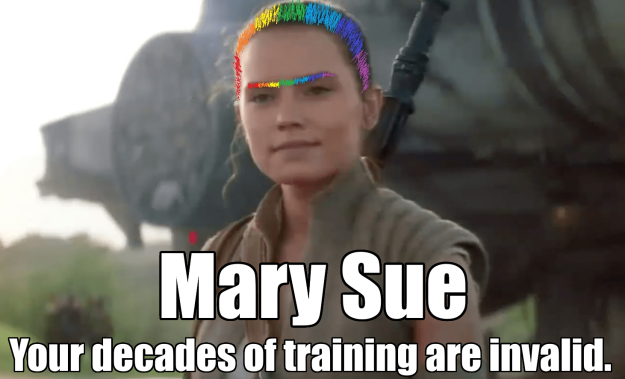
Considering this, is Rey a Mary Sue character? YES. No doubt about it. In fact, she’s so Mary Sue it’s surprising to see a character of her sort in a professional work, let alone in such a huge IP as Star Wars.

Not only is Rey an obvious Mary Sue character, she may very well be the most Mary Sue character I’ve ever seen outside of fan fiction. I kid you not, while researching this article, I looked up “Narcissistic Personality Disorder” to determine whether Rey would be just the character that someone with the condition would prefer to see themselves as.

Perhaps the greatest irony here is that the very namesake of Mary Sue comes from Star Trek fandom, Star Trek being a competing IP. At this point, the term “Mary Sue” can be shortened to “Rey”, as Star Wars has once again denied Star Trek what little cultural significance it has left.

Rey Mary Sue Star Wars

Aside from all that, Daisy Ridley and J.J. Abrams made quite a relatable character.