One thing I’ve been hearing is the sentiment that a college education isn’t worth it. It’s often expressed by pundits who notice the state of the job market, think that an education isn’t going as far as it used to, and they assume that it isn’t worthwhile to pursue a college education. I disagree with that perception, which I suspect has done a lot of damage in recent times. A person can hear it, assume that there’s nothing in it for them to take their education any further, and they end up underemployed in spite of their intelligence.
There are numerous cases in which college graduates are working difficult, low-skill, low-pay jobs. The media notices cases like this, reports them as evidence of how the job market is doing, and pundits notice these stories in turn and they blog about what they see as one of the greatest problems with society.
Yeah, there are plenty of Starbucks employees out there with college degrees, but there’s an aspect to this matter that I think goes largely unnoticed: It matters what you go to college for, not just that you went to college.
Perhaps many book store employees and Walmart cart pushers have college degrees, but how many people are asking them what they majored in?
It’s no secret at this point that it’s much harder to find a job with a degree in English or Philosophy than with a degree in Automotive or Engineering. Automotive and Engineering degrees are in demand because they involve a person learning skills that are relevant to those hiring.
When a person graduates from college, their degree indicates that they’ve sufficiently been prepared to perform a job as a professional. In many cases, college courses are intensive, fast-paced, and intellectually-involved to the point that when a person obtains a degree, it indicates that the person takes what they went to school for seriously. There’s very little risk in hiring such a person.
However, a college degree is more useful if it indicates skills that are in demand. There are many automotive repair shops that want to hire a person with a degree in automotive technology. What is a person prepared for when they major in English or Philosophy? Not much, really. Usually, the best they can hope for is to end up teaching English or Philosophy at a university.
Should colleges be blamed for offering degrees that aren’t very useful? Not really. The colleges that offer degrees that don’t reflect in-demand skills are providing a service that customers (students) are willing to pay for. The more serious problem is that students are investing piles of money into educational choices that aren’t likely to pay out very well.
There are many reasons why they do this. Perhaps they’re going for a college degree just to say that they have one. Perhaps their parents are pressuring them to attend college, and they, out of laziness, go for something that requires little effort. Perhaps they’re simply unaware of just how few opportunities await someone with an English or Philosophy degree. Or perhaps they are aware of how difficult the job market is for one with the degrees they’re pursuing, and they’re determined to teach these subjects for a living.
One problem, I think, is that people are largely intimidated by math. People often see math as being something difficult for ordinary people to figure out, and they leave it for the people they see as smart to worry about. One of the most frequently-heard complaints about math is that it’s hard to see how the more complex-looking math would be applied in life.
But here’s the thing: if someone doesn’t use the math they learned in high school in their job, their job probably doesn’t pay very well. One thing that automotive specialists, doctors, and engineers have in common is that each of them uses some relatively advanced math nearly any day that they work. Most people would probably prefer that people in such positions be well-practiced in math. People in these trades typically get paid very well, and this is because there aren’t very many people out there that have learned the skills that they have. It’s often the math that intimidates people.
College educations can still be very much worth it, but results can vary greatly depending on what a person goes to college for. The challenging things to learn often pay off the best. Don’t allow certain people to discourage you from bettering yourself. Even a person who goes to school for English or Philosophy can succeed. It helps to be realistic when it comes to your goals.
Surprisingly, Nintendo is getting into the business of offering a subscription-based goodie service similar to Loot Crate, a service that ships a box of goodies to subscribers on a monthly basis.
To get an idea of what Loot Crate is about, go to YouTube and search for “Loot Crate unboxing”. Many such videos feature people pulling items out of these boxes, enjoying the surprise that comes with opening one of these things. Watching one while expecting a Loot Crate in the mail might spoil the surprise, however.
I think the appeal of Loot Crate is for people who know that they’d want a bunch of pop-culture stuff to fill up an otherwise empty bookshelf with conversation pieces, but they aren’t sure what it is they want to buy, but they wouldn’t mind paying someone to determine for them just what it is they get. A lot of it is just toys that would probably sit on a bookshelf, be looked at from time-to-time, but otherwise not really be a big deal. Loot Crates usually come with a T-shirt, and sometimes some posters, which could come in handy for covering ugly bodies and ugly walls. Each month, Loot Crate shipments have a different theme, such as cyborgs.
As weird as some Loot Crate items may be, Loot Crate seems to be generally a good value. Sure, some of the items seem like excess inventory that’s been sitting in warehouses, and a service like Loot Crate may just be a way to sell it off, but about $14 a month isn’t a lot to ask for some of the stuff that you get. Even if some of it is meh. Like shoelaces, pins, decals… You might have had times that you’ve been to Gamestop, saw a mint tin with a design that you liked, but then saw the price tag and decided that you didn’t want to spend something like $4.99 for something like that. One might even feel inclined to hold off on impulse purchases, allowing Loot Crate to supply them with miscellaneous stuff.
So, Nintendo is getting into that with their upcoming monthly N-Box. I like that. For those who like Nintendo, this might still mostly be stuff that a person typically wouldn’t find a use for, but in themes that would be easy for them to appreciate.
There’s already a lot of speculation concerning possible contents, perhaps the most attention-getting would be exclusive Amiibo figures. There are people that are fanatical about those things. Including exclusive Amiibo figures would generate some guaranteed sales for Nintendo (and inspire more fights between determined collectors). Perhaps also they could include some accessories such as custom styluses and perhaps also some plushes.
Loot Crate does monthly themes; such a thing would be easy for Nintendo to do. Perhaps one month they could do a Mario themed box, and another a Pokemon themed box. They could do boxes to promote their new IPs, such as Splatoon. It’s easy to imagine them also doing a Luigi themed box, which would makes some fans happy (the ones that think it wasn’t enough that Nintendo declared a “Year of Luigi”).
For collectors, something like this might be a dream come true. Contents exclusive to early N-Boxes could end up becoming collectors items, especially if exclusive Amiibo figures are included.
Right now, the pricing of the service is unknown. But currently, the service has only been announced for the UK. I’d like to see Nintendo make this available to the United States.
A news story just posted on Serebii.net indicates that the Pokemon Global Link is going to implement stricter checks to determine whether pokemon used by players have been hacked. According to the story, if you are caught with a modified save file or modified pokemon, you could be banned from Rating Battles and Battle Competitions.
If I could make a suggestion, I would like for the Global Trade Station (GTS) to be included in these stricter hack checks. For players that don’t use hacks, hacked pokemon are often acquired from the GTS, often accidentally on the part of the non-hacking players from players that hack them. In fact, that can bring up another problem.
It is possible for players to use hacked pokemon while unaware that they’re using them. Again, non-hacking players may be unaware that a pokemon that they’ve received from the GTS may be hacked. Ordinary players may not know what makes a hacked pokemon, or perhaps the hacked pokemon has been hacked in such a way that even experienced players wouldn’t be able to tell it was hacked with close inspection, but whatever filter used by the Global Link could detect it. It would be pretty sad if someone who doesn’t hack pokemon were somehow penalized because they unwittingly used a pokemon that’s been hacked.
While applying stricter checks may keep hackers out of Rating Battles and Online Competitions, it would be nice if they’d also apply to the GTS to keep hacked pokemon away from players that just aren’t interested in them. While using the GTS, I’ve gotten some pokemon that have obviously been hacked. Among these are a Celebi and an Arceus that resemble legit event pokemon, except they’re missing ribbons that they’re supposed to have (unless there’s some way to remove ribbons from pokemon that I’m not aware of). While it’s nice to have rare pokemon, when they’re not the real deal, it’s not as satisfactory to have them. I’ve also gotten a shiny Latios and a shiny Latias from GTS, with competitively viable natures and perfect IVs. Some might say that’s a strong sign they were hacked, but it’s hard to confirm it for sure.
This might open old wounds to bring up, but official pokemon hack checkers haven’t been flawless. For example, was Nintendo not aware that it was possible for players to obtain a shiny Jirachi from the Pokemon Colosseum Bonus Disk? Yet, shiny Jirachi was banned from being transferred from gen 5 games to gen 6 games through Poke Transfer.
Considering this, one could see how ordinary players that don’t hack may be concerned. They could be penalized through no fault of their own. Looking at how the GTS has historically been managed is another cause for concern: it seems as though the GTS is set up in such a way that it can run somewhat stably without much need for moderation, if any. In this condition, the otherwise automated system is influenced by the users themselves, who may, at their discretion, respect the desires of those who put pokemon up for trade or devise means to circumvent restrictions.
Long story short, I like that stricter hack checks are being implemented, but I’d like to see such a thing apply to the GTS. What’s more, I’d like to see some care implemented in how punishments for violations are enforced. I don’t want to see players blocked who simply weren’t aware that the pokemon they brought with them were hacked. I’d also like to see the filters consistent with what’s actually been made available. If those who make the Pokemon games could use a little help, it might not be a bad idea to refer to Serebii’s event database. It’s pretty comprehensive.
And while I’m making suggestions, I wouldn’t mind seeing the restrictions against trading pokemon with certain ribbons lifted. The ribbons in question might be part of what make the pokemon special, but they shouldn’t prevent a player from doing what they’d otherwise do with pokemon, and it would make it much easier for players to obtain certain pokemon who haven’t been to certain events.
How these stricter checks will affect hackers, and for that matter, those who don’t hack, remains to be seen. Perhaps they will change the game for the better, but if mistakes are made, they might just upset the fans more than before they’d be implemented.
It doesn’t take long using social media to find some pretty spurious takes on recent news. This includes some conspiracy theories, which are pretty much intellectual junk food. As vexing as it may be, some conspiracy theories can really take off.
There’s a new one that’s going around, and if you’ve read the title of this entry, your palm might already be on your face. There are conspiracy theorists going around on social media saying that the recently deceased president of Nintendo has been offed by Freemasons.
Aside from being laughable, this conspiracy theory is also disgusting. The guy has only been dead for a few days, and a bunch of people with a tenuous grip on reality are attempting to use the tragedy to bring attention to themselves.
The position of the conspiracy theorists is that Satoru Iwata, during his presidency of Nintendo, enacted several contradictory policy changes that weren’t in line with the agenda of the Freemasons, who supposedly are exerting their influence on the video game industry. That sigh of disgust probably came from you.
There are several points that these conspiracy theorists bring up that they actually think support their position, and here is one example:
The Japanese name of Atari, founded by Freemasons, means “to hit the target”, indicating their goal of wanting to control the Japanese game industry.
One thing that can be learned about Freemasons from Google searches and poking around on “truth seeker” Geocities pages is that they like hiding their agenda in plain sight, typically by using symbology that’s been highly-publicized in films and books. If they’re that confident that their plans will succeed, then why has Atari, their supposed key player in the game industry, had so many commercial failures since the video game crash of the ’80s? Are we to really accept that a company that’s so sophisticated that it can carry out a hit on the president of a multi-national tech company (which happens to be an industry leader) is simultaneously so inept that it cannot produce a commercial success of it’s own?
These guys are already off to a pretty bad start, but there’s more:
Atari’s goal was to keep the Japanese people lazy and stupid, and Satoru Iwata resisted this.
Then they failed. Japan is easily one of the most industrious nations in the world today, with an economy second in strength only to the United States. Anyone who thinks that the typical Japanese man only sits around playing video games and reading manga are in for a surprise when they visit a place like Saitama for the first time. And again, are we really supposed to accept that Atari can carry out a hit on one of the most influential men in the tech industry, when it would be far more conductive to their supposed mission to address and overcome their commercial failures? One would think that if a company’s mission is to keep people addicted to video games, they’d be less about trying to bring attention to themselves by assassinating people known all over the world and more about knowing how to make a decent video game. Because at this rate, it would be far too easy for some overweight Loose Change enthusiast living thousands of miles away to expose their entire operation by using their Twitter account.
Another one:
Nintendo initially refused to reduce the price of the Nintendo 3DS, but then cut the price by 40% about 6 months after it’s release.
Satoru Iwata then cut his own executive pay in an effort to maintain Nintendo’s stock value, and the 3DS would go on to become one of Nintendo’s fastest-selling and successful gaming systems. Do I even have to explain why the position of conspiracy theorists on this matter are logically inconsistent? If you want a video game company to be highly successful, why would you have a problem with someone who makes moves that are highly beneficial to that company? Iwata was president of Nintendo when the Wii and Nintendo DS hit the market, and those were among the best selling game consoles ever. They each sold over a hundred million units. Iwata obviously wan’t attempting to sabotage the game industry.
Nintendo stated that their software production outside of Japan went up, when it has actually been going down.
And apparently being wrong about something justifies calling for a hit on a company president.
There’s more, but I think I made my point. Conspiracy theorists are ridiculous, and so is the idea that Nintendo’s president was killed by Freemasons working for Atari. As opposed to cancer, which we still don’t have a cure for (though they probably have quite a few conspiracy theories about that).
Conspiracy theories don’t take a lot of mental energy. It typically involves a person spending hours reading other people’s ideas, then thinking themselves enlightened and having figured things out for themselves. To demonstrate how easy it is to imagine up a new conspiracy theory, here’s a new one: The government and the Illuminati have been propagating conspiracy theories for decades to occupy people of substandard intelligence. How’s that for a paradox conspiracy theory?
If more people would have instead expended into medical science the kind of energy that they’re putting into circulating stupid conspiracy theories, we might have actually developed a cure for cancer by now.
It seems like there’s someone out there that has me beat when it comes to confidence. There is someone out there who likes what he likes, and is not at all ashamed of saying so. That person is TokenDuelist, the author of the webcomic Boss Rush Society. TokenDuelist posts to his DeviantArt account with furry lesbian art, MLP characters (at least one work of which being lesbian art), Pokemon fan art of a ten-year-old with huge breasts, and a bare-breasted woman pawing at a blurred-out banana. That he is a male should be evident considering the nature of the DeviantArt material described. He also posted a picture of himself using the same DeviantArt account. That’s some confidence, there.
As mentioned already, he is the author of a webcomic, and that’s what’s primarily getting the attention in this review.
Boss Rush Society stars Lucas (a.k.a. Giga), a young man who enters a battle tournament, but shows up late, and the tournament starts without him. When he does show up, there’s only one contestant remaining, and he’s permitted entry, leaving him only having one weakened and tired opponent to trounce before being crowned the winner of the tournament. Which, predictably enough, he does. Isn’t that every layabout’s fantasy? Getting the prize just for showing up and saying his ABCs.
The art style can be likened to a combination of manga and the work of Phil and Kaja Foglio (but not in a good way). There is an obvious problem with proportions, and that is particularly evident in the first panel of this page, where the claw game is taller than the woman standing in front of it, but the woman is much taller than the arcade machines right next to them. There are other, similar problems, but I think you’d see them if you were to read the comic for yourself.
Also, almost all the female characters have huge breasts, except for one, which was probably a character that we weren’t supposed to like. Again, it’s obvious that the author of this comic is male. He has this thing for huge, swollen, gravity-defying breasts. What the obsession is with oversized breasts, I don’t understand. When they get too big, they sag and can actually be pretty gross.
Usually, small expressions of sexual immaturity can be ignored as a quirk in some webcomics, but that’s really hard to do when it’s used as a punch line in the very first issue. An example of this can be seen on this page, where one of the characters, apparently the main character’s girlfriend, shrugs off that she could have seen the main character almost nude. After he throws her out of the room, she starts pounding on the door. Not only does Giga get an easy tournament victory that he didn’t deserve, he also has a nymphomaniac girlfriend. What a guy.
There are a couple reasons why tournament battles are a recurring concept in so many shounen manga: the arranged battling environment allows for matches that otherwise might not easily occur in the flow of the narrative, and it’s very easy to write for. However, the concept is hindered in Boss Rush Society by several problems:
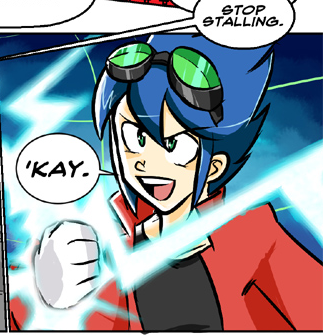
Too much meta humor. The main character actually stalls during his only tournament match to explain his weakness to spikes using video game logic. Yeah, you probably already figured this out, but Boss Rush Society has a video game theme. Not only did Giga show up late to the tournament and only have to face one tired opponent, he called for a time-out as a stall tactic to charge his energy. Perhaps for his next match, he can take on crippled girl scouts.
Too much exposition. One of the elementary rules of a visual medium is “show, don’t tell”. The first few pages established nicely that the backbone of the plot would involve tournament battles, so one would assume that any other dialogue would serve to set the stage for the next tournament battle. An excuse can be made for this for character development, but that leads to another problem:
The characters are seriously annoying. Every single character in Boss Rush Society is needlessly grating. Because of this, I wanted to see every character lose every match, regardless of which side they’re on. TokenDuelist needs to get the memo: you only portray a character as annoying when you want them to be perceived as annoying, such as when you don’t want your audience to like them. There isn’t a single character in Boss Rush Society that comes off as likable, the main character least of all. The single action of taking advantage of a weakened opponent for an easy tournament victory is more morally reprehensible than anything that the “bad guys” are ever shown to do.
Boss Rush Society is an excellent example of what can go wrong when someone who is not Japanese and plays lots of video games and watches lots of anime attempts to draw a manga of their own. Japanese manga and anime artists are better at it for a reason: they typically go to an art school where they do lots of practice drawing manga and anime before going on to become professionals. At that point, they can work shifts as long as 16 hours animating, get paid about as much as fast food employees, and some of them don’t even have homes because they’re allowed to sleep at their desks. It’s usually by about this point that many of them realize that they’ve made a mistake. Weeaboo artists typically aren’t aware of what being a manga/anime artist is like, otherwise, they’d probably stop trying so hard to be one.
Just when I thought I couldn’t take much more, I’ve read the entire series. As of now, there’s less than two dozen pages. One might think that this is because TokenDuelist is just getting started, but his archives indicate that this isn’t the case. He only releases his webcomic one page at a time, with updates as far as several months apart. TokenDuelist had nearly two years since the inception of his webcomic to carefully craft it’s 23 pages into a masterpiece, but it seems like he waived this so he can draw lots of furries on DeviantArt, and what we got instead was Boss Rush Society.
Worse yet, the spaced-out timing of releases for pages of Boss Rush Society suggests that, for each page, he carefully considered it’s content, and deliberately decided that they were worthwhile additions to his series. There is a reason why most suicides are quick: otherwise, a person might realize that what they are doing is a bad idea, and not go through with it. TokenDuelist gives himself as many as two months at a time to review the content of each page before making the conscious decision to add it to his webcomic.
Like I said before, TokenDuelist is confident. So confident that he actually links to his webcomic on message boards. Obviously, he thinks his webcomic is great, otherwise, he wouldn’t have such confidence.
I think it’s about time to give Boss Rush Society it’s score, which is a Robbie Rotten out of ten:
For a long time, Metroid has been one of my favorite game franchises. Growing up, I actually made friends because of Metroid games. The games themselves were excellent expressions of interactive art. They starred a lone hero exploring an alien world. Metroid games weren’t divided up into levels. Rather, the player could explore the alien world at their own pace, collecting power-ups that increased mobility and endurance as they did so, making it easier to defeat strong enemies and making previously off-limit areas accessible. In the year 2000, there was a controversial announcement that a new Metroid game would be made with a first-person perspective. Players were initially skeptical, but the Metroid Prime games turned out to be among the most critically-acclaimed Nintendo IPs.
After a while, Metroid game releases became scarce. During this slow period, Metroid Other M was released, which was controversial for several reasons, but was still generally a good game. One might have assumed that Nintendo wouldn’t make another Metroid game unless they could really wow with it. Metroid has a coolness appeal, and players enjoy exploring alien worlds at a pace that they set.
What has the Metroid franchise been doing lately? Check out a recently-released trailer for Metroid Prime: Federation Force:
What was Nintendo thinking?
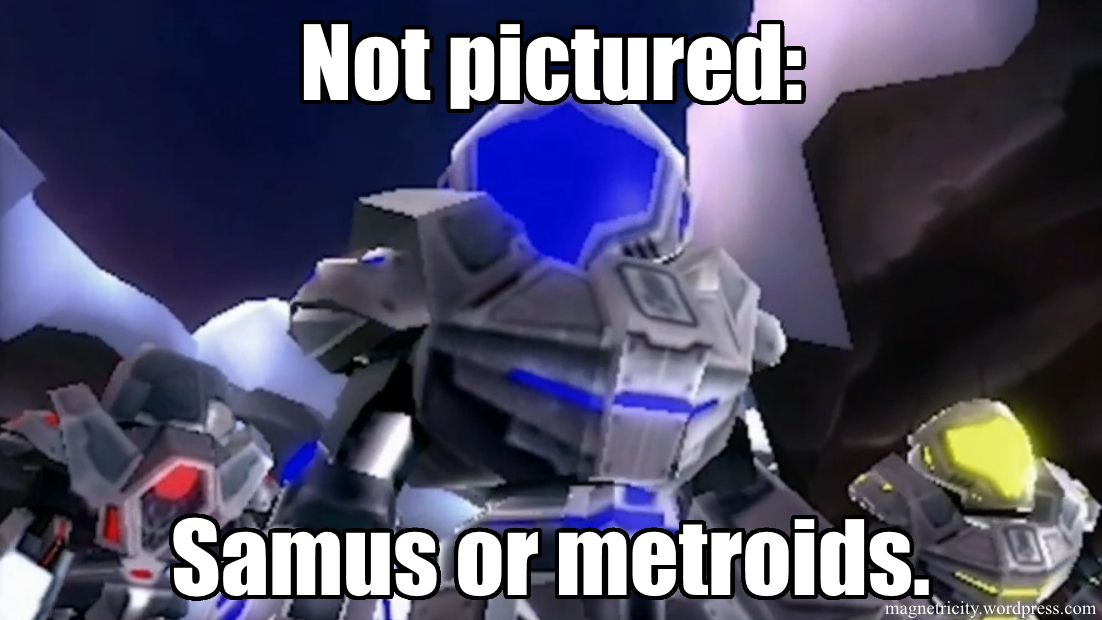
What we see is a trailer for a four-player shooter game that doesn’t have Samus or Metroids in it, but the name Metroid was slapped on it anyway.
This game stars four Federation troopers. You know, those guys that get killed in Metroid Other M? There’s a reason why troopers are depicted without their faces in IPs like Star Wars: you’re not supposed to care about them. Troopers are an archetype of disposable character that get killed in large numbers and no one bats an eye. In Metroid Prime Hunters, the different playable characters at least had individual aspects beyond what color they were. It’s like in Metroid Prime Federation Force, you’re being challenged to care less about the main characters.
To make matters worse, the troopers depicted aren’t the sweet-looking ones seen in Metroid Prime 3 or Metroid Other M. Instead, these troopers have the composition of lego men. It’s an ironic thing: at this year’s E3, Sony showed off an HD remake of Final Fantasy 7; the original version of which had polygon models that looked like they were lego characters. Nintendo took something gritty and realistic like Metroid and did the opposite. At least when Nintendo changed the graphical direction for The Legend of Zelda: the Wind Waker, the game still starred Link. Where is Samus in Federation Force? And for that matter, would we really want to see what they’re doing with her?
Also, Metroid Prime Federation Force is being packaged together with Metroid Prime Blast Ball. Which, once again, doesn’t seem to star Samus at all. When you think Metroid, what do you think of? Do you think of sports? No? Me neither.
Again, what was Nintendo thinking? Here is one guess:
Nintendo manager: What are you working on there? Former Metroid staff member: I know that you didn’t want me working on Metroid games since Metroid Other M, but I have this neat couple of pet projects here that have a Metroid theme. One is a soccer variant, and the other is a game starring lego versions of Federation troopers. Nintendo manager: They look terrible. Get back to work. I have a meeting to go to. Later, at the board meeting… Nintendo director: Metroid fans have been begging for a new game. E3 is coming up real soon. Do we have a game or two that we can slap the Metroid name onto and hastily throw a trailer together for? Nintendo manager: YES SIR!
You know that Nintendo really messed up when, right after the announcement, the first result for a Google Search for “Metroid Prime Federation Force” is a petition to have it cancelled. If you’re interested, here is a link to that petition. You can sign it to try to send a message to Nintendo that this isn’t the kind of Metroid game we want. I don’t think it would make much of a difference. Nintendo is probably determined to release this game, not caring much about fan objections that it doesn’t look like a Metroid game. If they release it, and it fails, they’ll probably take it as a sign that we’re not interested in Metroid games anymore, and they’ll probably just stop making them.
That’s why I’m happy that there are projects such as AM2R. The way things are looking, the ones who remember what Metroid games are really about are the fans. While Nintendo is making shooters about impersonal characters in multi-player battles, the ones that can really be counted on to make games in the true Metroid fashion are players themselves.
UPDATE (6/18/2014): In an interview with Kotaku, Nintendo’s Kensuke Tanabe revealed some features of MPFF, including:
Samus will make an appearance, and
You will be able to see metroids in a certain mission.
This doesn’t change the fact that I was disappointed with what I saw. The game looked bad for a DS title, it doesn’t look like a 3DS title with a concept that’s been around for 10 years. If it’s been in development for even half that time, I’d wonder just what they were doing.
Samus making an appearance doesn’t make MPFF a Metroid game any more than it makes Super Mario RPG or Kirby’s Dream Land 3 Metroid games. If Nintendo wanted us to know that Samus and Metroids were in MPFF, why didn’t they just include them in the trailer instead of having someone from Nintendo say so in an interview on the second day of the E3 trade show? It looks like Nintendo knows that the fans don’t like MPFF, and they’re doing damage control.
I’m seeing comments appear calling those who signed the petition to have MPFF cancelled entitled or crybabies. I don’t think the petition will make much of a difference, Nintendo will probably release the game anyway. If someone wants to express disappointment or even issue a complaint with Nintendo because the game looks like a waste of the silicon it was printed on, that’s up to them. When (and if) the game is released, the vote that will really matter is the votes that we make with our money. I might play it, but that’s going to be far more likely if, by the time it’s released, it looks much more like a Metroid game than what I saw in the sad excuse for a trailer that Nintendo showed for it (and for that matter, it would have to look much more like a professional product).
There are those who passionately white knight this game, but I don’t see much point. Even if it were revealed without the Metroid name, it would still look like a seriously sub-par FPS game that looks several generations behind even 3DS launch titles. Think that’s a harsh assessment? Look at just about any 3DS game, and compare it to what we’ve seen so far from MPFF. Nintendo’s 3DS can do much better than PS1-level visuals. Take away the Metroid name, there still wouldn’t be much to defend. As it is, it may be one of the biggest mistakes that Nintendo has ever made.
UPDATE (6/23/2015): The petition is only a week old and has over 20,000 signatures.
UPDATE (6/25/2015): The backlash against Metroid Prime Federation Force has gotten to the point that it’s caught Nintendo’s attention. Nintendo of America president Reggie Fils-Aime has responded:
“Look, we know that fans want a straight Samus Aran game,”
Sounds like we’re off to a good start, right?
“We also know that the best way to launch a game is to surprise and delight them, to give them a launch date, in an environment like this let them play it versus what other companies do, which is to announce a project that you may not see for five, six years. It’s just not the way we do things.”
Oh no? We don’t have a launch date for MPFF. As for letting us play it, was it even playable at E3? I mean outside of the Treehouse meeting where the press watched Nintendo staff play it. Was that what you meant? It’s nice that Nintendo announces projects that they’ve already been working on for years, so that you have something to show with your announcements. But did you really mean to suggest that Federation Force has been in development for years? Because it doesn’t look like it.
“Remember when that art style was first shown. The uproar from the Zelda community was intensely negative. If there had been social media then, there probably would have been a petition to make that game go away.”
Reggie, you’re the president of the American branch of a huge tech company. Did you really not know that there was social media back in the year 2002? Does “Friendster” ring a bell? How about “Xanga”? Or SixDegrees.com, or Classmates.com?
Do you know why there was an uproar over the art style of Wind Waker? Because it was inappropriate. It went against the image that the public had of The Legend of Zelda. There are people who have never played it because the game looked ridiculous to them. That means that this endeavor:
“(We) will also push the envelope in developing something that we know is high-quality and that we know will deliver in the marketplace.”
…May very well be rendered self-defeating.
Image matters. Those who dismissed Wind Waker as silly missed out on a high quality game. That’s not just their loss, it was also Nintendo’s. This is because they didn’t buy it. Making games that gamers aren’t likely to buy doesn’t seem like a good business practice. And if feedback has been an indication (and it usually is), MPFF isn’t going to do so well.
“We know the community wants to see a straight-up Metroid game. We know it.”
Thank you. That says a lot: it’s an indirect admission that MPFF is not the game we were waiting for, and it indicates that you do understand, at least in part, what we are expressing. What it means to me is that the Metroid franchise might not end on the sour note that is MPFF.
When it comes to introducing sequels and new entries in IPs, there is such a thing as taking too big a risk. Metroid Prime Federation Force is an example of a big risk being taken, and it didn’t go over well. I’d think that Nintendo would understand that some amount of predictability is a good thing. Imagine if, after years of not seeing a new Pokemon game, Nintendo announces a Pokemon racing game. Or if, years after not seeing a new Legend of Zelda game, a Zelda tennis game was announced. There’d probably be rioting. It’s been years since seeing a new Metroid game. Is it unreasonable to ask that the next one stars Samus Aran?
A Metroid sports game? What was Nintendo thinking?
Smogon banned Landorus. As of Friday, their members that achieved voting requirements have already reached a supermajority (of 75.5%) that was so overwhelming, that any further votes would not have changed the outcome. Therefore, the Incarnate form of Landorus is banned from OU, and is restricted to the Uber tier (or Anything Goes).
Wait, what?
I’m a little surprised that Landorus Therian form wasn’t the form being suspect tested. Landorus-T is the form that’s been consistently appearing in the top five for OU usage statistics.
Having said that, both forms of Landorus can cause serious problems. Both have excellent typing, both offensively and defensively. The combination of Ground and Flying types gives Landorus immunity to two popular attacking types. Landorus-I possesses an excellent speed tier, and both have access to Rock Polish for increased speed. Better yet, it doesn’t get paralyzed with Thunder Wave. Both have excellent abilities, with the nod going to Landorus-I, whose Sheer Force ability brings it’s already-high attack stat to stratospheric levels. Better yet, it can hold Life Orb for higher damage yield.
While it might be surprising which form was chosen for suspect testing, the outcome isn’t very surprising. Landorus was a very overcentralizing force. It was heavily used for a reason: it was very strong. Now Smogon’s popular OU environment will find itself adjusting to an absence of Landorus-I.
There are those who are on the outside looking in, who typically come about in times like this with something like the following:
Smogon bans every pokemon I like. They think they can change the rules for everyone. I don’t understand what Smogon is doing.
If Smogon only bans the pokemon you like, you probably like pokemon that are seriously unbalanced. Contrary to popular belief, Smogon isn’t out to change the rules for everyone. Smogon makes their rules for use in their own competitive environments. Those rules are not intended for use by any other community. This means that, unless you’re battling in Smogon’s competitive community, Smogon’s rules don’t apply to you.
So one might ask, “Why are there so many competitive battling communities that go by Smogon’s rules?” Even Serebii.net, with it’s Pokemon of the Week feature goes by Smogon’s rules. Why do they do this? Because Smogon is so popular, that they’ve become heavily trusted by fans. Some even trust their decisions above official Pokemon competitive rulings. Considering that the official VGC competitive environment is Garchomp and Mega Kangaskhan spam, it’s easy to see how someone would desire something more balanced. Smogon certainly has a far stronger mechanism for player input, which is natural, considering that Smogon.com is run by Pokemon players.
It’s not Smogon’s intention to try to change the game for everyone. Instead, many webmasters choose to adopt Smogon’s rules for their own competitive environments. Even among casual players, it’s easy for a person to say “let’s play this match by Smogon’s rules” and it’s not unusual for the other player to understand what this means.
What Smogon is doing seems pretty obvious. They are attempting to create a competitive Pokemon environment that is balanced. Smogon’s rules are as popular as they are because they have a very effective system for balancing competitive play, which is something that Nintendo and GameFreak don’t seem to spend much time bothering with.
So, Smogon banned Landorus’ Incarnate form. Perhaps its Therian form is next.
I’ve heard it said over and over again that Pokemon stole from Digimon with it’s new Mega Evolution game mechanic introduced in Pokemon X and Y. And while this is not true, it’s repeated again and again by uninformed people who didn’t bother looking into it.
Their statements basically come down to this:
Pokemon, after coming up with original content and implementing new and novel gameplay mechanics for well over a decade, decided to steal the concept of Mega Evolution from Digimon, and thought it would go unnoticed in spite of the fact that millions of people have played Digimon, and that there would be plenty of geniuses out there who notice the vague similarities.
The main reason anyone makes this mistake seems to be because of the use of the word, “mega”. But here’s the thing:
There are no mega digimon.
This might sound surprising, but it’s actually true. I know that if you’re playing the English version of Digimon, the Digimon growth stages are listed as follows:
DigiEgg
Baby
In-Training
Rookie
Champion
Ultimate
Mega
And I know what some of you are thinking: “Look Raizen! It’s right there! Mega! Its the last one on the list! Did you miss it?”
However, what most English players of Digimon don’t realize is that, in the English versions, the assignment of the words Ultimate and Mega for the last two stages is the result of a mistake.
Here is what the stages were called in the original Japanese version:
This is what the stages are actually called. Notice how there is no Mega stage? It is actually called “Ultimate”.
When Digimon was being translated to English, a mistake was made: The “Perfect” stage was instead called the “Ultimate” stage. The translators were probably informed that the final Digimon stage was called “Ultimate”, and thinking that the Perfect stage was the last one (as the word “Perfect” implies completion), they assigned the name to that stage, instead. When the real Ultimate stage was revealed to them, they had already given the name to something else. Oops. So the last stage was called “Mega” instead.
So there you go, the only reason anyone thinks that there is a mega digimon stage is due to a mistake made by translators. There are no mega digimon.
Some, being informed of this irrefutable statement of fact, might still take issue with the temporary nature of Mega Evolution as being too similar to the temporary nature of Ultimate-level digimon. Does it really need to be pointed out that both Pokemon and Digimon came from Japan, which are very familiar with the concept of transforming characters?
The following is an incomplete list of Japanese IPs with characters that can transform:
Dragonball Z
Kamen Rider
Sailor Moon
GaoGaiGar
InuYasha
Ranma 1/2
Magical Doremi
Moetan
Cardcaptor Sakura
Mermaid Melody
Sonic the Hedgehog
Naruto
Rosario Vampire
Magical Girl Lyrical Nanoha
Yu-Gi-Oh!
Shugo Chara!
Voltron
Demashitta! Powerpuff Girls Z
Bleach
Q-Ko-Chan the Earth Invader Girl
Tokyo Mew Mew
Pretty Cure
D.N.Angel
Most or nearly all super sentai genre anime and manga not already on this list
Most or nearly all mahou shoujo genre anime and manga not already on this list
And there’s more. Lots more.
There is a reason that the concept of transformation and reversion occurs so frequently in manga and anime: it’s a sweet concept. So don’t be surprised if, after nearly twenty years, GameFreak finally decides to implement it as a gameplay mechanic in Pokemon (counting characters like Rotom, Castform, Shaymin, Meloetta, Kyurem, Giratina, and Deoxys, they’ve been doing it for a while).
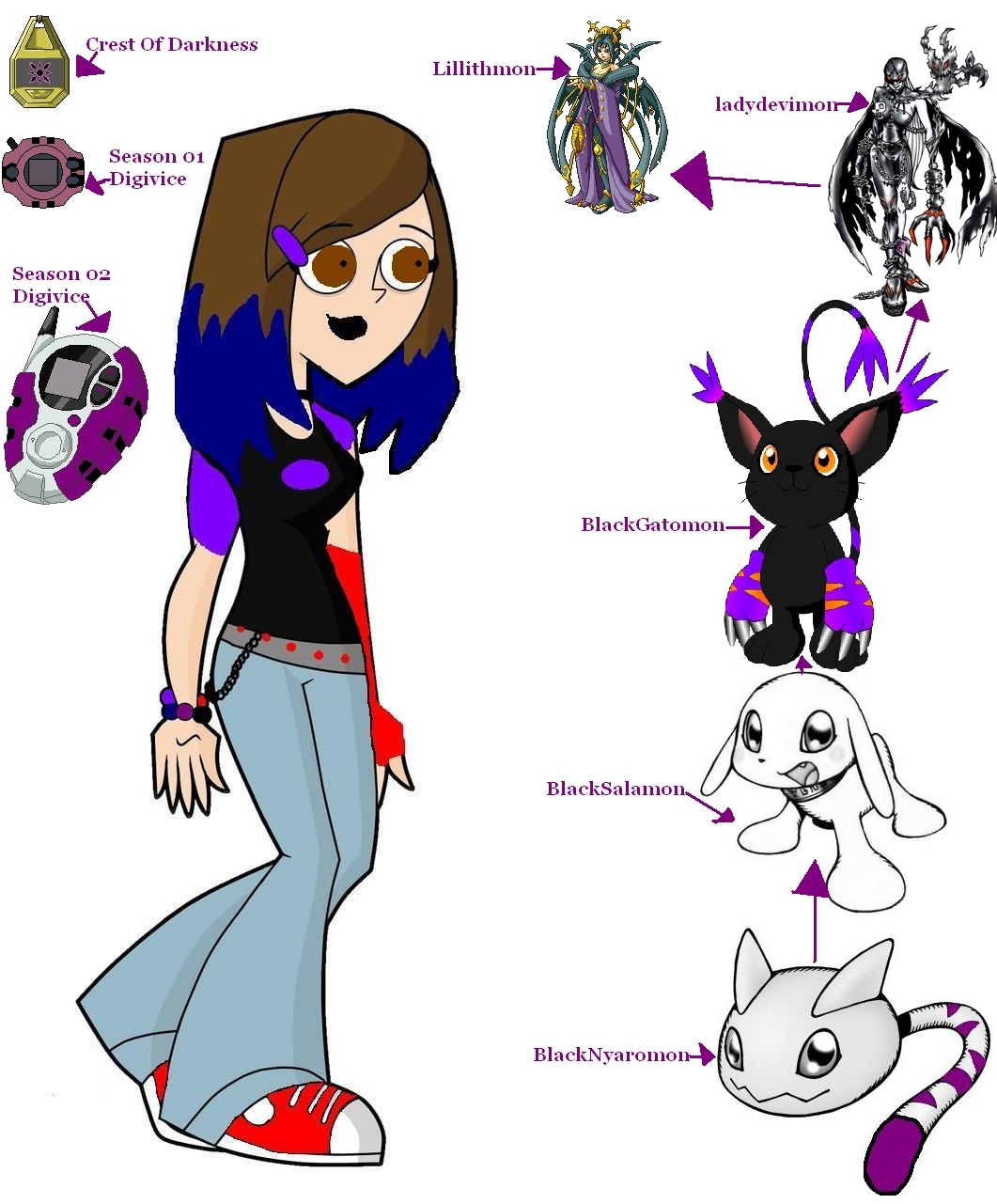
At this point, someone might grasp for straws, saying, “What about Digimon crests? They’re like mega stones! Pwned!!” What about them? Crests were pretty much discarded as a concept after the end of Digimon Adventure 1 and 2, when Digimon was still young. They were a plot device that emphasized character development rather than a necessity for digivolution. Digimon could reach the Ultimate stage without their help. Now if only the Digimon anime emphasized that point… Oh yeah, it did, and legions of Digimon fans missed it. Some fans they are.
A thing about fans: it seems like a lot of people take the word “fan” lightly, and apply it to themselves not knowing what it means. People seem to like calling themselves “fans” of something if they like a concept or sometimes watch an episode of a TV show. What most people don’t seem to realize is that “fan” is short for “fanatic”, and that it implies a consummate level of involvement that perhaps goes well beyond nerdhood. A person isn’t a “fan” of House M.D. if they watch an episode now and then. A person is a fan of House M.D. if they’ve watched just about every episode, maybe some of them several times.
A person isn’t a Digimon fan just because they watched the Digimon anime on TV once. Also, a person doesn’t get to call themselves a Digimon fan if they didn’t know that there wasn’t really a mega digivolution stage, because they didn’t know one of the most basic things about Digimon. However, if you have a poster of Kari Kamiya bathing on your bedroom wall, you probably are a Digimon fan.
Or if you’re a 23-year-old overweight woman that draws things like this.
A lot of people miss this, but mega evolution isn’t in every case from a third stage to a fourth one. In some cases, it’s from a first stage to a second one (such as for Mawile and Absol). In this sense, mega evolution could perhaps be more closely compared to “burst digivolution”, but most people who are familiar with Digimon aren’t even aware of what burst digivolution is because most people who are aware of Digimon don’t know much about it outside of the anime up to Digimon Tamers. After that, Digimon fell from cultural relevance, and the show and games could have been about just about anything, and people would largely not even notice what they were doing.
So some might point to burst digivolution and say that Pokemon stole that idea. Nope. Yeah, there are digimon that require an item to digivolve, but Pokemon has been doing that for a long time. It’s been a thing since the year 2000, when Slowpoke and Onix needed hold items to evolve to Slowking and Steelix, and there were others like them. Remember that?
However, it’s a moot point. Pointing out coincidental similarities between two very similar intellectual properties pretty much gets nowhere, especially considering that one of them (namely, Pokemon) still sells Nintendo handhelds and has had characters that appeared on commercial airliners, among other things, while the other (namely, Digimon) hasn’t been culturally significant in well over a decade. Really, why would a highly successful intellectual property that’s going on to two decades old want to emulate a different one that hasn’t been popular in a long time, and wasn’t really a big deal to begin with?
I think any reasonable person would be persuaded by now. Pokemon did not steal the Mega Evolution mechanic from Digimon. If you know someone who disagrees, there is something that you can do for the winning side: provide them a link to this article.
Digimon fans, don’t get upset. You can still enjoy your favorite game while knowing that Pokemon didn’t steal from it. It’s been the case for over a decade, anyway. This isn’t an article about how Pokemon came first (you can read more about that here). In fact, you probably just learned something about your favorite game (that there is no Mega digivolution stage). Everybody wins.
Serebii featured Lopunny as it’s Pokemon of the Week, and personally, I think they could have done more with it.
Lopunny is very viable in competitive battles, thanks to the recent addition of Lopunnite in Pokemon Omega Ruby and Alpha Sapphire. Here are a few movesets that I think Lopunny can use well.
First, I’ll start with one that I use. It’s similar to one that Serebii featured, and I think it can be considered a pretty standard Lopunny set:
Not a hard set to understand. Get Lopunny out there and mega evolve it, get some chip damage in with Fake Out, and then treat it as a fast Normal/Fighting sweeper, with one cool twist: thanks to the Scrappy ability that Lopunny acquires, it can hit the Ghost types that might otherwise switch into it with little problem with it’s Normal and Fighting moves. In fact, Mega Lopunny’s High Jump Kick is super-effective against Sableye. Ice Punch is for coverage.
Usagi Yojimbo
Lopunny
Jolly Nature
Ability: Limber
Item: Lopunnite
– Cosmic Power
– Drain Punch
– Return / Ice Punch / High Jump Kick / Baton Pass
– Return / Ice Punch / High Jump Kick / Baton Pass
252 HP / 128 Def / 128 SpD
Looking at Lopunny, one might not figure it to be a tank. But it does have decent defenses and access to Cosmic Power, so Lopunny can function as a tank with very high speed, and can use Drain Punch for recovery. The last two moves would depend on what supports Lopunny’s team well, with Return, Ice Punch, and High Jump Kick being attack moves that work well on Lopunny, and Baton Pass for passing on Lopunny’s defensive boosts. As for the EV spread, it can be adjusted depending on what seems like a bigger concern. One could go with more Defense or Special Defense, or max both with just a little in HP to focus on getting more out of a Cosmic Power boost. Impish or Careful nature boosts Defense or Special Defense, respectively, and may be preferable if you don’t care too much about the Speed for this set.
Last Resort Rabbit
Lopunny
Jolly Nature
Ability: Limber
Item: Lopunnite
– Fake Out
– Last Resort
– (blank)
– (blank)
252 Atk / 4 Def / 252 Spd
A very straightforward set. Lopunny comes in and uses Fake Out, and having done that, it can use Last Resort, its only other move. Fake Out helps with chip damage, and gives Lopunny a move to go with Last Resort so it will work. Scrappy really benefits Lopunny with this set, otherwise Ghost types would wall it. One might ask what this set would do about Rock and Steel types that would resist this set’s two moves. When up against these, it might be a better idea to switch Lopunny out and let one of it’s teammates deal with them. If hard-hitting, fast, and simple are how you like your pokemon, I think this set is something you’d probably enjoy.
I like Serebii’s Magma Head set, however. Lopunny can use Substitute pretty well. It can be tempting to put Drain Punch with the Magma Head set, but I think Power Up punch’s attack boost can serve Lopunny well. I don’t know why they called their set “Magma Head”, though.
Handheld gaming platforms have been some of my favorites. Because of this, I like seeing handheld gaming platforms succeed. And they are, if one is looking at Nintendo’s 3DS and mobile platforms.
However, not every gaming platform does well, and one such example is the Playstation Vita.
It’s predecessor did well. In fact, people were ready for the Playstation Portable to take the world by storm. I remember, after hearing that Sony was working on a handheld gaming console, one magazine predicted the end of Nintendo’s dominance of portable gaming. While this doesn’t seem unusual for a guy expressing his opinion, what was unusual was that it was being expressed in a review for Final Fantasy Tactics Advance for the Gameboy Advance. (By the way, if you’re wondering what a magazine is, it’s like an iPad made of trees.)
Of course, that didn’t happen. Nintendo released the Nintendo DS, and it outsold the PSP by far. However, the measure of a console’s success isn’t necessarily expressed by it’s sales numbers, but Nintendo clearly dominated handheld gaming, to the point that just about anything that competed with Nintendo handhelds didn’t stand a chance. Remember the NeoGeo Pocket Color? It was a very interesting system, but there wasn’t much marketing for it, and there wasn’t much of a variety of games. The Wonderswan handheld did okay in Japan. It had potential, but it wasn’t released in America.
So Sony, the company that upset Nintendo’s dominance of console gaming, was coming to handhelds. As people saw it, if anyone could put a dent in Nintendo’s dominance of handheld gaming, it would have been them. The PSP did very well due to a combination of marketing and the awareness of the Playstation brand. At the time the PSP launched, sales of the Nintendo DS were slow, so it looked like a possibility that Sony would release Nintendo’s grip on handheld gaming, as they did with console gaming. However, Nintendo DS’s software library improved, while things were more steady for the PSP. The DS ended up selling about twice as much as the PSP.
However, Sony still did something very significant. Even if they didn’t become the leader of the handheld market, when a game system sells over 80 million units, it’s usually considered a success.
Again, a console’s success isn’t necessarily expressed by it’s sales numbers. Sony didn’t have to become market leader to come away with a major victory: demonstrating that they had what it takes to compete with Nintendo, and take away a significant share of the market.
Even so, PSP’s story also had it’s downs. Sony sold it’s systems at a loss, with the strategy of recovering losses with software sales. This isn’t an unusual strategy. Console manufacturers have been doing this for a while, and they have been staying competitive. In the PSP’s case, however, the handheld initially cost far more to produce than the MSRP, and around the time the PSP launched, Sony’s gaming division was losing money, and the company overall was having financial troubles.
When the PS2 launched, the DVD was a new media format. A significant part of the PS2’s initial success was the fact that, for many people, the PS2 was their first DVD player. When the PSP came around, however, Sony had the idea that people would want to watch movies on their proprietary UMD format that (as far as I could tell) only played on PSPs. That didn’t work out. However, the PSP went on to sell millions, doing very well in a market that was dominated by Nintendo. Later, Sony released the PS3 with the ability to play BluRay disks. Some bought up PS3s because it seemed to be a better value than new BluRay players at the time (even though a new PS3 cost about $600 at the time it launched!). However, BluRay didn’t take off very well, and neither did HD DVD (which the Xbox 360 supported), it would seem that this was because the two had the bad timing of having to compete with streaming and digital downloads. This was likely another determining factor for the Wii’s success: the Wii wasn’t expensive due to lack of a DVD, BluRay, and HD DVD movie player feature, and owners could just use Wii to watch YouTube or Hulu on their TV.
When the PS Vita was revealed, I could tell that it wasn’t going to do well. Yeah, it did have what it takes to succeed as a handheld game console: a meaty processor, game cards instead of a disk drive, internal and removable memory, and some high-profile games. However, it just seemed like it wouldn’t do well.
For one thing, I didn’t like their proprietary memory cards (memory sticks?). Did Sony have something against SD cards? Even Nintendo’s 3DS had a slot for SD cards, even though that was unexpected. Therefore, I could swap files between my computer and a 3DS easily. I don’t know whether Sony did release a Vita memory card adapter for PC. Considering that they’re a huge media company, it’s hard to imagine that they would want to prevent a person from swapping files between a Vita and a PC.
For that matter, there wasn’t much marketing for Vita outside it’s launch period, and even that wasn’t very pronounced. That was a problem considering that Vita looked so similar to the PSP, that aside from some slight difference in dimensions, a casual observer wouldn’t see much difference. This was also initially a problem for the 3DS when it was new, but when the 3DS’s price dropped, gamers were much less hesitant to buy one. And when the 3DS XL model was introduced, the 3DS took off. Vita’s price wouldn’t drop until the next year. As a result, Nintendo’s 3DS ran circles around Vita, and by the time Vita’s price dropped, Sony had already dropped the ball.
Nintendo 3DS and Sony PS Vita are very different, so why compare them? Because they compete, so the success of one may depend on it’s ability to take a large part of the other’s base away. This has been a problem for PSP considering that many PSP owners also had 3DS systems, but the same wasn’t always true the other way around. Therefore, there were a lot of PSP owners out there that may not have viewed their PSP as their primary portable gaming system. Mobile gaming became huge during the PSP and DS’s lifetimes, and many gamers, if they had to choose two portable gaming platforms, would choose a mobile platform and a Nintendo platform. This seems to be the case again as 3DS and PS Vita compete.
Me, I had actually gone a while having forgotten that there was a PSVita. Later, I saw that they were still available for purchase at Gamestop, and I saw that Sony was still going at it. There still doesn’t seem to be a lot going on with the PS Vita, however.
It’s been over three years since the PS Vita has launched, and the system has only sold about 10 million units worldwide. That’s not very good.
So, will Sony continue to bother with handhelds after this? It would seem that Sony is considering a redesign of Vita, perhaps a minor version 3 revision. E3 is just next month, and perhaps it will be announced there. However, it doesn’t seem likely that Sony is doing another handheld soon. Sony has been in financial trouble for a while, and it might be that they’re cutting back on projects that have been costlier for them.
Will things turn around for the PSVita? I don’t know. The market for video games has been very fickle. But one thing that seems consistent is Nintendo’s success in portable gaming, and that’s likely to continue. That doesn’t mean that Sony couldn’t be profitable in the area of portable gaming, but they’d have to improve their strategy quite a bit. They’re not doing very much to market Vita, though it could help them a lot. Perhaps they could also benefit from a clearer focus, competing with either Nintendo’s 3DS or mobile gaming, and in so doing possibly winning a few sales in the process. As it’s doing now, however, it’s like the PSVita is barely there, not making much of an impact.
Considering how it’s been performing, perhaps it would be better for Sony to just let the PS Vita go, and instead focus on their next project.



 Magnetricity