Looks like we have a new protest song. It’s genius, so give it a listen and share it about, if you feel so inclined.
Our tax dollars are going to scams, but at least we have a song about it.
Leave a reply

Looks like we have a new protest song. It’s genius, so give it a listen and share it about, if you feel so inclined.

Lately, I’ve been thinking more and more about Mike Judge, and how it seems as though he was trying to warn us.
You’ve probably heard of the nineties film, Idiocracy. To summarize: a man was deemed to be completely average. Most relevant to the plot, he had average intelligence. He was then cryogenically suspended for 500 years.
At the time he was released, every other person on earth was so stupid that he was easily the world’s smartest man. It was to the point that people thought that the right way to hydrate the ground for agriculture was with sports drinks, resulting in a famine because they were salting the ground.
The popular notion about natural selection is that it’s survival of the fittest. But that’s actually not true. In reality, it’s survival of the most adapted. And this is still relevant for humans, because a major shift in society brings with it a shift in selection pressures.
Society is in trouble today, for a reason similar to how people ended up stupid in Idiocracy. In current society, selection pressures favor the stupid.
Consider how intelligent people start a family. First, they prepare. They build a career by seeking an education, putting together a resume, then cultivating years of professional experience. They build credit, and look for a home and a car, and in many other ways prepare themselves. It takes years, but they eventually consider themselves viable for the dating market, into which they start to dip their toes. A problem with this approach is that it pisses away some of the most fertile years of one’s life, so by the time they consider themselves ready, they’re probably only going to have a few children, assuming they succeed in finding someone.
Stupid people don’t worry about any of that stuff. They have sex because there’s pleasure involved, then deal with the consequences, ready or not.
As you read through all this, you’re probably wondering what this has to do with the title. How does this relate to late stage taxation?
One thing I learned about people and myself from video games is that people act based on incentive, even if the playstyle results in an experience that’s different from what the game developers intended.
Someone playing Pokémon Gold might want a shiny legendary Pokémon. They might save in front of the Pokémon and soft reset until it appears as a shiny, then go to the frustrating task of trying to catch it, assuming they wouldn’t just huck a valuable Master Ball at it.
They could go to that trouble. Or they could catch an ordinary version of that legendary, arrange a box in a certain way, then use arbitrary code execution to make it shiny, possibly saving many hours.
The incentive is to try to obtain what’s desirable in little time, even if it means that the game is being played differently from how the developers intended.
This holds true in life, as well. When you account for incentives, people become a lot more predictable.
The political class is one example. If an incentive exists for them to pursue a certain policy, they can be counted on to pursue that policy. They might do this even if the result is a society with undesirable selection pressures, especially if they can avoid the brunt of those consequences.
For a politician, the incentive lies with whatever gets them more votes. This is easy to accomplish with entitlement programs. For one thing, the people who act on incentive to accept these programs are also incentivized to vote for the politician who enabled them.
What’s more, it’s a snap for that politician to maintain good optics with such a show of altruism. Of course, it’s not true altruism because it’s being funded through the coercion that is taxation, taking from those who actually produced value. However, there are multiple layers of abstraction separating the coercion from the false altruism, allowing everyone involved to maintain plausible deniability.
This is all pretty bad. But it gets worse. There are three parties with an incentive to increase entitlement programs further, as well as the number of people on the government dole:
In fact, someone is paying for it: the productive class. Their incentive is to resist this massive theft. But as the political class have more and more people legally bribed, the productive class can do less and less about it.
And as the incentive to join the productive class dwindles, fewer people will want to join it. But as this happens, less is produced. Thus, there is less value to extract from the few left who are actually producing it.
As working Americans’ paychecks are being taxed into a black hole, they’re being convinced that they didn’t start a family when they wanted to due to a failure on their part.
All this is a recipe for a collapse of a society, which is the expected outcome as this continues.
As the birth rates of native populations collapses, politicians don’t take accountability for their contributions to the problem. That is not where their incentives lie. Rather, their incentive is to further expand their political power by replacing the native population with a migrant population, whose loyalty can be bought with value extracted from the already distressed native population.
Thus, the productive class who are already heavily taxed have a far more backbreaking burden placed upon them.
We already have a publicized example of what can happen when such corruption reaches an advanced state: the recently publicized Minnesota Somali entitlement scams. As was famously exposed by a citizen journalist, entire buildings had numerous empty daycare and Medicare offices, which weren’t doing much of anything, and all refused to assist the journalist in their respective alleged professional capacities. All while still accepting millions of dollars in funding taken from taxpayers.
One of which, famously, misspelled the word “Learning” on its sign.

This brought national attention to how funds are being misallocated in Minnesota. Minnesota governor Tim Walz dropped out of the race for reelection shortly afterwards, which wasn’t great optics for him.
To think that guy could have been the Vice President of the United States.
While the whole matter got widespread attention on social media, and action has been taken concerning this massive fraud, we’d be dreaming if we thought that something similar wasn’t happening all over the country, and not necessarily involving the same ethnic group.
In fact, this can be stated with almost complete confidence. Why? Because the leftist establishment involved with the Somali daycare fraud were acting on incentive, and the incentives to try something similar exists elsewhere, too. And when it comes to incentive, people are predictable.
I’ve mentioned intelligence and Somalis in the same article, I suppose I can give my opinion of Somali intelligence, seeing as it’s topical. Personally, I don’t see it as being as relevant as people make it out to be. After all, fraud is fraud, regardless of the intelligence of the person who commits it.
When I heard it said that the average IQ of a Somalian is 67, I was skeptical. After all, this is over two standard deviations below the mean, and well below the point where a person is too low to be allowed in the US armed forces. This is because it’s prohibitively difficult to train such a person to the point that they can carry out their duties autonomously.
Just imagine the implications for such a person if they were to attempt to enter the workforce. What is society supposed to do with such a person? It seems much of us have decided to grant them the means to live in relative comfort.
Even if one were to accept that intelligence has a genetic component, which seems to be the case, that there would be an entire country of people where most are low IQ to the point of being handicapped is a stretch to accept.
But it seems as though, whatever the intelligence of Somalis happens to be, this intelligence isn’t what was considered when the administrative state decided to use them as a pretext for extracting more wealth from productive Americans, or when Democrats decided to attempt to exploit them for votes, building power for themselves. But those same Somalis are predictable if they decided to move somewhere where they’d be given plenty of money, even if they accomplished nothing.
To be honest, I care less about the stupidity of Somalis than I do about the stupidity of Americans. And considering that there are Americans who are not only okay with the fraud, but are committing the felony of obstructing federal officers because they want it to continue, I imagine that our ancestors in their mud huts would wonder where things went wrong.
But tell them how selection pressures in late stage taxation favors the stupid, they’d probably wonder why anyone would allow matters to get to this point.

Be you.
No criminal record.
STEM major, because that seemed like the smart guy thing to do.
Graduated with honors.
Employed at production facility for a few years.
Makes just a couple more dollars per hour than someone who stocks grocery shelves nearby.
Goes home to a one-bedroom apartment in a car with mechanical problems.
Hasn’t been in a relationship in about a decade.
Tired of the same struggle meal that was had a few days in a row.
As far as you can tell, you did everything right.
The people on TV, social media, and in movies tell you that it’s somehow your fault, and that you deserve it, somehow.

Be Homer Simpson in the mid-nineties.
No college education.
Is a lowly nuclear power technician.
Has a wife and three children.
Lives in a house in a nice suburb, even the baby has her own bedroom.
Can afford to go on vacation three times a year.
Can buy new stuff like a grill anytime he wants.
Doesn’t seem to do anything right.
The entire point of his sitcom is that he’s a lower-middle-class loser.

Be some rando Somalian.
No education, period.
Goes to country that’s a better place because it’s not run like the shithole he’s from.
Rape was literally legal in his home country just five years ago.
Contributes literally nothing to society. Average IQ beneath legal threshold for being considered disabled.
Is paid millions of dollars by the government just for repeatedly showing up to an empty building with a misspelled day care sign.
Has a sports car and lives in a large lake front property.
His fraud is exposed, but there are Americans who are actually okay with it, for some reason.
I think it’s time we started having a conversation about what’s wrong with society.

Let’s hear it for the highest grossing intellectual property in all of human history, because they have really done it this time.
Starting Friday, September 26th, a special distribution event for special characters for Pokémon Scarlet and Violet was to commence. This event made shiny variants of special legendary Pokémon available to players, and which one they got depended on the version of the game that they played. It was Koraidon on Scarlet version, and Miraidon on Violet version.
For most of the world, the event went well. But for the distribution in the US at GameStop locations, the distribution ran into problems, quickly. Really quickly.
I have my own experience, but I’ll save it for the end, because it might be infuriating, depending on who you are.
Here’s how the event was supposed to work: players who visited GameStop could request a scratch-off code card, which they got for free, no purchase necessary. Then, the code could be redeemed on a Scarlet or Violet game, and the shiny legendary that the player got depended on which version they were playing on. And GameStop benefitted from increased foot traffic, which is great for retail outlets. Everybody happy, except for those who hate Pokémon and the people who play it, but life has always sucked for the haters.
Now, for how it really went. I probably only need to tell you the limiting factor, and you’ll probably figure it out from there.
There was a strict allocation of only 50 code cards per store.
Yeah. To put that into perspective, there are GameStop locations that sold over a thousand combined copies of Scarlet and Violet.
Many stores ran out of code cards in the first hour, which is ridiculous considering that the distribution was intended to last for weeks. If you weren’t among those who were in as soon as the store opened, you probably had to do without.
And this is in spite of some stores limiting the distribution of codes to one per customer. Remember how I said that more than one legendary was made, and which one you got depended on which version the code was redeemed on? A limit of one per customer means that many players only got one, even if they got both versions, like many of the huge fans do. That would really suck for players who wanted both legendaries, because they’d only get one, assuming they got a code at all.
As was the case with scalpers who swooped in and hoovered up the code cards for shiny variants of the Sword and Shield legendaries, so it was this time, but worse. They proceeded to hock them on eBay for a quick buck, while screwing over the hobby that’s enjoyed by many millions of fans. Currently, the codes are going for around $30. To put that into perspective, a new copy of Scarlet or Violet is $60 (prior to the DLC package, which might bring it to $95).
As far as I could tell, the US is the only country that has this problem, which suggests that the problem is with GameStop. In other countries, the method of distribution may vary, but based on what I’ve heard, it generally goes that players could request a code, it gets printed on a receipt, and there’s no limit to how many codes can be printed.
Which is a far better way to handle the distribution, even if a little clunky. But why do codes, at all? Why not do it through geolocated distributing through the mobile version of Pokémon Home? Did The Pokémon Company forget that one of their biggest mobile apps has this feature? Or, why not use Pokémon Pass? Did The Pokémon Company forget that they developed a mobile app specifically to handle this kind of situation?
There is some good news, however. GameStop has announced on X that they are getting more codes to aid in the distribution. And this time, they will be printed on receipts, like the distribution is handled in some other countries.
That’s great, right? That means an unlimited number of codes, ensuring that players who make it to GameStop before the event ends can get at least one code, right?
Except no, because the codes are once again limited to 50 per store. Even though the codes are printed, and therefore, should be without limit.
So, with 100 total codes per store, and 2325 GameStop locations in the US, this means that there are only 232500 codes distributed. Which sounds like a lot, until you consider what the sales numbers for the games likely are. I don’t know what the US sales numbers are, but the global sales for the Scarlet and Violet versions are over 26 million. Using that number, less than 1% of players got at least one code. But considering only US sales, I imagine the number is closer to 5%. But 1 in 20 doesn’t sound like satisfying demand.
It actually gets worse. The first day of the distribution, September 26th, just so happened to be the release date for 3 different TCG expansions. One of which was for the Pokémon TCG, so scalpers were already doing what they were gonna do, the code cards would have been a little extra money in the bank.
There was some Magic: the Gathering crossover with Spider-Man. I haven’t played the game in decades, so I don’t know what is up with some of these crossovers, some of which don’t seem thematically appropriate.
There was also some flipping Yu-Gi-Oh! expansion that at least one person hypothetically cares about.
GameStop basically spent an hour or two being a Disneyland for TCG scalpers, and code cards for distribution of shiny Pokémon were getting swept up in the hurricane.
So how it ended up going is that a distribution of characters that are digital, and could therefore be limitlessly multiplied, had arbitrarily low allocations placed upon them for no apparent reason, except maybe to spite players.
I said that I’d share my own experience, so here we go. On September the 26th, at about the time GameStop was opening, I was already out for something else. So, knowing about the distribution, I went to a GameStop. There was only a handful of people there.
I shopped around for a bit, thinking that if I were to buy something, that would be a little something extra to come away with. As I was shopping, I overheard someone asking for a code card. He got one. So, I asked for one, too. I got one. Then, I asked if I could get one more. I got a second. Cool!
I kept shopping, but none of the anime toys marketed to grown-ups caught my eye. So I left, two code cards in hand.
After I got home, I redeemed them, one for Violet, and one for Scarlet. After that, I found out on YouTube just how rare those code cards are.
Please don’t hate me. I had no idea the distribution would turn into such a fiasco.

To the end of arbitrary categorization, let’s look at various types of people who hate anime, with brief descriptions.
The Hanna-Barbara Boomer
This is the guy who remembers back when cartoons didn’t take their viewers seriously, didn’t bother with things like “character development” and “quality”, and still sees them as being for children, as though children don’t deserve a quality product.
The cartoons that he grew up with were boring and insipid, so it’s no surprise that he grew up to become yet another yutz who produces nothing of value, but still somehow has money. You probably somehow payed for the tech that he uses to fire off his mouth.
When he discovers Family Guy, his head will probably explode.
The MSM Karen
She’s one of the few people left who still listens to the mainstream media, so it’s no surprise when, after first hearing about anime from the MSM, she became convinced that it’s the biggest moral problem facing our country. She’s too closed-minded to listen to any facts to the contrary, which her minuscule brain will interpret as an attack against it.
If confronted with her, you can divert her attention if you were to present her with another documentary on another topic, provided the music is sufficiently creepy/mysterious-sounding, then find an opportunity to escape from this perfume-drenched outrage junkie.
The Baseball Cap
Jocko’s main beef with anime is that it’s complicated, therefore, he perceives it as threatening. And his way of dealing with threatening things is with torches and pitchforks.
The Baseball Cap looks forward to being accepted into college through a sports scholarship or, failing that, getting into the Army, unaware that the Army turns away those with an IQ under 82.
The Eagle Eye
This guy goes out of his way to make sure you know that he hates pedophiles. And because his peanut brain conflates anime with child abuse, he also hates anime and vilifies anyone who watches it.
Like anyone with dreams of being e-famous, he has a podcast that’s listened to by maybe one or two people, just in case you’re interested in the next installment of the series of “have I mentioned that I’m not a pedophile, today?” He also picks on furries. Or pretty much anything, as long as the heat’s off him and whatever the hell it is that he’s into.
The Funko Pop Bookshelf
The face of consoom culture, with the bookshelf to match. He unironically believes that buying Marvel crap makes him a better person, by reason of whatever the hell activist causes that multinational media conglomerates are currently bloviating about.
Like the Baseball Cap above, he’s an idiot. So if you were to get into the social commentary of Gundam or the psychological elements of Girls Last Tour, you’d likely be met with the same thousand-yard-stare that you’d see out of his rows and rows of near-identical Funko Pops.
The Espresso Spiritualist
This chick has the entire “You’re About to Hear Bullshit” starter pack. Power stones? Check. Thick-rimmed glasses? Double-check. Black nail polish? Standard issue. Hardcover copies of dubious spiritual tomes? It’s what the knapsack is for.
She basically believes that the Japanese are trying to hypnotize Americans with brainwaves, and that if you watch anime, you’re funding their efforts. You deal with her the same way as anyone else on this list: by not talking to her.
There you go. There’s others, but these are the kinds that are less likely to comprehend how embarrassing their viewpoints really are, increasing the likelihood that these are the ones that you’ll encounter.
I’ve been seeing Frieren come up from time to time. A friend recently recommended it to me, so I decided to make some time to watch the anime.
Two days and 22 episodes in, I think I can say I get the general premise, and can comment on the controversy surrounding it.
First thing to point out is that Frieren: Beyond Journey’s End is a work of fiction. Because I recognize it as such, it doesn’t inform my morality. If a work of fiction were to attempt to teach a moral lesson, it could teach any lesson that the author might want it to, and the scenario could be written to present it in a favorable light, regardless of what the reality of the matter might be if a person were to attempt to put it into practice.
Entertainment is supposed to be entertaining, and that’s all it has to do to justify its existence. The idea that entertainment must have a moral value is generally propagated by busybodies who don’t trust other people to think for themselves. If children are taught that entertainment is merely to entertain and not to inform moral perspectives, they could watch shows like South Park and Family Guy and still become a moral child (though those probably might not be your first entertainment choices for your child). It’s not a bad idea to instill the proper perspective to prepare them for the inevitability that they’ll come across these shows, or shows like them.
Otherwise, if your child comes across a cartoon that extols the virtues of pushing old people into mud instead of helping them across the street, there’s no telling how they’ll take it. There’s no substitute for proper parenting.
As obvious as this is, lazy parenting that failed to instill a proper perspective on entertainment has resulted in a new generation of busybodies that have become everyone else’s problem.
Based on this framing, you might guess that Frieren is Ren and Stimpy on PEDs. Nope. Frieren is about life, mortality, and friendship from the perspective of a person who, being an elf, would be likely to outlive the humans around her by many centuries. While the story takes place after another story has already concluded, it still succeeds in conveying a compelling and beautiful narrative, which is at times exciting.
So, what’s the problem?
The problem is, some people are taking issue with the portrayal of a fantastic race, called “demons”, as being evil.
For clarity, the demons in Frieren are not the mind manipulating spiritual beings that are often featured in religions, they’re more like the tieflings in Dungeons and Dragons in that they are humanoids with horns. But while the tieflings might be capable of morality on an individual by individual basis, the demons in Frieren are irredeemable psychopaths with no understanding of human desire for friendship or family, and have learned human language to the end of using it to manipulate. Which, concerning the abuse of language, makes them sound like the propagandists in the corporate mainstream information media.
I was aware of the controversy before watching Frieren. But what surprised me was just how little screen time was given to the topic of the morality of demons. The impression that I got was that demon morality was a contrivance designed to convey that Frieren’s original journey was strongly justified.
This is in addition to the antagonists being called demons, and the point was labored that they were incorrigibly wicked and that tragedy was the long-term consequence of any attempt to co-exist with them. Could the point have been more strongly conveyed?
However, for the busybodies, this is just the problem. Because as they see it, fantastic racism is still racism, and they can’t bring themselves to trust the rest of us to think for ourselves. But in coming to the defense of these fantastic psychopaths, these same busybodies are showing that they’re just the kind of people who, if they were to live in Frieren’s fantastic setting, would fall for the demon’s honeyed words.
At this point, you might have guessed that it’s primarily leftists who are raising an issue with Frieren. Yep. It’s leftists again.
And, right on brand, they want everything, including every form of entertainment, to bend the knee to their worldview, even anime and manga. Because when it comes to cultists, the usefulness of anything is measured by its utility for propagating the cult’s ideology.
But the problem isn’t just that the left seeks to subvert entertainment and transform it into a vehicle for their worldview. The left is also waging a long war against the traditional morality that derives its principles from natural law. To this end, they seek to undermine basic ethics in favor of a new set of values that is disconnected from reality and ignores the second order consequences of their own unwise behaviors.
It’s part of the reason why the left can’t meme. Memes are shortform communication delivered with an understanding of what’s considered normal, so that humor can be found in a variation from expectations, much like a punchline in a joke. Take the old cat meme, “I can has cheezburger?” For most viewers, the expectation is that a cat can’t employ language, but if it could, its syntax and spelling would likely be poor, as it is in the meme. However, if the meme were to have been presented by a vegan, and thus someone with a left-wing fringe ideology, they might include a disclaimer that they don’t condone the cat’s request, or they might object to even sharing the meme on principle.
Leftist memes tend to be wordy, and there’s a reason for that: the leftist meme is part of a deliberate attempt to redefine normalcy, and to this end, they don’t want there to be any possibility that the meme could be misinterpreted, especially in a way that may defeat their ideology.
The verbosity it would take to redefine expectations does not lend itself to shortform content. But it also reveals something about leftists: that their ideology is more important to them than whether you’re amused or entertained.
When you know this, it’s easy to see why leftists have a problem with Frieren. The rest of us have basic understandings about morality which don’t need continual reiterating. Among the points we consider axiomatic: Immorality is corrosive to families, communities, societies, and nations. Some cultures are incompatible with other cultures. There are people who make it difficult to live peacefully.
If you understand these things, then the way that Frieren handles the demons in its world shouldn’t challenge you. However, leftists feel threatened by Frieren, because the narrative of Frieren supposes a morality that hasn’t imbibed on a toxic dose of outgroup empathy.
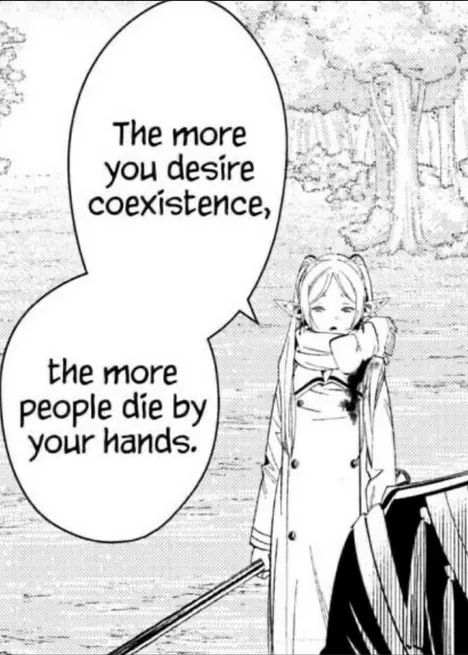
Frieren has frequently been accused of saying that coexistence with certain people is impossible. The following panel is often pointed to, which is probably the most controversial in the manga:
It has often been said that Frieren said that you can’t live with certain people. The words she used are different in the panel above, but they carry the same implication.
For clarity, here’s the surrounding context (being manga, panels and word bubbles are ordered from right to left):


While Frieren might not have used the phrase “coexistence with certain people is impossible”, it’s plain to see that this is a sentiment that she would hold, and she illustrated this while addressing a demon who was okay with sacrificing lives in an attempt at coexistence, showing that those lives were less meaningful to him than his endeavor.
However noble the demon’s stated endeavor may have sounded, it’s undermined by his inability to comprehend the value of life. It’s the old “making an omelet by breaking a few eggs” line of reasoning.
But however one might interpret Frieren’s words, it remains that the Frieren manga and anime are works of fiction. Any lesson, moral, or social statement that they make, whether expedient or not, should be viewed in that light.
After all, the main point of entertainment is to be entertaining. If leftists had their way with it, entertainment would be turned into propaganda.
And that’s one of many reasons why they must be resisted.
In times past, I would have used the term “simple situational awareness” to refer to an ability that I thought that most people had. As it turns out, this was projection, and this ability is more rare than I thought.
This was what I’ve learned through a long history of nearly bumping into people who back up without looking, or seeing people strike up conversations in doorways.
To me, one aspect of situational awareness is a reasonable understanding of your current situation, and where it’s taking place. After a long time exercising this ability, it’s almost automatic. I’d walk into a room, and note it’s layout, the exits, and likely high-traffic areas that a reasonable person would not want to poke around in if they don’t want to be annoying.
It can also be the wisdom that comes with avoiding certain behaviors, if the location is such that the behavior had the potential to lead to an undesirable outcome. For example, it hope it’s obvious why it would be risky to play pin the tail on the donkey while on an industrial mezzanine.
It seems like I’m one of the few who have this ability, which is why one of my previous employers had to put up a sign telling employees not to gather in front of the lunch room door to chat it up. It’s awesome that they put the sign up, but it sucked that they had to.
Come to think of it, I don’t recall anyone in management or anyone in a leadership position failing in situational awareness to the point of holding up foot traffic. And it stands to reason, because if someone is going to posture as an intellectual better, they can at least exhibit intellect.
When it comes down to it, the purpose of the brain in animals is to allow for decision-making for mobile creatures. To make decisions in light of our environment is one of the key features of the brain. It’s expedient to survival.
So then, why are there so many people who lack situational awareness? I’m guessing that it’s because the nature of society provides some amount of insulation from some of the worst consequences of recklessness. Sure, some consequences are still there, but they’ve been reduced to the point that people have relaxed some of their basic survival skills.
And, as you might expect, stupidity has filled in the resulting gap.
So it seems like simple situational awareness isn’t so simple anymore, it’s become more like a superpower.
Is this a superpower that you have? If you can use it, please do.

I had my own idea of how it was supposed to go. I’d set an alarm for 11:45, get some sleep, then when it came time to do a pre-order, it would be over with in minutes, then it would be back to bed. Whether it worked or not, I’d know in minutes, and could then get some sleep and later consider a backup plan.
No points for guessing that it went differently.
I was prepared to descend into battle against a bunch of bots, scalpers, and fellow Nintendo fans, as well as some social media influencers (I’ll save it for the end). What surprised me was how long it took.
My online retailer of choice was Best Buy. My reasoning had to do with the fact that the location I visited a few weeks back had a pile of PS5 Pros just sitting out, at a time when they were hard to find. Seemed reasonable to think the same store might have a few Switch 2s to spare after they would launch, so I made my account, set my location, got a page open to refresh, and downloaded the mobile app, to be safe.
Best Buy didn’t just screw the pooch, they nailed it to the porch to be thorough. Pre-order links would not become available until a half-hour after the scheduled time. Not only that, but customers such as myself had to wait in a que that gave no indication of progress. As I entertained the thought that the que was broken, I considered backing out and starting over, but didn’t want to lose my place in a hypothetical invisible line.
Eventually, I got a pre-order link! I clicked it, but for some unknown reason, it didnt work, so it was back to the back of the line. So, in addition to having been screwed and nailed, the pooch was also staple gunned.
I made additional attempts with multiple instances of Best Buy open on desktop, my phone browser, and the app, but to no avail. Out of desperation, I decided to also try other retailers.
GameStop would have probably been pointless, as I don’t remember having an account with them, and I’d probably have been de-prioritized by reason of having a new account.
Target would intermittently show a pre-order link, but each attempt to click on it would result in a failure message. The way it happened made me suspect that pre-orders were being made available in waves in an attempt to manage the traffic. That would have been an interesting plan, but it wouldn’t have been so great for those of us who’d rather get some sleep than stare at display screens in the middle of the night, which we’d have plenty of opportunity to do once we have our Switch 2 systems!
Also, I’ve been hearing that Target has been arbitrarily canceling pre-orders. That sounds like a nightmare.
Then, there’s Wal-Mart. Oh, Wal-Mart. I’ve long had an account with you. I’ve been buying lots of stuff from you. You know that I’m human. There was no need for me to hold some silly button to prove that that’s the case with a pseudo-captcha.
Personally, I suspect that it’s was the means to manage the influx of web traffic. But if they wanted to keep me busy, why not load a cheap knockoff of Space Invader to keep me entertained? The pseudo-captcha was kinda condescending.
I didn’t expect it, but it was Wal-Mart that came through. And I have an idea of how it happened, which might help people who are still trying. At some point, I noticed that a Switch 2 Pro Controller was available. I wanted one, so I added it to my cart. Later, I noticed that a Switch 2 became available.
It might be that there wasn’t a causal relationship, but it’s possible that adding to my cart another piece of Switch 2 merchandise may have sufficiently demonstrated that I probably wasn’t a scalper. If that’s how it works, it might help for those who are still trying. And if you don’t actually want a piece of merchandise, you can just remove it from your cart before checking out.
I want to see my fellow Nintendo enthusiasts succeed. As for scalpers, not so much. At least, not until they’ve reevaluated their choice to damage some beloved hobbies for a quick buck.
But then there’s the social media influencers who have been complaining about anything about Switch 2 that they possibly could, thinking that the algorithm would promote their negativity. It’s funny how interested they suddenly are in being among the first to own a Switch 2, isn’t it? It’s funnier still how many of them are angry because they couldn’t secure a pre-order of the console they already decided that they hate so much.
They’re disingenuous hacks, and they don’t deserve to have Switch 2s. And they don’t seem so cool now, do they, now that it’s obvious that they didn’t believe what they’ve been saying?
Did you hear the one about the guy who doesn’t know Jack about the games industry who is suddenly an expert on economics and geopolitics? You probably did, because there are so many such larpers shooting their mouths off. And you’re probably laughing just as hard as I am.
Days ago, Nintendo revealed the price point on their upcoming Switch 2 system, but have subsequently delayed pre-orders, as they reevaluate what they may charge for the system. This occurs as tariffs go into effect, and it seems reasonable to guess that there’s a causal connection.
While it’s easy to get ansey about how much the Switch 2 will cost, if you had the intention of buying one, you’re probably about two months away from having one, and three away from not caring what you paid for it.
How can I say that so confidently? Because I’ve been through this many times. On launch day for GameCube, I could have cared whether I had the $200 to buy one. But after that, I had one. I waited a bit to buy Wii, but after I got that, I didn’t even remember how much it cost. Same with Switch. Once the hurtle of initial expence is cleared, people are just going to move on to the next thing.
And if Nintendo is going to offer something of greater value than what they already have, wouldn’t it follow that they’d charge more for it? And if someone thinks the price is too high, they can decide not to buy it. No one is forcing anyone to make a purchase. It’s a free market.
And speaking of price points, it seems like fainting spells are on the uptick, because Nintendo is setting the MSRP for Mario Kart World at $80. People are used to paying $60 for a game, and here I’m remembering how much a new copy of Chrono Trigger cost in the nineties. Depending on where you looked, it would have been as much as $90.
Nintendo’s reasoning for the price point for Mario Kart World is that they put a lot of effort into the game. And this is reasonable. If I’m going to be getting a lot of game with lots of play and replay value, then it’s worth the money.
If you bought a new game with the complete DLC package, such as Pokémon Violet, then you probably spent $94.98 for it, before taking sales theft tax into account. Whether you would have gotten your money’s worth is up to you, but if that’s what you spent, then you were somehow able to justify making that purchase. Compared to that, to spend only $80 on Mario Kart World sounds a bit more reasonable.
But if that doesn’t seem reasonable to you, you don’t have to buy it. When it comes down to it, it’s the consumer who decides the value of a product, not the company that made it, regardless of inputs. And if you don’t want to pay the MSRP, you can just not buy the product. You might even find it at a more agreeable price later on.
But the temper tantrums are pointless. Nintendo knew that they’d hear screeching over any choice they’d make, and they’ve already figured out that they could just ignore it.
The PS5 Pro’s price didn’t come down, the Minecraft movie was still made, and Sonic from Sonic Boom still has blue arms. Nobody cares that someone from YouTube pretended to understand economics.
To get right to the heart of the matter, which I’m not hearing much about: Nintendo has investors, and Nintendo doesn’t want to upset them. To that end, they’d much rather turn a profit on the Switch 2’s first year. Pricing Switch 2 above cost would seem expedient to this.
Sure, Nintendo’s stock has fallen in the last few days, and this correlates with fans learning of the pricing of Switch 2 games. It’s also rebounded since yesterday, indicating that it wasn’t a lasting trend. But I suspect that sales numbers will play a larger role in stock valuation.
Care to guess whether millions of Nintendo fans, and way too many loathsome scalpers, would contribute to huge Switch 2 sales at launch even if it were to be priced like the PS5 Pro?

A few years ago, I pointed to an old Simpsons “Treehouse of Horror” episode to give a hint concerning where I believed society was headed. The episode was titled, Nightmare Cafeteria, and was a parody of the film, Soylent Green.
In the episode, the elementary school staff decided to punish students by processing them into food, which the faculty then developed a taste for. This led up to a scene that I focused on, which depicted the few students who were left being monitored intently for even the slightest infraction, over which they would be sent off to satisfy the appetites of the demented faculty.
As things are, it can be said that society has reached a similar point, by reason of the surveillance state.
When discussing the surveillance state, there are people who frequently express the sentiment that if someone doesn’t do something wrong, they have no reason to worry. The point that needs to be impressed upon them is that a person who is monitored at all times can be accused at any time.
Suppose you came to a complete stop at an intersection, just as a squad car was approaching. Then, you advance. A completely legal and lawful advance. But, unbeknownst to you, the approaching officer was power-tripping and bitter about whatever, so he decided to use footage of your lawful driving to accuse you of a rolling stop. And you don’t find out until you get a citation in the mail, days later.
What would you do? Or, perhaps the better question is, what can you do?
The fine amount was low enough that you’d probably just pay it to avoid further trouble, even though the footage you can view online plainly shows your innocence, but substantial in value to the point of being considered the theft that it is, perhaps roughly equivalent to two days of work by a man who actually produces value.
The state has found a new way to extract value, and this can be accomplished by the surveillance apparatus. And even someone who is innocent can be victimized by it. Thus the point: a person who is monitored at all times can be accused at any time.
And while the accusation may be refuted, the accusation itself can have consequences. If you got a fine that was the equivalent to a day’s work by a skilled tradesman, would you contest it if it meant losing a day’s work to attend a hearing? Or would you just pay, knowing that you’d end up losing value, either way?
For a long time, it was taxation. Now, it seems the state has found yet another way to steal. Theft has evolved.
 Magnetricity