Category Archives: First World Problems

The thought of these 8 fads being over brings a smile to my face.

This is a blog wherein I do complain about stuff, but I do like to generally keep things positive. While there are things going on today that I find irritating to think about and fads that make me think that so many people have been hit on the heads as children, there are some things to be positive about.

I don’t know about you, but I’m one of those people that sometimes breaks out into a smile. Because people don’t read my mind, they might assume that I’m just crazy, rather than savoring an especially positive thought (while I do enjoy my privacy, I know that there are some people who I’d welcome to read my mind because they’d learn a few things that could result in them becoming better people).

EDIT: In light of the fact that new, technologically-driven ways to violate privacy are continually being developed, I’m making it clear here that that last paragraph concluded with a joke. No human being has ever been granted my permission to read my mind, including through technologically-assisted methods. So don’t do that.

There are thoughts that bring a smile to my face, and I’m sharing a few of them right here. Mainly, they have to do with certain things that used to be really popular and irked me, but I managed to live to see the day in which they are things of the past. I think of the following fads being over, and it brings a smile to my face.

1. H.I.M. (His Infernal Majesty)
This was some trendy pseudo-rebellious garbage that pandered to black finger nail polish wearing high school kids who wanted a little bit of satanic symbolism to help them be passive-aggressive towards religion for image’s sake. Their associated symbol was a pentagram with two rounded points that made it look like there was a heart in there. What was the point of this? Who cares? The fad is over. I survived, the fad did not.

2. The Emo fad
Another stupid fad that pandered to children, this one encouraged them to act all depressed in spite of the fact that they’re children who have never experienced a real hardship in their lives outside of their mom and dad not letting them borrow the car.

I can think of the following challenges that kids face:

  1. Showing up for school. Apparently, they get credit just for that.
  2. Not stepping out of line. When everyone else is bigger than you, it’s easy for them to beat you up.
  3. Keeping your mouth shut. It’s a challenge for kids to realize that they don’t know better than the adults in their lives who have been at this “life” thing much longer than they have.

There are children out there with very little in the way of food, shelter, and clothing, and they were probably more irked by the emo movement than I was because the emo kids seemed so sad to be reaping the benefits of middle-class life in a first world nation. Not that they’d still be upset about it, because the fad is over.

3. Miscellaneous nineties music
The music was probably the most annoying thing about the nineties. While it may open some wounds to bring it up, it is comforting to know that the garbage that was popular back then is no longer annoying us today.

When was the last time you turned on the radio and heard The Mighty Mighty Boss Tones? Or Third Eye Blind? Or any of that other garbage that likely had some political undertones? Left-wing political undertones, of course. This is the entertainment industry we’re talking about here. It’s not like they trust you to think for yourselves.

For that matter, when was the last time you turned on the radio and allowed it to dictate to you what music you listen to? No thanks, radio. I prefer to listen to my own playlists, without the advertisements.

4. Tight/bangin’ as slang
There have been various iterations of the word “cool” over the ages that come and go. There were a couple in particular that I was really glad to see go: “tight” and “bangin'”. Both seemed to be popular at the same time, and both of them I was really happy to see go, because of the sexual connotation involved that made them cringe-worthy. Here are a couple examples of their use:

“That hamburger was tight, yo.”

That’s “tight” as in a property of a woman’s vagina, because apparently a Burger King hamburger can be compared to the grip supplied by a birth canal during coitus, right?

“Those chicken wings were bangin’!”

To understand the full annoyance of the delivery, imagine a mildly-overweight middle-aged woman trying way too hard to sound hip tilting her head back and to the side on the word “were”, so she can push the word “bangin'” at you so you immediately feel like going home and scrubbing that association between the sexual connotation and her overly-mascaraed face from your brain with steel wool and butane.

When these two slangs were phased out as substitutions for the word “cool”, the collective did language a huge favor.

5. Michael Moore’s career
One thing that really annoyed me about the Bush presidency wasn’t Bush himself, it was the sheer smugness of the self-appointed intellectual superiors who complained about him nonstop, while a bunch of liberal arts majors carried water for them in spite of the fact that they had no idea what was going on. Considering that these people had near institutional control of the information media, it was difficult to escape all of the whining over everything he had ever done. But if I were to pick just one of them that I found more shrill and annoying than the rest, that would be Michael Moore.

While hating on Bush was the fad of the time, Michael Moore took it to an art form. To the point of making a movie to bust Bush’s chops. His arrogance was so astounding, that I actually wanted to see Bush win reelection out of spite. Which was just what happened.

Wonder what Michael Moore is up to now? When was the last time he said anything that you gave a care about?

Exactly.

It’s true that he still does speaking events, but it’s not as fun watching him descend into lunacy as it once was. Besides, right now, we have The Young Turks for that, and those guys are pure unintentional entertainment. If it’s a left-wing meltdown that you’re in the mood for, Cenk Uygur has you covered. Michael Moore is old news.

6. The DaVinci Code
If it weren’t bad enough that we had a fake documentary from Michael Moore, there were a bunch more inspired by The DaVinci Code. If you’ve already forgotten what The DaVinci Code was about, that’s enviable in it’s own sense. It was basically a work of fiction based on the premise that Jesus actually had children, which was then covered up by a mysterious order who somehow benefited by keeping this information to themselves. The order, being highly secretive and cunning, decided that the best way to keep their secret from the public was to have Leonardo DaVinci plant evidence of it throughout his work. The associated media flavored the material with mysterious, moody music and yellow, faded parchment, because you’re supposed to feel as though such a conspiracy actually happened.

Here’s the kicker: The author, Dan Brown, says that the cover up actually occurred. And suckers ate it up. Plenty of them.

So, what happened? One might like to think that the aforementioned suckers realized that they were being conned into buying garbage and doing a media machine’s marketing for them, but it’s far more likely that they got distracted by the next fad theology that came along. In any case, the DaVinci Code fad was over, and the History Channel moved on to marketing another stupid movie.

7. Loose Change
I could have merged this and the previous two into an entry called “Fakumentaries”, considering that all three of Fahrenheit 9/11, The DaVinci Code, and Loose Change came around at about the same time, indicating that there was this unusual demand at the time for being lied to by pseudo-intellectuals with obvious agendas. Our children will think that we were so stupid, but there’s no denying that there were many stupid people around at the time, as evidenced by these three fakumentaries.

What makes Loose Change so special is that it was produced by a film student by the name of Dylan Avery, who made it as an example of the kind of nonsense that 9/11 truthers believe. What Dylan didn’t count on was that, after having released his film to the internet, millions of people were stupid enough to take it at face value. So, did Dylan set the record straight?

No. He gave himself up.

He had something that most film students could only dream of having prior to graduation: a huge audience. If he set the record straight, he’d lose that audience and have to build it up again in the industry, which is something that many in the film industry spend their entire lives doing. So he issued a revised version of his film and gave the suckers what they wanted.

So, why don’t you hear about him today? For one thing, he made the mistake of releasing his video to the internet for free, so no one had to pay him for it. Not a very sustainable way to do business. Since then, he’s worked on several other films, but no one cares about them.

Of course, if more people had thought to ask why a mere film student would possess such insight into the inner-workings of a conspiracy to present a planned demolition as a terror attack, we wouldn’t have heard much about Loose Change to begin with.

8. Truck nuts
Truck nuts are one of those things that you’d see at a store somewhere and think to yourself, “Man, these things are stupid. Only a total dunce would put something like this on their car.” But then you see some people actually mount them on their cars, and you find yourself wishing that you had a rifle in your car so you can shoot them right off while you’re on the highway.

So, what are truck nuts? It’s a pair of plastic testicles that one can hang from their vehicle, right under the license plate. Putting them on your car sends a message, and that message is that you’d buy anything.

One thing I found weird about them is that I didn’t see anyone attempt to hang them on the front of their car, only on the back. Maybe it’s because they are being used to express a desire to [REDACTED].

So, there you have it. A list of fads that I’m glad are over. And sure, a few more annoying ones have popped up since. But at least we know that fads do come to an end, even the annoying ones.

Where’s the Fair Use? We still have to fight for it.

If you use YouTube a lot, you’ve likely come across a number of videos that exclaim “WTFU”, or “Where’s the Fair Use?”. This is because on social media, there are many wrongful copyright claims that have the effect of stifling the expression of opinions.

A fresh example of this is the recent removal of a video by Steven Crowder, in which he explained why Democratic Socialism doesn’t work. The video was removed from YouTube at the request of Mashable, with the claim that Crowder’s use of portions of their video was a violation of their intellectual property rights.

Here is a video of Crowder’s opinion on the matter (Trigger Warning: Steven Crowder is a Conservative comedian. If you’re an SJW or similarly weak-bladdered, you might be exposed to an opinion that is not your own):

In American law, there is a legal protection called “Fair Use”. Fair Use allows for the limited use of copyrighted materials for educational, review, or satirical purposes without being considered to have broken copyright law. Crowder’s video, like those of many other YouTube personalities, falls nicely under Fair Use.

So, what’s the problem? The doctrine of Fair Use is being ignored, that’s what.

It gets worse when you consider that YouTube’s policy on copyright claims is horribly flawed. When a copyright claim is made on a video, the channel that uploaded it gets a strike on its account. Strikes can be contested, but the uploader is faced with the burden of proving that they didn’t violate copyright law, instead of placing the burden of proving that a violation of copyright law occurred on the one filing a complaint, which is right where it belongs.

It gets worse. When a copyright claim is made against a channel, any money that the video would have made the uploader goes to the person making the claim until the claim is resolved. Even once it’s resolved, the person making the complaint doesn’t have to pay it back. Because of this, there are people who abuse the system by making false complaints to make some money for themselves. As of this writing, they actually get away with it.

And it gets worse, still. Once a channel has three strikes, it’s deleted. The whole channel.

That’s a catastrophic blow for a channel that has gone big. Channels that have over 100,000 subscribers can easily make the account owner as much money as a minimum wage job. For some people, their YouTube channel is their livelihood.

As you’ve likely already gathered, a person doesn’t need to be the copyright holder to file a copyright complaint. On YouTube, false copyright complaints are rampant. In many cases, as is the case with Steven Crowder’s video, a false allegation of copyright infringement can be filed in an attempt to silence an opinion that they don’t like. Sometimes, a company will file a copyright complaint in order to remove a review that might hurt the sales of their product, even if it’s obvious that the copyrighted material has been used in a manner consistent with the allowances afforded by Fair Use.

So, what can we do about it? On the one hand, you could do as Doug Walker did and make a video pleading for the administration of good, decent sense:

Look at those puppy eyes! Don’t you see that all this copyright abuse is making him sad?

Yes, you can be another messenger in a world full of messengers that are easy to ignore because most of them won’t actually do anything proactive about their problems.

On the other hand, you can do something about it. Because when it comes down to it, most problems don’t go away by themselves, even if almost everyone is aware of them. Sympathy posts to attempt to bring attention to a matter are usually pleas to have someone else do the work.

So, what can we do about it?

Phoenix Wright lawyer up

That’s right, lawyer up. If someone makes a false copyright allegation against one of your YouTube videos, take them to court, win, and in so doing, establish a legal precedent that would serve as a deterrent against anyone who would attempt the same thing.

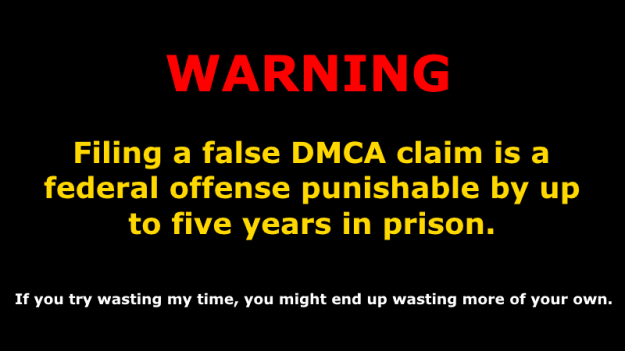
You would have the law on your side. According to the Digital Millennium Copyright Act (DMCA), filing a false DMCA claim is punishable by up to five years in prison. Of the Federal variety.

I’ve seen videos begin or end with splash images claiming that the limited use of copyrighted materials in the video falls under fair use. If you really want to deter false flaggers, here’s the kind of thing you should use:

YouTube warning

Make it clear that you’re serious.

If you’re wondering where the Fair Use is, it’s because we’re not done fighting for it yet. Until a YouTuber that’s brave enough steps forward to defend their freedom, we’re likely to keep hearing about things like #WTFU for quite some time. Not that that means that anyone’s doing anything about it.

#Fightfor15 backfires: McDonald’s considers replacing workforce with robots

robot

I remember my first job. It was working for McDonald’s, I kid you not.

However, it’s looking like times are changing. We might be saying “good-bye” to the day when high school seniors flipped burgers so they can buy Pokemon cards. The recent push for a massive jump in minimum wage has caused McDonald’s to seriously consider employing robots to replace their crew members. And considering the logistics behind it, it might actually be a pretty good move for McDonald’s.

I don’t know how expensive some of the robots they’re considering may be, but here’s some numbers to crunch:

Minimum wage may increase to $15 per hour.
A full-time work week is 40 hours.
There are about 52 weeks in a year.
Therefore, a full-time worker at the proposed minimum wage would make $31,200.00 per year.

If just one robot set McDonald’s back $60,000, it would end up paying for itself in less than two years. That would be a serious bargain. But there’s more. Employing robots can result in the following benefits:

  • Robots won’t complain about working overtime, nor would they demand more pay for it.
  • The only benefits that they’d require is routine maintenance.
  • They won’t goof off to go on Twitter to complain about their job or accuse their boss of being in some “old boy’s club”.
  • They won’t complain about special orders.
  • No showing up late. Showing up late is for humans.
  • They’re not going to have a bad day or decide to hate their jobs, so they’re always going to be polite to the customers.

And there’s more. If they can find some robots cheap enough that can accomplish the same tasks as humans, something which is becoming easier to do, McDonald’s stands to benefit from employing robots.

I know that some McDonald’s crew might mind losing their jobs to some robots. Me, I have my own reasons for thinking that a minimum wage increase is a terrible idea. I’ve worked minimum wage and close to it long enough to understand the kind of damage that minimum wage increases do to the value of money. The government might force employers to pay their staff a higher wage. But nothing is preventing renters, retailers, and utility providers from charging more for their products and services. When there is a minimum wage increase, the cost of stuff starts shooting up.

And why wouldn’t it? Businesses have a harder time making ends meet when they’re forced to pay their staff more, and increasing the costs of products and services is a natural way of trying to offset an increase in the cost of running a business. People would have more money anyway, so if they were able to pay for it before, they’d be able to pay for it at the adjusted rate.

So, in summary, we’d be payed more, but…

  • …We’d be charged more for everything, too.
  • …The value of the money itself would plummet, which would be tough nuggets if you’ve been trying to save the stuff.
  • …There’s no guarantee that there’d be a rate increase for skilled workers, so if you went to school to do what you do, it might become harder for you to get by.
  • …And you might end up losing your source of income to a robot, in which case, you’d actually end up making less.

As I’ve mentioned before, I’ve lived as a poor person for quite some time, so I know how these things go. The idea that poor people would benefit from a minimum wage increase is a myth. However, it’s getting to the point that even fast food workers are having to compete with robots. That humans have been less expensive to hire has long been a selling point, but it looks like that’s changing.

Anita Sarkeesian abandons Kickstarter project, Tropes Vs. Women in Video Games

MTIyMzAzMTMyMjM4NjQzODE0.png

If you’re an SJW, today might be a good day to crawl into your safe space, because Anita Sarkeesian has abandoned her Kickstarter project, Tropes Vs. Women in Video Games.

Of course, she’s selling it as “moving on to something else”, but the rest of us know what’s going on. Her project has been thoroughly exposed as a sham, and she’s decided to lick her wounds and try something else.

Anita has raised $158,922.00 on the project’s Kickstarter page. Whether she has any plans to refund any of the 6,968 backers of this project is unknown.

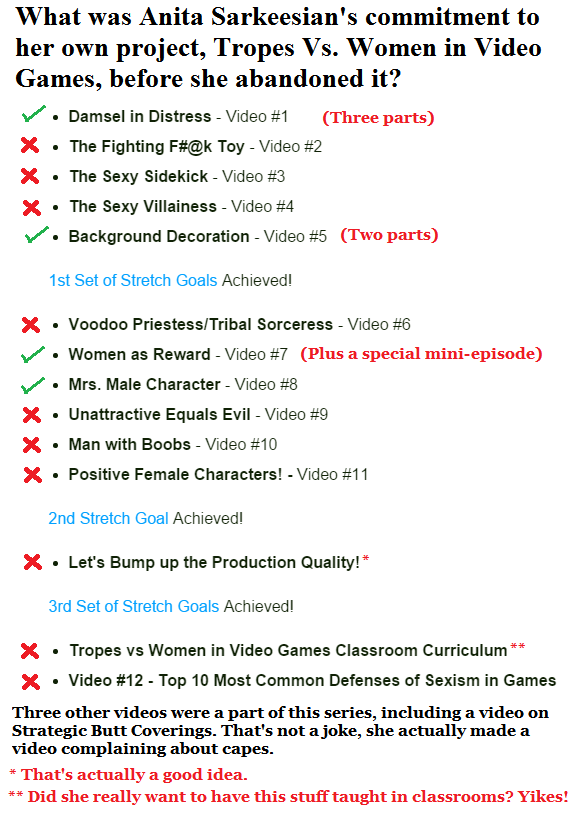
I’ve constructed the following graphic to help illustrate the progress that the project has made since it was first launched three-and-a-half years ago on May 17, 2012:

Anita's video agenda progress.png

Anita attended California State University, Northridge (which has a surprisingly high 52.9% rate of acceptance) where she majored in communications, which involved analyzing media for narrative. So when Anita takes in over a hundred thousand dollars to play thousands of dollars in video games, she’s doing what she went to school for. She’s not the only YouTube personality who comments on the content of video games, but I think she managed to do pretty well for herself in making as much money as she has.

The purpose of Anita’s series was to demonstrate that there is sexism in video games. Many video games do portray women in some pretty unrealistic and even outlandish ways, and in some cases heavily sexualizes them. Nobody really needed a social critic to point any of this out. The thing is, practically no one cares. Everyone who plays video games knows that they’re an expression of somebody’s fantasies.

Is Sarkeesian actually a gamer.png

Anita complains anyway, because as she sees it, video games normalize certain stereotypes. As Anita sees it, someone is needed to speak out against stereotypes against women because gamers are impressionable, unable to distinguish fantasy from reality. Of course, Anita is wrong.

One reason I prefer to stay away from radical feminists is because they tend to be extremely negative, sometimes assuming that complete strangers are criminals, particularly men. Most people don’t need to be told that almost no men actually have a desire to rape. Most of us recognize rape for the act of violence that it is. Of the men that actually have done it, most of them regret the act instantly. Even laws written primarily by men place rape on the same level as murder in terms of seriousness. Such laws have been around for a very long time, even in times believed by feminists to be the height of patriarchy. To the rest of us, this is obvious. To radical feminists, however, each man is potential rape waiting to happen. I have a hard time stomaching that kind of negativity.

I’m in favor of freedom of expression, even if what is being expressed is something I don’t personally agree with. I’m certain that Anita has heard of the game, Grand Theft Auto. It’s a bombastic game in which the protagonist is rewarded for committing outrageous crimes. However, the popularity of the game didn’t result in a surge in automobile thefts. This is because people know better, and aren’t so easily influenced by the expression of someone else’s fantasies, even if they enjoy the gameplay mechanics and play the game for hours a day. And even if someone steals a car because they learned to do it from a video game, it’s the car thief that’s held accountable, not the video game. The people who made the video game were exercising their protected freedom of expression.

So, what’s Anita working on next? She started a new crowdfunding project concerning the role of women in history. One can hope that the project won’t be nearly as divisive, unconstructive, and misleading as the one that she just gave up on (though this is Anita Sarkeesian we’re talking about, here). The initial fundraising goal of her new project is $200,000. That’s interesting considering that her previous project had a goal of only $6000. If she asked for thousands of dollars to play a bunch of video games, why is she asking for hundreds of thousands of dollars to do research that one can do with the simple assistance of Google?

anita research project.png

Believe it or not, women didn’t get their rights because a bunch a firebrands were shrill enough. Women got equal rights with men because men decided that society would benefit from it. What this means is that the feminist movement in it’s current form isn’t just divisive and as a result counterproductive. What it means is that feminism, in it’s current form, has been unnecessary all along.

Update (4-10-2016): Anita has made a video update, but she made it available for backers only. I found out about it because I was curious as to whether the project has raised more money or gained new backers since it was announced that Anita was moving on to something else. It wouldn’t have surprised me if it did, but as it turns out, that wasn’t the case. The video that was posted was not on one of the topics in Anita’s outline for her campaign, so in that regard, the video didn’t do anything to give her backers what they paid for.

It’s obvious that the reason she posts videos for backers only is because she’s far more sensitive to criticism than she lets on. Criticism (which Anita mistakes for “harassment”) is a normal and natural part of the experience of  publishing content on the internet, and is to be expected when what is produced is of inferior quality. Anita is taking measures to hide her content from her critics because she can’t take it anywhere close to how well she dishes it out (though she’s not very good at that, either).

I don’t like chicken wings much, either.

If you’ve already read my article on white chocolate, you’ve probably figured out that I don’t like it. There’s another food item I don’t like, and that’s chicken wings.

I know what some of you might be thinking; “Haw dude, but I like chicken wings!” I know. A lot of people do. At one point, that was kind of surprising to me. But it seems like each time they serve wings at the cafeteria, the lines are extra long, likely because when wings are served, students send text messages to let each other know so more people can get in line. It doesn’t help that the cafeteria staff takes their time carefully counting them so that each student that orders them gets a certain amount. I seldom get wings, so when my turn finally comes around, I quickly get my order.

So, why don’t I like chicken wings? Because there’s not much to them. Chicken wings are largely skin, bones, and heavy amounts of glaze or whatever they’re coated with. Also, there’s a little bit of meat in there somewhere. I really don’t know what it is that makes chicken wings so popular, but I suspect that it has something to do with some diabolical Edward Bernays style marketing, because chicken wings were once considered a waste product.

And if you do attempt to eat them, bring some napkins with you. Those things are a MESS. Much of whatever glaze that’s on them comes off on your hands and your face (I say “your” face because I don’t have to order something I don’t like).

Then there’s the skin. Much of the fat that’s in chicken is on the skin, which is why it’s a good idea to remove the skin that’s on chicken before attempting to eat it. Wings that are glazed have the glaze placed directly on the skin. The expectation is that you eat the skin. A person can attempt to remove it, but it’s a lot of work, and the glaze comes off, which is where the wings get much of their flavor. There’s also the work of attempting to remove the bones, but by the time a person accomplished that much work, they’re left with very little meat.

That’s the problem with chicken wings: they’re too much work for too little reward. A person can decide that they don’t care, and attempt to eat them, skin and all. But then they’re packing on the pounds from all the glaze and skin they’re eating. A person can take the hard way, and get too little for it, or take the easy way, and gain a lot of weight. Should I really have to fight my food when it’s already dead?

And even if you do bring a bunch of napkins with you, that glaze persistently sticks to your hands, meriting a quick trip to the restroom right after eating to wash your hands, getting doorknobs and anything else you touch sticky along the way. So if you get a text, you either ignore it until you’ve washed your hands, or your phone is among the things that get messy on your way to wash the sugary sauce from your hands.

So, no. I don’t like wings.

The Pivoting Spork: Worst Utensil Ever?

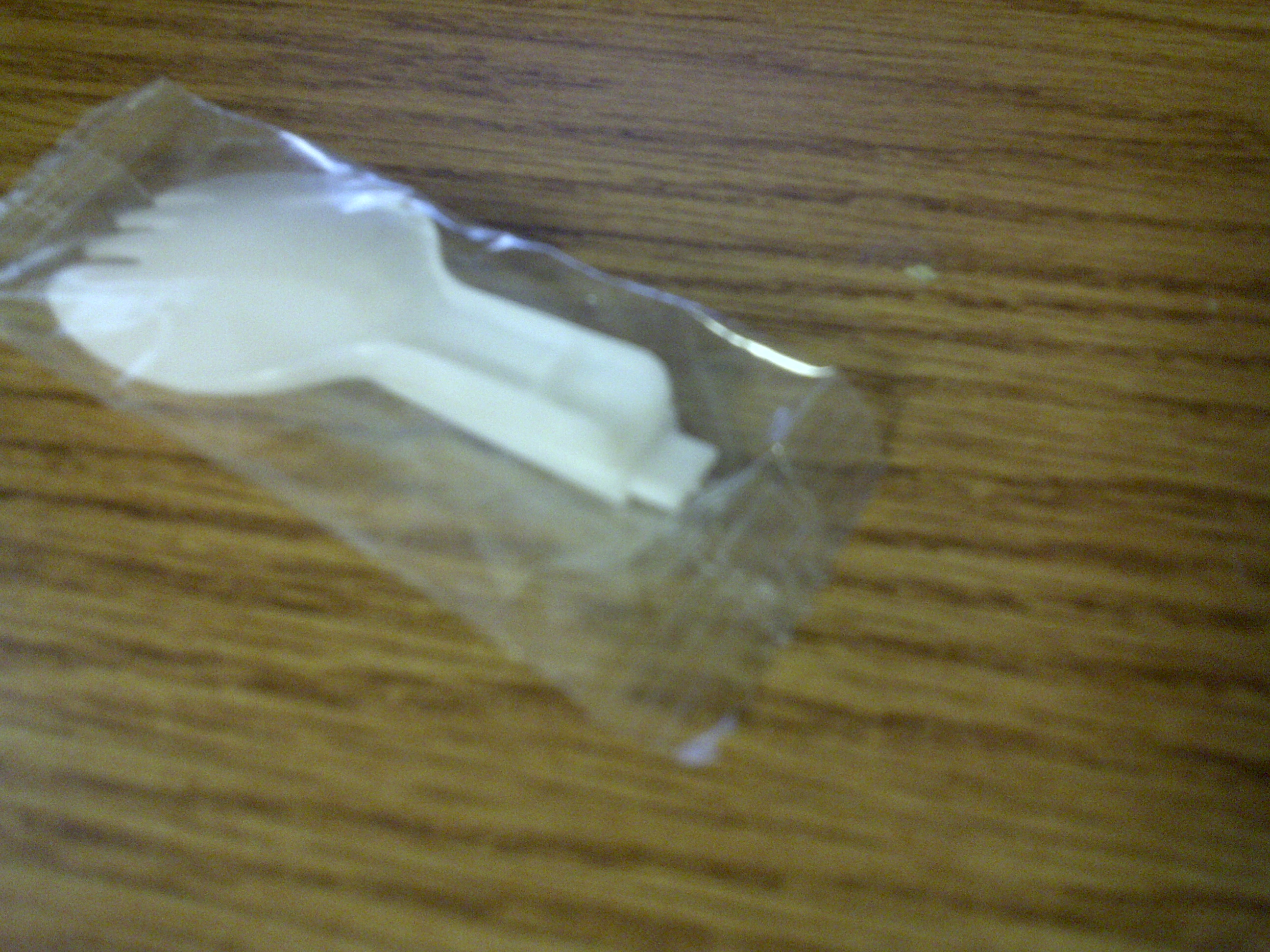
IMG-20151001-00772

A while ago, I found the utensil pictured above: a spork with a pivot.

At first glance, it’s hard to imagine that this spork would be an adequate eating utensil. For one thing, it’s a spork. Sporks are inherently flawed. They attempt to be both a fork and a spoon, but they don’t quite measure up at either task.

Here is how the typical spork does at both the tasks they are designed for:

  • At being a spoon: Horribly. Sporks don’t hold much liquid, if at all, because the liquid easily spills between the prongs.
  • At being a fork: Horribly. Sporks generally have short prongs, so attempts to skewer food with them typically don’t work well.

It’s quite obvious that sporks are inherently flawed. For one of the tasks that they are designed for, the prongs are too short, and for the other, the length of the prongs becomes a liability. Because of this, it’s easy to see why we have separate utensils for carrying out the functions of a fork and a spoon.

In the case of this pivoting spork, the typical problems associated with sporks are aggravated by some serious design flaws, which become apparent with close observation:

IMG-20151001-00773

The prongs are dull, so this spork isn’t going to do well at skewering much. And if a person does succeed in skewering a piece of beef with these prongs, they aren’t likely to stay in place, not only due to the fact that the prongs are short, but because the prongs narrow with a wide angle. This means that just about anything skewered with this spork would quickly slide right off.

But there’s more:

IMG-20151001-00776

This picture might not be ideal, but does give an idea of the depth of the spork. Because of this, not only would we have the typical problem with liquid falling between the prongs, this spork is very shallow. Even if it weren’t pronged (and therefore were a spoon) it wouldn’t be holding much liquid.

As shown in the following picture, the handle is designed to fold back and snap into place:

IMG-20151001-00774

The pivot is a thin layer of plastic that folds to snap the handle into place. Therefore, if the pivot were to snap, you probably won’t be getting much more use out of this spork than you would be to begin with. I would have preferred that this spork’s handle did not include a pivot, considering that, for most tools, the more moving parts it would have, the more potential it would have for failure.

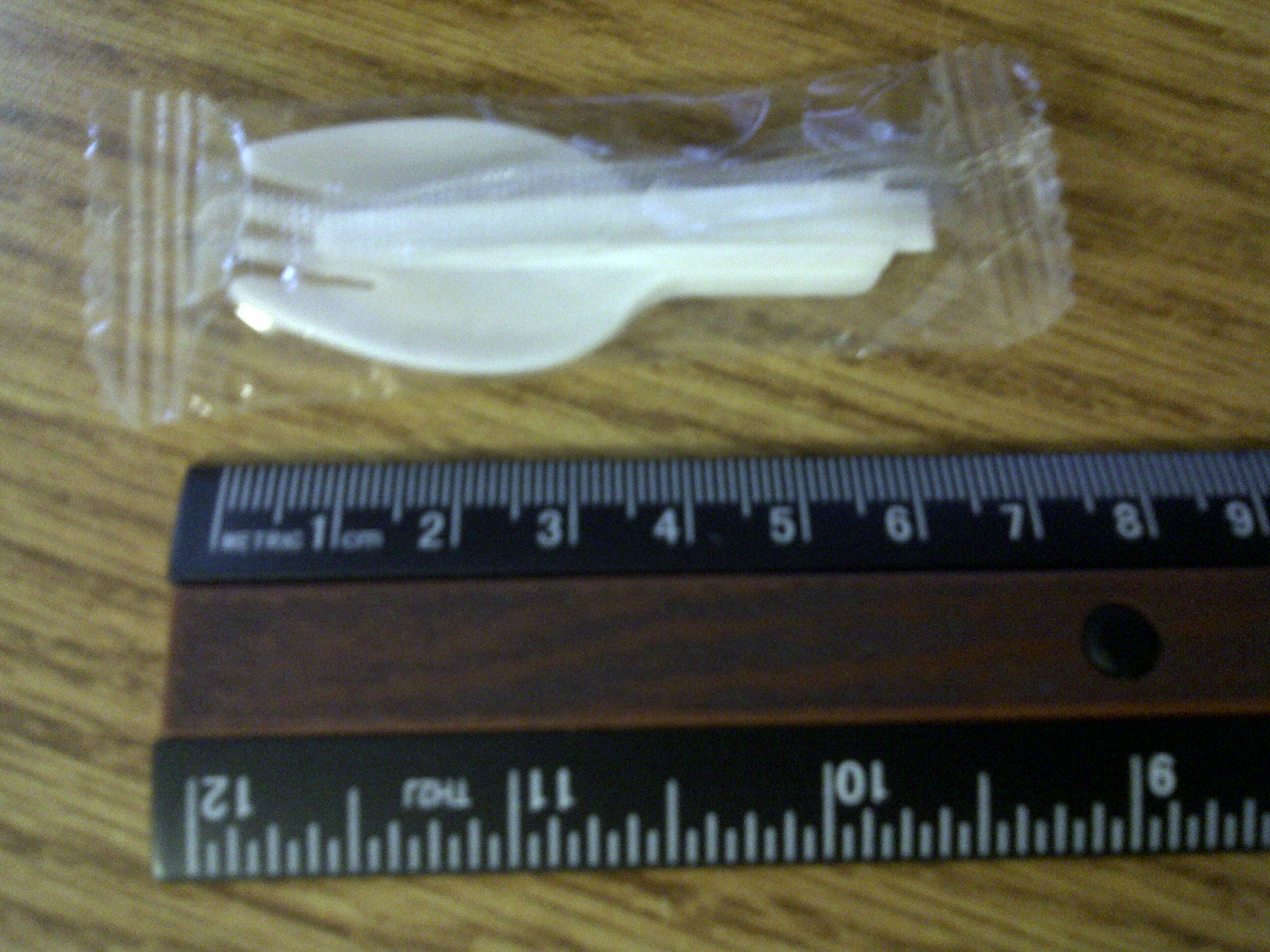
So, why would someone design something like this? It would seem that the idea was to both save space and to be convenient, which is probably why a person would try to combine their utensils. Here is a picture of the spork with a ruler to give an idea of it’s size:

IMG-20151001-00777

This thing isn’t going to take up much space. However, is this really much of an issue to begin with when it comes to spoons and forks? It’s hard to imagine a person having such a problem saving space in their travel pack that they have to take out a metal fork and spoon set to put this thing in there. A person might get the idea to make a mint tin kit of some sort that might include something like this, but they’d probably want to quickly replace this thing with another tool better suited to it’s purpose.

Looking at the picture above, it becomes apparent that the handle would only come to about seven-and-a-half centimeters long (about 3 inches), so it likely won’t rest comfortably on one’s hand as one holds it correctly. The tip of the handle might poke into the skin on the hand between the thumb and index finger, which would probably be uncomfortable. In this position, it’s easy to imagine that the pivot would snap out of place. I haven’t used this spork yet, so I don’t know for sure.

One positive thing about this spork is that it’s made of plastic. This is positive because after a person gives this thing a try and discovers that it doesn’t perform it’s task as a utensil well, there wouldn’t be much in terms of waste when it is simply thrown away. That might not be an expression of confidence in the utensil on the part of its designer, but it does show some foresight on his part. He probably knew that people would just want to throw it away.

This pivoting spork seems like something that a cheap fast-food restaurant would include with their drive-thru meals in an attempt to save money, and because they wouldn’t care very much about how their customers or employees felt. It’s easy to imagine that such a company is also attempting to save money with abrasive dollar store cleaning detergent and one-ply toilet paper. This is the kind of utensil that says “This company is pinching pennies and doesn’t care what you or our hundreds of thousands of other customers like you think. Also, we pay our staff minimum wage.”

This might be the worst utensil I have ever found. How about you? Have you found any utensils that are objectively bad at what they do?

Fat shaming and Nicole Arbour

A recent video by Nicole Arbour on YouTube caused quite a stir for it’s topic of fat shaming. In it, the host, Nicole Arbour, called out fat people for the claims that they make about themselves and pointed out that they have a problem. As you could probably imagine, the video got a lot of criticism. So much in fact, that the video was taken down for a short while before being placed back up and comments on the video have been disabled.

While her video did have it’s problems (such as that the host was mildly annoying), on her point that there is a problem with body fat in America, she mostly nailed it. America does have a problem with body fat.

So, why is Nicole Arbour so heavily criticized for her position? Because people don’t like admitting that they have problems that are their own fault. Yeah, there are some cases where people are fat because they have legitimate disabilities that affect their growth, and there are other causes that people can hardly help. However, cases like those are rare. In the case of nearly all Americans that are overweight, they got that way because they weren’t exercising very good self-control. We live in one of the few cultures in history that has an abundance of food, and people still treat it as though it might not still be there the next day.

In fact, in America, our own police forces have a problem with overweight officers. Considering that people count on them to protect them, that’s a scary thought. A physically fit perpetrator could easily outrun them. There are also security guards, though they’re not the same thing (if that’s the kind of thing you want to do with your life, that’s your choice).

People generally don’t like having it pointed out to them that their bad state is a product of their own choices, and is therefore their own fault. Because of this, people tend toward those who tell them what they like to hear, regardless of what’s good for them. This enables them to write off as “mean people” those who are pointing out what’s wrong.

A person who tells it like it is doesn’t always have to resort to satire. However, sometimes it takes a little more than gentle pleading to get people to change for the better. Most people seem to be familiar with only one kind of encouragement. I think it would be plenty motivating to take care of myself if it meant not becoming misshapen and disfigured, and if it also meant that I could avoid being made fun of for my weight, that’s also a plus. Potential suitors do pay attention to physical characteristics, and some of them can indicate lifestyle choices which are not ideal.

As a person who has been both skinny and borderline overweight, I can tell you that it’s a lot more fun to be skinny. I enjoy having that energy and sound health. There’s also the perk of being attractive. That might take some effort to maintain (perhaps more so for some than others), but it’s worth it.

If a person is overweight, what can they do about it? They could make the choice to take better care of themselves. However, it seems easier for many of them to write off people like Nicole Arbour as those who don’t know what they’re talking about as their paunch steadily grows and sags.