It happened one hot summer day: A knock at my door. Then, as I opened it, in came an ice fairy. “This is great!” I thought. “With my own ice fairy, I won’t have to pay as much to keep this place cool!” But then, she sat herself down in front of the air conditioner. This was not what I had in mind.
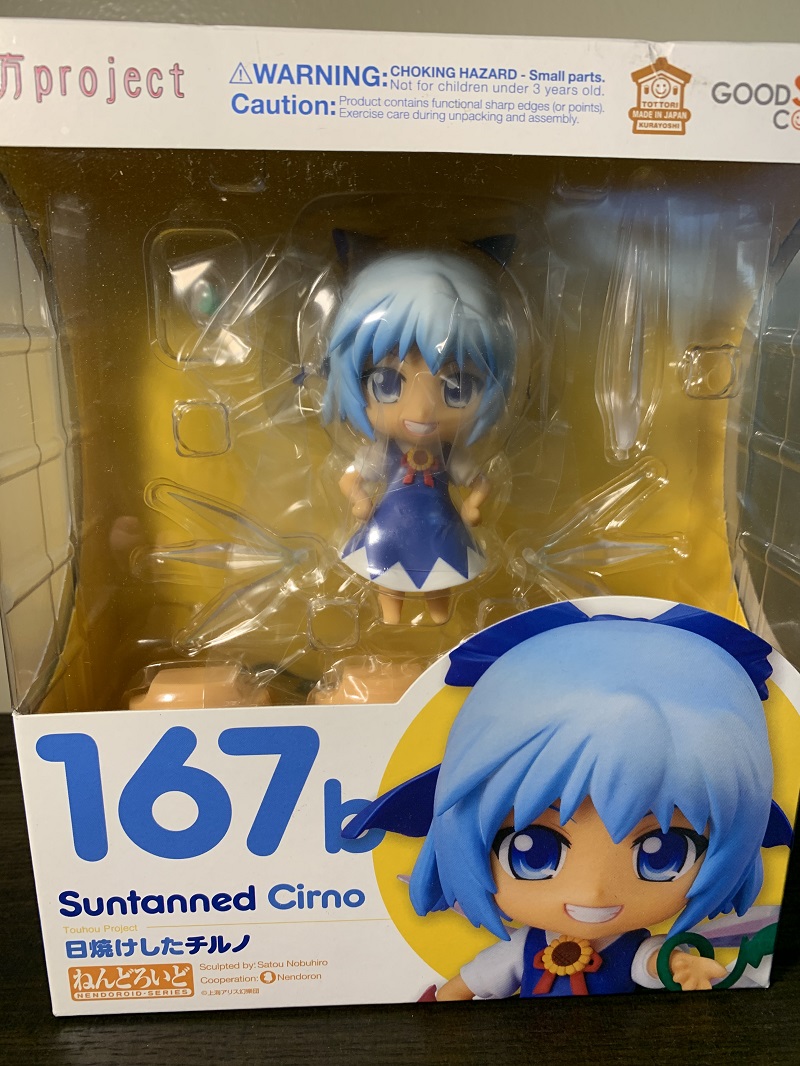
I decided to go for my first Nendoroid, Cirno from the Touhou Project series of video games. This would be the suntanned variant; the ordinary Cirno has lighter skin, doesn’t have the little decorative sunflower, and doesn’t come with the vine.
Here is the back of the box:
One might wonder what the significance of this character would be to me that I’d choose her out of the hundreds of Nendoroid characters available. Come on, it’s Cirno. If you’re familiar with Touhou, it won’t take long to figure out why she’s the most popular character. I liked the suntanned variant because there is a certain irony in that even an ice fairy can only do so much to cope with the hot weather.
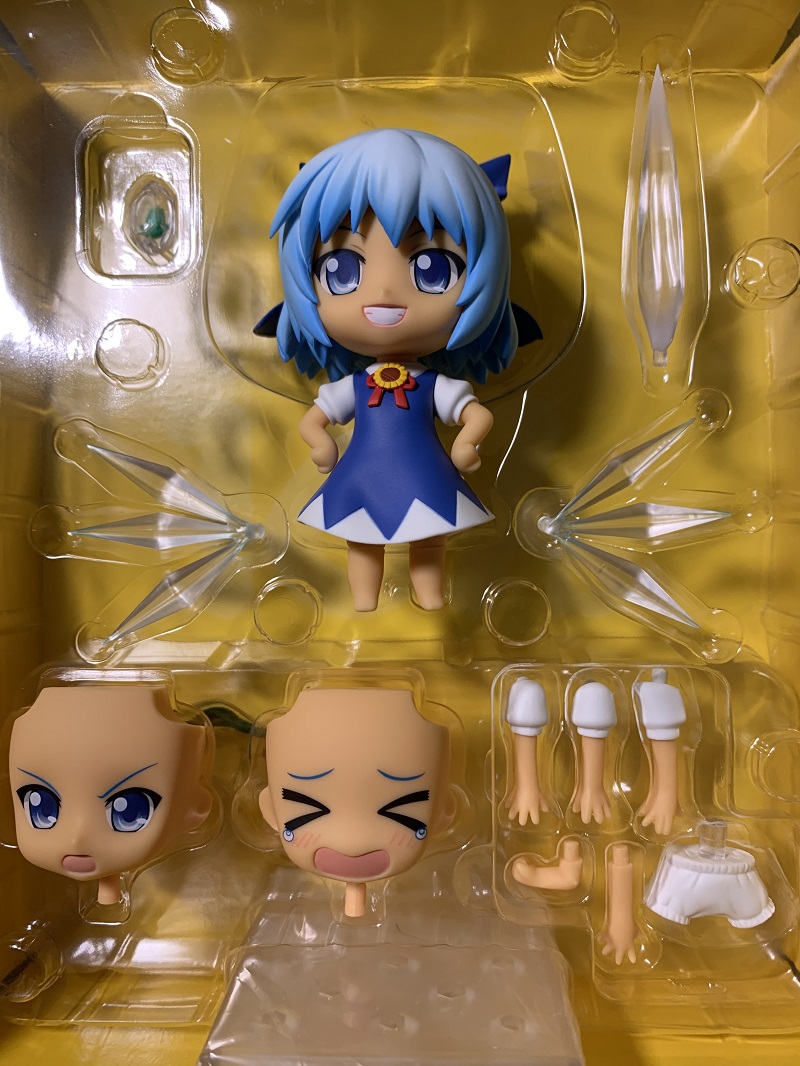
I didn’t buy this just to leave it in a box in a closet. I intended to open it. Here are the contents:
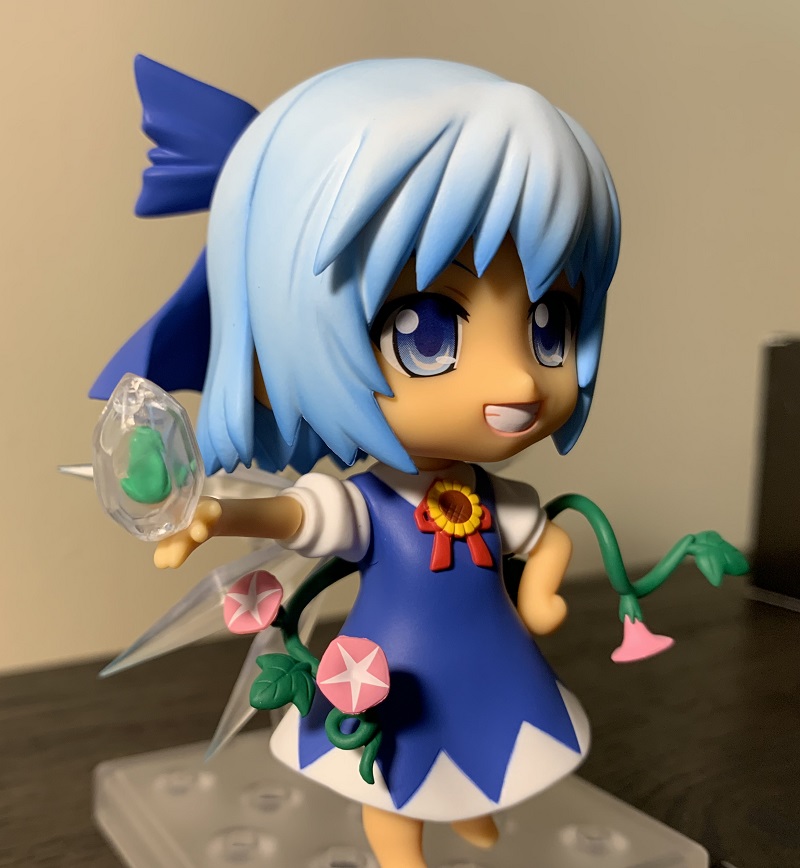
Included is a set of faceplates and limbs, giving this expressive character’s figure a variety of possible poses. She also comes with a couple accessories, including an icicle lance, and a small frog encased in ice. If you’re wondering about the bloomers, she comes wearing another pair, which allows for different poses.
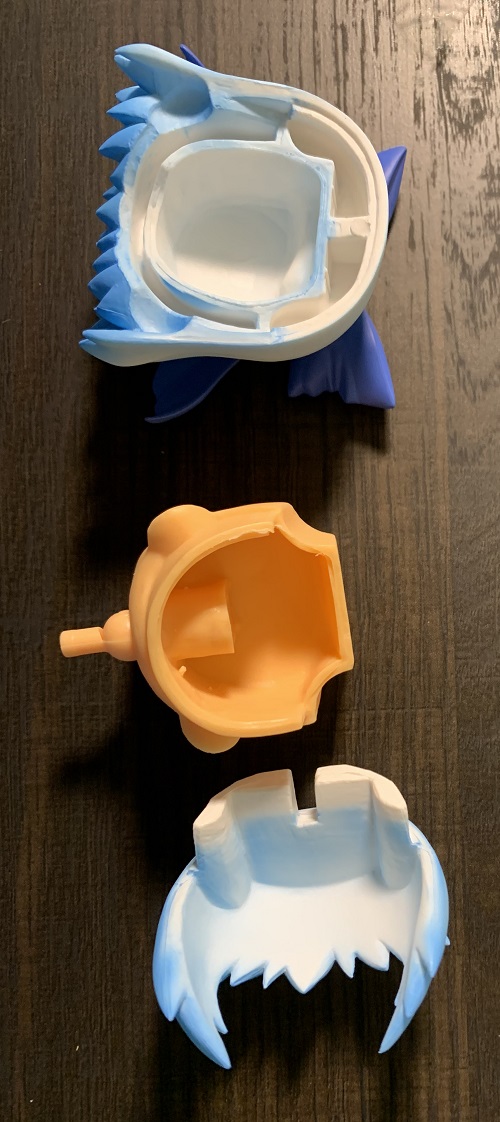
Changing the faceplate is a bit of a process. Apparently, the neck (which is articulated) is a part of the faceplate, and changing her faceplate takes undoing her hair.
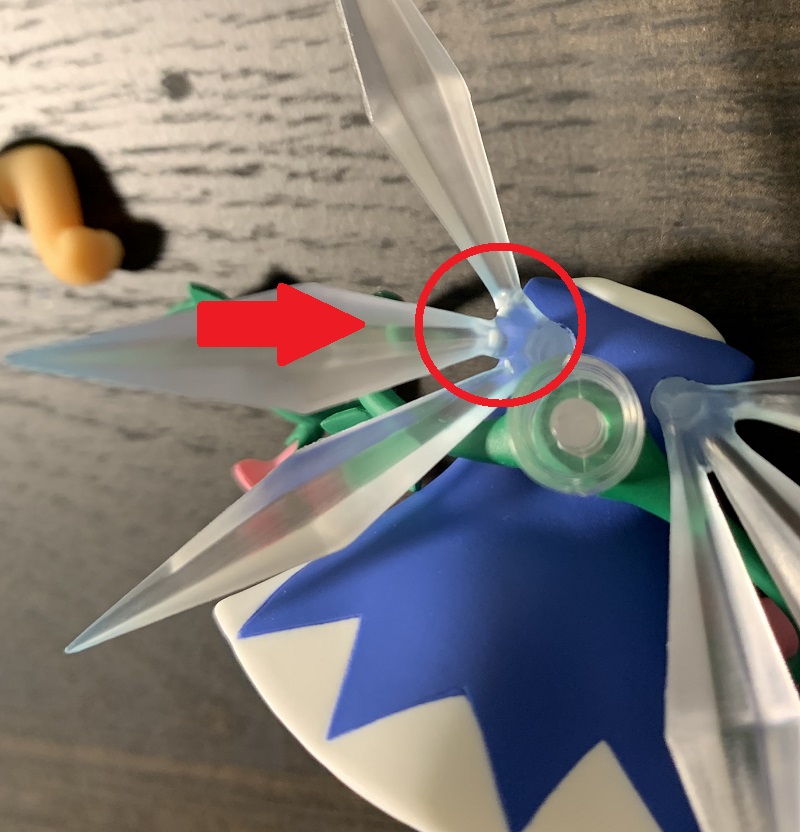
I didn’t have it out of the box for long before some of the plastic showed signs of stress. Particularly, on a couple of the icy “wings” indicated in the picture above. I’m a little concerned that they might break if I mess with them too much, and goes to show that Nendoroids are mainly just for show, and not so much for the kids to play with.
There she is, set up on the stand! Cirno is adorable, even with her cocky smile. For most of the figure, the paint job is pretty basic, putting aside her hair, which has a nice subtle gradient.
One of Cirno’s accessories is a frog encased in ice. It’s easy to forget sometimes that Cirno can have a bit of a naughty side. She views frogs as inferior creatures, and believes that she has the right to freeze them if she wishes to.
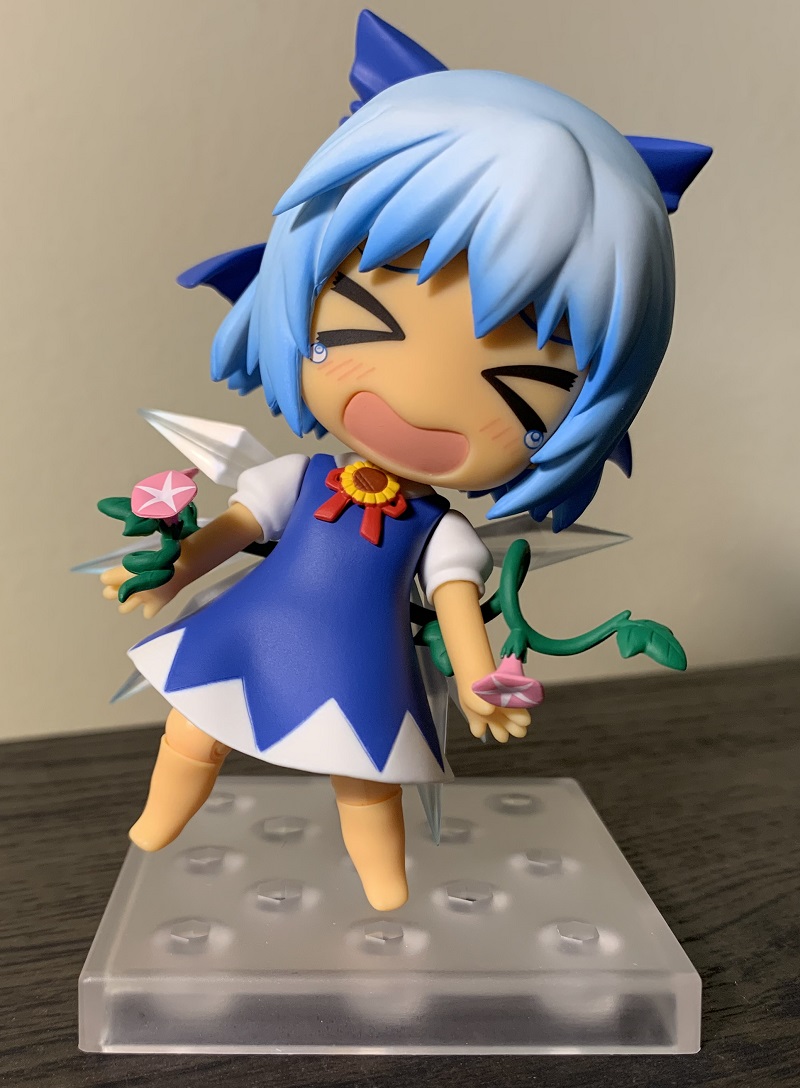
And this is Cirno looking not-so-happy. Perhaps Suwako found out what she’s been doing to the frogs? It’s a bit more obvious in this picture, but the legs bend at the knees. What’s more, they also pivot where they meet her bloomers, so they’re pretty well articulated. But the feet? Not so much. It’s the stand that keeps her upright.
Notice the lack of footwear? Perhaps, when you can fly, shoes are kinda superfluous.
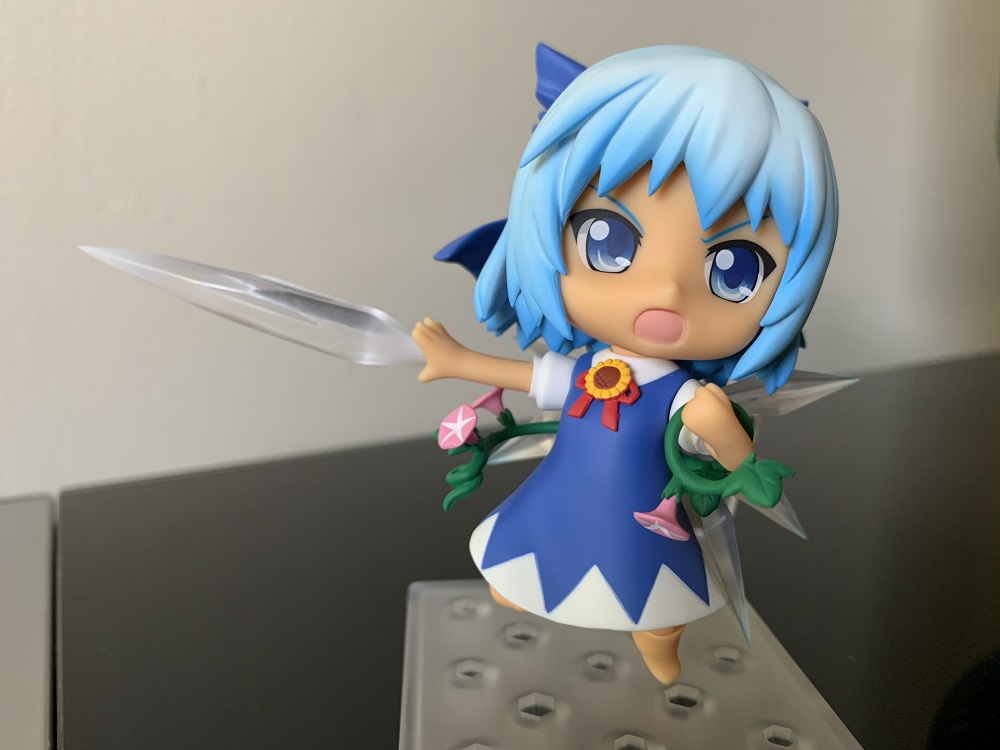
Here’s Cirno in an action pose! I decided that I’d go with this one, and it’s currently sitting on my desk, where the added personality is much-needed.
Now to give Nendoroid #167b: Suntanned Cirno a score. To be honest, I didn’t feel like I got my money’s worth. A typical Nendoroid would set a person back $60, or even more for highly-sought-after characters. That seems like a bit much for what basically comes down to a collection of delicate pieces of plastic.
But because I like the character, I think I can give this product a 7 out of 10.
And I think that’s really the point. A Nendoroid isn’t so much about collecting every single one as it is about having a highly-collectible figure or an attractive conversation piece depicting a character that you really like. If you don’t like the character, then really, what’s the point?
But to be blunt, I think it might be a while before I spring for another one. Marnie from Pokemon, maybe?
Author: Akihito Tsukushi Status: Ongoing Genre: Adventure, Fantasy, Horror Localization: Seven Seas Entertainment Rating: Older Teen Available to read online on BookWalker, fees may apply.
(This review consists of general impressions and is spoiler-free)
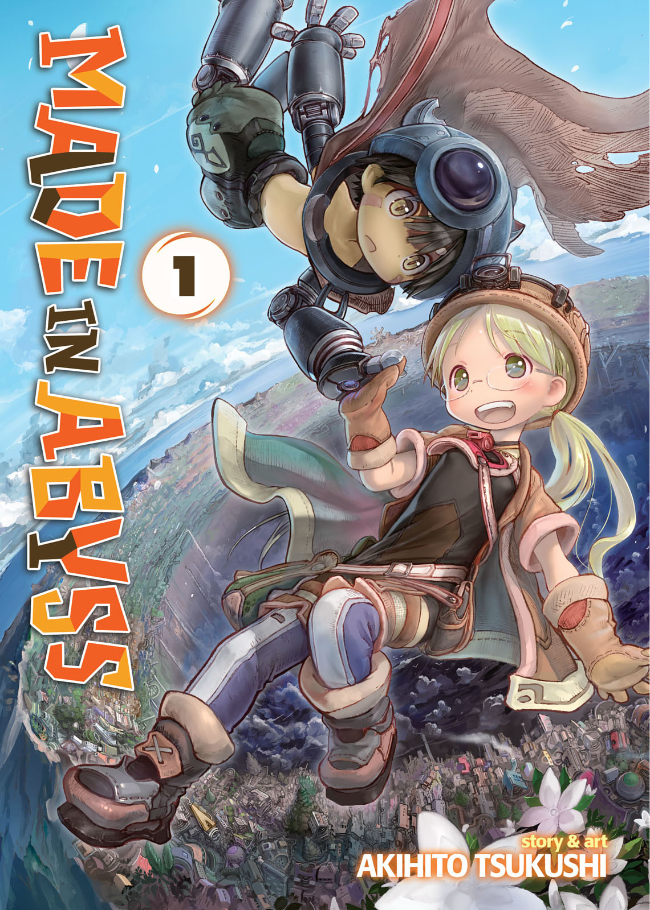
See that cover up there? If that alone were to cultivate your expectations, it might not take long reading Made in Abyss to discover that it’s a serious case of artistic style dissonance. That’s putting aside, of course, the many warnings circulating the web.
Made in Abyss is an excellent fantasy adventure and is one of the best examples of worldbuilding I’ve ever seen. This review is just getting started, let’s dive into it.
The story begins in an island town surrounding a deep abyss. The town’s economy depends on treasures discovered in the Abyss, with even residents of an orphanage participating in treasure hunts.
The Abyss itself is home to many monsters and other life forms, which makes trips to the abyss dangerous. However, the Abyss has an enigmatic “curse” which makes raiders experience deleterious effects when they attempt to ascend upwards. The deeper the expedition, the worse the effects.
The main character is Riko, an orphan girl whose mother is a famous raider. One day, when on a raid with others from the orphanage, Riko is attacked by a monster, but saved by a mysterious robotic boy with no memories of where he came from, or even why he attempted to save Riko. The robot boy then lived among the orphans, passing himself off as a human boy.
One day, a celebration was held in honor of Riko’s mom, who went on an expedition she did not return from. However, Riko did not give up hope that her mother was still alive. One day, she was shown a message from among her mother’s effects:
Come to the bottom. There I’ll be waiting.
If you guessed that Riko escaped with the robot boy into the depths of the abyss to reunite with her mother, knowing that she’s embarking on a journey from which she can never return, then you’re getting the hang of this “manga” thing.
As Riko and Reg journey through the Abyss, they encounter numerous life-forms that range in danger from benign to the kind of thing that even a man with a death wish would want to avoid. So nightmarish are the denizens, that this manga might even ruin leaves for you.
Much of the progression of the early story has to do with how the group copes with the dangers of the Abyss, as well as how they find the basics for survival, such as food, shelter, and water.
In the instances in which there is danger, there is a sense of something at stake, since Riko’s party isn’t just some assemblage of generic character classes (warrior, healer, wizard, etc.). Riko and her friends are dripping with personality, further supplemented by moments of levity which serve to further characterize the cast. Because, you know, just because the plot isn’t being advanced doesn’t mean the story isn’t being meaningful.
What’s more, there is a connotation of lasting consequence with every possible thing that could go wrong. For example, if someone were to fall over and hit their face on something, they might have to wear a bandage on their face for a very long time. If an artifact slips out of someone’s hand and they end up losing it, it’s gone. If someone ends up injured or poisoned, the agonizing choices that have to be made for one’s immediate survival are just the start of it.
And that’s just what nature has to throw at the heroes. Once other humans are involved, the stakes get higher over whether they are friend or foe. For example, once this guy starts showing up:
…That’s the last chance for anyone who is faint of heart to take a hike. Over the course of the series, the only one who has managed to outdo Bondrewd’s horrors was Bondrewd himself.
To describe the art style in just a few words, think Ichigo Machimaro meets Tony DiTerlizzi. The stylistic design of the characters is a stark contrast compared to how gorgeous the environments are, whether they are of the island town or the majestic landscapes of the deep abyss.
The way the characters are stylized seems to follow their intended effect. Children and more sympathetic characters tend to be portrayed with softer, rounder features, while adults generally have sharper, more angular features. While the manga obviously stars the children, the adults are in a class of their own, as they exude a certain world-weariness that would be difficult to find outside of fast-food staff.
One thing I found kinda surprising was that there was nudity. Not just that it was there, but also that it was treated as a matter-of-fact thing. It was mainly the tip-of-the-mountain that was showing; I didn’t see any tube steaks or roast beef sandwiches. But if you’re mature enough for boom sticks, grown-up beverages, and movies where things get killed, you could probably handle it.
Made in Abyss has an intellectual element, as well. A few volumes in, and the birth allegories start to become more obvious. And the more you think about it, the more you start to notice. Or is that confirmation bias at work?
From what I’ve seen so far (up to volume 9), this manga series seems excellent, and I’m looking forward to seeing what comes next. New volumes seem to come once every few months to about a year. That’s fine, considering that it’s more likely to be a better product if it’s not rushed. Still, volume 9 ended with a cliffhanger, which doesn’t do much to make waiting easy.
There is already an anime adaptation underway, but I’m kinda on-the-fence as to whether to give it a look. It’s not that I have a problem with knowing what’s going to happen; it’s that I know what parts of it might be difficult to watch. It’s one thing to read the difficult parts, but seeing them in motion might be emotionally draining.
But hey, the warnings aren’t to discourage you, they’re to make sure you’re mentally prepared. Still, Made in Abyss wasn’t made for everyone. Some audiences might find this one disturbing.
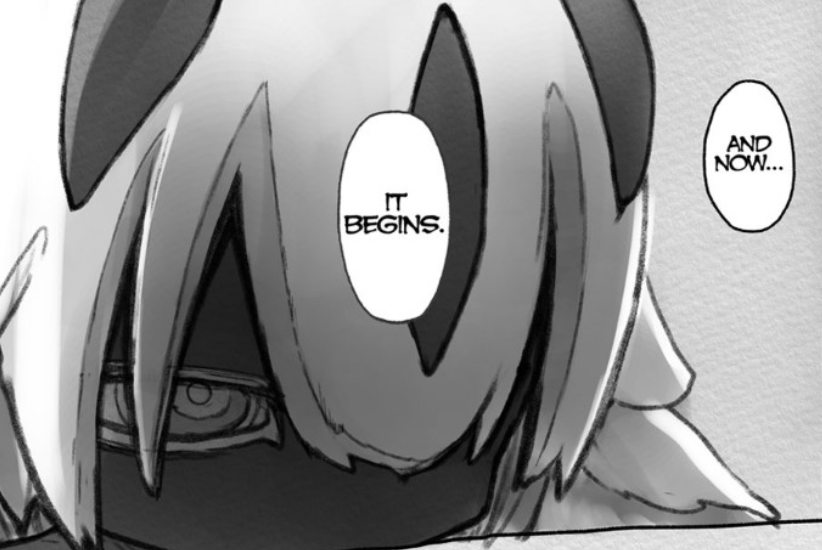
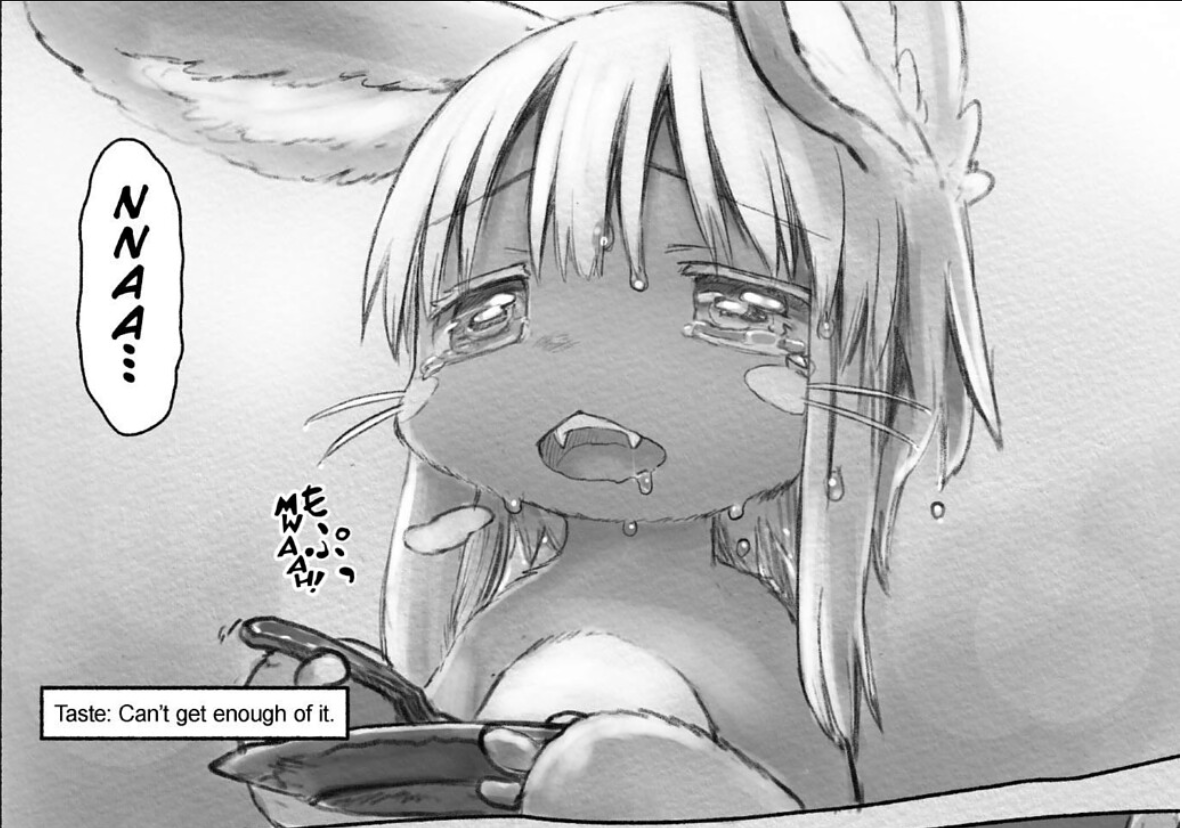
But now onto it’s score. Made in Abyss volumes 1-9 get a score of a satisfied Nanachi out of 10.
Which, as you might guess, would be a 10 out of 10. It’s outstanding.
By the way, I wonder whether Akihito Tsukushi has heard of Cave Story?
(The art provided in this review is snippets from the reviewed manga, to give an example of the work. These are used for review purposes, and therefore fall under Fair Use.)
Can we agree at this point that making games easier doesn’t make them more fulfilling? I ask this because someone showed me his new copy of Mario Kart 8 that rewards him for playing a no-lose mode without input.
The Mario Kart in question isn’t the only offender in this regard. There was a recent Mario game that awarded the player with invincibility if they lost enough times on one level. I think that the best games to represent this generation of gamers would be the clicker games, which award players with prizes just for clicking, and sometimes even allows them to play without input.
Because of this, I’ve decided to write up this review of Touhou Eiyashou: Imperishable Night, the eighth entry in the Touhou series. It’s a game that harkens back to a time when men were men, women were women, and Burger King cashiers were who-knows-what.
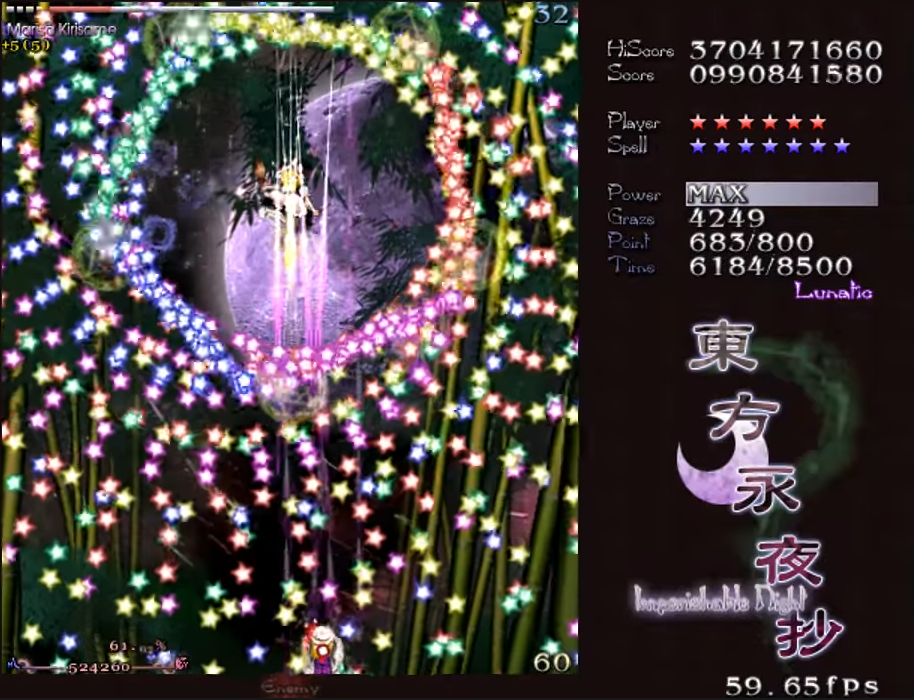
Touhou 8 is a Danmaku Shooter, which means that you’re going to have screens full of bullets coming at you, and the real test is in your ability to avoid beautiful patterns of projectiles.
Deal with it.
If you’re the kind of guy who thinks himself above games that look cute, you missed out on the masterpiece that is The Wind Waker. You’d probably also let your guard down because you’d think this game is easy just because of its art style, only to get whooped on the easiest setting. Let’s not kid ourselves here, Touhou is hard. Like, monumentally break-your-face hard. I wanted to get that out there before someone decides to give it a try only to discover that it’s actually challenging to win, and then complain to me because this game about anime girls that can fly and fight each other with fireworks made them feel bad.
When it comes down to it, that’s the great thing about Touhou. It’s challenging from beginning to end, and there’s no way to cheese your way through it. So if you want to beat the game, you actually have to be good at it. It’s not like the American education system that gives you credit just for showing up and reciting Marxist propaganda. So when you make it to the ending where these girls are celebrating with rice wine (Just how old are these girls?), it actually feels like an accomplishment in which you can take true pride. You’ll have earned the right to see the ending, and it’s more rewarding than just finding the results of a simple Google image search.
Touhou 8 has four difficulties: Easy: The difficulty for newbies and those who want to chill, but is still hard, Normal: Usually ignored. Hard: A tertiary setting that’s usually ignored in favor of the next one. Lunatic: Touhou at it’s most rewarding, most YouTube runs are probably on this setting.
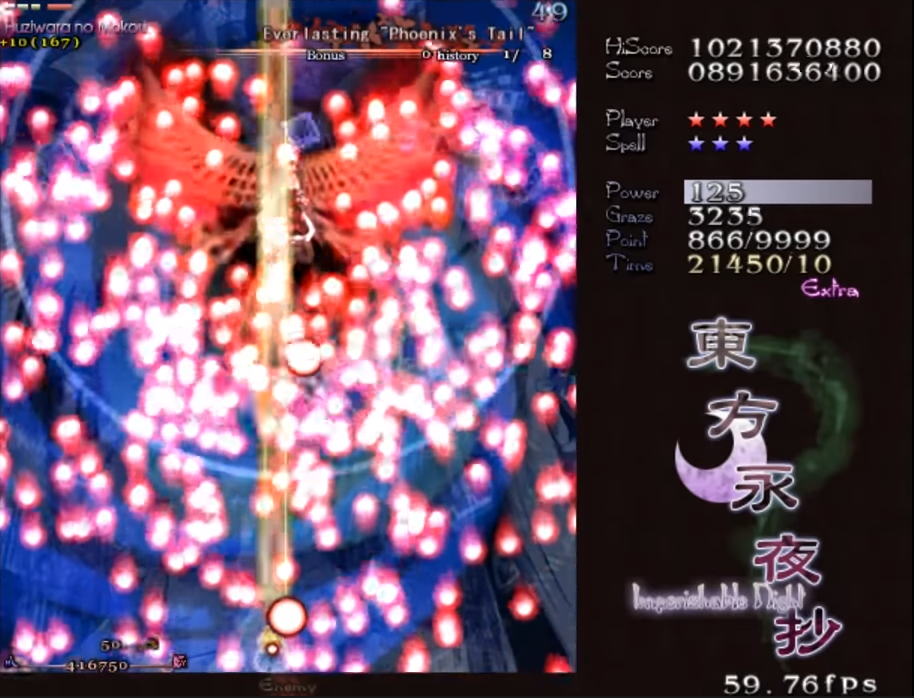
Aside from multiple difficulty levels, Imperishable Night offers variety in gameplay in the form of having four teams to choose from, with one character being the lead, and the other swapping in when focusing. A playthrough has different possible bosses depending on characters selected and certain other conditions, such as the fact that the true final boss doesn’t show up unless you’ve beat the game already and didn’t use a continue on the current playthrough. It’s another way in which you don’t beat the game unless you actually get good at it. There’s also an extra stage which is harder than anything else the game throws at you, which is unlocked by beating the main game.
Not many players make it to this part.
For those who think that games like these are too hard, there’s a practice mode that allows players to take on stages or specific attacks, so that players can improve and play more consistently. It’s not about making it easier on the player, so, once again, if you want that rewarding thrill of having beaten the game, you actually have to get good at it. This isn’t one of those click-and-win travesties that’s passing for video games nowadays.
The main thing that Touhou 8 tests is the player’s focus. There is actually more to the gameplay than “the screen fills with bullets”. There are actually patterns to attacks, and each attack is unique. Not only that, the attacks are pretty well telegraphed, so that when the player loses a life, it feels like less of a cheap shot and more of a mistake on the part of the player. After all, Touhou is a game of skill, not of rote memorization. There is no being trapped in a no-win scenario, but if that does somehow happen, it should be pretty obvious to the player how they could have avoided it. As hard as the game is, if you lost, it’s pretty much your fault. There’s no excuses, and excuses don’t let you win, anyway.
Another great thing about this game is the music. The game’s soundtrack has a nostalgic oriental theme to it, and it’s very fast-paced and upbeat. I don’t know what the consensus is when it comes to video game music, but to me, it’s a valuable part of the experience. When I ask someone who has played a game what they think of a certain track, and they tell me that they had the sound off, they’re telling me that they missed out.
While the same general thing can be said for each of the Touhou games, I picked out Imperishable Night for this review. Why this one? It’s my personal favorite because of a combination of different factors, such as the theme of the game being more epic (Searching for a moon that goes missing and battling an immortal princess? Cool.), and this one introduced some of my favorite characters, such as Reisen, which is an interesting character on several levels, and her concept is very appealing to me. It shouldn’t be hard to understand why.
Reisen – her gun has bunny ears.
So if you want to take a stand against the oversimplification of video games, a great place to start is by purchasing a copy of Touhou. And by that, I mean actually support the guy who makes these games by buying one. Touhou is one of those games which, like Cave Story, is genius even though the whole thing is made by only one guy. Yeah, this guy who goes by the moniker ZUN has written, composed, and programmed the Touhou games by himself. So if you want to play his games, go ahead and support him by buying them so it’s easier for him to buy beer.
When you think of a self-improvement guide on how to be more manly, what do you think of? You’d probably think it would include, among other things, a few useful how-tos on tasks like jump-starting a car. Maybe you’d think to find an outline on an exercise regimen. You might even expect something philosophical to get you to consider what you stand for and how strongly.
If you’re expecting anything as useful from Men’s Society: a Guide, then you’re already set up for disappointment. Like it or not, there is a new kind of manliness in town; a kind that is obsessed with image and with defining your identity with what you buy, rather than your character.
Men’s Society: a Guide comes to us from menssociety.com, and it largely reads as an advertisement for items featured on their online store. I mean, their website, because their online store is their top page. The commercial agenda screams “ethics” as loudly as some energy scam kiosk right inside the doors of a grocery chain.
Let’s keep it real here: real manliness came to be because the traits associated with it were what was necessary for men to get by in times when resources were limited. Real men are strong, smart, skilled, nimble, adaptive, and strong of character. The new form of manliness that’s obsessed with an outward show of old-timey rusticness is nothing more than a sham that was crafted to get people to spend money on things.
Where does Men’s Society fit in the scheme of things? To find out, let’s look at the topics discussed in this book, one at a time:
Grooming – a few fundamentals and a list of grooming supplies for you to buy
Drinking – a list of alcoholic beverages for you to buy
Style – a few staples of outward appearance for you to buy
Culture – a list of books, films, and other media for you to buy
Travel – a few pointers about getting from one place to another, so you can continue buying things somewhere else
Manners – the part of the book that was rushed because it’s not intrinsically conductive to you buying things
Whether it’s consumption of media or consumption of products, the main point of this book, again and again, is consume, consume, consume. The commercialization of manliness weakens manliness in the same way that the commercialization of Christmas led to the weakening of the Christian identity. Commercialization is nothing more than a means to an end, that being to line the pocketbooks of a few with leafy greens at the expense of the rest of us. To the entrepreneur enriched by this endeavor, any identity weakened in the process is considered an acceptable expense.
The authors of Men’s Society are British, so the perspective of this book is from that of a British man. There are a few points in this book that indicates that real manliness in the UK is in serious trouble.
For one thing, there is a section in this book on how to survive a flight. Fast fact: surviving a flight is easy. Flight is considered the safest way to travel, and it’s no mistake that nearly everyone who attempts flight survives the experience. All there is to surviving a flight is to sit down and not make too much noise. Do it right, and none of the other passengers will have much reason to throw you out a window.
There is a paragraph that discourages manspreading. Non-ironically. It opens with this gem:
MANSPREADING
This is a derogatory term that you don’t want used to describe you.
Sorry, Men’s Society, “manspreading” is a verb, not a noun. You have failed.
And it gets worse, as three pages later, the book includes a similar section on mainsplaining. Again, non-ironically. The term “mansplaining” was obviously invented in a cynical effort to shut down productive conversation because feminists can’t stand being proven wrong. A willingness to hold water for the intersectional agenda is a sign of weakness and isn’t a trait of one qualified to teach manliness.
When the advice isn’t bad or geared towards marketing, it’s usually lazy. One can imagine that a book packed with advice on men’s style would include at least a few informative pages about hats. Instead, there’s a short paragraph at the end of a chapter which says little more than that it’s acceptable to wear baseball hats and “street-style go-tos” (whatever those are), and that if you were to wear any other style of hat, “you’re a bold man.”
Really? That’s all that Men’s Society has to say about hats? What a cheap cop-out. There’s a lot more to say about hats, but I suspect that the brevity to this section is owed to the fact that I found no hats in their online store (but two pages of shaving products and three pages of haircare products). I imagine that they’d have more to say about the style of a derby or the protection of a bucket hat if those were products in their online store.
This is a bit of an aside, but Men’s Society has an obvious obsession with mint tin kits. I get it, pocket-sized kits are awesome. But here’s the thing: you don’t need to buy them. Mint tin kits are packed with cheap items that would usually set a person back just a few dollars altogether if one would construct them themselves.
Men’s Society understands the profit behind giving some trial-size products their own label then selling them for 25 British pounds (about $30), and here’s an example of one from their website:
Yes, a beard removal kit. They think so little of your ability to accomplish the task with the items you have on-hand that they put together a kit designed to assist you toward that end.
Speaking of shaving, people can stop patting themselves on the back for using a razor to shave, as though that were any kind of accomplishment. Technology should be embraced as an expression of how adaptive and nimble men are, not shunned for that smug glow of superiority that comes with refusing to keep up. I use electricity to shave because I’m not a luddite.
You don’t have to pay piles of money for mint tin kits. You can make one of your own. Assembling one for yourself shows ingenuity and is rewarding when you finish one up. It’s so simple, I can give you a short guide right here:
Procure a mint tin. An Altoid’s tin would work.
Throw out those suspiciously non-Kosher Altoids mints and wash the mint smell from the tin. (Is there pork in them, or something?)
Put what you want in them, whatever would reasonably fit. Fishing hooks, band-aids, twine, it’s up to you.
That’s it. You now have a mint tin kit, and didn’t pay someone $30 to do it for you.
While we’re at it, here’s an article on how to make mint tin kits on Art of Manliness, a much better page on manliness than Men’s Society.
Part of the book that I found myself sometimes liking was the “Don’t Be That Guy” sections, which added a little bit of humor to an otherwise commercial experience. A couple of my favorites include “Don’t Be That Guy: You know, the guy with longer hair who thinks he’s Kurt Cobain?” and “You know, the guy who leaves the top four buttons of his shirt unbuttoned?” However, these are short blurbs in what is otherwise a paid advertisement (one that the reader paid for, not the marketer).
As it is, Men’s Society: a Guide could be more appropriately called, “Men’s Society: A Buyer’s Guide”. It’s written with the expectation that if you’d pay for a book to tell you how to be manly, then it can suggest a bunch of other things for you to buy, leading you down a deep rabbit hole of continual spending in a vain attempt to find identity. And that’s assuming that you’d want a bunch of posh blokes telling you how to be manly. Men’s Society brings to mind the words of an Asian proverb:
“The superior man understands what is right; the inferior man understands what will sell.”
-Confucius
The time has come to give this book it’s score. Men’s Society: a Guide gets a score of Don’t Be That Guy out of ten.
Because the Don’t Be That Guy sections make up around 1% of this book, that comes to 0.1 out of 10.
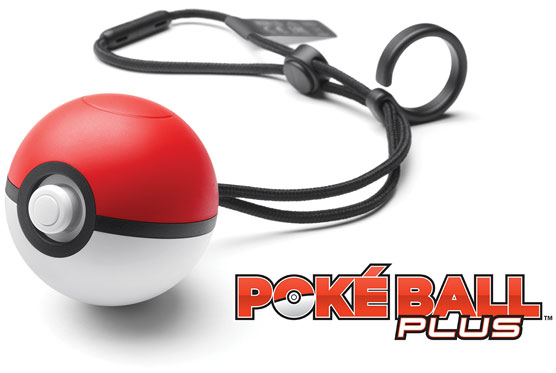
When Pokemon: Let’s Go, Pikachu! and Pokemon: Let’s Go, Eevee! were released late last year, they came alongside a peripheral that was intended to act as a dedicated controller for the games. Not only that, it also functioned similarly to the Pokemon Go Plus accessory for smartphones.
Is this thing worth buying?
I ended up getting one a little while back, and after having played with it quite a bit, I think I can answer the question: it really depends on whether you play at least one of the two Let’s Go games, and whether you play Pokemon Go. And even if you play both, it’s still a “maybe”, because there still wouldn’t be a guarantee that it would appeal to you. Personally, I think I got my money’s worth, but not everyone would have the same tastes in game accessories as me.
The PokeBall Plus functions as a dedicated controller for the Pokemon: Let’s Go games. As far as I know, any attempt to use the controller with any other game would only result in failure.
When used with the Let’s Go games, the PokeBall Plus is a motion-sensitive controller. As a controller, it’s pretty simplistic. It has a main button, which would be the button of the pokeball that we’ve been seeing all these years. The main button basically acts as your “A” button: you use it to talk to people, make menu selections, interact with Pikachu, that basic A button stuff.
But here’s the catch: the main button is actually a “click” feature by pushing down on a control stick. So, the button that you use to make selections such as executing attacks? You also use it to move around, and to highlight different options and different attacks. I’m not a fan of it. It’s way too easy to attempt to select something accidentally because the stick is moved in a direction.
The spherical shape of the controller does make it disorienting when it comes to moving in a direction. There’s not really much in terms of tactile feedback to determine how the controller is oriented in one’s hand. That means that you have to look down at it to determine whether you’re holding it right. At the very least, the rubber coating of the controller does prevent it from slipping, so you don’t have to reposition it very often. Having said that, a spherical controller isn’t terribly ergonomic.
There’s also a “B” button on the controller, and it’s on the top of it. It’s simple, you use it to cancel selections. There’s not much to it, and it works just as you’d expect. But when outside of battle, it acts as a “pause”, which brings up the menu, and also closes it.
Shaking the controller acts as the “Y” button when prompted, but also provides a shortcut to interacting with Pikachu/Eevee. When in battle, and Pikachu/Eevee’s special is available, shaking also provides the shortcut to using it.
Now, here’s the big thing: when confronting wild pokemon, the PokeBall Plus provides that extra bit of simulation. The motion controls work similarly to the joy-con, but you get that added satisfaction of swinging a Pokeball at a pokemon with an accessory designed to expedite the experience. It’s accurate, too. In fact, it seems like the PokeBall Plus is more accurate when throwing Pokeballs than an ordinary joy-con.
Another nice touch is that the opening around the control stick of the main button is illuminated by what may be RGB LEDs, which can glow certain colors depending on what you’re doing in the game. It glows certain colors when attempting to catch pokemon, and when you catch one, it emits a color that corresponds to the pokemon that was just caught. Cooler still is the fact that the PokeBall Plus also makes sounds, such as cries of pokemon that were just caught. It’s little things like that that makes the PokeBall Plus a very thoughtfully-designed product.
Having said that, it’s still the case that the right way to catch pokemon in Let’s Go is to undock the Switch and play in handheld mode, especially if you intend to chain pokemon for large amounts of candy.
Another added function of the PokeBall Plus is that you can send one of your own pokemon to it, and take it around with you as you go about your day-to-day business. When you do this, the controller acts as a step counter. You’ll be able to “play” with the pokemon inside by making it active with the control stick, and it’ll respond to shaking, “petting” motions, and moving the control stick in circles. I’m still not entirely sure what the benefits of playing with the pokemon might be, but certain activities might increase the rewards obtained when sending the pokemon back to the game.
Players that wish to raise legendary pokemon or other pokemon that are very difficult to obtain candy for in Let’s Go would appreciate that the PokeBall Plus makes it possible to obtain candy for these pokemon in substantial quantity. Just put the pokemon in, take it for a long walk, perhaps use the device with Pokemon Go, and when you send your pokemon back to your game, you’ll likely get quite a few species-specific candies.
Aside from sometimes enjoying the novelty of a Pokeball-shaped controller, the main thing I use it for in Let’s Go Pikachu! is getting lots of species-specific candies. It’s not hard to get tons of Oddish Candies in-game, but getting lots of Mewtwo or Meltan candy? Obtaining lots of candy specific to legendary pokemon is a tall order in Let’s Go without the help of the Pokeball Plus.
Now for the main thing that I use the PokeBall Plus for: as an accessory for Pokemon Go. As a Pokemon Go accessory, the PokeBall Plus rules. It functions basically the same as the Pokemon Go Plus accessory: when you pair it with your game, it allows you to play Pokemon Go somewhat passively.
Here are the main perks:
It vibrates when a wild pokemon is nearby. Push B to consume a regular pokeball attempting to capture it. If it works, you catch the pokemon. If it fails, it flees.
It automatically spins PokeStops you’re near. Wild pokemon seem to take priority, so you might have to attempt to capture them, first.
That first point is great, because if you manage to accumulate regular pokeballs in massive quantity, you can just spend them out quickly, and if you catch something with one, great! You get the EXP, candy, and stardust that you normally would, but if you use the PokeBall Plus in this manner, you’re currently only able to use regular pokeballs this way, and it’s only ordinary throws. But hey, if you’d otherwise just chuck those pokeballs out to make room for great balls and ultra balls, what’s the harm in spending them like this?
Also, this provides a quick way of gaining experience: Just set a Lucky Egg, walk through a WalMart parking lot or some similar place, and use the PokeBall Plus to try catching lots of pokemon. Using the PokeBall Plus to attempt a capture may not be a sure thing, but it bypasses the long animations associated with using the app, so you could gain lots of EXP fast if there’s lots of pokemon around to capture.
I’m able to accrete pokemon to myself while walking down the street. What an age we live in!
And if you’re wearing a heavy coat and don’t have your phone out, how would anyone know whether you’re playing Pokemon Go? Of course, that would only be a selling point if you cared whether anyone found you out.
Overall, I’m pleased with the PokeBall Plus, but I know that it’s not going to appeal to everyone. If you have one of the Let’s Go games, it adds a novelty to the experience. But to be honest, I found myself using a joy-con while playing, instead. If you play Pokemon Go, and want to add to the experience what feels like a late-game power-up in a video game, then you might find yourself enjoying the PokeBall Plus. But it’s most likely to appeal to you if you fall into both categories.
However, if you don’t play Pokemon Go, and you’re starting to move on from Let’s Go to some other games, then the PokeBall Plus would likely start to spend a lot of time sitting in your entertainment center as a conversation piece.
Also, for the modders out there: the matte nature of the rubber may make it difficult for paint to stick to the thing. It’s a shame, I was looking forward to seeing what people would come up with.
But hey, while the promotion is still running, you can still get a Mew out of the deal. Supposedly, it’s a limited-time thing, but I don’t know how long it’s supposed to last. Also, if it’s the Mew that you’re in it for, it would be much safer buying the PokeBall Plus new. Only one Mew would be distributed for each individual device.
The very specific nature of this accessory makes it difficult to score. If you don’t have at least one of the games it’s specifically-designed for, the PokeBall Plus is likely to be an expensive piece of plastic. But for hardcore Pokemon fanatics that wanted more of an element of immersion, it might be a dream come true.
Based on my own feelings about it, I can give the PokeBall Plus a score of 8.4 out of 10.
I wonder whether this thing would be compatible with any future Pokemon games? There might be some potential for expansion, here.
One of my favorite comics while growing up was Calvin and Hobbes. It was about a boy, a stuffed tiger that seemed real to him, and it had tons of social commentary.
Being a kid, I didn’t immediately understand what Calvin and Hobbes was about. To me, it seemed to be about what a bad kid Calvin was in spite of his intelligence, and the misadventures he could get into when his imagination would run away with him. It wasn’t until later, when I had grown up and long after the comic had concluded that I realized just how much of it was clever criticism of commercialism and syndication of the comic industry in particular.
Of course, I was a kid, so there wasn’t much expectation that I’d understand just what Calvin and Hobbes was really about. But imagine if someone not only missed the point of the comic, they made a comic that attempted homage, claimed the original as its inspiration, did everything that the author of the original pined against, and failed in just about every way imaginable.
You really don’t have to imagine such a thing, because Addanac City exists.
Addanac City features Hank (pictured above), the worst possible thing that could happen after a night of drunken sex that you don’t remember. But while Calvin misbehaved but was generally relatable, George Ford (the author of Addanac City) went well out of his way to make Hank out to be a horrendous child with no redeemable qualities. So yeah, Addanac City goes the Allen Gregory route in storytelling where the main character is so abrasive and rancid that it befouls just about everything else that the comic is attempting to do. Not that it was doing any of it particularly well to begin with.
Addanac City is supposed to be a gag-a-day strip. It fails every single time because the jokes are so horribly repugnant that it’s almost as though someone were struggling to make something bad on purpose.
I was going to post an example here, but I decided to instead post a link to the archive. Go ahead and pick any one at random. There isn’t a single one that won’t prove my point.
Speaking of the “bad on purpose” thing, people can quit it with the whole “make-something-that’s-only-ironically-likable” dealie. I know that it seems easier to win a race to the bottom, and thus stand out as being the worst at something. But there are so many people running that race that it’s an actual challenge now and takes some effort to “win”. Because of this, it’s harder than it’s ever been to plod along with a minimum of effort. So, why not put some effort into making something that’s actually a positive contribution? Besides, Sonichu exists, so you’d already be beat, anyway.
Because it’s classified as a gag-a-day strip, George doesn’t have to bother with something called “plot”, freeing up his precious little effort for characterization. But he didn’t bother with this either, because the personalities of each of his characters are various degrees of fulminating rectum. Even Susie Derkins Christie, one of the victims of Hank’s antics, has her moments.
As far as art goes, each of the characters are to the eyes as farts are to the nostrils. It takes someone with some funny preferences to not be totally disgusted. George takes the concept of cartooning to mean that there’s no need to consider either anatomy or consistency. While it’s acceptable for cartoons to have colors that are vivid, George makes them so stark that they’re an attack on the eyes of the person who views them.
Another example is not being posted here. Here’s another link to the archives. You can pick any one; the art hasn’t improved at all since the comic’s inception.
There is an inconsistent use of gradients for shading, which makes everything that’s not shaded look flat, and in some cases, clothing textures are Photoshopped in for some outfits, but not for others. It’s as though George wanted to use some Photoshop effects for his comic, but neither knew how to use them properly or consistently. The result is a comic with a mish-mash of improperly applied effects with bright, painful colors.
Okay, fine. Here’s an example:
See all the problems? Now you know why I don’t want them on my blog. I don’t want George Ford’s content dragging mine down. I also don’t want men blaming me for erectile dysfunction or women blaming me for not self-lubricating.
Everything about this comic conspires to make it terrible. What makes it even more of an insult that he’s comparing his work to Calvin and Hobbes. If any humorous irony can be had from this, it’s that the author is so inept that he doesn’t recognize his comic as being the very thing that his source of inspiration warned against comics becoming: a bunch of illustrations for bad jokes that can be completed to the author’s satisfaction before lunch.
If you want to see something really interesting, here’s a YouTube video of George having one of his comics read aloud:
What’s interesting about it? That he got a woman to read it with him. And that woman is his wife. HIS WIFE. Something to think about if you’re one of those lonely men who find themselves wishing for a woman with low enough standards.
Now for a score that reflects how this comic holds up against my own standards:
0.2 / 10
You know how I usually find something funny in the comic to use as it’s score? Not this time. I just don’t want to go back there. Jack was a better webcomic than this. Vegan Artbook was a better webcomic. Even Boss Rush Society holds up as a better webcomic. Addanac City is just a mess.
If you like cheesy sports games, you might want to sit down for this one, because believe it or not, there are game series’ out there that only release a new entry when someone can think of an idea or few that would make a great game, not just to tweak some rosters a bit. One of them is Metroid.
The Metroid series is one in which the game makers usually put in a monumental effort to make something enjoyable to play, and most gamers just sit it out even as those who’ve played the game rave about how great it is. Once again, those passive sit-this-one-out types are missing out while those of us who like Metroid games are once again enjoying one of the most immersive, atmospheric, and enjoyable games that gaming has to offer.
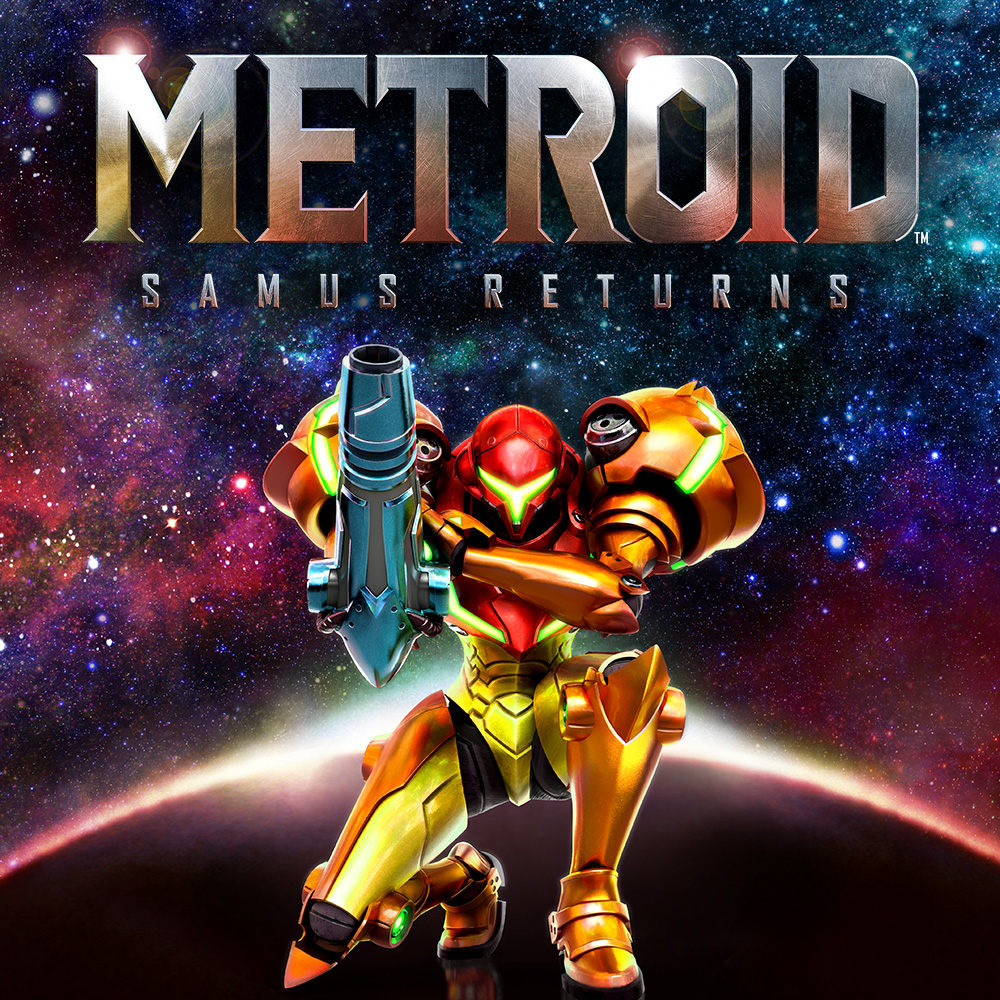
Metroid: Samus Returns is a retelling of the story of Metroid II: Return of Samus. Calling it a remake doesn’t do it justice, because the entire game has been redone from the ground up, leaving just the basic scenario intact. What this means is, having already played Metroid II doesn’t mean you’ve already played this game.
Samus Returns starts you off as Samus Aran, who has just landed on the planet SR388, tasked with the job of exterminating the metroids there. Apparently, at this point, the Galactic Federation has found the metroids to be more trouble than they’re worth, so they’ve decided that they’ve just got to go. What better way to exterminate a bunch of dangerous super-monsters than to send a lone bounty hunter to do the job, with no backup whatsoever.
This game is huge. Because the caverns you’ll be exploring are so immense, it helps to have plenty of tools at your disposal. As one might expect, typical Metroid series upgrades are here, including High Jump Boots, the Varia Suit, and the Spring Ball, which is to be expected because they are in the original. The Spider Ball is included as well, which is welcome because it definitely adds to Samus’ mobility and makes tons of areas accessible, and itself is available early on. So much freedom is given to Samus’ movement, that Samus Returns doesn’t feel like a typical platformer. Whereas in most platformers the walls are obstacles, in Samus Returns the Spider Ball makes them feel like a tool that can be used to reach new areas. Because of this, one can imagine the care that must be taken to take into account Samus’ abilities as each area is designed to keep the game balanced and consistently challenging. This is something that developer Mercury Steam succeeded at. What’s more, there is a real sense of empowerment in the number of options Samus may have in overcoming an enemy or obstacle. It really feels as though the player is in charge, and that if something can’t be reached, then the player simply wasn’t intended to access it just yet.
However, power-ups aren’t the main keys to progress in Samus Returns. Samus progresses by collecting metroid DNA, which can be obtained by slaying metroids that Samus comes across. This DNA is then scanned with a statue, which removes progress-blocking acid once Samus collects enough, and there’s just enough metroids in the area to do this. One could ask how an ancient race can know just how many metroids will be in an area and their exact DNA compositions decades in advance, or just what they’d have to gain by roadblocking an exterminator that wasn’t even born yet. But hey, it’s a video game, what matters is that the game is mechanically sound.
Samus does get some new abilities that weren’t present in the original, which add to the uniqueness of the experience of Samus Returns. Among these is the melee counter. This is achieved by quickly pressing the X button as an enemy charges you (easy to tell, because they’ll “glint” a certain way just before they do it). This stuns the enemy, giving you the opportunity to kill them while they’re stunned. If you respond with blaster fire quickly enough, you’ll automatically lock on to them and kill them with a single shot. As much as I’ve played Samus Returns, I’ve found this satisfying every single time.
Taking advantage of this isn’t a bad idea. Because otherwise, the enemies in this game are tough, taking more shots than I remember similar enemies taking in most other Metroid games. What’s more, the enemies in this game are very aggressive. Some of which will charge you on sight, which is usually right when they appear on screen, so you’ll have plenty of opportunity to use this fun new mechanic. Thankfully, there’s no cheesing it like the sensemove mechanic from Other M, so your timing has to be on point.
One welcome new mechanic is the inclusion of Aeion abilities, which are pretty powerful, but their use consumes an Aeion bar, which gets replenished by pick-ups, and its maximum is increased by Aeion tanks that can be found throughout the game. There is variety in these abilities, which can be switched on the fly due to them being mapped to the control pad. There’s an ability that helps offensively, one that’s defensive, one that just about renders the Speed Booster obsolete (how’s that for cryptic?), and one that’s controversial because it makes exploring the huge map much easier. In my opinion, it really didn’t take anything away from the game, and was great to have considering that the maps in Samus Returns are huge. The Aeion meter depleted faster than I would have preferred, but that’s fine, because these abilities would be broken if players could constantly use them as a crutch.
Another great ability that’s welcome is the ability to “analog aim” by holding down the L shoulder button. Doing this causes Samus to stop in place and you can aim her gun using the control slider. Because of this, Samus is no longer limited to the 8 traditional directions to aim her weapon (though this can still be done while moving), and you can now aim with more precision. This might take a little time to get used to, but once you get the hang of it, it’s great to have, as you no longer have to reposition Samus to hit certain targets, and can be used in boss battles to get more attacks in.
In the original, the boss battles were the metroids themselves, and there were a few dozen of them. The original was repetitive because the variation in experience between metroids of the same form was supplied by the environment you fought them in. In Samus Returns, however, that repetition mostly vanishes for several reasons. For one thing, there’s more variation in the obstacles the environments provide. What’s more, the metroids themselves are no longer straightforward in their attacks. Each one will usually have several attacks, which call for different responses. Better still, metroids also have attacks that can be melee countered, giving you the opportunity to deliver some serious damage.
Speaking of boss battles, there are a couple new battles in there to change things up, one of which has some pretty significant implications for the Metroid series continuity. It’s a welcome addition, especially for fans of the series.
Amiibo Corner
Would you be missing anything if you didn’t use Amiibos? Yeah, but whether it’s a big deal would depend on who you are. Amiibos supply backup tanks for health, ammo, and Aeion energy, but they really aren’t game breaking and don’t count towards your item collection rate. There are more post-game bonuses, such as gallery images and a music room, but whether these are a big deal will depend on whether you care about such things.
The really big Amiibo to own would be the squishy Metroid one. During the game, it gives you the location of a metroid in the area. This can be a big help, but not always. It doesn’t always give you the location of the most practical one for you to find next. Still, this comes in real handy considering that otherwise you might be spending a lot more time combing these huge maps. But even more significant would be the post-game bonus that it provides: an extra mode that provides even more challenge than the Hard difficulty.
That’s something to think about right there. This game’s normal mode is already hard. Which is just how I would have wanted it. Each of the games challenges are just hard enough to offer a sense of satisfaction upon overcoming them. Then there’s a Hard mode, in which enemies do double the damage. The difficulty level offered by the Metroid Amiibo is Fusion Mode, in which the enemies do four times the damage, and you see Samus in her Fusion suit, serving as a reminder to watch your step. Having this hardcore difficulty behind an Amiibo paywall may upset some players, especially considering how difficult to find these Amiibos are right now. And we certainly don’t like the idea of rewarding Amiibo scalpers for what they’re doing, which is taking advantage of those who weren’t able to get their Amiibos on day one.
If you’re one of those gamers that don’t own a 3DS just yet, it would be worth going out to buy one, even if just to play this game. It’s that good. How many stars would I give it? How about a galaxy out of ten?
Which is a 10 out of 10. This game deserves it, and so does developer Mercury Steam. This game offers tight controls, atmospheric visuals and sound, high replay value, and novel gameplay mechanics that only add to the experience. The only catch is, you gotta buy it. Which I did. Twice. I did my part to encourage excellence in game design. How about you?
The moment you realize that only the first two letters of that rebuttal are necessary.
If smugness had an official webcomic, that webcomic would be Vegan Artbook. The sheer amount of arrogance we are dealing with here would take Satan aback.
Vegan Artbook is about a group of vegans and their interactions with non-vegans. Those interactions boil down to how vegans are such great human beings, and how non-vegans are the cruelest, stupidest, most short-sighted monsters that the artist can imagine.
You could attempt to contact the artist directly and let her know that she’s wrong, her positions are all oversimplifications, many of her “facts” are misleading, and throw numerous scientifically-supported facts firmly grounded in nutrition, biology, and physiology, with supporting documents from reputable sources that can be checked with Google Scholar, etc. Then you’d read a few of her comics and come to understand that she’s aware of these facts, and just doesn’t care. If she cares enough about what you have to say, she’ll draw a caricature saying it which will usually have squiggly arms, buck teeth, acne, or whatever she can think of that would make you seem like a monster. Then she’ll honestly wonder why her webcomic has critics.
To her credit, however, she actually does delete some of her comics if someone can succeed in convincing her that making them was a terrible idea. Here’s one that was edited:
Old, left. New, right. Can you spot the difference?
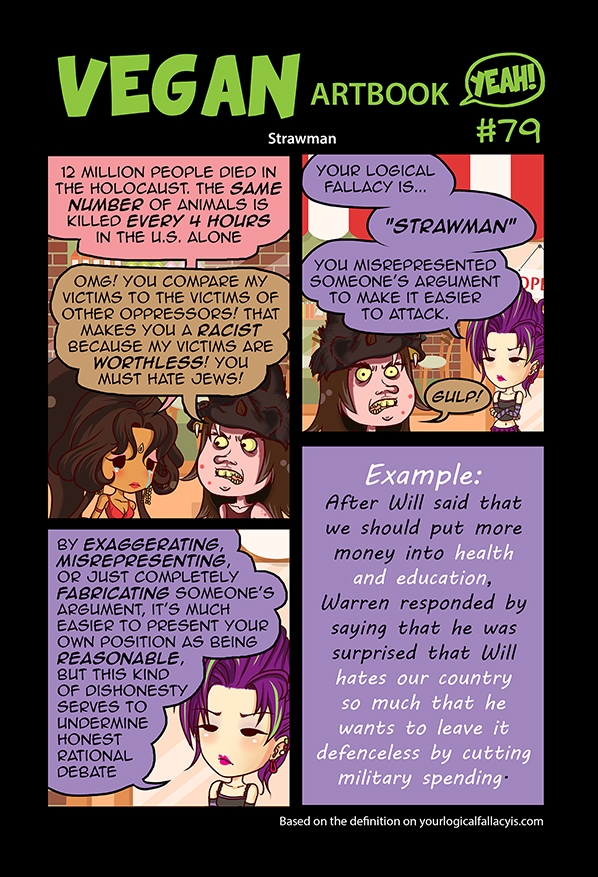
Or this one, which was deleted from her page altogether:
Gather around! Vegan Artbook is going to teach us what a straw man fallacy is.
So, let’s not give up on the artist altogether. Let’s keep going! With enough persuasion, she may just delete every single one of her comics, and finally come around to being a decent, normal human being! But let’s not get our hopes up.
Vegan Artbook does have a cast of characters, but calling them characters is unfair to any other comic that has characters and to the definition of the word “character”. While there are different personages with distinct appearances, each of the protagonists are mouthpieces for the artist’s agenda with no deviation in the slightest. There’s a girl named Dolly that starts out as a meat-eater, but shortly into the comic, she changes sides and loses any aspect of her character that differentiated her from the rest of the protagonists, besides the color pink.
The antagonists are portrayed as varying degrees of insane, and they usually only serve as faces to say whatever argument that the artist feels like arguing against on that day, whether it be a ridiculous straw man argument or something that the artist doesn’t realize sounds reasonable and rational. But by the end of the page, they’re usually reduced to being unable to argue further, often by the counter-argument the artist wanted to convey or some quick zinger.
The art in Vegan Artbook seems competent at first blush. It’s so cute, that I just wanna huggle the entire cast, even as they call me a vicious monster! But then you realize how wrong you are for liking it because Priya went to the Ctrl+C then Ctrl+V school for webcomic art. Because of this laziness technique, she only has to draw each character once, and if she gets it right the first time, just modify the facial expressions, and it’s smooth sailing from then on out.
While most webcomic artists improve with time, the art style in Vegan Artbook is one of the few to have actually gotten worse. While her earlier comics were vibrant and colorful, Priya’s latest comics (which star a self-insert, tending Vegan Artbook towards Sonichu territory) are done in a monochrome with brown. This is somewhat reminiscent of old sepia-colored photographs, but is entirely inappropriate for a webcomic done in a Sanrio style. I’m puzzled as to why she would choose to do this. My guess is that the artist thinks that this is somehow more eco-friendly, but that would only matter for the printed books in her online store (which are still printed with bright colors), not for something transmitted as data and displayed on a monitor, which uses no ink or trees.
Then, with no warning, the comic hits you with gore. Some panels are filled with photographs of gory images that the artist uses to show just how ugly the production of meat is. This comes with no warning for those who happen to be reading her comic at work, which can actually make her comic a disservice to the careers of its intended audience. As you could probably imagine, some of the images used are discredited photographs that were once used in PETA propaganda.
For most of this review, my focus was on the webcomic itself. But for a moment, I’d like to indulge by taking on the author’s philosophy, seeing as it takes center stage in her comic. Like many SJW comics, not every page of Vegan Artbook is a comic page. Some pages are “splash pages” or “pin-ups” that convey distilled smugness. The following summarizes the purpose of the author’s personal philosophy pretty well:
Vegans and vegetarians alike bloviate about how it’s their mission to limit suffering, harm, or whatever they choose to call it. When you talk to one enough, you’ll find that that’s what their position pretty much comes down to. However, their entire endeavor is self-defeating, which becomes obvious when you make the following observation:
Suffering is an intrinsic part of life.
Think about it. You suffer day after day. You suffer because some jerk cut you off on the highway. You suffer because you slave away with MS Office in a cubicle for 8 hours a day working with people who have no idea what you do and therefore assume that you have no value. You suffer because congress votes your constitutional freedoms away while shooting down any solution that could make anything any better for the rest of us. You suffer because your teenage children think that they know better than you, even though you’ve been around at least twice as long as they have, and they’ve spent half their time alive soiling their undergarments. And none of this is unusual.
Then you look at livestock. They never have to worry about paying the bills or having their property repossessed. They never have to worry about starving, or being hunted by natural predators. They have it well until the day that they’re slaughtered and made into someone’s food, which is done with a manner that’s quicker and far more humane than a natural predator would. Livestock have it so well.
In spite of this, the suffering of livestock matters more to vegans than the suffering of their fellow human beings. This is what makes them so reprehensible. But there’s more to it. They say that they’re in it to limit suffering, but they always draw the line when things get too difficult for them.
There are two things that vegans could do if they really wished to limit suffering. I wouldn’t even bring these ideas up if it weren’t clear that I disagree with them (which I do). I bring them up because I want to make it known just what veganism and its underlying philosophy leads to when followed to their shared conclusion. Here they are:
Stop procreating. Throughout a person’s life, even if they’re vegan, they consume plenty of resources, including the indirect deaths of numerous insects, small mammals, and other animals that are killed in an effort to bring these resources to you and your children. This includes the numerous rodents that are directly or indirectly killed as a result of grain harvesting.
Taking your own life. If you do this, you’ll immediately stop consuming natural resources and stop causing indirect deaths that make vegan diets possible. Also, numerous insects and microbes get a free meal, so there’s that.
I could also bring up the possibility of going on a shooting rampage, but some vegans would probably actually consider it, and it’s not necessary to go that far to point out how morally moribund that the vegan philosophy is.
But I don’t just dislike Veganism for what it becomes when it’s followed to it’s conclusion. I hate it because it propagates through dishonesty. Veganism makes more vegans by preying on the under-informed, including those who are unaware of the necessity of iodine and B vitamins in neurological health, resulting in the brain damage of those who adhere to the vegan diet, and starting a vicious cycle which makes the vegan’s victim more likely to accept anything that they say.
Vegan Artbook lies to you all over the place to try to sell you veganism. That’s why this comic upsets me so much. Vegans themselves should stop and reconsider what they’re doing. If it’s necessary to lie to get people to accept what you’re trying to sell them, perhaps you shouldn’t believe it, either.
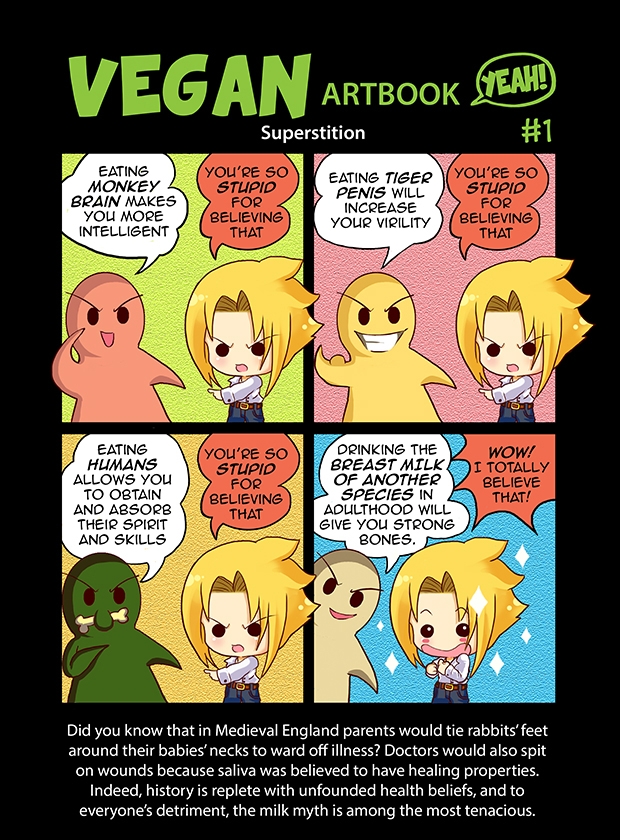
Take the comic’s opening salvo:
It’s a popular belief that Calcium is all that’s needed for strong bones. Calcium’s absorption into the body is aided by vitamin D, vitamin K, and magnesium. All of the above vitamins and minerals are in milk. This makes milk pretty much ideal for bone health.
Now, look how that comic is numbered. Yep, this is Vegan Artbook number one. That’s the artist’s commitment to research and starting strong with statements supported by facts.
Oh, by the way, Priya actually compares meat-eaters to Hitler. You know, the most infamous vegetarian in human history?
And there’s more. Lot’s more. This review could have easily turned into a point-by-point rebuttal of every stupid and naive claim that’s made in Vegan Artbook. But then it would be super-long and not really be much of a review. Still, it bears mentioning, considering that Vegan Artbook is one of those webcomics that is made with the intention of teaching, in which case it matters all the more that she gets the facts right. It doesn’t help that her idea of teaching is to repeatedly call everyone who disagrees with her stupid until they stop.
And speaking of stopping, I’m going to stop this review and give the webcomic its score, which is a the-reason-I’m-ending-this-review out of ten.
Which would be a 0.8 out of ten. A person can only take so much of this. Besides, I’m going to head out and see whether spite makes hamburgers tastier.
UPDATE: It does. The fact that I get vitamins from it that vegans only get from BS sources if at all is icing on the cake. Carnivores have more fun.
I’m aware that there is another webcomic by the same name that came before, and that it’s somewhat stylistically similar. But that’s not the strangest thing about Jack.
This webcomic is classified as “horror” on The Duck, but I really don’t know how to classify it because most horror comics demand that it be taken seriously. Otherwise, it’s a particularly sick comedy. But hey, it doesn’t do particularly well at either, so whatever frame of mind you get into as you read this, you’re not bound to enjoy Jack very much.
Jack stars the title character, who is a man in a hockey mask who was supposedly a fugitive of some sort. Jason Voorhees would find this lame. The comic starts out with Jack on a stake, being threatened by a man leading a lynch mob, with Jack and the lynch mob trying to talk the man out of killing Jack. There is a highly unrealistic conversation about the legal consequences of killing Jack coming from Jack himself, because apparently it’s completely realistic to expect that a raving lunatic with a lynch mob at his side would be dissuaded by the legal repercussions of what he’s doing. From then on, Jack is released and sets out to avenge his kidnapping with homicide. But, as it turns out, Jack was actually killed, and Jack was telepathically tasked with rescuing the corpse of the alligator that ate him from the guy who left him to drown by the alligator itself.
Confusing? This comic is only getting started.
In the next story arc, Jack goes to a bar. A prostitute offers him some fun for some money, and Jack refuses. The prostitute does not take this well, so her pimp has him kidnapped in retaliation.
Fast fact: generally speaking, prostitutes don’t get upset if you don’t feel like having sex with them. They’re in it for the money. If they have bills to pay, and you don’t want their services, they’ll just move along and find someone who does.
So, what does the couple do with Jack? They rape him. No really, that’s what they do. We’re already past the point of “what-am-I-even-reading”, so it’s amazing that this comic can further continue its plunge downhill. But it does, and the hero is rescued by some random furry who happened to be walking by.
You read that right. This comic has furries. The author wants you to take it seriously as a horror comic, and it has furries. And you’re supposed to take it seriously. And it has furries.
Where was I? Oh yeah, after this, Jack goes to jail, where he’s allowed to keep his mask, because it seems like standard procedures are suspended in this comic that you’re supposed to take seriously. It’s there that Jack meets someone who knows the people he just killed, and he somehow cuts his ears off when they’re behind the straps of his mask, and Jack does nothing to stop it, even though no one is holding his arms down.
Is it too much to ask that he struggles or does something more than look slightly peeved that he’s being disfigured with a knife?
That’s not an anomaly, either. That’s just how fighting is handled in Jack. Every blow is taken directly with usually no effort on the part of the assailed to practice basic self-preservation. An enemy can be completely upon his victim, with every perceivable advantage, but it’s still the victim’s turn to attack, and the assailant won’t so much as resist until their opponent has finished their attack. Because of this, the fighting in Jack is so stupid that it’s fun to read in a way the author probably didn’t intend.
Yes, I know that the point of all this suffering on the part of Jack is to show how he’s breaking down to the point that he’s the psychopath that he ends up becoming. I know, but I don’t care. This comic is so stupid and poorly-executed that what’s supposed to be tragic instead comes off as funny.
In Jack, there isn’t really one consistent art style. Jack comes off as an experimental comic in which numerous artistic styles are tried, but nothing is really stuck with. The result comes off as something that some high school student drew to show his friends how crazy he/she is so they don’t mess with him/her. Then they honestly don’t understand why they’re still being relentlessly made fun of.
There are parts that are mostly monochrome. The exception would be the blood, which is colored in red, as though we’re supposed to have our attention drawn to it. Aside from this indulgence, this is easily Jack at its best-looking, as it shows that the artist is competent at shading.
Other parts of the comic are full-color, but the colors are bright and garish, and appear to be colored with Crayola markers or an equivalent. Crayola markers are terrible for coloring, and are usually only used by children who don’t have a more sophisticated option available. It’s super-easy for strokes to overlap, which in the case of Crayola markers, results in darker colors where it happens. Someone who is masterful can take advantage of this to create depth, but this isn’t a skill that the author of Jack appears to have.
Then there’s the anatomy. Most humans are skeletal in appearance, which can probably be sold as being stylistic to go with the punk-metal horror style. However, you also notice how muscle tissue is misplaced in such a way as to interfere with a sense of depth, and you know that this comic is drawn by someone who is terrible with anatomy.
Being a furry doesn’t get you off Scott-free. The author only knows how to draw wolf snouts, but that doesn’t mean that she won’t still attempt to put other animals, such as rabbits, into her comics. Behold:
Is it a rabbit? Is it a dog? No! It’s just ugly.
This comic starts out confusing, and then descends into unintentional sick humor. Or was it intentional? It’s hard to tell. Maybe the artist is some kind of super troll, and everyone who points out this comics numerous flaws is playing into her hands in some way that can only be done by making a hilariously bad webcomic. Sounds like an airtight explanation, until you figure that there’s no perceivable benefit to doing such a thing. It’s just easier to say that she’s a bad webcomic artist. Hanlon’s razor and such.
Anyhow, on to the score, which is a there-there out of ten:
Which would be a 3.3. Because it’s not all bad, right?
I get the idea that this comic is intended to be enjoyed when in a certain frame of mind, which would be achieved by playing heavy metal from your speakers, drinking Kentucky bourbon, and banging your head while making a goat sign. But you could enjoy all that even more by not having this comic have anything to do with it.
Suppose you’re in the mood for some righteous indignation. Some frequent, scheduled YouTube content where some guy shouts at the camera about random topics. Then you stumble across an old channel called “AngryAussie”. You watch a few videos and say, “No thanks”, then you keep searching.
That’s pretty much the entire AngryAussie experience.
However, suppose you were to stick around and poke about his archives. That’s when things really start to get interesting.
For one thing, you find out that the channel is old. Really old. Some of his videos have been around for over a decade, so he got into YouTube shortly after it got started.
You also notice something else: there was a time in which the guy was skinnier. Much, much skinnier. He does take his efforts to hide it. His avatar is of himself from back when he was skinnier, and his newer content shows him from the chest up, whereas the content from when he was much skinnier showed him from the waist up. While he’s going to these pains to make a better image for himself, he’s apparently not taking the effort to lay off the donuts.
Why does it matter? When you spend time in front of the camera, your image is part of what you’re doing; your face is how you make your living. And, as it would seem, time has not been kind to AngryAussie.
This is true in more than one sense. While his older content from shortly after he got started had viewcounts numbering in the thousands and even tens of thousands, his newer content only has viewcounts numbering in the hundreds. Yet, he keeps going, with a certain persistence that one would only have if it didn’t matter to them that no one is interested in their content any longer.
And that brings us to the main problem with AngryAussie’s channel: the content.
AngryAussie’s videos can best be described as going on angry tangents about whatever is newsworthy or whatever random topics just happen to catch his ire. When I say “angry”, I don’t mean “angry” as in “tee-hee he’s an internet comedian with his fair share of clever zingers”. I mean “angry” as in “aggressively beats you over the head with whatever point he’s trying to make”.
Unless your opinion is completely in lock-step with whatever point he’s trying to make, you’re bound to come away feeling at least a little condescended. This already does plenty to limit AngryAussie’s appeal. But it gets worse: if you leave a comment telling him that you disagree with him at all, prepare to see your comment deleted, and your account possibly being banned from his channel.
AngryAussie seems pretty sincere in the belief that freedom of expression should belong to him, but not to the people who frequent his channel. One could argue that this made him very early to the SJW movement. However, when your content has very limited appeal to begin with, it’s a bad idea to block whatever few viewers that you have over petty disagreements.
Want evidence of this? Go back to his earlier videos. At one point in time, he replied to most people who commented, and it’s interesting to sort them by date to see him replying to comments that are no longer there. Of course, it would be much easier for him to respond to each commenter now, seeing as he has so few. The fact that he blocks those who argue back likely has something to do with how few viewers he has.
If you can’t take it, don’t dish it out to begin with. In fact, critical feedback is a good thing, as it provides insight on how to improve. It’s not unusual to run into criticism that has no purpose other than to tear you down, but the solution to that is to carry on unfazed, and grow some thicker skin, if need be.
Let’s take an example of his content to see just what we’re dealing with. The following video is titled “WAINGAFAT? Koran quoting bigots!”
Your first question may be “What is a WAINGAFAT? Some kind of Australian slang?” No, it’s an acronym which is short for “What Am I Not Giving A Fuck About Today”.
His choice of topic is one that I agree with, because I too get tired of seeing bigots use the Koran to advance their sordid agenda. Let’s examine what he has to say.
INTRO WARNING: Content starts at 0:17
“Who am I not giving a fuck about today? Random losers who go around online and prove that Islam is evil,”
Wow, there goes my expectations! As it turns out, the people who he thinks are losers are those who are critical of a religion. This happens to be something that AngryAussie himself does, by the way.
INTERNAL CONTRADICTION WARNING: He does it in this very same video.
“putting out random, out-of-context quotes from the Koran, saying ‘THAT PROVES IT!'”
It does prove it. If a fanatical ideology that kills people has a proclamation calling for the death of non-believers in it’s very charter, that is proof that it is a violent ideology. QED.
“…A quote from the Koran doesn’t prove a fucking thing.”
This would get quite a response if it were instead directed at Muslims. They’d wonder just who this man is that he thinks that he’s in a position to tell them what their religion is all about. They’d call him a religiouly-ignorant rattling cap. And they’d be right.
“Something is lost on you because you’re not capable of a logical sequence of thought.”
Apparently it’s not logical thinking to point out what a book says as the reason behind the behavior of those who take it seriously. Also, it’s apparently not logical to look for reasons why a particular ideology turns out a disproportionately high number of violent fanatics.
“You do not actually LISTEN to other people. Listening involves understanding what the other person says. Not just waiting for your next turn to spout some shit.”
From 0:55 to 1:07. That’s the point in the video in which he completely demolishes everything that he’s ever done on YouTube. Go ahead, watch it. If you’ve seen any of his other videos, or just this one for that matter, you’re going to laugh so hard.
In just 12 seconds, he destroyed his entire YouTube career.
“I can give you quotes from both the New and Old Testament that justify murder, rape, and slavery. Does that mean that all Christians and Jews are terrorists too?”
No, you can’t. Murder and rape are endorsed nowhere in the Bible. In the Old Testament, slavery was merely tolerated, and heavily regulated to the point that it wouldn’t have been considered attractive to practice. The New Testament discouraged slavery in favor of a brotherly relationship between believers, which was the entire point of the book of Philemon. The Christian world would eventually use New Testament reasoning to call for the abolition of slavery in the western world altogether. Source: Every reputable theologian and Bible scholar ever.
On the other hand, Muslim countries still practice slavery, and some are actively involved in the African slave trade to this day.
“Um, Atheists, don’t bother answering that, because I know what your answer will be.”
AngryAussie himself is an Atheist, and therefore assumes their response. I don’t, but that’s because I believe that most Atheists are better people than AngryAussie.
“But where they do start to shit me a bit is when they say ‘you should read the Koran, then you’d know’ as if they’d read the Koran. And they will bald-faced lie and say that they’ve read the Koran.”
What really starts to “shit him a bit” is when someone not only presents evidence, but invites him to see the evidence for himself. It’s easier for him to just say that they’ve never read the Koran, and then never bother to look into it. This is called, “being lazy.”
As an aside, I’ve read the Koran. Extensively. In fact, I’ve spent thousands of hours researching Islamic ideology to see just why Muslims do what they do, and whether the desire of their fanatics is actually supported by the Koran. And it is. It didn’t even take a few hours to arrive at that determination; the reason why I’ve researched it so much is because Islamic theology is fascinating. Muhammad was the Chris-Chan of the 7th century.
That fact isn’t preventing AngryAussie from doing no research whatsoever and then acting like he has any idea what’s going on.
“This is the same kind of moron who pulls a quote out and says ‘this proves gay marriage is evil and wrong, homosexuality is bad’ because it’s described in the Bible as ‘an abomination’. Yeah, in Leviticus, the Jewish book of law. So, if your using that, saying ‘ooh, that’s God’s word, that’s absolutely it’, Leviticus also talks about keeping Kosher! Do you keep Kosher, right along with saying that man-on-man sex is an abomination?”
It’s amazing how, with every word, AngryAussie proves that he doesn’t understand a thing about Christian or Jewish ideology. For one thing, homosexuality wasn’t just denounced in the Old Testament book of Leviticus, it was also denounced in the New Testament book of Romans. There is New Testament justification for the Christian position on homosexuality. The key difference is that the NT doesn’t call for stoning people for being gay. The reason for that is because the command to stone them is understood to be limited to Israeli national law, which is why Christians and Jews don’t practice stoning. Source: Every reputable theologian and Biblical scholar ever.
Incidentally, Islam not only actively teaches that homosexuality is wrong, but actively calls for the death penalty for those who practice it. If you think that they’re wrong, find the Koran passage that tells them that they’re wrong, go over to ISIS, and show them. They claim to take the Koran seriously, so let’s see how they take it. It would probably be an eye-opening experience for them.
“And, Orthodox Jews? You don’t have to answer that, because I know what your answer will be.”
I suspect that it would sound something like, “You just mocked what we stood for. Don’t act like we’re friends.”
In the end of the video, he does admit that some “dodgy” things are done in the name of Islam, so by that point, he’ll have insulted every religion that he mentioned in his video. He wraps up by saying that he isn’t interested in any resultant backlash that may result from touching on this topic, which is what you’d expect from an internet angry man who can’t take it as well as he dishes it out. Want proof? Scroll down and try finding the comments of the commenters he insults. Can’t do it? That’s because he deleted them.
Of course, that regrettable pile of crap was from 8 years ago. What’s AngryAussie up to today? If you answered making fun of Donald Trump and calling right-wingers Nazis, then that groan of “Of course. Another one of those.” probably came from you.
So yeah, AngryAussie is currently competing directly with the corporate mainstream information media, and pushing the SJW narrative at a time when the SJW movement is going through its backlash phase, during which it’s seriously not cool to be an SJW. And if the SJW movement is anything like the punk or hippie movements that preceded it (it is), the whole thing is only going downhill from here on out, and in just a short while, the dead-enders will be the only ones left.
I’m getting tired of this guy, so it’s about time to give his channel it’s score, which is censorship out of ten.
Which is a zero. That’s what you get when you get on a platform that gives you a voice, call everyone else stupid for not having your worldview, then delete the comments from those who respond in kind. Enjoy having a platform that YouTube grants you totally free of charge, while denying that same platform for your fellow users.






 Cover art.
 Deal with it.
 Not many players make it to this part.
 Reisen – her gun has bunny ears.




 The moment you realize that only the first two letters of that rebuttal are necessary.
 Old, left. New, right. Can you spot the difference?
 Gather around! Vegan Artbook is going to teach us what a


 Is it too much to ask that he struggles or does something more than look slightly peeved that he’s being disfigured with a knife?
 Is it a rabbit? Is it a dog? No! It’s just ugly.


 Magnetricity