Hello everyone! This post is a brief explanation on a new tag I’m creating, called weapons-grade sarcasm.
Sometimes, I might make a post that is so ridiculously over-the-top sarcastic, that there will be no doubt in the mind of anyone of reasonable intelligence that the post is sarcastic. However, not everyone is of reasonable intelligence.
Therefore, the tag weapons-grade sarcasm has been made for the benefit of both the stupid and those with terminal literal-mindedness to provide an indication that eliminates any doubt that sarcasm is being employed.
You might be wondering, “Hold on, this post is tagged as weapons-grade sarcasm. Does that mean that this post is sarcastic, too?” To answer this question, I’ll point out that this post is intended to be taken more seriously than any other post with this tag. Also, you’re probably among those who would benefit the most from the tag’s creation.
Please look forward to more content to come.
Edit: Well, I tried. The press or anyone intent on defaming me will probably either miss this post for failure to perform a trivial investigation, or deliberately ignore it. At least this post is here so I can point to it, if desired.
Okay, is anybody actually falling for this? Let me know.
What I’m talking about is a graph that started trending on X, which shows a bar graph of what is supposedly the most unattractive hobbies for men, “according to women”. The chart is as follows:
I ignored it at first glance, but seeing as people kept giving it attention, I’ve decided to take it behind the shed. Spoiler alert, it’s coming back with some teeth missing.
First of all, Online Trolling is listed among the hobbies. That should be a powerful indicator of what’s going on, here. Hopefully, I don’t have to spell this out. Okay, I’ll do it anyway, because no reader left behind.
It’s bullshit. Someone came up with this graph just to mess with people. And it worked.
But it’s not the first indicator that someone is messing with you. That would be the fact that there’s no citations. And if there’s no citations, this means that there’s no study, no survey, no polling, or anything of the sort. If someone wanted their study to be at all respectable, there would be a citation, so that a person could look into the methodology to ascertain that the data has any value. There’s no citation, so there’s nothing of value.
Instead, every indication is that someone just pulled all this information straight out of their ass, and posted it on social media knowing that it would push some buttons.
Notice something else about the data? Conveniently, every data point on the bar graph decrements by five. Sure, it’s possible that if you survey thousands of people, it’s possible for the data points, when arranged in the form of a bar graph, would form a neat decrementation by fives. But it would be strongly unlikely.
Having said all that, the point that really pushes people’s buttons is the one about playing video games. I call BS, because women I’ve met play video games. In fact, the last woman I was with played video games. She had a big stack of them. But she hid them from me, even though she didn’t have to, and I ended up finding them accidentally.
Look, I remember a time when video games were the pastime of hobbyists who frequented Radio Shack. Back then, I would’ve understood if someone regarded them as some nerd hobby. But a lot has changed since then, and now it’s something that pretty much everybody does. It’s been decades since it’s been regarded as a nerd hobby, and if anyone today said that they didn’t play them, I wouldn’t believe them.
If anybody has any doubt that Chris Chan believes what he goes on about on social media, there he is, stating it as matter of fact to a squad of arresting officers. I bring this up because there are more than a few people out there who read about Chris, and have their doubts, like he has to be playing a character online, like all those TikTok celebs who are willing to do just about anything for only a little bit of e-clout.
But there he is, rattling off to a bunch of officers about Sonichus and Rosechus in what could be the most serious situation that he could find himself in. Because in his mind, all this stuff about dimensional merges is as real as can be. When he goes on and on about the things the officer’s children consume to stave off boredom, there he is, speaking of them as though they aren’t just made-up bullshit.
Consider the implications of this for Chris’ other delusions. He probably actually believes that he’s the most important person alive, with millions of people counting on him to bring about a world where cartoon characters coexist among us. He probably actually believes that he can will himself into a woman by listening to sound waves on YouTube. He probably actually believes that he’s a goddess and the living incarnation of an old game console. His pony persona is milk to that breakfast cereal of delusion that he keeps spooning into his face because he can’t get enough of it.
But it just keeps getting crazier. As Chris Chan is led away to a place where people like him belong, the officers take note of unusual cars gathered around. For a moment, they entertain the thought that they’re arresting someone who’s on a watch list (a strong possibility), and they may have to speak to a few feds. But no, these were a bunch of weens chasing Chris Chan for clout. From the perspective of the officers, hearing the exchange between Chris Chan and online influencers had to have been surreal.
But the climax was when Chris was conversing with the officer driving him to the station. That was when Chris was explaining the dimensional merge, and the opportunity to meet characters like Spider Man. I could easily imagine the officer accidentally rear-ending another vehicle while attempting to comprehend the madness he was hearing.
And then, with no prompt whatsoever, Chris spills it about his polyamorous marriage with fictional characters, including his own creation Magi Chan and the Pokémon Mewtwo.
Let’s hear it for the officers, who maintained their composure throughout the whole ordeal. It couldn’t have been easy. And, without question, they played their part in making society a safer place for the rest of us.
But they had homework to do. It’s easy to imagine that at least one of them went home and looked up just how famous Chris Chan is online, and ended up bingeing Geno Samuel’s long-running documentary. And then probably entertained the idea of running off to somewhere like French Polynesia to escape all the attention they might end up getting.
Without a doubt, the Chris Chan arrest body cam footage is the single funniest piece of Chris Chan media ever produced, and it’s going to be hyper-analyzed by autists the world over for years to come.
It’s becoming increasingly evident that DEI is coming for anime, and it’s coming at a time when voice actors in anime-style games like Genshin Impact are threatening boycotts and meaningless online petitions (but I repeat myself), and manga localizers are crying foul because they could be replaced with AI.
Okay then, I’ll throw my opinion out there. DEI is really late to the party. I mean, really, really late. The party’s already over, everyone has already thrown up, and no one would have been interested in the Bud Light that DEI brought with them, anyway.
The anime boom is over. It has been, for a long time. Prior to it, it was the nineties, anime was really hard to get ahold of for cheap, because it had to cross an ocean to get to us, and translating it to your native language was not easy. Then the internet happened, and at that point, decades of anime started flooding over, and a person could easily go to Suncoast (remember Suncoast?) and pick up volumes of Naruto, Dragon Ball Z, Bleach, and lots of less mainstream stuff that’s been in Japan for decades.
That was the west’s anime boom. But then, releases of new anime slowed to the point of what was new to Japan. And, as it so happens, anime is something of a fringe hobby in Japan. So, in the west, anime is starting to settle down as a niche entertainment option, though not as niche as it was in the eighties.
I get that DEI might be going for anime to spite people like me who has long considered it an alternative to the polluted bullshit that western entertainment like Disney has become. I understand just how fun it can be to put a disproportionate amount of resources into what is basically just spite. It can be a fun sport. But oftentimes, it’s just a cynic’s quest. And in this case, the party is pretty much already over.
And what’s more, alternatives will pretty much always exist, and people will always tend more towards entertainment options that will take them away from the world’s problems, rather than remind them of those who are only making things worse.
At this point, there’s pretty much just one manga and one anime that I have much interest in. And if a bunch of astroturfed localizers set out to ruin it, then I’ll just seek out fan translations and perhaps even the Japanese versions, as they’ll be much closer to what the author originally intended when they wrote their story.
Even though I’m not Japanese, I understand that it’s the tendency of Japanese audiences to care more about the author’s original intent, than the agenda of a committee with creative control over the IP. And when you understand that, it will make intuitive sense to you why DEI is going to fail miserably to gain a foothold in Japan. When it comes down to it, while an American audience might not give much thought to the person or people who wrote The Powerpuff Girls, those who read Naruto are likely to care whether it’s the Naruto that Masashi Kishimoto wrote. Just the same, if creative control of Made In Abyss were taken away from Akihito Tsukushi, it’s easy to imagine that most of its fans would be done with it.
If the DEI investors were aware of this, and they’re probably not, then it’s hard to imagine that there’s anything behind their willingness to go after anime and manga than an attempt to destroy it.
But at this point, it’s too late for that. The best manga that has been made over the course of decades has already been localized, most of it about two decades ago. The boom is pretty much over, and the main stuff to go after would be new stuff that trickles out of what was a fringe industry in its home country.
Alternatives will always exist, and they will always be simple for people to find. And it will be because of the connected nature of today’s world, which was what caused the anime boom, to begin with.
When it comes down to it, the general population has a trait that the ideological dead-enders of DEI lack, and that’s the adaptability of mind that enables us to thrive in changing circumstances. The world is changing, fads come and go, and that’s exactly why DEI will eventually be a byword of times gone by.
From Steve Cioccolanti & Discover Ministries on YouTube
A video from a few months prior to the assassination attempt against Trump had started trending because it shows a man, Brandon Biggs, predicting an attempted assassination against him.
And the similarities give pause for thought.
I can accept that it’s a miracle that Trump survived, because if the bullet that passed through his ear was just a centimeter closer to his head, this country could have easily broken into pandemonium.
Months prior, in a video discussing a total solar eclipse, Brandon Biggs was one of three hosts discussing Bible prophecy. In it, he discussed how he saw a vision of an assassination attempt against Trump. According to Biggs, a bullet narrowly missed his ear, but caused a sound wave that burst his eardrum, resulting in blood getting on his face. Afterwards, he got down and accepted Jesus with a passion. According to Biggs, Trump was a Christian before, but this incident ignited a special passion for Jesus.
The video is embedded below. Biggs’ prophecy begins at about 11 minutes in, if you want to get right to it.
There are many people out there who are accepting the prophecy as legitimate. But it’s not a bad idea to have some healthy skepticism. After having learned of this prophecy, I’ve decided to look into Brandon Biggs and his theology. For one thing, to see what other prophetic predictions he may have made, in the interest of determining how accurate he may have been with those. Also, to learn about his church, because I imagine that it’s getting an influx of interest.
The church Biggs pastors at is Discover Church. Rather than being a traditional church, Discover Church is an online ministry, which doesn’t consider itself a substitution for attending church in person. It nonetheless has multiple membership tiers with differing monthly fees.
Brandon Biggs does have his own YouTube channel, called Last Days. On this channel, he discusses prophecy, with a particular focus on the predictions that he makes.
According to critics, he has made multiple predictions that did not come to pass. For example, he predicted a sharp increase in the price of silver, which did not come to pass. He also predicted a market crash in the year 2013, which also did not come to pass. He also predicted a sharp increase in the value of the Iraqi Dinar; no prize for guessing that this also did not come to pass.
While I’ve heard these claims, I did not come across evidence that Biggs made them. One possibility is that he did not actually make them. Another more believable possibility is that Biggs recognized the optics in making bad prophetic financial predictions, and deleted them from his channel.
Nonetheless, the accuracy of Biggs’ prediction concerning Trump seems startling, even if it’s not precise. However, when examined critically, Biggs’ prediction becomes less impressive.
False prophets tend to do what I like to call, “throwing spaghetti at the wall”. When you throw spaghetti at a wall, the expectation is that most strands of pasta will fall to the floor, but a few strands might stick to the wall. When a toddler that throws spaghetti in such a manner brags about their own ability to make pasta stick to the wall, they’re hoping that you’ll ignore that most of the spaghetti is on the floor.
While a broken clock may be right twice a day, it helps to remember that it’s right for the wrong reason. The fact is, there are many, many people out there who make false prophecies and predictions. With so many people making so many guesses, some of them are bound to come close. And this becomes more likely considering that some of those guesses are guesses which, if they weren’t stated as prophecies, would be reasonable to make.
One prediction that would have been easy to make is an assassination attempt against Donald Trump. This is because political tensions in the United States is high, to the point that some Americans are actually killing each other over differences in political opinion. For example, just two days ago as of this posting, a 22-year-old Michigan man killed an 80-year-old with an ATV for putting up Trump signs, before ending his own life. That’s the point where things are. And, to make matters worse, the corporate media has been spending the better part of a decade propagandizing against Trump, making him out to be a fascist, a racist, a Russian asset, a threat to democracy, and much more.
While there are many criticisms that could be had about Russian society, at least the Russians were smart enough to know that the Pravda was lying to them. But propagandize the American public enough, and at least one lunatic is likely to act on the misinformation. There have been predictions of assassination attempts against Trump specifically going back at least as far as 2016. It’s amazing that one hasn’t been attempted until July of 2024.
Once some lunatic makes an attempt, of the many predictions that have been made, it’s the one that came the closest that would be most likely to stand out.
And Brandon Biggs’ prediction came close. But like the failed assassin, he would miss the mark.
Pay attention in the video above. Biggs stated that the bullet would narrowly miss Trump, but that the sound wave would cause an eardrum to break, resulting in bleeding. In reality, the bullet did hit Trump, but passed through his ear, leaving Trump otherwise uninjured. There are no reports of Trump’s eardrum being broken.
Biggs’ prediction was close, but close only counts in horseshoes and hand grenades.
Another component of Biggs’ prophecy is that, in that time window, Trump would get down and strengthen his commitment to Jesus, finding a passion for Jesus stronger than he had before. In reality, it seems that Trump ducked down out of self-preservation. Moments after getting up, Trump lifted his fist in the air, and shouted “Fight, fight, fight!” It’s true that Trump credited God with his survival. However, in the past, Trump stated that he never asked God for forgiveness. This would be a necessary step to becoming a Christian.
A person cannot renew their commitment to something that they weren’t committed to already. But hey, how was Biggs supposed to be aware of Trump’s spiritual state?
In a more recent video, Biggs addressed the discrepancy between his prophecy’s prediction concerning the miss that would have broke the eardrum with what really happened. He stated that the vision that he had was true, but that he merely assumed that the blood came from a broken eardrum.
Naturally, we cannot falsify a vision that Biggs alone saw. All we can reasonably do is discredit his prophecy when the words that he used are at variance with reality. Of course, it’s also reasonable to ask why his prophecies primarily concern speculation on the value of commodities and currencies, when we have no indication that Biblical prophets concerned themselves with such things. And why these predictions of his are usually wrong.
Like many similar cults, Discover Church has a business model that I like to call the Profitable Prophet Plan. Their variant of the Profitable Prophet Plan has a feature that can be called, Shotgun Spirituality, because it takes a spray-and-pray approach to prophecy, where many predictions are made over the course of time, and they pray that one of their bullets hits a target, upon which point they can declare victory for the one bullet that hit, hoping you’ll ignore the many that missed.
While I disagree with the idea that such poor accuracy is worth a dime of anyone’s money, Shotgun Spirituality does succeed in wowing enough people to keep many such an enterprise afloat.
At this time, I suspect that Brandon Biggs’ prophecy was not so much a prophecy as it was a guess, one of many like it, notable only for its accuracy, if not its precision. It seems sensible to view it as such, especially in light of his dubious prophetic investment advice, which he has apparently attempted to sweep under the rug.
But what do you think? Do you think that Biggs’ predictions are actually worth getting a membership package to his online ministry over? Or would you value it as less than an Iraqi Dinar? Please leave a comment to let me know whether you believe Biggs’ prophecy was a hit, or whether he was as inaccurate as Thomas Matthew Crooks.
It’s time for another dose of basic observation of reality. And today, it’s needed because a bunch of professionally-offended social media losers are throwing a fit over the creative decisions of a Chinese video game company.
Recently, the game company Mihoyo revealed a new Natlan setting for their Genshin Impact mobile game. It was recently revealed that the setting for the region has elements of inspiration from the African and South American continent, and even though the game is a few years old and has been played by millions of players, people are just now realizing that there aren’t any black characters in the game.
Even though the number of African tribesman who give a shit about skin tones in a game that they’ve never heard of is probably precisely zero, a bunch of Reddit and Twitter users have proceeded to flood Mihoyo with complaints, because that’s pretty much all they can do.
What they didn’t count on is that Mihoyo is based, and stated that Genshin Impact is just a video game, that any character can look the way that the game’s makers want them to look, and that, because it’s a work of fiction, nothing about Genshin Impact has any bearing on reality.
Basically, a Chinese game company told them what their parents should have told them back when their ages consisted of a single digit. They probably also quickly figured out what was going on by sorting complaints by IP address, and finding that hundreds at a time are coming from the exact same device. And, having been at this for years, they’re probably aware that, when you work in customer service, you’ll encounter a bunch of people with mental illnesses who hide behind sockpuppet accounts, and are so crazy that they think media contains hidden messages from the government/simulation intended specifically for them.
Ask me how I know.
One could easily point out that if there were black characters in the game, then the perpetually-offended will instead complain about cultural appropriation. One might even get the idea that one just can’t win with them. But you can win. When one of them starts getting offended on someone else’s behalf, just don’t engage with them. Let them bang their pots and pans together, where they’ll accomplish nothing.
And while you’re at it, savor the sad irony of the fact that, even though they are connected to the summation of human knowledge, if they had spent even half the effort that they put into being offended instead learning to do something useful, they might have self-taught themselves a skilled trade, and our generation may even have already cured cancer. Or at least learn how to make their own video games. Or even learn to draw in the anime style, so they can beat off to something which they drew, rather than relying on other people to draw it for them. Instead, they are actually dumber than they would be if they had never discovered the internet.
I don’t know what an African tribesman would think of Genshin Impact if they were to learn about it. It’s easy to imagine that such an experience would be their first brush with the technology needed to run the game. Their typical concerns would more likely involve whether a neighboring tribe would invade them while they slept, forcibly remove their genitals, then sell them into forced labor (something that a dumbass neighboring chieftain may attempt to do just because he had a bad dream). There’s also the question of whether they can get enough to eat, something that a person who is aware that mobile games exist probably never has to worry about. An African tribesman cannot possibly give a shit about the skin tones of imaginary characters in a mobile game that they’ve never heard of, and if they had somehow heard of it, they’d probably join the Chinese in wondering just what the hell is wrong with anyone who would give a care. To become offended on behalf of an African tribesman is supremely pointless.
Genshin Impact is just a game, and nothing about it has any bearing on the real world. In that respect, it’s like any video game ever. If you don’t have fun playing that game, your solution to that problem is to not play that game.
If Mihoyo is going to be based concerning this matter, I might just support them. And not just because I want to add Nilou to my roster.
Some voice actors came out against Mihoyo on this matter. This is pretty brave, considering that it’s easier than it’s ever been to replace them. Also, it’s probably true that they’re under contractual obligation to not lay a steaming, fiber-rich loaf all over their employer.
One of them went as far as to call Mihoyo’s actions “unforgivable”. I get that people use that phrase to be dramatic, but they should think about what that means. If someone calls anything that I do “unforgivable”, what they’re saying is that I cannot possibly be reconciled to them, I don’t see any reason to waste any energy trying to impress them.
I look forward to the contributions of the replacement VAs. And if Mihoyo goes the AI route, that would go to show how impressive that the technology has become.
You should be thankful that you’re alive, too. Because if things had gone just slightly differently, you’d be fighting for survival instead of reading this.
I’m hearing a lot of stories about what people think happened with the failed assassination attempt against Donald Trump. As less speculative information comes to light, the Secret Service and local law enforcement looks worse and worse.
But as bad as things might be for some of the most infamous dodgers of accountability in all the world’s history, if any of the bullets had hit square with the failed shooter’s intended target, we’d be in an entirely different country, right now.
Let’s talk about it. And be warned, this will get graphic.
If you really wanted to see something sad, then picture the immediate aftermath of any of the missed bullets hitting their mark. The assembled crowd and the viewers on live television would have been treated to an exploded head.
At that point, the tens of millions of people who voted for Trump in the last election would have thrown their hands up, and said “I guess we don’t have a leader anymore, or a cause.”, then go back home, where they would then just consume product, and decide to study Marxism.
Except that wouldn’t have happened. Not even close. What would have happened instead is that America would have exploded into unbelievable violence.
If you want advice on how you could survive in such a scenario, I could say this: stay inside. Hopefully, the food you’d have on-hand would be enough to last you a while. Prop furniture against the door, and don’t open it unless you recognize the voice of your family. And pay attention for the sound of alarms.
I know that this might sound like I’m describing the worst-case scenario for dramatic effect. But I think most people have no idea how bad things could have been. The number of people who voted for Trump in the last election numbered around 75 million. Imagine if even half of them decided to go door-to-door in a huge game of find the leftist.
There would have been unimaginable carnage.
Emergency services would not have been able to respond to all calls. They might only be able to respond to a few, thanks to the few remaining with sufficient normalcy bias. But they too would have families and a sense of self-preservation, so the police, ambulances, and firefighters would be largely out.
Stores would have been raided, and with supply lines disrupted, you’d have been left with whatever you have on hand. Would it be enough to last you for weeks?
Just based on that, large cities would have become real-life Battle Royales.
At that point, you’d probably care less who the president is, as government probably would have little impact on your life unless you lived in the few areas where martial law could be successfully established.
Then there’s what would have happened on an international stage. With the United States being preoccupied with its own affairs, rogue states would proceed to do as they please. Ukraine would be taken by Russia immediately, and Israel and Taiwan would likely be invaded, too. The world would quickly fall apart as the U.S. would lose any capacity to intervene. That some rogue states might have deployed radiological weapons would have been a possibility.
The question of how long it would be before the United States would have returned to being any sort of organized society would have been difficult to determine, but it’s possible that maps would have needed redrawn, and skylines could have changed.
And thankfully, we don’t live in a world where this scenario came about. This is because three bullets all missed as Trump moved his head to the side at just the right moment.
A fraction of an inch and a fraction of a second was just how close we were to a different world, one that would have been brought about by a defective boy who managed to elude an incompetent security apparatus.
It gets me to thinking that it’s likely that Trump benefited from divine intervention. If that’s true, we all did. Most of us might not have even considered how bad things could have been. We might have even gone from fretting over frivolous things like whether our shoes match our shirts, to fighting for our lives.
And when it comes down to it, there’s no telling when that might happen, anyway. The fact is, we live in a dangerous would, and our society might be hinging on a tenuous factor.
Interestingly, it was only days beforehand that current president Joe Biden was passionately defending his decision to stay in the race. In an interview on live television, he even stated that he’d remain in the race unless God himself told him to withdraw.
I don’t know whether Trump narrowly surviving an assassination attempt would have been the sign that he was looking for. But what I can say is this: if you’re going to invoke the greatest name in Heaven over something you might do, you’d better be ready to do it.
According to GameFreak, the makers of the Pokémon games, the Pokémon, named Yungoos, was not intended to bear a resemblance to Donald Trump.
Donald Trump, as you’re likely well aware, was nearly assassinated just days ago, the gunman only having succeeded in removing a chunk of Trump’s right ear.
Yungoos has an evolved form, named Gumshoos, which bears a stronger resemblance to Trump. Notice something about its ear?
Yeah, it’s got a notch in its ear.
To be fair, both its ears are like this, and some small mammals do have bifurcated ears. So, I feel inclined to say that this is just a coincidence. After all, why would GameFreak be able to see the future?
But I expect some people to point to this as evidence of the simulation glitching out.
That came as a surprise. As you’ve probably already heard, an assassination attempt was made against presumptive Republican nominee and former President Donald Trump as he was speaking at a rally in Butler, Pennsylvania, which is about a dozen miles north of Pittsburgh.
The event was a shock. But when the dust settled, the presidential candidate escaped with an apparent minor injury. At least two people are confirmed dead, one of which was an innocent event attendee, and the other was the presumed gunman.
About Trump, I have never seen one man win so hard in such a short amount of time. It was only last month that Trump defeated current president Joe Biden in a debate so convincingly, that Biden’s own party, and the leftist information media, started expressing a strong desire that Biden withdraw from the race. To put that into perspective, the same establishment forces have conspired for the last three years to try to convince us that everything is fine, even though the buying power of our money has plummeted, and the cost of energy, food and rent have soared.
And, shortly before that, Donald Trump was convicted of 34 felonies in what was obviously a politically-motivated show-trial, and an attempt to deny the American electorate a preferred candidate and a voice.
Just yesterday, seconds after an assassination attempt, Trump saluted with his fist in the air, with a fresh, undressed bullet wound in his ear.
If the election were held tomorrow, Donald Trump would easily win over 500 electoral votes.
As for the attempted assassin, I could imagine what was going on in his mind after firing the first shot, and Trump only looked mildly annoyed, like he was swatting a fly. The gunman had to have realized with horror that his final moments would come with the greatest failure of his life.
The shooter has since been identified. He was the kind of guy you might have imagined: a noodle-armed wussie. The guy had a family and a cause, and his final actions brought shame and disgrace to them all. Not only that, the guy just handed victory to the man he attempted to kill. It’s hard to imagine failing so immensely.
A short while ago, I finally decided to buy a MAGA hat. I viewed it as a piece of political memorabilia. But now, I’m wearing it, even as I’m typing this.
As I see it, the attempt on Trump’s life was yet another in a long line of attempts to deny a return to the presidency for a candidate who deserves to win, and yet another attempt to deny the American people the candidate who we prefer, and yet another attempt, whether by a corrupt establishment or by a fringe actor, to defeat this constitutional republic while pretending to save democracy.
At this point, you’re probably wondering what you can do. For one thing, and this should be obvious: Don’t resort to violence. There’s way too much potential for it to backfire, as we’ve seen just yesterday.
Also, you probably don’t need anyone to tell to you to vote for Trump, because you’re probably already going to do it. As of this writing, Americans would turn up in droves to vote for Trump, and polling places might need extra staff to prepare for the influx of voters. Considering recent events, along with the failures of the current administration, the average American voter would vote for Trump, even at the risk of being fired upon, themselves.
The obvious aside, what I suggest is to pursue virtue. Invest in yourself by trying to be a better person. This can be done by working out and getting into shape, tracking caloric intake (there are apps that can help immensely with this), and studying to become better at your career. Avoid self-destructive behavior of any sort. If you drink alcohol, keep it in moderation. If you smoke, or otherwise abuse drugs or other substances, try to quit. If you build yourself up, the result will be a better you. A sound body and a sound mind contribute to each other, so be virtuous in both respects.
You’d certainly be better able to handle the challenges that are ahead.
Disclaimer: Primogems are a precious in-game commodity. I advise you to pursue multiple opinions as to which characters to pull for!
It’s been a few days since I wrote up an article claiming that Sigewinne from Genshin Impact was shortchanged. In the time since, I realized that a key aspect of her kit, a healing charge attack that heals the entire party, was just what I wanted for my party.
Before you go and wish on her banner, know that she might not suit your team or your play style. There’s also the fact that I had her signature weapon to give to her, which I obtained while pulling for Furina’s weapon. My experience with Sigewinne may have been influenced by that, which is something to consider if, for some reason, my opinion is what influences you to pull for her.
But hey, I was wrong before, such as when I wrote an article calling Sigewinne shortchanged.
Sigewinne is a bow user. I wouldn’t primarily use her for her bow attack, but it’s something that’s proven useful for my team, which otherwise lacked a bow user. Those are great, because when you happen upon a wild critter, you can get some extra cooking ingredients out of it. I’ve gotten so used to not having a bow user in my party that I’ve easily forgotten that I could do that.
But you wouldn’t find yourself cooking as often, because her charged attack heals your entire party with each “bounce”, (except Sigewinne, who gets a big chunk of healing when the attack duration expires). And using it again only takes waiting out a cooldown.
You don’t even need any targets to use this move, so if there’s any time that your party needs healing, just have Sigewinne blow bubbles. And yes, this does make the game much, much easier. And it’s made bosses that I’ve struggled with nearly trivial. Sigewinne can take an account from getting by to thriving.
Sigewinne’s elemental burst is a bit controversial, as she has to remain on-field for its duration. But that’s acceptable, as it’s comparable to a mini-Neuvilette. The damage output is amazingly high, so as I see it, it’s worth the inconvenience.
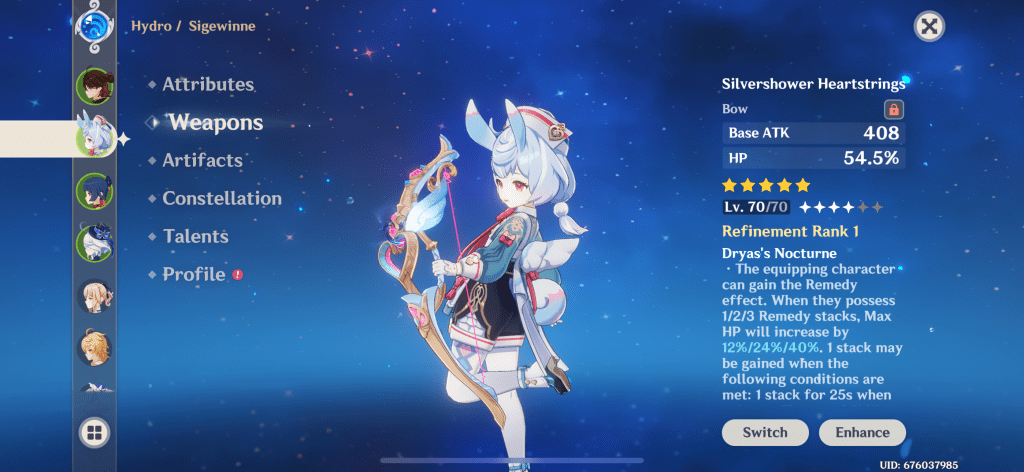
Building Sigewinne is simple in theory: if you’re in a hurry, just select artifacts to get her HP as high as you can get it. Whether it’s offense or healing, the major aspects of Sigewinne’s kit scales off her HP. A bow that increases HP (such as her signature) would do great. In fact, her bow was easily tailor-crafted around her elemental charge, which was already her selling-point.
Sigewinne with her signature weapon, Silvershower Heartstrings. Don’t look at me, I didn’t name it.
Sigewinne is a great comfort healer on her own. In fact, she would seem to be the best in the game in that regard. Yes, contrary to what I said before, Sigewinne is better than Barbera as a comfort healer (putting aside Barbera’s auto-revive at C6, which is great). Barbera needs her burst to do full-party healing, which is inconvenient when exploring, and her charge only heals the active character, who might get wet as a result, which could result in unwanted elemental reactions. Like getting frozen.
So, Sigewinne is a great comfort healer. She might even be the best comfort healer in Genshin Impact, so far.
And, before I forget, she can actually automatically heal characters that fall below 50% HP while they are swimming in the depths of Fontaine. She only needs to be in the party to do this, and the only catch is that the ability has a cooldown. So if you were already good at fighting in the depths of Fontaine, you’d become almost unbeatable. This is great if you plan on spending plenty of time in Fontaine’s waters, which is likely if you plan on leveling Sigewinne.
Truth in advertising: Hoyoverse marketing depicts Sigewinne gathering the flower needed to up her level cap.
As far as teammates go, I haven’t attempted using Sigewinne in any post-game content, such as Spiral Abyss, but I think it’s safe to say that she’d be one of the many who would want Furina’s company. And the two go together amazingly well. Furina reduces the party’s HP, while increasing damage input as the party’s HP changes, and Sigewinne adds more damage output with Furina’s ability by also changing the party’s HP, by bringing it back up. After those two, you could pick just about any main DPS and any sub DPS, and have a killer team. Because you’d have hydro application covered by Furina and Sigewinne (mainly Furina), you could pick your other teammates for a desirable elemental reaction that involves hydro.
My current team’s sub DPS is Xiangling, with the main being a C4 Gaming. Triggering vaporize for high damage is simple, and this team is super fun to play! The main flow is to have Furina’s troupe gang up on the baddies, activating her burst, if available. Then, Sigewinne activates her charge, and optionally, you can fire off her burst. Xiangling activates her burst, if available, and you can plop down Gouba, if desired. If all the bad guys weren’t already demolished, then Gaming can come in and clean up. Switch to another character and reactivate their ability, if desired. Just mind your HP, as Furina’s ousia charge can zap your party’s HP. But hey, don’t forget that you have an adorable nudibranch on your side to make the boo-boos all better!
It seems like Sigewinne is getting some undeserved hate from people who aren’t even giving her a chance. While I got swept along with that for a while, my experience with her has been very positive. To not run along with the crowd has its rewards.
But Sigewinne might put a sticker on you while you’re not looking.