As a brief disclaimer: This post contains spoilers for Made In Abyss chapter 67, which as of this posting has just released in Japan.
Made In Abyss chapter 67 has just released, and as is often the case for this series, the chapter ends with a cliffhanger.
But this time, the cliffhanger has caused quite a stir, as it contains a heavy implication that the party of protagonists has just lost a major character.
While the manga has been released in Japanese, the language barrier is not an issue in understanding the last scene, which conveyed much of the drama visually. Thus, one doesn’t need to understand Japanese to know what happened in that scene.
In the chapter, Riko’s squad, along with Hail Hex, continue their journey into the Seventh (and possibly final) Layer. As they do so, they converse.
In the last scene, the party comes to a halt, as they sense that something doesn’t seem right. Just then, Nanachi senses something (possibly a piece of organic debris) hurtling towards the twins, Menae and Sherumi. Acting quickly, Nanachi pushed the twins out of harm’s way. But in doing so, Nanachi put herself in danger.
While it remains unclear what became of Nanachi, we see that the helmet she was wearing was removed from her head, and the helmet was crushed. Not only that, we see Reg reaching with his extendible arm in a possibly vain effort to rescue his friend.
While it may be too soon to write a eulogy for Nanachi, at this point, the outlook doesn’t seem good for her. Nonetheless, fans of Made In Abyss are concerned that they may have to say goodbye to this beloved character.
As has been pointed out before (possibly here), the character Nanachi has been on borrowed time. Nanachi was originally intended by author Akihito Tsukushi to meet her end in the Ido Front arc, where her character arc would have been complete, and she and Bondrewd the Novel would have both perished while fighting each other. Interestingly, this averted outcome was referenced by Nanachi herself at the conclusion of the Ido Front arc.
Interestingly, while writing the manga, Tsukushi hurried through the Third Layer part of the story, leaving out much of what was originally intended, because he was afraid that his manga would be cancelled. He was in a hurry to introduce the character Nanachi, reasoning that she would be popular enough to save the series. The portion that was left out of the manga made it into the anime.
However, Tsukushi underestimated how popular Nanachi would be, so he made the choice for Nanachi to continue on with Riko’s party.
When the story advanced to the Sixth Layer and the Village of the Hollows, it seemed as though Nanachi would be written out, as Nanachi found a copy of her friend Mitty, so she sold herself to Belaf so that Belaf would stop continually eating the regenerating immortal, and therefore Nanachi could live peacefully with Mitty.
However, there was an apparent change of plans, considering that Faputa was destroying the village. So Belaf placed his memories in Nanachi, and set her free with a new outfit.
Nanachi has picked up a sort of plot armor, by virtue of the fact that she’s so popular. But with the series nearing its conclusion, there’s no guarantee that much of the cast will live to see the end. What’s more, Made In Abyss was written to be emotionally impactful, and events in the series so far have proven that there’s little that’s off the table.
When it comes down to it, in spite of her appearance, Nanachi has been a sad character. She was taken in by a mad scientist who experimented on her and a few dozen other children, and she saw her best friend get mutated in front of her eyes. She didn’t value her own life much, as evidenced by the fact that she sold herself to Belaf to save Mitty, and she was suicidal when Reg first met her, though she didn’t want to act on that while Mitty was alive, and she remained alive after the first Mitty was slain to honor her promise to Reg. Then, she had to say goodbye to Mitty again, after she found a copy of her in the Sixth Layer. What’s more, other characters conducted themselves with Nanachi in a way that didn’t consider her wishes. For example, even though she’s fluffy and other characters liked to pet her, she didn’t want it, and she preferred for the other characters to respect her personal space.
Considering this, for Nanachi to sacrifice herself to save a couple other people, even though they just met, is well within her character.
It’s a type of virtue that doesn’t tend to last long in a world like this.
Whether it’s truly over for Nanachi is still up in the air, and we may find out in the next chapter, which we’re likely to see in a few months. But one Redditor has expressed skepticism that things have ended for Nanachi:
Tsukushi has already warned that, by the time the story concluded, the members of Riko’s party would be unrecognizable. He has also pointed out that people on adventures do die. That being the case, it’s no surprise that a story he has written would come with the occasional figurative gut punch. And a person who has read Made In Abyss up to this point would reasonably expect it.
But at the moment, for those who keep up with it and have a particular attachment to the character of Nanachi, it might not be a bad idea to find someone to talk to. And maybe come to the understanding that a parasocial relationship that involves overly strong emotions might not be healthy.
The Hindustan Times reported a story which alleged that a few K-pop idols are receiving backlash for enjoying a “dark anime” with “pedophilic content”. The anime in question is Made In Abyss, an adventure anime wherein a girl and a robotic boy explore a gigantic chasm, navigating its dangerous ecosystems in a quest to reach its bottom.
The Hindustan Times can be blamed for burying the lede, as the real story that led to the controversy would be the cancel culture of the K-pop community, and it turns out that much of its community is pretty toxic.
One might imagine that a collective appreciation for K-pop would bring the K-pop community together, but what we instead see is a toxicity among fans who divide themselves into factions based on their preferences for K-pop artists.
Personally, I’m glad that it’s the K-pop brand of tribalist bullshit that’s keeping these clowns occupied, because if they got into either sports or religion, they’d probably cause some riots.
The K-pop tribalism is so toxic that some fans will actually dig into the social media activity of the other tribe’s K-pop artist of choice to find anything that can be held against them. Pretty much cancel culture per se.
It so happens that this time, the K-pop artists under scrutiny are Soobin, Woozi, and Taeyong for liking Made In Abyss, an exquisite anime with developed characters, excellent worldbuilding, a heavily-favored soundtrack, and a tone that indicates that it takes its viewers seriously. The problem is, the anime is sometimes accused of promoting pedophilia by people who aren’t mature enough for the anime.
It’s disturbing enough that the toxicity of the K-pop community has reached the point that fans are willing to drag K-pop idols enjoyed by another K-pop faction down by making them out to be pariahs, it’s even worse when they are willing to drag down anime communities that weren’t even involved to begin with, and don’t deserve the negative attention that they might end up getting.
Being one who enjoys Pokémon, I can point out that, while there has been some amount of toxicity in the community, much of it came from bad actors who were quickly recognized, and the Pokémon community has mostly resisted dividing up into factions. If you can avoid certain bad influencers, you’ll generally have no problem avoiding drama in the Pokémon community.
That being my point of reference, from my perspective, the state of the K-pop community is surprising and horrifying. I didn’t have much interest in K-pop to begin with, but with the pervasiveness of toxicity and cancel culture within its community, I have no problem keeping my distance.
I suppose some might expect that I’d defend Made In Abyss from accusations that it somehow promotes pedophilia. The fact is, I really don’t have to. For one thing, I’ll refer to this flowchart that I like sharing:
One of the things I like about the Made In Abyss community is that when someone attempts to describe it to someone who hasn’t seen it, they might bring up some of its more extreme elements in an effort to warn someone that they’re there. But in doing so, they might make it sound like some hyper-edgelord anime that it’s actually not. While it’s true that there are some disturbing scenes, they don’t make up the majority of the anime’s runtime, but instead serves to make the point that there is a connotation of danger for the protagonists.
While it’s true that there are brief instances of nudity, no sex acts were committed, and the scenes played out naturally. Anyone who holds these brief scenes against the whole of the anime are failing to evaluate it from a position of honest criticism. One may even get the idea that they haven’t actually watched it.
But in any case, Made In Abyss was made for grownups, and it’s obvious that much of the K-pop community is way too young to watch anime like Made In Abyss.
And what’s more, when someone can be rightly described as smug and closed-minded, I don’t really mind that they don’t enjoy the same things that I do. As I’d have it, I’d prefer that such people were not in my own community.
Finally, it can be pointed out that we live in a world where trafficking of actual, living human children is a real problem. When someone throws themselves into a tizzy because a fictional character, a literal piece of merchandise, may be doing something sexual, they are expressing some misplaced priorities.
(This theory may contain spoilers for the Made In Abyss manga up to chapter 66.)
The next story arc for Made In Abyss is developing, and I wanted to go ahead and share an idea of what I think might be about to happen next, based on the hints that we’ve been given so far. This fan theory concerns Riko, the Song of Hariyomari, and the identity of the so-called Priestess that has been mentioned by characters such as Tepaste and Nishagora.
First, about the Song of Hariyomari. According to the narrative, the Song of Hariyomari is a song passed along by the children of Orth, and is said to contain a message relevant to White Whistles, the legends among cave raiders, and may even contain a hint on how to advance to the 7th layer.
Earlier in the story, Nanachi is seen reading a book to her friend, Mitty. It would later be known to the reader that the verse that was read came from the Song of Hariyomari. This would happen when Riko’s party happens upon an emperorshell in the 6th layer, and the party recalls Nanachi having read the verse.
We also see at the Tumble Tavern that Habolg overhears a conversation between Cravagli and Tepaste, and then asks Jiruo whether he’s familiar with the song. Later, while on a joint expedition, Habolg happens upon a discovery which causes him to question whether Cravagli intended to somehow bring a fable to life.
The song is also known to the White Whistle, Srajo the Obscure, who is on the trail of the Priestess. Srajo teaches much of the song to Riko after determining that Riko is someone she could trust.
Next, the Priestess. We’re not given much information about this mysterious personage, aside from that it’s a person who interprets omens from the abyss, and it is said that she’s the one to have authored the Song of Hariyomari. Tepaste and Cravagli are somehow connected to the Priestess, but it’s not clear how. When Nishagora discovers Riko’s party, she sets eyes on Riko’s white whistle, and exclaims that she’s found the Priestess’s clan. However, Tepaste says that she never met the group.
According to Srajo, her party, Hail Hex, is in pursuit of the Priestess, who she says is trapped between the 6th and 7th layers, unable to advance. Because the strains of ascension in those layers are deadly, that’s a bad place to be stuck.
Where we left off, Riko’s party was on the verge of a joint expedition into the 7th layer alongside Hail Hex. While Riko is concerned with reaching the bottom, readers are suspicious of the motives of Srajo, who probably hasn’t given up her pursuit of the Priestess.
Having established all that, I think we’re about ready to get into some speculation. So here’s what I think might be going on: I suspect that the Priestess may be Riko herself, who also wrote the Song of Hariyomari.
On the surface, this seems impossible. After all, at the outset of the arc, Hail Hex is already in pursuit of the Priestess, whose cadre already includes Cravagli and Tepaste. So, how can it be that someone who just entered the 6th layer can be the same person who’s already being pursued between the 6th and 7th layers?
Much earlier in the story, Ozen the Immovable explained the time dilation, which causes time to move differently in the deeper layers, to the point that a person can spend weeks in the abyss while months pass on the surface.
It could be that the time dilation is more like a time warp which becomes more evident in the deeper layers. One could ask how Ozen would be unaware of this, but remember that most cave raiders cannot ascend from the 6th layer, due to the strains at that level. Thus, it’s reasonable to expect that if there was a time warp, it might go unreported, even if the people caught within were to notice it, at all.
Notice how, shortly after Riko’s party meets her, Nishagora comments on how time behaves around Riko’s party. Depending on translation, she could say that time “flies”, or “stabilizes”, or something to the latter effect. I have my doubts that Nishagora was merely commenting on how Riko and friends are “fun to be around”, as the party responded with confused expressions, to which she replies that it’s okay that they don’t know, and that she’s bad at explaining things, anyhow.
What I suspect is about to happen is that Riko will be presented with the opportunity to become the new Priestess, to replace the previous one, with the ability to interpret omens facilitated by her connection to the abyss (remember her dream about Mitty?). Perhaps the whole reason why Bondrewd crafted Prushka into Riko’s white whistle was because he believed that Riko could facilitate the “dawn” of the next thousand years. Perhaps when Bondrewd went to Iruburu, he gave instructions on how to embellish Riko’s white whistle, which Nishagora would then recognize.
But, if we know Riko, she doesn’t care about any of that, she just wants to adventure to the bottom, where she expects to meet her mother, or whoever might be waiting for her. Thus, Riko would decline, and insist on continuing her adventure.
Of course, this would be greatly upsetting to the cadre of cave raiders who carefully conspired over the course of years to groom Riko to be the next Priestess, which might include the likes of Bondrewd the Novel! And the one closest to Riko to give pursuit would be Srajo the Obscure!
But, there would be a problem. During the pursuit, Riko would be caught in a time loop, with Srajo’s party continually on her trail, and by the time she realizes it, it’s too late!
So, Riko needs to come up with a plan. Otherwise, she and her friends will be pursued by Hail Hex forever! Obviously, fighting them would be out of the question, as Nishagora alone would be too much to handle, and there’s no telling what Yataramaru and the twins are capable of.
However, Riko gets an idea: she could send a warning to herself in the past, one that could be passed along over the course of centuries and make it back to herself. It’s said that the Song of Hariyomari contains a clue on how to advance to the 7th layer, which is supposedly about the point where the Priestess is stuck.
Therefore, Riko completes the cycle by composing the Song of Hariyomari, and passing it along in the hopes that it would be heard by her younger self!
When a message must be passed along verbally with minimal distortion, music is an excellent way of doing this. If you’re familiar with the game of Telephone, you know that the phrase whispered into the ear of the first kid in line is usually way different from what the last child hears, then announces. Riko, being a child herself, is likely familiar with this game, and likely also realizes that people tend to be much better at remembering messages that are in the form of music.
And the message was transmitted so effectively, that it became known to orphans in Orth, and was even known to adults like Cravagli. Even Nanachi was seen reading the song to Mitty. These hint to Riko’s plan (if it is her plan) so far being a resounding success!
So, would this plan be enough to save Riko, and allow her to escape? Will this even be anywhere close to how events might play out?
I don’t know. But I’m looking forward to seeing what happens in the next chapter!
It goes without saying that liking someone doesn’t mean agreeing with everything that they have to say. When it comes to trans activism, Matt Walsh usually hits it out of the park.
But when it comes to culture as relates to entertainment, he usually lets out some pretty bad takes.
There are various degrees of out-of-touch. Not paying attention to politics is not the same as not watching TV, which is not the same as not following culture.
But then there’s the absolute extreme: saying that anime is demonic, that video games destroy kids minds, and that grownups should not watch cartoons.
It’s those kinds of takes that make me appreciate just how cool my dad really was. He knew that a person’s entertainment doesn’t make them who they are, which probably has something to do with why I have a similar perspective. But even if that wasn’t the case, I’d like to think that I’d have been able to figure that out on my own.
In a world where entertainment is being corrupted in an attempt to fit it in an agenda, it’s hopeless to think we can fight back by withdrawing ourselves and our children from the culture. That’s just not realistic. It’s vastly superior to instead teach our children that entertainment can be enjoyed, but not be the primary influence of their worldview. And, at the same time, we can work to take back culture while contributing to it.
That’s how we win: Not by running from battles, but by participating in them.
It should be obvious how stupid it is to paint anime with one broad stroke by saying the whole of it is demonic, because there are many, many different anime out there with many different genres. Some anime out there is great for children, because they’d be intended for them. Some anime is geared towards adults, and is intelligently written by writers who take their audiences seriously. Of course, some of it is really weird and of limited appeal. But the great thing about anime is that there’s something for everyone.
And really, conservatives should be getting behind anime, because Japan is a conservative society, which doesn’t have western leftist ideals, and whose entertainment options are free from woke influence.
In spite of this, there are some on the fringe who are attempting to make the case that anime is pedophilia, using fringe examples that are not mainstream in obvious acts of the cherry-picking fallacy.
I’m going to let you in on a little secret. Lean in close, because this is totes a secretly-secret secret. Are you listening? Okay…
Child abuse is illegal in Japan. In fact, it’s illegal anywhere that Sharia is not the law of the land. The existence of drawings which may be protected as free expression does not indicate the legality of the acts depicted.
Something similar can be said about video games. In fact, I don’t view them as simulations, even if that’s what some of them are going for. I view them as games.
I don’t play Grand Theft Auto. But if I did, I’d know that playing it doesn’t make me a carjacker. Similarly, playing Cooking Mama doesn’t make me a chef, playing Guitar Hero doesn’t make me a rockstar, playing Cave Story doesn’t make me an android, and playing The Legend of Zelda doesn’t make me a legendary hero. They’re games. That’s all they are. Even the ones that I play don’t inform my worldview, because I can tell the difference between fantasy and reality.
Matt Walsh is also of the opinion that men should not own plushes. He probably never heard about Fumos. But he did make an exception in the case of his own merch, a plush of Johnny the Walrus.
Sample of Johnny the Walrus taken from Amazon.
It’s obvious that Matt Walsh is proud of Johnny the Walrus. But let’s be serious here, how many kids are going around saying “Yay, I love Johnny the Walrus!”?
Probably exactly none of them.
And I shudder to think that Johnny the Walrus is the only entertainment option for Matt Walsh’s poor kids. Even The Adventures of Lil’ Chad looks better than this sub-DeviantArt tripe. Is this really what Matt Walsh thinks will build culture?
Conservatives have been pretty good about getting behind anime as a non-woke alternative to the ESG-influenced garbage that we’ve been seeing out of Disney and western comics lately. If companies like Disney want our business back, the companies should return to the values held by Americans, and most of the world, for that matter. The woke movement as we see it today is a product of algorithmic manipulation, and is a misrepresentation of the values that people actually hold.
But as for the fringe group who views anime as “brain waves coming from Japan”, they’re little more than the Satanic Panic from the 80’s, but with a few word-swaps. But this time around, they’re not going to amount to anything, because their language alienates and their vilification is easy to see through.
If that’s the kind of thing Matt Walsh is getting behind, then Matt Walsh is limiting his audience. And it’s obviously very important to him, considering that that’s how he measures his success as compared to other content creators, like The Quartering.
What is your philosophy as a content creator? Is it to maintain your integrity, even if it means having limited appeal? Or is it to maximize profits by maximizing your audience, saying whatever you have to to get there? For a while, it seemed as though Matt was doing the former. But if he’s going to boast of the size of his following compared to creators like The Quartering, then that’s harder to say definitively, isn’t it?
Of course, if someone is trying to rack up shock views by feeding into a Neo-Satanic Panic, then a larger viewership doesn’t seem like an accomplishment in which one can take true pride.
Matt Walsh does pretty well when it comes to confronting the extreme elements of the trans movement. But when it comes to most other things, he would do well to keep his mouth shut.
I grew up with the likes of Batman, so it kinda saddens me to see how things are going for the Dark Knight, and his compatriots in western comic books. But at the same time, I don’t want to see Batman succeed for the wrong reasons. And with DC and Marvel comics having become full-on woke rags, it’s pretty much necessary for those comic companies to tumble, if it means that they’ll learn a few things as it happens.
If you’ve been following along, you already know that manga has been killing the hell out of western comics. As I’ve already covered, manga sales in the year 2020 were three times that of DC and Marvel salescombined. As pointed out by Deb Aoki on Twitter, EuropeComics has posted a graph which visualizes just how much hell is being killed out of western comics:
more fun with data — @EuropeComics posted this graph showing the estimated revenue of the top 10 comics publishers in the world in 2020-2021. Top 4? All #manga publishers, w/ Korean #webtoons (Kakao/Tapas) and Naver (Webtoon) in the #5/#6 spots, passing Marvel & DC with ease. pic.twitter.com/Dzv3GL5kLV
The first four publishers on that list are manga publishers, and each one of them outsells both Marvel and DC combined, with Marvel and DC placing numbers 7 and 8 behind Korean webtoon publishers.
It looks like no one is buying western comic books anymore, and I wonder why?
Oh yeah, that’s right. It’s because Marvel and DC have gone full-on woke, with DC having started a yearly publication starring characters whose sexual preferences are the most front-facing aspects of their personalities.
Did DC really publish this with the expectation that anyone reading it would feel like they’re being taken seriously?
Now, I get it. Your boomer parents and grandparents grew up with Hanna Barbara bullshit like Hong Kong Phooey, and would therefore feel threatened by anything from across the ocean that might challenge them, which has a lot to do with why they’re among the few left who are currently providing Marvel and DC as much support as they have. I also get that they grew up in an age where it was rare for cartoons to be made for anyone besides children. Even so, the idea that children don’t deserve better products just because they’re children is just an excuse to produce inferior products, which in turn conditions children into becoming adults willing to settle for mediocrity.
Seriously.
I read manga because manga takes me seriously enough to present me with entertainment without beating me over the head with the blunt end of whatever misguided moral that the publisher wanted to push, as though they couldn’t trust me to think for myself.
If the story is about a golden-haired dude battling it out with a galactic tyrant on an exploding planet, the comic doesn’t need to do anything to further justify itself. If some cook is facing off against his dad because of some deep-seated grudge, we don’t need a PSA telling us not to pick on people who like buttsecks. If some deranged scientist performs horrific vivisections just to enhance his capacity to explore come caverns, he’s plainly the bad guy, it’s not necessary to make him a Nazi, as well.
If western comic book heroes are to succeed again at some point in the future, they’re going to have to go back to being, you know, heroes. It’s going to take a whole lot of swallowing to down all the pride needed for Batman and the Avengers to come back up from where they currently are.
But in the time it takes for them to do it, I’ve got plenty of other things to read.
Author: Akihito Tsukushi Status: Concluded (one installment) Genre: Drama, Fantasy, Psychological Localization: Seven Seas Entertainment Rating: Teen 13+
(This analysis discusses plot elements, and thus contains spoilers.)
I was browsing the Made In Abyss subreddit the other day, when I found a topic linking to other works by author Akihito Tsukushi. Among the stories that I found was a short story written by Tsukushi in the manga format, called From Star Strings (links to MangaDex).
From Star Strings is relatively short; it’s a one-off one chapter work, about 70 pages long, that I read through in about a half-hour. It told a compelling story about a girl who lived alone, having a planet to herself, who set off on a journey. Like many of Tsukushi’s works, the artistic style is like a combination of that of Tony DiTerlizzi and Precious Memories, but with something of a dark edge.
I suggest following the link above to read the story for yourself, and form your own first impressions before continuing on with this article. There are spoilers ahead.
The protagonist this time is a young girl who doesn’t know where she came from or anything about her life prior to having an entire planet to herself, which conveniently simplifies her motives. She also knows little besides her own name, which is Kuroru, and how to speak, which is conveniently just enough for her motivations to be communicated to the reader through monologue.
But let’s not fall into the trap of asking distracting questions.
On her little world, Kuroru had a sprawling, Earth-like environment to explore. She had plenty to eat, little to no danger, and did not want for anything. Except for one thing: she was alone. And having explored her own world, she deduced that there was no one else there.
One day, Kuroru happened upon a red, glowing string. One end was on the ground, and the string extended into the sky, beyond the girl’s ability to see the other end. She imagined that there had to be another world like hers on the other end.
She worked up the courage, and began tugging on the string. Then, minutes later, vibrations returned through the string that stretched into the sky. It seemed as though she finally made contact with another person!
Over the course of days, Kuroru would tug at the string, and await a response, which would come shortly afterward in the form of movement of the string. At one point, she thought to play music on the string. As before, she got a response.
One day, Kuroru decided that she’d meet the person on the other end of the string. But to do that, she’d have to climb the string to the other end. This would not be easy, as she had trouble gripping the string with her bare hands. What’s more, she did not know the distance she would have to climb to traverse the space between planets.
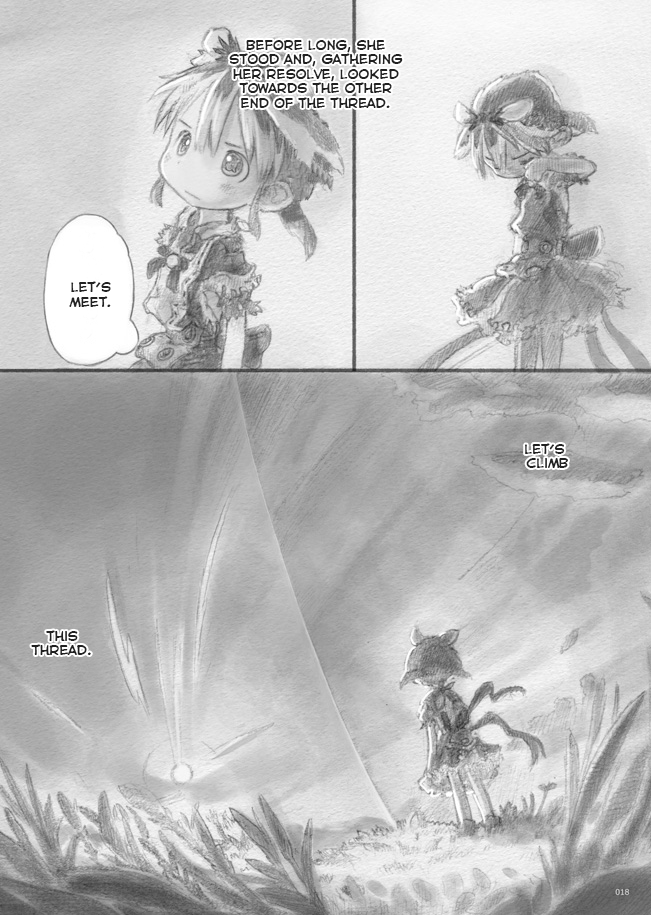
This page was selected to be representative of the artistic style of From Star Strings. Consistent with Tsukushi’s usual style, we see a cute character set in exquisitely-drawn environments.
So, she started preparing. She practiced going hungry to accustom herself to going without food, and dipping in water to accustom herself to holding her breath. She made herself a pair of gloves to help her grip the string. She packed food for the trip, carefully determining what she could preserve. And she even prepared a gift for the person she expected to meet.
And then, Kuroru began her climb. At first, the climb was difficult. As she ascended, she eventually saw the tops of the clouds. Then, her own world became a bright, round and shrinking light beneath her. With gravity relaxing it’s pull, the girl was able to make greater distance with her strength.
As one of the story’s fantastic elements, the girl didn’t have a problem with breathing in space, and her temperature wasn’t an issue. But as her equipment began to wear, and there was no end in sight, the girl was in a great position to appreciate the enormity of the distance between planets.
If you’re familiar with other works by Akihito Tsukushi, you’re likely aware that he’ll sometimes use dark elements in his storytelling, to convey a sense of danger, and the possibility that things can go wrong for the protagonists. Such is the case in From Star Strings, where simply dozing off or losing her grip could send the protagonist drifting through the unfathomable abyss of space, never to be found by anybody.
But, in time, a sphere of light appeared in the distance, growing in size as the girl drew near! So she pulled herself towards it, and as the light expanded, she began to make out the landscape!
However, she did not arrive gracefully to the new world, as she lost her grip and plummeted a short distance to the new world, being injured upon impact. Surveying the new world, the girl’s heart sank. She did not see the kind of greenery she saw on her own world. The ground beneath her feet didn’t seem dependable, and shifted in places. And, worst of all, there didn’t seem to be anyone else around.
The girl arrived tired and hungry to a world that was inhospitable. No food or potable water awaited her. And there was no company. The vibrations that returned to the girl through the string were apparently generated by the girl herself, having returned to her after making its course across the string. It seemed like a terrible end to a fantastic journey.
But it was not over yet.
In time, Kuroru learned to live on her new world. She was able to procure “food” to eat. Curiously, the stones were edible to her. The girl was even able to make a shelter for herself somewhere in the shifting landscape. And she recovered from her injury, though it initially seemed fatal.
It was different from her old home. But she was alive. She found her own way to survive and form a routine of sorts in the marginal world. And she made a doll for herself, a sad attempt to cope with her loneliness and disappointment. Each time a doll was broken, she’d make a new one. Interestingly, she gave any doll she made the same name as herself, as this would make it easier to cope if anything were to happen to them.
But then, one day, she found it.
A string. Not the same red string that connected the world Kuroru remembered to the one she was on, but a blue string intertwined with a thinner blue string. It was previously inaccessible due to the shifting landscape.
She made a determination to climb the string, to make it to the hypothetical world on the other side. She did not hesitate to make this trip in the same way as she did for the first one. It took her less time to prepare herself.
What’s interesting is that, if Kuroru could have made another, similar trip, she could have returned to the world she had come from. On her previous planet, all her basic needs have been met. All of them, that is, except one. She was all alone, and while her old world was hospitable, there wasn’t anyone waiting for her there.
To the end of fulfilling her strongest desire, she was willing to climb a different string, not knowing what awaited her, on the chance that a person would be on the other end.
The last few panels suggest the kind of world that might have awaited Kuroru on the other end. However, the manga concluded before her journey ended. Did she make it to the other end? Was the world that we saw in the last panels the one she would have arrived on?
I don’t know. To take one from Tsukushi himself, let’s imagine.
From Star Strings was obviously intended as an allegory for those who pursued a path with hope, only to be disappointed. Yet, hope still does not completely disappear, because as we continue on, we may find another opportunity to go where we want to go, and for our wish to come true. The world can be harsh and unaccommodating, but we are not the world that we live in. And, in a sense, our world is something we can decide on for ourselves.
From Star Strings is recommended reading. And I give it a score of 8.5 out of 10.
You’re on a journey, aren’t you? But it’s not over, is it?
Developer: Chime Corporation Publisher: Spike Chunsoft Genre: Action RPG Rating: Mature Platform: Nintendo Switch, PS4, PC
There isn’t usually much expectation that a video game based on a manga or anime would hold up when compared to the original source material. But when considering how beloved Akihito Tsukushi’s Made In Abyss is, one can hold out hope that the developer and publisher would understand just how important it is to the fanbase to do justice with Made In Abyss: Binary Star Falling Into Darkness.
While one may consider it a pleasant surprise when a game is released months ahead of schedule, if you’ve been following the game industry long enough to develop a little cynicism, you’d see it as a sign that the publisher decided to rush it, perhaps because funds were starting to run a little low. Or, as was likely the case with Binary Star, Spike Chunsoft wanted to rush the game to market while the recently-aired second season of the Made In Abyss anime is still fresh in the memories of viewers, and the game is in a better position to profit off the popularity of the license.
That’s not to say that Binary Star was a bad game. The skeleton of a highly ambitious project is there: great worldbuilding, an intriguing story, well-fleshed-out characters, and great potential for treasure-hunting mechanics. Of course, it’s easy to point out that these are owed to the source material, and that the follow-through would be in the efforts of the game developers. And that’s where things start to falter.
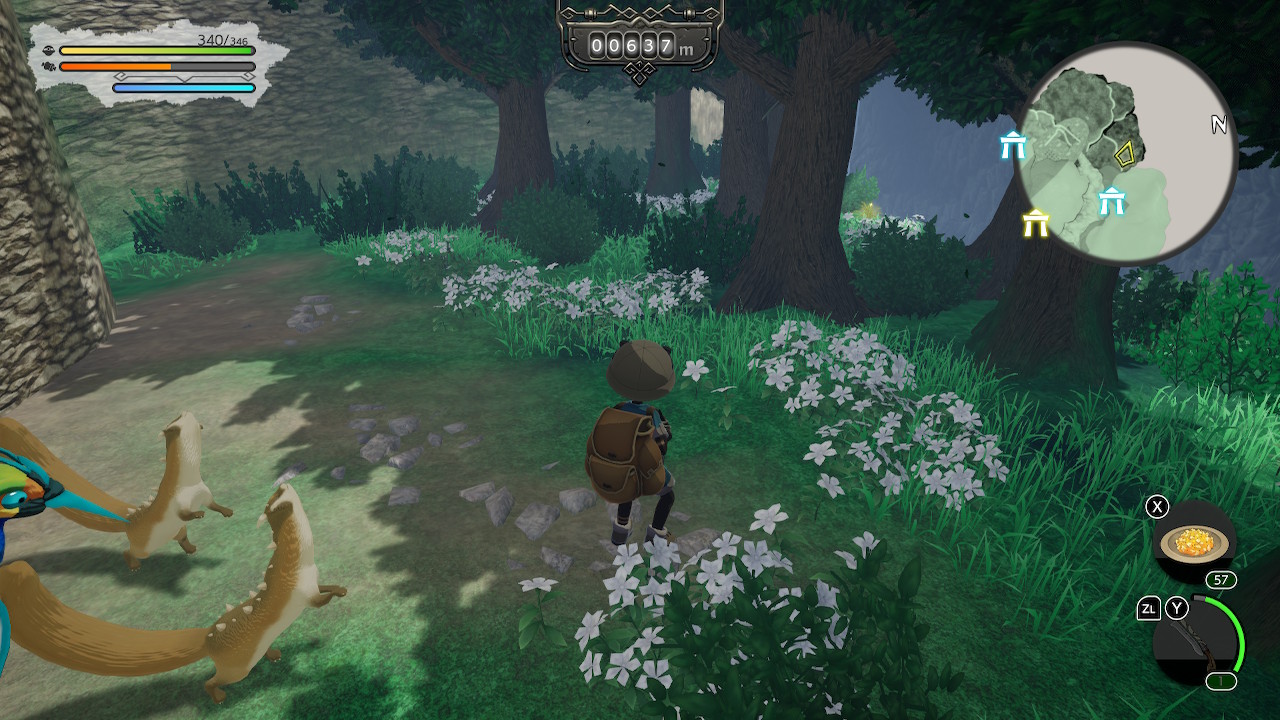
This game would be a blast if it weren’t for a few bad design choices that could have easily been decided against. The most notorious of which would be the repeatedly-spawning enemies. Normally, when a game character is placed in a sprawling, expansive environment, the player’s tendency is to take a minute or two to bask in the beauty of the scenery they are presented with. But don’t take too long doing that in Binary Star, because when you enter a new area, a timer ticks down, and when enough time passes, enemies start spawning. And they’ll usually teleport into existence right behind you, as though the game itself has a problem with you just wanting to chill.
If this sounds like it might be an annoyance to you, you might want to go for the Steam version. Some clever players have developed a mod which prevents enemies from spawning in such a way. Otherwise, you might end up getting triggered at the sight of ferrets.
I get the idea that the game makers had a hard time deciding whether to closely follow Riko’s adventure from the manga, or give players a new, customizable main character to go on his/her own adventure. To the credit of the game makers, they decided on including both. However, it’s obvious that the meat of the game is in the new main character’s campaign, while Riko’s story (which only includes her adventures up to the second layer) acts as a kind of tutorial that’s a few hours long.
Unfortunately, to get to the better part of the game, to complete the tutorial first is mandatory. And as far as tutorials go, it doesn’t really work that great. Riko and Reg are likely to annoy you as they repeat the same lines over and over again while traipsing about in the Abyss. It won’t take long for you to get used to the fact that Reg “senses something” when he and Riko are in no immediate danger.
This is one game that isn’t to be judged by the first few hours.
While I’m complaining, I can also point out that the “strains of ascending” are a huge inconvenience. I know that it’s a huge part of the worldbuilding in Made In Abyss, but from a game mechanics perspective, it’s likely to bust your groove when you want to, you know, go up.
Let’s take a moment to appreciate the irony that some twisted jerk built a staircase in a place where the very act of ascending causes people to barf.
But as much as I can think of to complain about, I found myself enjoying Binary Star quite a lot, especially when I got to the point when I could play the main campaign. That was when I could finally create and name my own customizable character, and have him interact with the other characters in Made In Abyss. And the execution was compelling and addictive enough that I eventually developed a forbearance concerning the game’s shortcomings.
The story follows a child who joins Belchero orphanage alongside a group of other kids. At that point, it’s been months since Riko departed into the abyss in a quest to find her mother, and since then, the other children began to speak of her as a legend. You might have noticed a dark undertone in the reasoning for training orphans to mine in the abyss, as there’d be fewer people who would miss them in the event that an expedition turns tragic.
If you see tendrils bordering the screen, you might want to wait a few seconds to acclimate. If your character barfs, he/she can get hungry again in a hurry.
The action in the game takes place in the Abyss, where you’ll have to make careful judgements as to what dangers to brave and how far you’ll go, considering that at the end of an expedition, you’d have to make a return trip. As you journey, there are many things to account for, such as what supplies you brought, what healing items and food you brought, and the weight of the treasures you find, considering that there’s a limit to how much you can carry before your character is slowed.
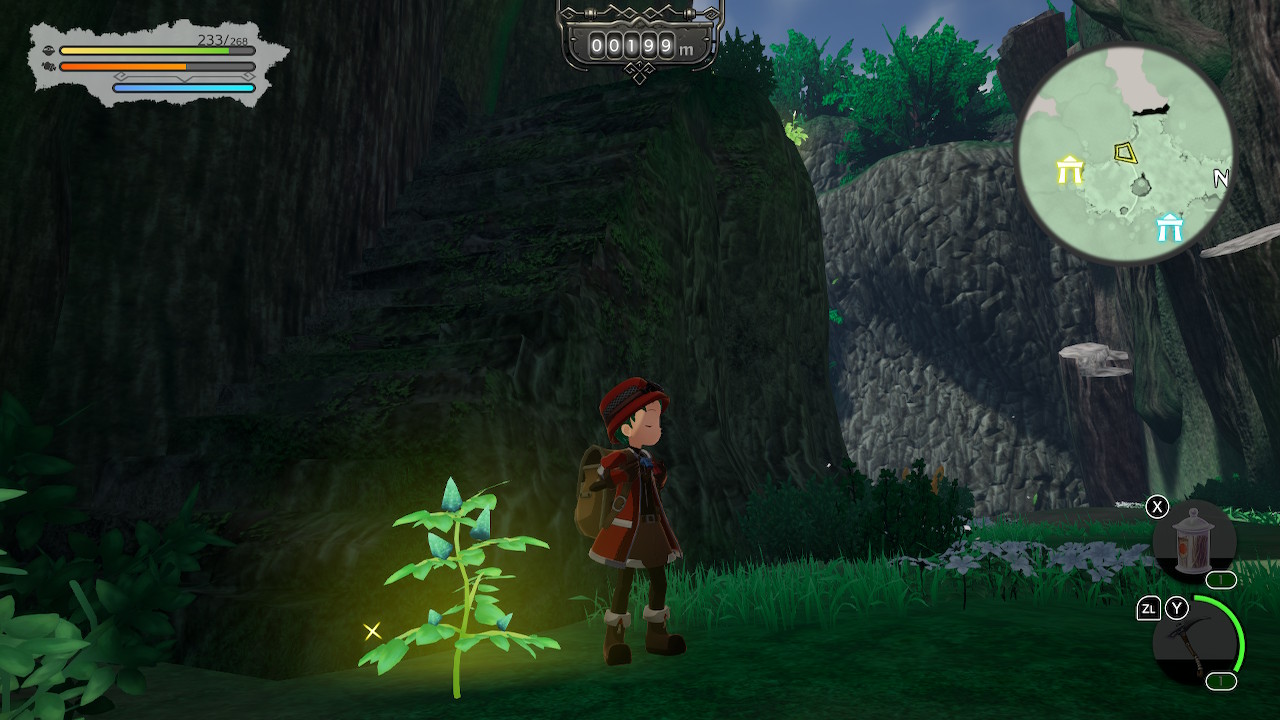
In addition to the HP bar, you’ll also have a hunger bar, which decrements with time. Hunger is something to account for when making longer trips, as when the hunger bar is depleted, your character becomes helpless. There’s also an energy bar, which depletes when the character takes an action. However, it’ll completely restore when the character stands still for a few seconds, as long as the character is not starving. However, it doesn’t recover on its own when climbing a rock face, which places a limit on how much you can climb at a time.
It’s possible to cheese some of the more dangerous primeval creatures, if you’re patient.
There are also status conditions to watch for, such as two different kinds of poison. There are also arm injuries, which temporarily limits the actions you can take with your arms, and leg injuries, which temporarily decreases mobility. Special items heal these conditions in a hurry, which is great, because some of them can be a serious problem when a dangerous monster is upon you!
While the game isn’t heavy on delivering the tension, there’s still a sense that things can go horribly wrong, even from just a moment of poor judgement. Just slipping on a rock face can result in your character falling to their death. It seems that this game’s M rating is largely owed to how grisly some of the possible deaths are. In some cases, it seems a little gratuitous, but it’s not as though the Made In Abyss series was made for kids.
Evil ferrets.
Made In Abyss is one game where if you fail to plan, you plan to fail. While in Orth, you can plan for runs into the Abyss, with shops for replenishing your equipment, food, and medicine. There’s also a facility for selling off relics that you find for money. You also have access to your room, where there’s a chest where you can decide what to take with you. There are also many armor items, but many of the more effective ones add significantly to your weight allotment. It’s a judgement call as to whether it’s worthwhile to settle for a particular armor set, or upgrade for a set that might be worth the weight it adds to your gear.
It bears pointing out that your character doesn’t gain EXP directly from beating enemies, you mainly get those from selling relics and completing quests. Thus, it’s usually better to avoid dangerous primeval creatures unless you need their drops or you have some other reason for fighting them.
It’s generally better to pick a cap with a lamp, even if it’s not the highest-defense option.
As the story progresses, more main missions open up, the completion of which can lead to the player growing in rank, such as from Red Whistle to Blue Whistle. Growing in ranks grants access to more skills, which can then be unlocked with points that players accrue by leveling up. Some of these skills are quite significant, and can increase the number of items that can be crafted, and improve other skills, such as mobility when climbing or dodging, or even increase the bag’s weight capacity.
It’s a bit of an indulgence, but there is some enjoyment to be had in having your own customizable character interact with characters from Made In Abyss. You can even give your character heterochromia, if stereotypical OCs are more your thing. And like stereotypical OCs, you can proceed to have them befriend just about every established character in the series that appears in this game. Having said that, there are at least a couple established characters which, if I were to see them while walking down the street, I’d cross to the other side of the street.
There are a few boss characters, but with a few exceptions, they’re some pretty simple battles that can be cheesed. But this doesn’t bother me, as the boss battles aren’t really the main point of this game. Once you’ve completed all the boss battles and most of the game’s major objectives, you’ll come to a steep drop-off in reason to continue playing. Sure, you could continue to take on missions and develop White Whistle skills, but there isn’t much at that point to do with those skills.
While spawning enemies can be annoying, you can use them to your advantage. They can become a great source of food and other drops.
This is one game that can be pointed to as being highly ambitious, and having a lot of potential just from the source material, and while there are some redeeming qualities, the whole deal is held back by an apparent rush to an early release date, and some poor design choices that could have easily not been made.
I think an appropriate score for Made In Abyss: Binary Star Falling Into Darkness would be 6.5 out of 10.
This might be one race to the bottom that you could get behind.
UPDATE: Literally, update. Among the changes in version 1.0.3, you can skip the Hello Abyss mode and go right into Deep In Abyss mode, which is where the meat of the game is. That’s great for players who might lose their patience with the initially-mandatory pseudo-tutorial mode.
But that’s not all, they also changed the system that spawned in minor enemies when you spend enough time in one area. Not by eliminating that mechanic entirely, as I might have preferred, but by making it take more time for the enemies to spawn in. I gave the game another try, and I noticed that it took much longer to get attacked by evil ferrets.
It seems the developers at Chime were aware of gamers’ biggest complaints, and they addressed them. That’s great for those who are still on the fence on whether to give Binary Star a try. But the update came weeks after I already completed all the game’s major objectives, so they wouldn’t make that much of a difference for me unless I decide I want to give this game another go.
Missing a better initial experience with a game that ends up getting an update is one of the ways that the game industry, in its current form, would punish a gamer who rushes through a new release like a freak.
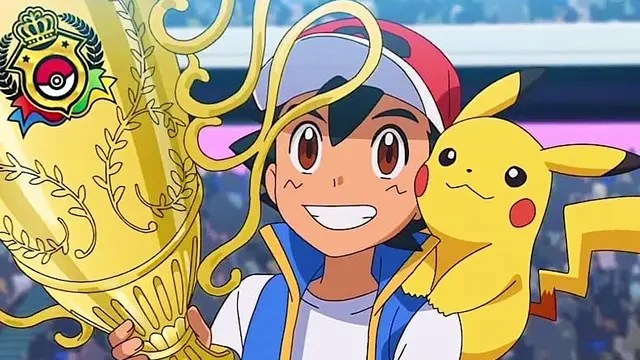
Ash Ketchum from Pallet Town has finally done it! In the latest episode of the anime, Ash defeats Leon, the standing #1 trainer in all the world, in the World Coronation Master’s Eight tournament! In so doing, not only has Ash defeated the previously-undefeated Leon, the 10-year-old trainer has finally succeeded in becoming the world’s number one trainer!
It’s been a long, long journey. After all, the Pokémon anime has been running for 25 years, starting from it’s debut episode on April 1, 1997. In that time, Ash has gone from having little apparent talent or knowledge (but a whole lot of enthusiasm) to a skilled and competent trainer. You might remember if you were following along in the early episodes, but his first two gym badges were awarded to him outside of battle, and it wasn’t until his third gym challenge that he earned a badge. But since the Indigo League, Ash has developed a lot in competency. Even though it took a while.
Since starting out on his Pokémon journey, Ash has won some significant victories. Ash progressed high in the Indigo League, which was a feat, considering it was his first tournament. Ash also won against the Champion in the Orange League, and later obtained all the symbols in the Battle Frontier, a feat that impressed Scott so much that he extended Ash the offer of becoming one of the Frontier Brains (which Ash declined). It wasn’t until Ash became the Alola champion that he was ranked among the other champions.
As a champion, Ash got to battle in the World Coronation series, where he took on (and overcame) champions such as Diantha and Cynthia, the latter of which seemed nearly indestructible when Ash first witnessed her battle. All this culminated in Ash’s battle with the world’s number one trainer, the previously undefeated Leon.
In case you’re wondering about spoilers, public screenings of Ash’s victory were displayed in public in Tokyo:
And even though the episode has only aired in Japan so far, the English-language The Pokémon Company has announced Ash’s victory on Twitter within minutes of it happening:
So no, it wasn’t realistic for you to avoid knowing this before watching the anime for yourself, especially with fans all over the world discussing it.
One question that would understandably come up is where the Pokémon anime would go from here. We already know that the anime picks up with Ash’s friend Goh, who goes on an expedition to locate the mythical Pokémon, Mew. As of this posting, we are a week away from the release of new installments of the Pokémon video games, the Pokémon Scarlet and Violet versions for Nintendo Switch. The setting for the games will be the new region of Paldea, based on the real-world locations of Spain and Portugal. If Paldea is the setting for future episodes of the anime, Ash could continue as the main character there. But as for what his goal may be, we don’t yet know, as Ash is already the world’s number one trainer. But it’s possible that future episodes may focus on new characters, such as the new protagonists Florian and Juliana.
Florian (left) and Juliana (right) as they appear in Pokémon Scarlet
As things go for the Pokémon anime, it’s when one journey wraps up that another follows close behind, and this is usually timed to occur with the release of new installments of the Pokémon games. That Pokémon’s marketing machine is well-oiled may have a lot to do with why it’s the highest-grossing intellectual property in the world’s history.
This is undoubtedly a huge day in the anime world, as Pokémon has been one of the most popular and longest-running anime of all time (this is episode #1221). But if Ash can become a Pokémon Master, and Naruto can become Hokage, then perhaps we’ll see the day that Luffy finally finds the One Piece treasure. But I’m not counting on it happening anytime soon.
Congratulations, champ! Now, what are you gonna do next?
When the Dynamax phenomenon was first revealed in a trailer for Pokémon Sword and Shield, some players recalled that certain oversized Pokémon had already appeared in the first season of the anime. First was a Dragonite just a few episodes in, then a Tentacruel a few episodes after that. Later, we’d see more in the appearance of giant Alakazam, Gengar, and Jigglypuff.
While it’s not likely that a connection between the appearance of these Pokémon and the implementation of a new gameplay mechanic decades later was intended as of the time of their first appearance in the anime, it’s still fun to think that they might have factored into the thinking of Game Freak as they developed Sword and Shield.
But with the upcoming Pokémon Scarlet and Violet games, there is a new mechanic, called “terrastallization”. This makes a Pokémon take on a crystalline appearance, as well as gain a new type.
As tantalizing as it may seem, there actually is precedence for such an occurrence in the anime, decades prior. To see it, we’d have to go back to the Orange Islands. The Pokémon I’m referring to would be the Crystal Onix.
In the early days of Pokémon, the Crystal Onix captured the imaginations of fans everywhere. Not just for its dazzling appearance, but also for the fact that it seemed to resist the Water types that would normally lay an Onix out flat, but was weak to Fire moves, which they usually resisted.
As it so happens, terrastallization doesn’t just change a Pokémon’s appearance, it also changes its type to whatever Tera type that the individual Pokémon has. Based on the evidence provided, we can determine the type of the Crystal Onix, as there is only one type that resists Water but is weak to Fire, and that type is Grass!
It’s interesting to think that decades prior to the implementation of terrastallization in a main Pokémon game, there was already a similar concept shown in the anime. But what do you think? Does this look like a coincidence to you? Or might the Crystal Onix have been in Game Freak’s consideration as they were developing Pokémon Scarlet and Violet?
By the way, Japan’s Liberal Democratic Party is similar to America’s conservatives, and a mangaka is an author of Japanese comic books.
This is a culture war victory because Ken has strong anti-censorship views, particularly concerning manga (Japanese comic books). He’s of the opinion that if westerners are interested in manga, they should have them as the author intended. He was also outspoken against proposed legislation which would have outlawed many doujin (unofficial, independently-made manga) because the legislation in question would have been overly strict in handling copyrights, and made no distinction between drawings and photographs when it came to depictions of nudity.
Considering this, it seems likely that Japan’s mangaka are going to continue to hold strong in resisting western pressure to adopt woke themes in their work, and with a mangaka now championing them in public office, their position is getting stronger.
Because Japanese entertainment is free of woke themes, many are turning to manga and anime as an alternative to the politically-charged comics and cartoons produced by western entertainment companies. Foreign influencers recognized that this is happening, and have attempted to include manga and anime in their sphere of influence, to various degrees of failure.
It was just last year that the president of Kadokawa expressed his belief that manga was more extreme than swimsuit content, and that he wanted the company to change so it would be more likely to be reviewed by western tech companies like Apple and Google. Because his words had the potential to cost his company a lot of money, he was made to take a pay cut, which included paying back back-pay.
Prior to his election, Ken Akamatsu was most famous for Love Hina, a comedy about a boy who made a promise to meet a girl again upon attending a prestigious university, but forgot her name. As he studies for the entrance exam, he becomes the manager of a girls dorm.
It stands to reason that those in the creative arts would take less kindly to attempts to censor them, but things aren’t always so straightforward. With western media companies, it’s usually the companies that have creative control over IPs, and the IP creator usually sides with the media company because they don’t want to risk losing involvement with their own brainchildren. Western media companies tend to bow to vocal minorities, in part because they wish to avoid the potential for negative publicity, but also because western activists tend to be entitled and belligerent. Worse yet, western media companies tend to lack either courage or principle.
Japanese media companies tend to be more principled, and what’s more, because the manga industry is highly competitive, mangaka tend to make fewer choices that would risk alienating their audiences.
Principled and based.
Japan now has someone in their House of Councillors to represent mangaka and those who read manga, and he has a strong anti-censorship position. The woke mob continues to lose ground.













 Magnetricity