We have lost against the surveillance state.

A few years ago, I pointed to an old Simpsons “Treehouse of Horror” episode to give a hint concerning where I believed society was headed. The episode was titled, Nightmare Cafeteria, and was a parody of the film, Soylent Green.

In the episode, the elementary school staff decided to punish students by processing them into food, which the faculty then developed a taste for. This led up to a scene that I focused on, which depicted the few students who were left being monitored intently for even the slightest infraction, over which they would be sent off to satisfy the appetites of the demented faculty.

As things are, it can be said that society has reached a similar point, by reason of the surveillance state.

When discussing the surveillance state, there are people who frequently express the sentiment that if someone doesn’t do something wrong, they have no reason to worry. The point that needs to be impressed upon them is that a person who is monitored at all times can be accused at any time.

Suppose you came to a complete stop at an intersection, just as a squad car was approaching. Then, you advance. A completely legal and lawful advance. But, unbeknownst to you, the approaching officer was power-tripping and bitter about whatever, so he decided to use footage of your lawful driving to accuse you of a rolling stop. And you don’t find out until you get a citation in the mail, days later.

What would you do? Or, perhaps the better question is, what can you do?

The fine amount was low enough that you’d probably just pay it to avoid further trouble, even though the footage you can view online plainly shows your innocence, but substantial in value to the point of being considered the theft that it is, perhaps roughly equivalent to two days of work by a man who actually produces value.

The state has found a new way to extract value, and this can be accomplished by the surveillance apparatus. And even someone who is innocent can be victimized by it. Thus the point: a person who is monitored at all times can be accused at any time.

And while the accusation may be refuted, the accusation itself can have consequences. If you got a fine that was the equivalent to a day’s work by a skilled tradesman, would you contest it if it meant losing a day’s work to attend a hearing? Or would you just pay, knowing that you’d end up losing value, either way?

For a long time, it was taxation. Now, it seems the state has found yet another way to steal. Theft has evolved.


Seems humanity really is in trouble.

I’m starting to get the idea that environmentalists don’t actually want us to take them seriously. That’s what I can come away with regarding their preparations for the COP30 climate summit.

Which involved paving over thousands of acres of protected Amazon rainforest in order to build a four-lane highway leading to the location of the summit.

If you were hoping that you read that wrong, your day may have just been ruined.

The so-called intellectuals, who wanted to virtue signal over the environment being destroyed, just had thousands of acres of delicate ecosystem destroyed because they didn’t want to be inconvenienced.

If it was about inconvenience, they could have just had their little summit over Zoom, rather than consuming fuel with their private jets.

But when it comes down to it, climate summits are largely just performances, and for there to be the performance that they want, they have to emit immense amounts of carbon and pave over whatever forests they have to in order to reach their arbitrary venue.

This whole matter has some troubling implications when you consider that the elites who bloviate about the environment are some of the same clowns who are running the circus. What other decisions are they making that are self-defeating and bad for the rest of us? Or do they even care?

If only there was an obvious way to know whether these guys actually believe what they say.

Is This the World’s Dumbest Criminal?

Aleefah Sumpter, from the Senoia Police Department

When I heard someone get called “world’s dumbest criminal”, that caught my attention. The person we’d be talking about today is a Georgia woman, 25-year-old Aleefah Sumpter, who allegedly pilfered a customer’s debit card information on her job at Whataburger. Which she then used to pay probation fines and court fees.

The victim later checked his account, noticed the fraudulent $400 charge, then proceeded to call the probation court that the payment was made to, as well as the police, and it didn’t take them long to figure out what was going on.

Let’s let this sink in: A fraudulent debit charge was used to pay probation fines and court fees.

It’s a crime that’s trivially simple to trace, and there’s no prize for guessing the prime suspect. Who, by the way, the victim was able to pick out of a lineup.

The suspect, Aleefah, agreed to turn herself in on Feb 21. But instead of doing so, she fled to Florida, and her family said that she had been planning the trip before she was charged. Whether she’d be safe from the big, mean felony charge in the land of gators and Mickey Mouse, I don’t know. But I suspect she gave them a flimsy excuse to pass on as she fled. Whatever her reasoning, she’s a wanted woman now, and some are even going as far as calling her the world’s dumbest criminal.

If you’re wondering what Aleefah was originally on probation for, it was a misdemeanor drug offense. That’s pretty much it.

So, is Aleefah Sumpter really the world’s dumbest criminal? Probably not. There are many contenders for that distinction. And maybe some of them are deliberately trying to earn it.

But what’s apparent to me is that Aleefah has a lot to learn about the digital age.

The Activist-to-Authoritarian Pipeline, Explained

You might have noticed that many on the activist left tend towards authoritarianism on occasions when they find themselves in positions of power. Not surprisingly, they’ll then advocate for more activism, knowing that it serves them.

But what is a mystery is why activists, when they take hold of power, suddenly tend towards authoritarianism. This is the case whether we’re talking about elected officials or even just low-level government employees. It’s vexing because the public image of the activist is that of a libertarian, one fighting for freedoms, whether or not this image is consistent with the policies that they’re actually advocating for.

To one outside looking in, it can be a conundrum why an activist, when they finally have their hands on the levers of power, go full authoritarian. The reason this happens comes down to a simple failure to instill sincerely-held values.

Activism appeals to a sense of youthful restlessness. To one in their teens and early-twenties, it seems like a pretty sweet deal; they get to blow off some steam, do some naughty stuff, and they get to come away from it saying that they furthered a positive cause, whether or not it was really positive, at all.

And through it all, what’s idealized for them is to “effect change”. What change would that be? Really, just about any change might appeal to a person’s sense of accomplishment, especially when they lack the wisdom to recognize the knock-on consequences of a large-scale implementation of their causes. And, in many cases, they don’t look much into it.

What matters to them is that they “effect change”.

So, what happens when an activist without sincere values effects change so hard that they catch the attention of someone in a position of power who becomes interested in elevating them?

It’s easy to guess: someone who can effect change pulling the levers of power, who feels justified in laying the boot on their opposition, whom they may view as enemies rather than countrymen.

Thus, the activist-to-authoritarian pipeline.

The United States has been living in the consequences of this process, which has been occurring over the course of decades. It’s the reason why you see riots where perpetrators who commit violent crimes get off scot-free, enabled by left-wing politicians and prosecutors, with news anchors turning a blind eye to the crimes. Many such public figures were once violent agitators themselves, and whats more, it doesn’t directly serve their interests to deter someone who is furthering their causes.

This could have been prevented with a proper instilling of real values. Which is the job of the child’s parents, as is the case when it comes to much of their upbringing. It’s not the job of the school system, it’s the job of the parents.

Yet, so many keep failing. Are people afraid to instruct their own children, or something?

When it comes down to it, the individual is not just an elementary building block of society, they are also an elementary agent of a culture. If someone is not taught from a young age to see the value of a culture, it’s no surprise that they would feel nothing as they act to destroy it.

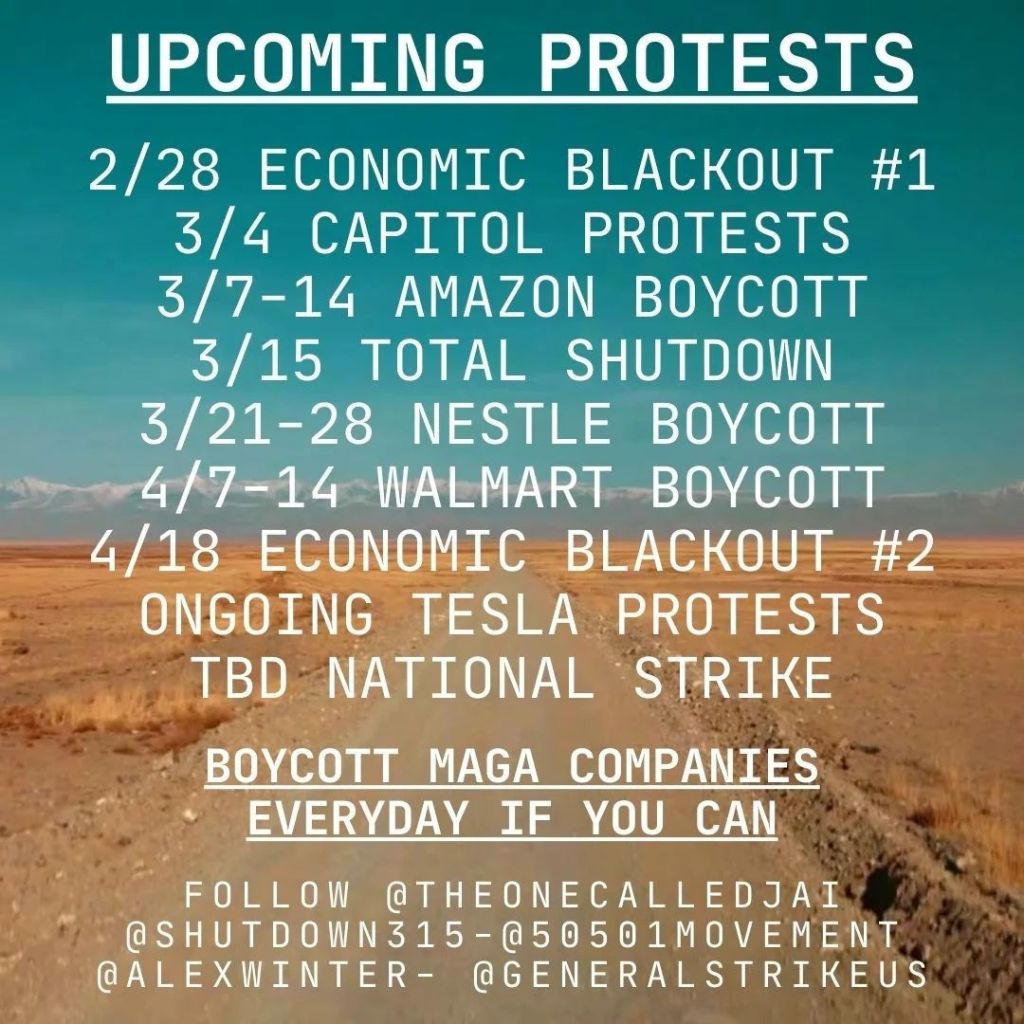
Leftists are planning a one-day “economic blackout” for tomorrow. LOL.

Hey look, another stupid one-day boycott:

Pictured above is the gameplan for a left-wing one-day boycott of major businesses and services, in the hopes of sending a message. That message being, “we show them who really holds the power”.

The boycott is being pitched as non-partisan, but considering it’s traction among the left, it’s plainly a reaction on their part because they’re upset that they’re losing their grip on culture. The claim of being non-partisan is clearly intended as an attempt to expand leftists’ influence when they know that they are not culturally dominant.

They are not the “silent majority”, and the 2024 Presidential election provided the numbers to prove it.

Here’s a list of their extended gameplan, which makes mention of companies that have ditched DEI, such as Wal-Mart and Amazon:

You might be wondering, “Raizen, what are you doing sharing their gameplan? Doesn’t that help them?” I’ll explain why passing this info along doesn’t help them in the following list of reasons the boycott is almost certain to fail:

  • Boycotters prep for one-day boycotts by making their purchases in advance, or making up for them in the days after, so the companys’ bottom lines are often unaffected. This is especially the case with products such as gasoline.
  • Investors who learn of the boycott in advance can reallocate their investments, and thus profit off the boycott.
  • Imagine consoomers not consooming for a day.
  • Some people may decide to spend an inordinate amount on the day of the boycott, out of spite.
  • People tend to have less money when they don’t understand how the world works. For that reason, if leftist foot soldiers decide not to spend for a day, it’s probably not going to be very impactful.

And a bunch of leftists presume to tell the rest of us about economics.

So no, it’s not necessary for you to make a big ol’ shopping list and go wild on Friday. The left-wing one-day boycott is largely self-defeating.

And with how much better off companies that ditch DEI are likely to be in the long-term, they probably won’t much care.

My Impressions of Pokémon Presents 2025

Continuing with tradition, The Pokémon Company has dropped a Pokémon Presents show on the anniversary of the debut of the first Pokémon games.

As one might expect, the Direct initially focused on a bunch of mobile games, most of which most fans might not care much about. Cresselia and Darkrai are interesting Pokémon to bring to Pokémon Sleep, and that’s cool for whoever is playing that. Pokémon UNITE is bringing Alolan Raichu to the roster in April. I might check that out, considering I like Raichu.

Pokémon GO is running a Unova-themed event, which culminates with Pokémon GO Tour Global, but it doesn’t seem the announcement told us anything new about it. A new season, called Might and Mastery, is coming up, and it seems to be themed around Urshifu.

Also, an event is coming up in Pokémon Cafe Remix. I played the game for maybe a couple days when it first came out, but I don’t really care much for it, now.

A new mini-set is arriving for Pokémon TCG Pocket, and it’s arriving tomorrow. That doesn’t give us much time to save up pack hourglasses. The mini-set is themed around Arceus, and the appearance of a new Raichu card suggests that Pokémon in the set might work together well with Arceus.

I don’t know how many players still care about Pokémon Masters EX, but I sometimes peek back in to see what’s going on. It seems there will be new versions of Brendan and May who will have Groudon and Kyogre respectively, both shiny and both capable of Primal Reversion. I may spring for the new Brendan, so I’ll have a strong Ground type that’s ahead of the power creep.

It seems as though Scarlet and Violet aren’t behind us, just yet. There are a few new events planned for the current core Pokémon titles, including redeemable codes for in-game phone cases, with the case available depending on the game version, and an upcoming Mass Outbreak event themed around certain red, green, and blue Pokémon.

What has me excited in SV is the announcement of new upcoming Tera Raid events featuring Pokémon which have the Mightiest Mark. So far, I’ve caught each Pokémon featured in Tera Raids with the Mightiest Mark, some of which were quite challenging, and I’m looking forward to more!

In my opinion, the biggest announcement of the Presents would be Pokémon Champions, which shows itself as being the next generation of link battles! The program is coming to Nintendo Switch, Android, and will also be available to those who haven’t gotten around to ditching iOS.

Pokémon Champions focuses on battles, according to the gameplay mechanics of the core games. But Champions looks to be encompassing, as it will connect to Pokémon Home, allowing players to battle with their own Pokémon, and include the major gameplay mechanics of Mega Evolution and Terrastalization, in the same battle!

Consider the implications of that!

Will every Pokémon be eligible? Maybe so. Will other mechanics such as Primal Reversion and Z-moves be available? Perhaps. It’s looking like there’s going to be a lot of potential for new and old strategies to emerge!

(EDIT: It’s been revealed that not all Pokémon are going to be in Pokémon Champions, initially. Kinda disappointing, but the implications of this depends on which gets left out.)

It’s been one year since the last announcement about Pokémon Legends Z-A (hereafter ZA, because brevity), and GameFreak finally has something new to say about it!

We got a look at the three starters, which are Chikorita, Tepig, and Totodile. Players are probably already forming factions. I’ll probably go with Chikorita this time, because I’d like to see a Pokémon that’s been getting picked on succeed, perhaps by reason of a great new form. And if not, then I’d probably be enjoying a challenging playthrough. If Chikorita doesn’t change, I’d at least have an idea of what to expect.

We got to see more Mega evolutions, but I didn’t notice any new ones. Still, it’s cool that we’re getting many of them back.

What I find interesting is the new battle style where moves have an RTS kind of element, where placement can influence outcomes, and moves have areas of effect. It’s interesting, and I look to seeing how it works in the game once it releases.

And I’ll have to be patient about that, as ZA is to be released late this year!

With Pokémon, it’s easy to be enthusiastic, as there’s usually a lot going on. This year’s Pokémon Presents reflected that well, and was easily among the strongest of them. But I’m still wondering how GameFreak will incorporate Switch 2 into their plans. Is it too soon to ask? GameFreak has historically been hesitant to develop for new hardware.

Is Apple Going To Sink With the DEI Ship?

While much of the corporate world is starting to get the idea that DEI in its various appellations is not a great idea, Apple is pushing back. They’ve encouraged investors to vote against a measure that would pressure Apple to join the movement where other companies, like Meta and Target, are ditching DEI.

As I’ve pointed out before, to survive in this world, it’s expedient to have a flexibility of mind to adapt to changes. And within the last couple years, one of the changes that has occurred is that companies are dropping DEI and other variants of it, which are not great for companies that adopt it.

In light of this, it’s really disappointing that Apple is among the few companies that are resisting this change. But it’s not altogether surprising.

It seems as though Apple favors virtue signaling over innovation. As expensive as Apple products are, they’re not terribly innovative. Their main selling point is their stability, which one might expect considering that the hardware and the OS are both developed in-house.

So, what’s the signal that Apple is boosting? Did you know that Tim Cook is gay?

No kidding? Was the rainbow that is shown off with product reveals not sufficient to give it away?

Image credit: cultofmac.com

Normally, that wouldn’t be known. But for some reason, that information is widely publicated. Ideally, this would have no bearing on the quality of a product being engineered and manufactured. But when a company is putting a visibly high amount of effort in communicating how dedicated they are to signaling, consumers start to get suspicious.

While Tim Cook might not identify with what it’s like to be straight, most people are, and they know what their tendencies are.

It might not be politically correct to say, but let’s acknowledge the reality of the matter: Most straight people would not want to be mistakenly seen as a homosexual.

It’s like a form of self-preservation. And five years of social engineering aren’t going to make a dent in a trait that’s been conductive to humanity’s continuity for as long as humans have existed.

Considering this tendency, it’s understandable that most people might be hesitant to adopt a brand where there’s higher potential to be mistaken for being a homosexual.

They might instead consider a phone from Samsung, which is headquartered in Korea, where the western world’s cultural problems are distant.

It might even be a significant factor in Android having roughly three times the share of the mobile OS market compared to iOS.

Other businesses are on the pivot to profit, whether Apple is enthusiastic about it or not. People speak of dying on their chosen hill, but it’s important to know that not every hill is worth dying on.

Disney Ditching DEI

It seems the house of mouse is among the growing list of companies that are rolling back DEI initiatives. According to a note sent to employees and obtained by Axios, Disney is going to be focusing more on “business outcomes”.

And we know what that means. It means that Disney is joining the pivot to profit.

The note states that performance factors will focus on “Talent Strategy” rather than “Diversity & Inclusion”, and they’re dropping their “Reimagine Tomorrow” initiative, and have already replaced its website with an updated corporate hub.

Additionally, Disney has removed an auto-playing content advisory for certain programs on Disney Plus, and replaced it with a brief disclaimer in the details section of these programs. Which, as I see it, does suffice.

This development is yet another in a culture which is shifting back towards normalcy. While this may have been attributed to Trump’s resounding victory back in November, the pushback against the likes of DEI has been well underway at that point, with Trump’s victory being yet another indicator of where the US’s culture has been trending towards.

The fact is, DEI and similar notions have been huge liabilities, and it didn’t help the activists’ cause that the venture capital has been drying up.

Now that Disney is coming back around, I suspect that conservatives and those with families will be warming up to them, again. This is great, because this would amount to positive feedback for making better decisions. As I’ve pointed out about Mark Zuckerberg’s redemption arc, forgiveness can be strategically valuable. After all, if a person were presented with no avenue for redemption, they would have no reason to seek it. It’s better to have a Disney that aligns with our values than a Disney that opposes us, and it’s not bad for them to have an avenue to come back around.

And an incentive can help motivate them. The pivot to profit.

Of course, it’s also possible that we might get to watch Star Wars again, without worrying whether it would be undermined by some activist message.

GameStop CEO Drags DEI On X

Sometimes, when a guy goes through enough slop, he’ll just stop being nice. Such is the case with the CEO of the struggling company GameStop, who dragged DEI on X.

To him I say, welcome to the club of those who are sick of it.

Here’s an embed of what he said:

And here’s a screengrab, in case the embed fails:

A CEO’s job is basically to keep investors happy. Naturally, this would involve avoiding saying things that carry the risk of devaluing the company, even as the company goes on sale. I bring this up to help make the point that Ryan has evidently run out of cares to give.

The point he’s making is obvious: GameStop is not in great shape, and poor decisions such as allowing DEI to permeate its corporate culture has played a significant role in that.

I’m not pretending to know how to run a company. But I do know that consultants who push DEI can do some real damage. They know just enough about corporate structure to effect some change, but lack the wisdom to understand the second order consequences of their pet policies.

And when it comes down to it, the DEI pushers are like a cult. In a cult, when there’s failure, the ideology not blamed. When a cult encounters failure, the usual solution is to try the ideology even harder. You’ll see this not just in religious cults, but also in the likes of Marxism and corporate cults such as call centers.

What Ryan Cohen has indicated is that GameStop is so heavily compromised by DEI that there’s little chance of getting rid of it without the corporate equivalent of an exterminator.

When a company adopts DEI, it starts spiraling the drain, usually right away. As it’s corrupting influence becomes more apparent, you’ll see more sound-minded people starting to nope out, while a few who stick around who know what’s going on largely just try to extract as much value as they can, often through the DEI grift, itself.

And then you see people like Ryan Cohen, who throw their hands up and show just how they feel about it.

As more companies dump DEI, we’re probably going to be seeing more of this.

Is Microsoft finally failing out of the console wars?

We got the sales numbers for Xbox in 2024, and they’re not looking too hot for Microsoft. If things continue on this trend, Microsoft might just fail out of the console wars, and it would’ve happened about two decades after I thought it might.

But then, Microsoft has an immense amount of money that they can throw at their problems, thinking that that might make them better.

Microsoft is kinda like the guy who bellys up to the poker table, and eventually beats out all the other players, not for any skill they’d have at the game, but because they have a small mountain of chips and can therefore just keep betting until the other players eventually fold.

Except that, in the console wars, that didn’t happen.

As reported by CBR, Xbox sold about 2.7 million Xbox units in 2024 in the United States. Considering that that’s their greatest market, those are not great numbers. In Europe, they moved only 290,000 units in that same time. In Japan, the Xbox brand gets a participation trophy.

The waning sales numbers of the Xbox brand comes fresh after Microsoft’s eyebrow-raising ad campaign in which they proclaimed that a variety of devices are Xboxs.

Here I thought that if I wanted an Xbox, I could buy an Xbox console. Turns out, I don’t have to. But when it comes down to it, who really does? If a variety of devices could fulfill the functions of an Xbox, then it’s hard to sell Xbox as a dedicated console.

If my smartphone is an Xbox, why buy an Xbox console? Would the games run better on the console by reason of being optimized? And if a phone’s hardware proves insufficient to run an Xbox game, then why not a gaming PC, or maybe even just a PC?

And maybe that’s the point. Perhaps the Xbox consoles are becoming just an expense for Microsoft. For a long time, console manufacturers (with possible exceptions) have been selling their consoles below cost, with the idea of making the money back through the games that gamers purchase. Perhaps Microsoft is realizing that they might be better off just selling software.

That’s one of the reasons why consoles are usually a pretty sweet deal for gamers; they often get better hardware than they pay for.

But I’m getting the idea that Microsoft is trying to bury the Xbox console, in an effort to keep the green brand in the green (assuming it was ever there).

I might come off as a fanboy, but that’s mainly because I don’t like Microsoft’s corporate image. There’s also the fact that Xbox seems to be marketed towards x-treme gamers, the kind that chug Mountain Dew, think that sports cars are practical, and think that graphics make games great as they play this month’s FPS, with a color pallate of gray, brown, and gun-muzzle flare.

I like playing games because they’re fun. Which is, you know, the whole point.

But it seems like I’m not the only one seeing through the crass marketing of a software conglomerate. The 2.7 million sales figure can be largely explained by the likes of niche gamers who buy everything because they have more money than sense, and speculative investors who aren’t very bright. But we probably have to rely on Microsoft to tell us how many of these things are actually connected to the internet, and aren’t just hacked to run Linux by hobbyists who are bored.

Before the Nintendo and Sony fanboys start high-fiving each other, it can be pointed out that having one less competitor in the console war isn’t necessarily a good thing. Competition discourages companies from behaving like monopolies. If you thought that the PS5 Pro was expensive, just imagine how expensive it would be if Sony had no competition. Then there’s how long Nintendo might plug away with decade-old tablet technology, if not for pressure from investors. We could call the Nintendo Switch 2 the Nintendo People Kept Begging Us To Make New Hardware So We Did.

I don’t like Microsoft, but I recognize that a Sony with less competition would not be great for gaming. Sony wants to integrate media under a monolithic name (their own). With less competition, they are closer to that. Sure, Nintendo is currently beating PlayStation in sales, but what Nintendo does doesn’t seem to have much effect on Sony’s decisions. Nintendo and Sony may be competitors in the console market, but they behave as though they are in their own separate worlds.

Whether Microsoft withdraws from consoles remains to be seen. But, at this point, they seem to be going the route that Sega once did. Except, in this case, they took a lot longer getting there.