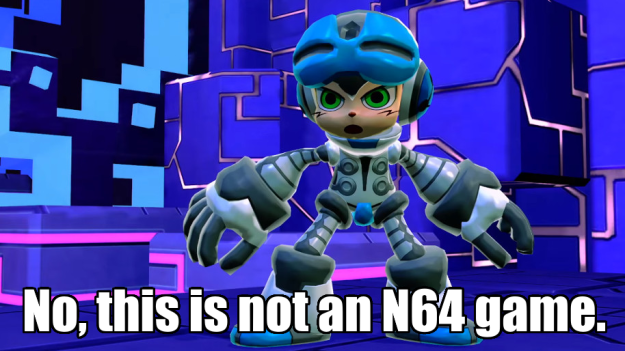
Mighty No. 9 is a mighty disappointment.

Mighty No. 64.png

I haven’t purchased or played Mighty No. 9, so my perspective of the matter is one of being on the outside looking in. At this point, however, I’m not planning on buying it. I know well enough from my vantage point that Mighty No. 9 has proven to be a serious disappointment. It may even turn out to be the biggest disappointment in gaming this year. Yeah, that bad.

At first, it seemed as though Mighty No. 9 was going to usher in a new age in video game funding; an age where the risk in funding blockbusters is removed because games are funded by gamers themselves who are interested in seeing the project come to fruition. Better yet, the project was funded by the legendary Keiji Inafune of Mega Man fame, and the project was to be the spiritual successor to the Mega Man series. With that kind of star power, there was a lot of potential.

However, attitudes toward the project soured as more and more drama unrolled during the development process, which included someone with very little gaming background being appointed to an important position on the staff because she happened to be someone’s girlfriend.

One would imagine that if anyone would know what it takes to make a great Mega Man game, it would be Keiji Inafune. Therefore, one would also imagine that he knew what it would take to make what was intended to be its spiritual successor. However, just about everything that made Mega Man great is missing from Mighty No. 9, right down to Mega Man’s charm.

Mighty No. 9 managed to raise $4 million from its Kickstarter campaign. Where did that money go? It certainly didn’t go into making the game look polished, as the product looks at least a couple generations behind. It didn’t seem to go into the music, either. That’s a shame, because Mega Man had great music. When a game has a good soundtrack, that can be a selling point for me.

So, what happened?

Personally, I suspect that Inafune got greedy. He knew that his own name, considered legendary among gamers, would be all that it would take to sell games. He already had the four million dollars that he raised from his Kickstarter campaign, and the additional money that he’ll rake in from sales will be icing on the cake. If there was a time for him to cash in his legacy with a game that was hyped to the point that it could hardly live up to expectations, even if a monumental effort were put into it, this would be it.

So, what did we learn? Hopefully, what gamers have learned is that if someone is demanding huge amounts of money for a project and has little to no obligation to deliver a product that’s substantial in quality, that might not be a very good investment. Granted, at least in this case, a finished product came out of the deal, unlike with Anita Sarkeesian’s Tropes project, which she just about abandoned even though it was well behind schedule, and wasn’t anywhere close to completion (though she kept the money anyway).

If it weren’t for the runaway success that is Undertale, it could be said that Mighty No. 9 killed the era of supporting major game releases through crowdfunding. But there is another thing we can take away from this. And that is that just because we put someone on a pedestal and consider them a hero, doesn’t mean that they won’t disappoint us.


Did the Pokemon Company make a Donald Trump pokemon?

Yungoos

Take a gander at the pokemon pictured above. Its name is Yungoos. Does it bear a resemblance to someone who has been appearing in the news a lot lately?

Pokemon games typically feature a Normal-type pokemon that isn’t very strong on the very first route. The first generation had Rattata, the second had Sentret, and so on. It looks like the seventh generation’s Rattata is based on Donald Trump.

Don’t believe me? Check out that hair. Then, if that weren’t enough, check out that determined grimace. See it yet?

Also, check out the flavor text that goes with this pokemon:

Yungoos is a big eater that is never satisfied. The majority of its long body is given over to its stomach, and its digestion is swift, so it’s always hungry.

So, what’s the joke, here? If Yungoos is based on Donald Trump, then this bit of text suggests that this Donald Trump pokemon is greedy. In a somewhat similar fashion, Donald Trump has a reputation as an aggressive entrepreneur that shows little sign of satisfaction.

But that’s not all. There are more hints in the flavor text:

Yungoos is not a Pokemon that is native to the Alola region.

Donald Trump’s grandfather was a German immigrant. And there’s more:

It was brought to the region to help deal with the explosive population of a certain other Pokemon, and now Yungoos are commonly seen around the Alola region.

Of all things, Trump’s strong stance on illegal immigration got a reference. But I do feel a little curious. What is the identity of the pokemon that Yungoos was brought in to “deal” with?

I don’t really expect Yungoos to become the official mascot of the Trump campaign, but I can imagine Trump supporters putting this thing on a campaign sign. Actually, that kind of thing is much easier to imagine with image editing software:

trump supporters pokemon yungoos

If its evolved form is a Hillary Clinton pokemon, that would ruin it.

Where’s the Fair Use? We still have to fight for it.

If you use YouTube a lot, you’ve likely come across a number of videos that exclaim “WTFU”, or “Where’s the Fair Use?”. This is because on social media, there are many wrongful copyright claims that have the effect of stifling the expression of opinions.

A fresh example of this is the recent removal of a video by Steven Crowder, in which he explained why Democratic Socialism doesn’t work. The video was removed from YouTube at the request of Mashable, with the claim that Crowder’s use of portions of their video was a violation of their intellectual property rights.

Here is a video of Crowder’s opinion on the matter (Trigger Warning: Steven Crowder is a Conservative comedian. If you’re an SJW or similarly weak-bladdered, you might be exposed to an opinion that is not your own):

In American law, there is a legal protection called “Fair Use”. Fair Use allows for the limited use of copyrighted materials for educational, review, or satirical purposes without being considered to have broken copyright law. Crowder’s video, like those of many other YouTube personalities, falls nicely under Fair Use.

So, what’s the problem? The doctrine of Fair Use is being ignored, that’s what.

It gets worse when you consider that YouTube’s policy on copyright claims is horribly flawed. When a copyright claim is made on a video, the channel that uploaded it gets a strike on its account. Strikes can be contested, but the uploader is faced with the burden of proving that they didn’t violate copyright law, instead of placing the burden of proving that a violation of copyright law occurred on the one filing a complaint, which is right where it belongs.

It gets worse. When a copyright claim is made against a channel, any money that the video would have made the uploader goes to the person making the claim until the claim is resolved. Even once it’s resolved, the person making the complaint doesn’t have to pay it back. Because of this, there are people who abuse the system by making false complaints to make some money for themselves. As of this writing, they actually get away with it.

And it gets worse, still. Once a channel has three strikes, it’s deleted. The whole channel.

That’s a catastrophic blow for a channel that has gone big. Channels that have over 100,000 subscribers can easily make the account owner as much money as a minimum wage job. For some people, their YouTube channel is their livelihood.

As you’ve likely already gathered, a person doesn’t need to be the copyright holder to file a copyright complaint. On YouTube, false copyright complaints are rampant. In many cases, as is the case with Steven Crowder’s video, a false allegation of copyright infringement can be filed in an attempt to silence an opinion that they don’t like. Sometimes, a company will file a copyright complaint in order to remove a review that might hurt the sales of their product, even if it’s obvious that the copyrighted material has been used in a manner consistent with the allowances afforded by Fair Use.

So, what can we do about it? On the one hand, you could do as Doug Walker did and make a video pleading for the administration of good, decent sense:

Look at those puppy eyes! Don’t you see that all this copyright abuse is making him sad?

Yes, you can be another messenger in a world full of messengers that are easy to ignore because most of them won’t actually do anything proactive about their problems.

On the other hand, you can do something about it. Because when it comes down to it, most problems don’t go away by themselves, even if almost everyone is aware of them. Sympathy posts to attempt to bring attention to a matter are usually pleas to have someone else do the work.

So, what can we do about it?

Phoenix Wright lawyer up

That’s right, lawyer up. If someone makes a false copyright allegation against one of your YouTube videos, take them to court, win, and in so doing, establish a legal precedent that would serve as a deterrent against anyone who would attempt the same thing.

You would have the law on your side. According to the Digital Millennium Copyright Act (DMCA), filing a false DMCA claim is punishable by up to five years in prison. Of the Federal variety.

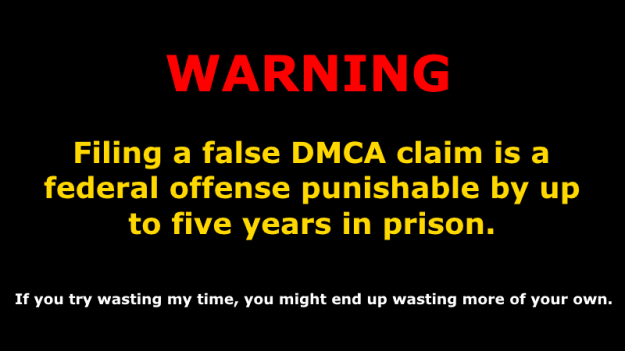
I’ve seen videos begin or end with splash images claiming that the limited use of copyrighted materials in the video falls under fair use. If you really want to deter false flaggers, here’s the kind of thing you should use:

YouTube warning

Make it clear that you’re serious.

If you’re wondering where the Fair Use is, it’s because we’re not done fighting for it yet. Until a YouTuber that’s brave enough steps forward to defend their freedom, we’re likely to keep hearing about things like #WTFU for quite some time. Not that that means that anyone’s doing anything about it.

#Fightfor15 backfires: McDonald’s considers replacing workforce with robots

robot

I remember my first job. It was working for McDonald’s, I kid you not.

However, it’s looking like times are changing. We might be saying “good-bye” to the day when high school seniors flipped burgers so they can buy Pokemon cards. The recent push for a massive jump in minimum wage has caused McDonald’s to seriously consider employing robots to replace their crew members. And considering the logistics behind it, it might actually be a pretty good move for McDonald’s.

I don’t know how expensive some of the robots they’re considering may be, but here’s some numbers to crunch:

Minimum wage may increase to $15 per hour.
A full-time work week is 40 hours.
There are about 52 weeks in a year.
Therefore, a full-time worker at the proposed minimum wage would make $31,200.00 per year.

If just one robot set McDonald’s back $60,000, it would end up paying for itself in less than two years. That would be a serious bargain. But there’s more. Employing robots can result in the following benefits:

  • Robots won’t complain about working overtime, nor would they demand more pay for it.
  • The only benefits that they’d require is routine maintenance.
  • They won’t goof off to go on Twitter to complain about their job or accuse their boss of being in some “old boy’s club”.
  • They won’t complain about special orders.
  • No showing up late. Showing up late is for humans.
  • They’re not going to have a bad day or decide to hate their jobs, so they’re always going to be polite to the customers.

And there’s more. If they can find some robots cheap enough that can accomplish the same tasks as humans, something which is becoming easier to do, McDonald’s stands to benefit from employing robots.

I know that some McDonald’s crew might mind losing their jobs to some robots. Me, I have my own reasons for thinking that a minimum wage increase is a terrible idea. I’ve worked minimum wage and close to it long enough to understand the kind of damage that minimum wage increases do to the value of money. The government might force employers to pay their staff a higher wage. But nothing is preventing renters, retailers, and utility providers from charging more for their products and services. When there is a minimum wage increase, the cost of stuff starts shooting up.

And why wouldn’t it? Businesses have a harder time making ends meet when they’re forced to pay their staff more, and increasing the costs of products and services is a natural way of trying to offset an increase in the cost of running a business. People would have more money anyway, so if they were able to pay for it before, they’d be able to pay for it at the adjusted rate.

So, in summary, we’d be payed more, but…

  • …We’d be charged more for everything, too.
  • …The value of the money itself would plummet, which would be tough nuggets if you’ve been trying to save the stuff.
  • …There’s no guarantee that there’d be a rate increase for skilled workers, so if you went to school to do what you do, it might become harder for you to get by.
  • …And you might end up losing your source of income to a robot, in which case, you’d actually end up making less.

As I’ve mentioned before, I’ve lived as a poor person for quite some time, so I know how these things go. The idea that poor people would benefit from a minimum wage increase is a myth. However, it’s getting to the point that even fast food workers are having to compete with robots. That humans have been less expensive to hire has long been a selling point, but it looks like that’s changing.

Why does The Big Bang Theory irk me?

BBT no.png

If “smugly thinking that you are so smart because you found something out by using the internet” had it’s own TV show, that show would be The Big Bang Theory (BBT). Its fan base actually fancies themselves as among the nerds just for watching a show that was written to appeal to grandiose fantasies of being nerdy, as opposed to being unattractive and lost in bad television without the intelligence.

That’s the appeal of the show. That’s what makes people continually come back for more of it: that the viewers think that they’re so smart for living in the 21st century, and this is the show that pats them on the back for it.

People are not scientists just for watching a show about people pretending to be scientists. That’s the kind of thing that’s hard to imagine having to explain to anyone over two years old. But here we are today, witnessing another new low in humanity’s race to the bottom.

Think I’m overreacting? Here’s a clip from BBT. Keep in mind that this wasn’t some random clip from some hostile viewer out to make BBT look bad by sarcastically adding a laugh track every time the show fails at humor. The video was posted by CBS as representative of the kind of humor that the show has to offer:

There’s a reason this show has a laugh track. Without it, viewers would have no idea when the writers want them to laugh, and the show would just be one stale, awkward delivery after another.

Not only does this show give people a false sense of intellectual grandiosity, it actively misleads them. The clip above briefly mentions Galileo’s conflict with the Catholic church. Myths about Galileo’s persecution have long been thrown around, but recently, I heard someone mention that Galileo was excommunicated. My BS detector went off, so I later did some research.

What I found out was that Galileo was not excommunicated. At worst, he was put under house arrest.

When you think about the great acts of religious persecution throughout the ages, what do you think about?

  • In the year 1915, entire towns of Armenian Christians were killed by invading Young Turks, in what is today known as The Armenian Genocide.
  • In the 1940s, millions of Jews were killed by Aryan supremacists in what is known today as the Holocaust.
  • Rudie poo house arrest.

Galileo was under house arrest because he presented a theory that was in conflict with the Catholic church’s then-popular geocentric ideology, which, contrary to popular belief, was taught nowhere in the Bible, but instead found it’s way into Catholic thinking due to the influence of Platonic philosophy. But you don’t hear pseudo-intellectuals firing their mouths off about how Platonic philosophy is leading people astray.

Galileo wasn’t excommunicated. He decided to remain a Catholic. He did so because that was what he believed in, not so some fifteen-year-old with a superiority complex can later dump on what he stood for.

When it comes down to it, people aren’t actually interested in science. They’re more interested in thinking themselves so smart because they own smartphones. Yeah, those things which are made to be as simple to use as they can be so that just about anyone could use them. Touchscreens are among the most straightforward interfaces known to mankind, and smartphones usually have just one button on the front of them. Don’t feel so smug just for being able to use something like that.

If people were interested in science, we’d see more people forming hypotheses and then rigorously testing them using the scientific method and documenting their observations, and reading long research articles published in periodicals. It seems like people are far more interested in bad television.

When most people say that they like science, what they really mean is that they like playing games on their cell phones.

How to make a great hamburger

Making hamburgers is easy to do, but hard to do well. The following is a recipe for a good hamburger.

Before getting started, be sure that you have all of the ingredients ready. That’s a culinary basic.

Here is the list of ingredients:
Ground beef
Wheat kaiser roll
Brown mustard
Pepper Jack cheese
Pickles
Jalapeno slices

Lean ground beef works. When the fat content is higher, the fat usually cooks right off, and what’s left is a juicier, more flavorful hamburger. You’ll want to shape the beef by hand into a patty nearly an inch thick, and slightly wider than the roll you intend to use as the bun. The patty shrinks slightly as it cooks, so going large isn’t a bad policy. Besides, there’s something inviting about a hamburger that extends slightly beyond the bun.

Preferably, the hamburger should be cooked over an open flame, but it is acceptable to cook it on the stove over medium to medium-high heat. You’ll want the patty to remain on the heat for about half-a-minute to a minute, then turn it 45 degrees and allow it to cook on the same side. You’ll know that one side is done when the sides appear cooked (a brown-grey color), though if some juice boils through the burger, that’s a sign that one side is near done. Flip it over, and allow the other side to cook for the same amount of time, turning it 45 degrees after a short time of cooking.

At no point during cooking should you “smoosh” the burger with your spatula. Doing so causes juices to escape that would otherwise assist in the cooking of the hamburger, and make the burger flavorful and moist when it is done. Smooshing hamburgers results in dry hamburgers.

You’ll want a nice roll, and a wheat kaiser roll will do. Don’t settle for cheap hamburger buns. It’s a crying shame to put so much effort into making a nice hamburger with nice toppings only to put it on a cheap bun. A wheat kaiser roll would be great. By wheat, I don’t mean those cheap rolls that are only died brown in an attempt to trick poor people, and contain only trace amounts of wheat so that it could legally be called wheat on the package. Nice wheat rolls may cost a little more, but the result is a nicer hamburger. To get the most out of it, after it has been sliced, lightly toast your roll. This can be easily done by placing them directly on the surface the hamburger was cooked on for a few moments.

Next, it’s time for toppings. The mustard goes on the bottom roll, right between the bottom roll and the patty. The rest of the toppings go between the patty and the top bun. Brown mustard is preferred, but yellow mustard is okay. If you really like mustard, you could use both.

A cheese slice goes directly on top of the patty. Pepper jack is preferred, though muenster works as well. On top of that goes the pickles. Don’t use soggy pickles like the kind you’d expect to get at McDonalds. Vlasic has a variety of sandwich slice pickles. Those would work pretty well, or something like them. On top of that goes Jalapeno slices. Be generous with them. Optionally, a pineapple slice can be added. That may sound weird, but it actually goes great on hamburgers. Top with even more mustard and put the top bun in place. There you go.

With that, your hamburger should be ready. A recommended beverage to go with it is beer.

There are some who might wonder why some toppings are missing. One of these toppings would be bacon. I know that there are many people out there that think that bacon makes everything better. It doesn’t. Bacon is not a big, screaming deal. Stop fetishizing it.

What about relish? Relish is made from pickles, and when pickles are already included on the sandwich, relish is a little redundant. If you wish, you may substitute a suitable relish for the pickles.

Then there’s ketchup. I’m not really fond of ketchup. Ketchup is really more of a kid’s topping than something to put on a serious hamburger. What’s more, ketchup ruins the flavor of just about anything. Like eggs. If even a dab of ketchup touches eggs, they’re ruined. I had ketchup on eggs once. Accidentally. I hated it. Some people even put ketchup on their steak. Gross. Good steak isn’t cheap. A Delmonico steak at a nice restaurant would set a minimum wage worker back four or five hours of work. If a person is going to work so hard for a steak, they shouldn’t ruin it with cheap toppings.

Now you know how to make a great hamburger.

Is there a fast way to tell whether politicians are lying about global warming?

Is there a fast way to tell whether the concept of anthropogenic global warming is being presented with political motives to fleece a gullible public? I believe that there is.

Al Gore in Davis Guggenheim's documentary An Inconvenient Truth.

The man pictured above is Al Gore. Al Gore has made it his mission to preach about the dangers of anthropogenic global warming. He has been so passionate about his message that he has written a book and a movie making the case that anthropogenic global warming could have catastrophic consequences in the near future. Among his stated fears is that the ocean level will rise as a result of anthropogenic global warming.

barack-obama-04

The person in this picture is Barack Obama, the current President of the United States and liberal idealogue. Like Al Gore, he believes that anthropogenic global warming will have catastrophic effects on the globe in the near-term future. In fact, he has stated that climate change is a threat to national security. Yes, in a world where Al Qaeda, ISIS, Boko Haram, and Hamas exist, Obama openly proclaims that climate change is a threat to national security.

al-gore-house-santa-barbara

Pictured above is Al Gore’s property in Montecito, California. It was purchased in the year 2010, after Al Gore published his book and his movie. The property is estimated to be $8 million in value.

Why would a person invest in property in an oceanfront city if they actually believed that it would soon be underwater?

magnum-pi-estate

Pictured above is oceanfront property linked to the popular show, Magnum P.I.. In the year 2015, President Obama was linked to the purchase of this property. The property was sold for $8.7 million dollars.

Again, if a person is sincere in their belief that rising water levels would pose a direct threat to the lives of those living on and near coasts, even saying that “seas will slowly keep rising and storms will get more severe, based on the science” (as Obama said in 2013), and saying that “we’ll continue to see rising oceans, longer, hotter heat waves, dangerous droughts and floods” (as Obama said in his State of the Union address in 2015), why would the same person buy beachfront property?

If a person is sincere in a belief, why would they make long-term investments costing millions of dollars that are entirely inconsistent with those beliefs?

Stealing jokes does not make you clever.

joke thieves are not clever

Earlier, I overheard someone say something about how he trolled supporters of Donald Trump.

What did he do? He approached some Donald Trump supporters and told them some inspirational quotes, then told them that Donald Trump said those things.

Naturally, the Donald Trump supporters said that these inspirational quotes sounded nice. No surprise there. They were inspirational quotes. They sound nice by design.

I don’t believe that the guy actually approached Donald Trump supporters and attributed inspirational quotes to him. For one thing, I know the guy well enough to know that such an activity was well outside his range of usual activities. But my main reason for not believing him will become clear by the end of this post.

After the theoretical Donald Trump supporters said that the quotes sounded nice, he told them that the quotes actually originated from Adolf Hitler.

Still waiting for the punch line? Sorry, that was it.

Believe it or not, Adolf Hitler was capable of sometimes not sounding horrible. There was a reason why the guy had a following. Being a hateful, genocidal maniac doesn’t make for a very attractive political leader.

Now for the main reason why I don’t believe that this guy actually approached Donald Trump supporters about anything: In 2013, a Pinterest user posted pictures of Taylor Swift with inspirational quotes. You probably already see where this is going. On August 30 of that same year, the same Pinterest user was called out for attributing Hitler quotes to Taylor Swift. She was trolling.

After that, legions of copycats started popping up and doing the same thing, as though the rest of us don’t also have access to the internet and could have read about the same joke on Reddit.

Look, Donald Trump is a political figure. If you don’t like him, point out what’s wrong with what he stands for.

But if you’re an unclever hack, try taking credit for someone else’s prank that you read about on the internet. Why would anyone else have heard about it?

Don’t make a Target out of me.

don't target me

Earlier, I went on a trip to Target to look at some notebooks. I didn’t find the one I was looking for, so I left the store.

I had made it to a crosswalk at the edge of the parking lot, when I looked behind me and noticed someone from security walking in my direction, and getting pretty close. Was security actually thinking that I might have stolen something?

When the signal came on for me to walk, I went ahead and crossed the street. After a bit of a distance, I glanced behind me and saw the same security employee having turned around and walking toward the enterance. One thing I understood about security personnel is that there’s nothing they can do about someone who has already stepped beyond store property.

I get that they may have been suspicious because I walked into the store and left without buying anything. However, that’s actually typical consumer behavior. It’s called “shopping”.

I wasn’t wearing heavy clothes or a hat. I wasn’t wearing a backpack, even though I’m a student. I just went into the store looking for something in particular, and left after having not found it.

Well, Target? What is it that you want me to say? I’m sorry that I walked into your store and looked at your notebooks. Maybe next time I’ll shop online, find it cheaper, and get it shipped directly to me.

If the light didn’t change as soon as it did, things could have been worse. Maybe the guy was just keeping an eye on me. But maybe he wanted to bring me back into the store, wasting time for everyone involved.

It used to be that the simple behavior of leaving without making a purchase was something that didn’t arouse suspicion. But it looks like times are changing.

I think that it might have something to do with this spreading attitude that has people assuming the worst of each other. People are going around accusing other people of being gangsters or sexual deviants. People are regarding people with more suspicion these days. Maybe this whole “stranger danger” thing is backfiring.

I don’t know what’s going on. It seems like there’s something not right with the way people are thinking, and it’s kind of scary.

EDIT: I did some shopping for the notebook I was looking for online. It turns out that Target can’t step. Here is what I found:

Moleskine msrp

This was the notebook I was looking for, as it appears on the official website for Moleskine. After looking a little more, I found this:

moleskine ebay

Why did I bother going to Target? Come to think of it, there’s not much reason to go to Target at all.

Target should be glad that there are still people that visit their store. If you can get something online for less money with no inconvenience and not have to deal with an overzealous security staff, what reason is there to go to Target?

Anita Sarkeesian abandons Kickstarter project, Tropes Vs. Women in Video Games

MTIyMzAzMTMyMjM4NjQzODE0.png

If you’re an SJW, today might be a good day to crawl into your safe space, because Anita Sarkeesian has abandoned her Kickstarter project, Tropes Vs. Women in Video Games.

Of course, she’s selling it as “moving on to something else”, but the rest of us know what’s going on. Her project has been thoroughly exposed as a sham, and she’s decided to lick her wounds and try something else.

Anita has raised $158,922.00 on the project’s Kickstarter page. Whether she has any plans to refund any of the 6,968 backers of this project is unknown.

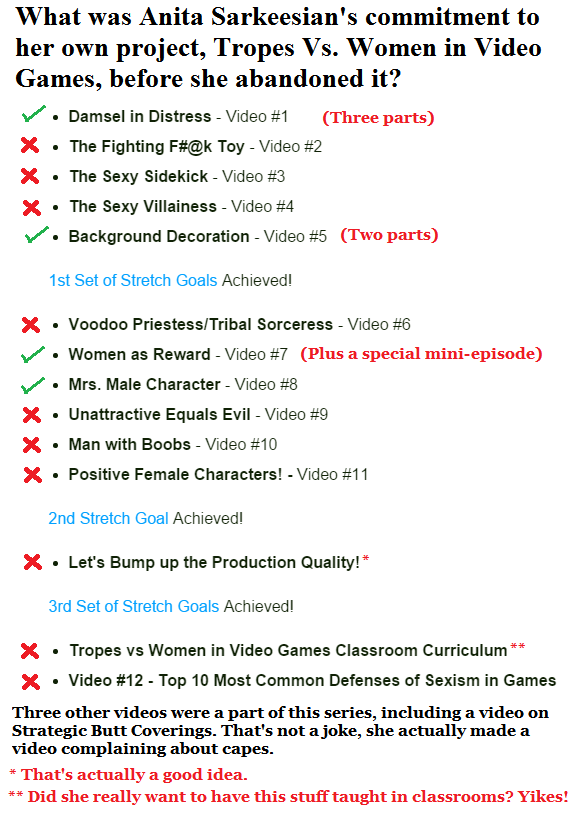
I’ve constructed the following graphic to help illustrate the progress that the project has made since it was first launched three-and-a-half years ago on May 17, 2012:

Anita's video agenda progress.png

Anita attended California State University, Northridge (which has a surprisingly high 52.9% rate of acceptance) where she majored in communications, which involved analyzing media for narrative. So when Anita takes in over a hundred thousand dollars to play thousands of dollars in video games, she’s doing what she went to school for. She’s not the only YouTube personality who comments on the content of video games, but I think she managed to do pretty well for herself in making as much money as she has.

The purpose of Anita’s series was to demonstrate that there is sexism in video games. Many video games do portray women in some pretty unrealistic and even outlandish ways, and in some cases heavily sexualizes them. Nobody really needed a social critic to point any of this out. The thing is, practically no one cares. Everyone who plays video games knows that they’re an expression of somebody’s fantasies.

Is Sarkeesian actually a gamer.png

Anita complains anyway, because as she sees it, video games normalize certain stereotypes. As Anita sees it, someone is needed to speak out against stereotypes against women because gamers are impressionable, unable to distinguish fantasy from reality. Of course, Anita is wrong.

One reason I prefer to stay away from radical feminists is because they tend to be extremely negative, sometimes assuming that complete strangers are criminals, particularly men. Most people don’t need to be told that almost no men actually have a desire to rape. Most of us recognize rape for the act of violence that it is. Of the men that actually have done it, most of them regret the act instantly. Even laws written primarily by men place rape on the same level as murder in terms of seriousness. Such laws have been around for a very long time, even in times believed by feminists to be the height of patriarchy. To the rest of us, this is obvious. To radical feminists, however, each man is potential rape waiting to happen. I have a hard time stomaching that kind of negativity.

I’m in favor of freedom of expression, even if what is being expressed is something I don’t personally agree with. I’m certain that Anita has heard of the game, Grand Theft Auto. It’s a bombastic game in which the protagonist is rewarded for committing outrageous crimes. However, the popularity of the game didn’t result in a surge in automobile thefts. This is because people know better, and aren’t so easily influenced by the expression of someone else’s fantasies, even if they enjoy the gameplay mechanics and play the game for hours a day. And even if someone steals a car because they learned to do it from a video game, it’s the car thief that’s held accountable, not the video game. The people who made the video game were exercising their protected freedom of expression.

So, what’s Anita working on next? She started a new crowdfunding project concerning the role of women in history. One can hope that the project won’t be nearly as divisive, unconstructive, and misleading as the one that she just gave up on (though this is Anita Sarkeesian we’re talking about, here). The initial fundraising goal of her new project is $200,000. That’s interesting considering that her previous project had a goal of only $6000. If she asked for thousands of dollars to play a bunch of video games, why is she asking for hundreds of thousands of dollars to do research that one can do with the simple assistance of Google?

anita research project.png

Believe it or not, women didn’t get their rights because a bunch a firebrands were shrill enough. Women got equal rights with men because men decided that society would benefit from it. What this means is that the feminist movement in it’s current form isn’t just divisive and as a result counterproductive. What it means is that feminism, in it’s current form, has been unnecessary all along.

Update (4-10-2016): Anita has made a video update, but she made it available for backers only. I found out about it because I was curious as to whether the project has raised more money or gained new backers since it was announced that Anita was moving on to something else. It wouldn’t have surprised me if it did, but as it turns out, that wasn’t the case. The video that was posted was not on one of the topics in Anita’s outline for her campaign, so in that regard, the video didn’t do anything to give her backers what they paid for.

It’s obvious that the reason she posts videos for backers only is because she’s far more sensitive to criticism than she lets on. Criticism (which Anita mistakes for “harassment”) is a normal and natural part of the experience of  publishing content on the internet, and is to be expected when what is produced is of inferior quality. Anita is taking measures to hide her content from her critics because she can’t take it anywhere close to how well she dishes it out (though she’s not very good at that, either).