Category Archives: Rants

Stealing jokes does not make you clever.

joke thieves are not clever

Earlier, I overheard someone say something about how he trolled supporters of Donald Trump.

What did he do? He approached some Donald Trump supporters and told them some inspirational quotes, then told them that Donald Trump said those things.

Naturally, the Donald Trump supporters said that these inspirational quotes sounded nice. No surprise there. They were inspirational quotes. They sound nice by design.

I don’t believe that the guy actually approached Donald Trump supporters and attributed inspirational quotes to him. For one thing, I know the guy well enough to know that such an activity was well outside his range of usual activities. But my main reason for not believing him will become clear by the end of this post.

After the theoretical Donald Trump supporters said that the quotes sounded nice, he told them that the quotes actually originated from Adolf Hitler.

Still waiting for the punch line? Sorry, that was it.

Believe it or not, Adolf Hitler was capable of sometimes not sounding horrible. There was a reason why the guy had a following. Being a hateful, genocidal maniac doesn’t make for a very attractive political leader.

Now for the main reason why I don’t believe that this guy actually approached Donald Trump supporters about anything: In 2013, a Pinterest user posted pictures of Taylor Swift with inspirational quotes. You probably already see where this is going. On August 30 of that same year, the same Pinterest user was called out for attributing Hitler quotes to Taylor Swift. She was trolling.

After that, legions of copycats started popping up and doing the same thing, as though the rest of us don’t also have access to the internet and could have read about the same joke on Reddit.

Look, Donald Trump is a political figure. If you don’t like him, point out what’s wrong with what he stands for.

But if you’re an unclever hack, try taking credit for someone else’s prank that you read about on the internet. Why would anyone else have heard about it?

Don’t make a Target out of me.

don't target me

Earlier, I went on a trip to Target to look at some notebooks. I didn’t find the one I was looking for, so I left the store.

I had made it to a crosswalk at the edge of the parking lot, when I looked behind me and noticed someone from security walking in my direction, and getting pretty close. Was security actually thinking that I might have stolen something?

When the signal came on for me to walk, I went ahead and crossed the street. After a bit of a distance, I glanced behind me and saw the same security employee having turned around and walking toward the enterance. One thing I understood about security personnel is that there’s nothing they can do about someone who has already stepped beyond store property.

I get that they may have been suspicious because I walked into the store and left without buying anything. However, that’s actually typical consumer behavior. It’s called “shopping”.

I wasn’t wearing heavy clothes or a hat. I wasn’t wearing a backpack, even though I’m a student. I just went into the store looking for something in particular, and left after having not found it.

Well, Target? What is it that you want me to say? I’m sorry that I walked into your store and looked at your notebooks. Maybe next time I’ll shop online, find it cheaper, and get it shipped directly to me.

If the light didn’t change as soon as it did, things could have been worse. Maybe the guy was just keeping an eye on me. But maybe he wanted to bring me back into the store, wasting time for everyone involved.

It used to be that the simple behavior of leaving without making a purchase was something that didn’t arouse suspicion. But it looks like times are changing.

I think that it might have something to do with this spreading attitude that has people assuming the worst of each other. People are going around accusing other people of being gangsters or sexual deviants. People are regarding people with more suspicion these days. Maybe this whole “stranger danger” thing is backfiring.

I don’t know what’s going on. It seems like there’s something not right with the way people are thinking, and it’s kind of scary.

EDIT: I did some shopping for the notebook I was looking for online. It turns out that Target can’t step. Here is what I found:

Moleskine msrp

This was the notebook I was looking for, as it appears on the official website for Moleskine. After looking a little more, I found this:

moleskine ebay

Why did I bother going to Target? Come to think of it, there’s not much reason to go to Target at all.

Target should be glad that there are still people that visit their store. If you can get something online for less money with no inconvenience and not have to deal with an overzealous security staff, what reason is there to go to Target?

Anita Sarkeesian abandons Kickstarter project, Tropes Vs. Women in Video Games

MTIyMzAzMTMyMjM4NjQzODE0.png

If you’re an SJW, today might be a good day to crawl into your safe space, because Anita Sarkeesian has abandoned her Kickstarter project, Tropes Vs. Women in Video Games.

Of course, she’s selling it as “moving on to something else”, but the rest of us know what’s going on. Her project has been thoroughly exposed as a sham, and she’s decided to lick her wounds and try something else.

Anita has raised $158,922.00 on the project’s Kickstarter page. Whether she has any plans to refund any of the 6,968 backers of this project is unknown.

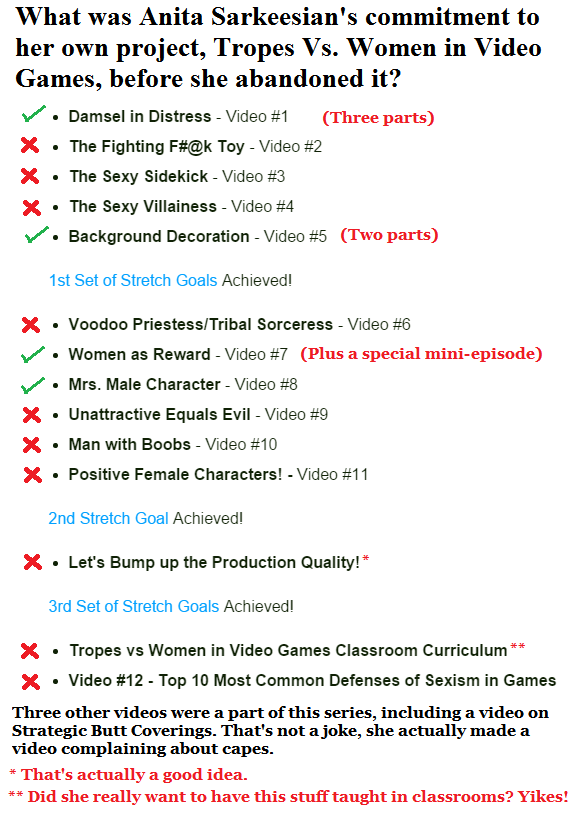
I’ve constructed the following graphic to help illustrate the progress that the project has made since it was first launched three-and-a-half years ago on May 17, 2012:

Anita's video agenda progress.png

Anita attended California State University, Northridge (which has a surprisingly high 52.9% rate of acceptance) where she majored in communications, which involved analyzing media for narrative. So when Anita takes in over a hundred thousand dollars to play thousands of dollars in video games, she’s doing what she went to school for. She’s not the only YouTube personality who comments on the content of video games, but I think she managed to do pretty well for herself in making as much money as she has.

The purpose of Anita’s series was to demonstrate that there is sexism in video games. Many video games do portray women in some pretty unrealistic and even outlandish ways, and in some cases heavily sexualizes them. Nobody really needed a social critic to point any of this out. The thing is, practically no one cares. Everyone who plays video games knows that they’re an expression of somebody’s fantasies.

Is Sarkeesian actually a gamer.png

Anita complains anyway, because as she sees it, video games normalize certain stereotypes. As Anita sees it, someone is needed to speak out against stereotypes against women because gamers are impressionable, unable to distinguish fantasy from reality. Of course, Anita is wrong.

One reason I prefer to stay away from radical feminists is because they tend to be extremely negative, sometimes assuming that complete strangers are criminals, particularly men. Most people don’t need to be told that almost no men actually have a desire to rape. Most of us recognize rape for the act of violence that it is. Of the men that actually have done it, most of them regret the act instantly. Even laws written primarily by men place rape on the same level as murder in terms of seriousness. Such laws have been around for a very long time, even in times believed by feminists to be the height of patriarchy. To the rest of us, this is obvious. To radical feminists, however, each man is potential rape waiting to happen. I have a hard time stomaching that kind of negativity.

I’m in favor of freedom of expression, even if what is being expressed is something I don’t personally agree with. I’m certain that Anita has heard of the game, Grand Theft Auto. It’s a bombastic game in which the protagonist is rewarded for committing outrageous crimes. However, the popularity of the game didn’t result in a surge in automobile thefts. This is because people know better, and aren’t so easily influenced by the expression of someone else’s fantasies, even if they enjoy the gameplay mechanics and play the game for hours a day. And even if someone steals a car because they learned to do it from a video game, it’s the car thief that’s held accountable, not the video game. The people who made the video game were exercising their protected freedom of expression.

So, what’s Anita working on next? She started a new crowdfunding project concerning the role of women in history. One can hope that the project won’t be nearly as divisive, unconstructive, and misleading as the one that she just gave up on (though this is Anita Sarkeesian we’re talking about, here). The initial fundraising goal of her new project is $200,000. That’s interesting considering that her previous project had a goal of only $6000. If she asked for thousands of dollars to play a bunch of video games, why is she asking for hundreds of thousands of dollars to do research that one can do with the simple assistance of Google?

anita research project.png

Believe it or not, women didn’t get their rights because a bunch a firebrands were shrill enough. Women got equal rights with men because men decided that society would benefit from it. What this means is that the feminist movement in it’s current form isn’t just divisive and as a result counterproductive. What it means is that feminism, in it’s current form, has been unnecessary all along.

Update (4-10-2016): Anita has made a video update, but she made it available for backers only. I found out about it because I was curious as to whether the project has raised more money or gained new backers since it was announced that Anita was moving on to something else. It wouldn’t have surprised me if it did, but as it turns out, that wasn’t the case. The video that was posted was not on one of the topics in Anita’s outline for her campaign, so in that regard, the video didn’t do anything to give her backers what they paid for.

It’s obvious that the reason she posts videos for backers only is because she’s far more sensitive to criticism than she lets on. Criticism (which Anita mistakes for “harassment”) is a normal and natural part of the experience of  publishing content on the internet, and is to be expected when what is produced is of inferior quality. Anita is taking measures to hide her content from her critics because she can’t take it anywhere close to how well she dishes it out (though she’s not very good at that, either).

Lessons in Kitchen Table Economics

There are a lot of misconceptions about poor people going around. Among these are the idea that the poor are not allowed to have some basic things, such as internet access, which certain out-of-touch persons view as being a luxury, rather than the modern-day necessity that it is.

I think that a simple, short course in low-income logistics would be what it takes to make people come to an understanding of just the kind of challenges that poor people have to deal with. Even ordinary people in America live like kings, so it’s easy for them to have an emotional disconnection with those that aren’t very well off, perhaps due to simple ignorance concerning those challenges.

Ordinary Americans have much to learn from the poor among them. Having been poor for some time, I’m in a position to enlighten them as to the challenges that poor people face. Because of this, I’ve decided to make this entry a short course in Kitchen Table Economics.

Poor people don’t just have humiliating jobs, they also have very little money. Very little. Because of how little money poor people have, they typically become very smart with their money. They pretty much have to be. For poor people, the consequences of a moment of foolishness are much, much higher.

There may be variations in the experience of the poor person, but the experience is generally reflected well in the math that I’m about to share. If there are differences in your expenses, Microsoft Excel can help you.

To get started, many poor people work low-qualification jobs in the food-service, retail, or grocery industries. Because the qualifications for these jobs are so low, there is no shortage of unemployed people qualified to work these jobs. If companies could get away with paying less than minimum wage, they would do it, considering that this would be a more profitable choice for them. Currently, the federal minimum wage is $7.25 per hour, as it has been since 2009.

The following graphic shows how much a person would make working minimum wage for a year, full-time. Seldom does a minimum wage employee work full-time, however. Many companies strategically assign their employees just short of the number of hours per week that it would take to classify them as full-time, to avoid the legal obligation of providing benefits.

KE1 paycheck math.png

Typical deductions made to the paycheck are an estimate, but it’s not unusual for a person to take home around 72% of their paycheck. Therefore, the take home pay for a week would come to $208.80. The yearly and monthly salaries are calculated based on this, because this is the money that poor people can actually do something with. So, based on this, a full-time employee making minimum wage makes only $10,857.60 per year. Politicians have no idea how anyone could live off of that kind of money, and too many people assume that if they do, it must be their fault somehow. By the end of this lesson, you’ll have a much better understanding of how poor people pull it off.

Now that we have a good idea of what a poor person’s monthly salary looks like, let’s take a look at what they would do with it:

KE2 monthly expenses.png

For the breakdown of monthly expenses:

  • The rent would be for a typical one-bedroom apartment in an urban or somewhat suburban area. Perhaps not ideal or in an ideal neighborhood, but deemed good enough for poor people and perhaps nice enough to include expenses such as heat, water, sewer and trash in the rent. One might not want to raise their kids in a neighborhood like that, but for this example, the poor person would be single.
  • The electric bill would be an estimate, and could vary wildly depending on time of year. In the spring and autumn, the electric bill could be as gentle as $20-30 per month, but can be as harsh as $130 in winter or summer months, when one would struggle for a 68 degree temperature.
  • The phone expense would assume that a smart phone is not being used. Instead, it would be something like a Trac-Phone which would charge about $20 for three months of service with limited minutes. The $7.50 per month figure would be an estimate for a similar service.
  • The internet bill would assume a typical high speed service which could greatly vary in price. Contrary to the sentiments of the out-of-touch (such as David Menzies, who in his echo chamber still believes that internet access is a luxury), an internet connection is a necessity in the modern world. Many would-be employers don’t even accept paper applications or résumés anymore, and when interested in setting up interviews, they typically inform applicants via email. It’s not practical for a person to walk miles to the nearest library on a daily basis for the chance that a person might get an email to set up an interview for the next day, especially considering that libraries are struggling to remain open.
  • The bus pass was included because of the sheer difficulty that poor people face in obtaining, maintaining, and fueling an automobile. Unless your work is close by or you don’t mind walking miles to get there (on top of the additional daily miles that David Menzies would have you walk to check emails at the library), a bus pass would serve you well.

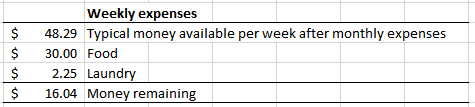
After all this, a person is left with over $200 each month. So, what’s the problem? We’re not done yet. There are also weekly expenses, such as food and laundry.
KE3 weekly expenses.png

“Hold on,” you might be thinking, “so little for food?” Life as a poor person is difficult, so concessions are often made to make ends meet. A poor person seldom eats out, typically doing so for special occasions or for a treat. As mentioned already, the person in this example would be a single person, so he’d be spending money to feed himself.

For poor people, the quality of the food they eat is typically pretty low. It’s possible to eat some healthy food for cheap, such as bananas, eggs, and oatmeal. But those choices are limited, and outside of that, there’d be plenty of sodium-heavy, low-nutrient food that would be useful for little besides staving off the sensation of hunger. After a while of eating such things, it’s possible to feel the effects of malnutrition in spite of not really feeling hungry.

I included the expense of laundry, because by this point, a difference can be made by stretching pocket change. At a typical laundromat, a single use of a washer is around $1.25, while a single use of the drier is around $1.00. This is assuming that you have only one load to do. If you have more than one load of laundry, you’re going to have less of that pocket change to stretch out until the next time you get paid.

After all this, you’d have about $16.04 left over in a week. For those who are not poor, that’s about an hour’s salary. It wouldn’t seem like something that a person would even bother attempting to save up. But assuming that a person tried:

KE4 theoretical savings.png

Hooray! A poor person could afford to buy the newest PlayStation! And it only takes six months of living like a virtual serf!

Not so fast. There are some highly variable expenses that can pop up from time to time that could make things much more difficult for the minimum wage worker. Clothing wasn’t mentioned. A person might move out of his parent’s place with a few changes of clothes, but if a piece of clothing were to wear out, it might be time for a trip to Goodwill or The Salvation Army or another thrift store to attempt to get a replacement on the cheap. If a poor person wears designer clothing, they likely managed to obtain it there.

Then there’s the possibility that an accident happened, and the poor person must go to the hospital. Assuming that they have medical coverage, even the cost of an emergency room copay (about $100) would be all it takes to ruin them, not to mention that they might be missing entire days of work, reducing their pay.

Another thing that could ruin a poor person is minor fines for something like jaywalking. Even if a minimum wage worker were to only receive a $50 citation, it could impact their quality of life for the short term future. If you’re looking for evidence that the system favors the rich, consider the fact that the ordinary person would be relatively unaffected by tickets for traffic violations, while if a poor person were to step out of line in even the slightest way, a similar fine when imposed on them would be all that it would take to bury them.

So far, we haven’t discussed how our poor person would get his hands on furniture. Unless he managed to get a sofa or a bed as a gift, he might have been sleeping on the floor. Or there’s dumpster diving.

With that, some myths about minimum wage living should have been demolished. Minimum wage is often referred to as “living wage”, but among those who attempt to live off of it, this is regarded as a sick joke.

The purpose of this article wasn’t to encourage some sort of class warfare. The idea was to get some much-needed perspective out there so that the general population would come to a better understanding of what life as a poor person is actually like. Not every poor person is trying to game the system to get stuff for free from the government, nor are they in every case in the position that they are in due to a lack of wisdom.

If you see someone working in grocery, retail, or fast food, and they are smiling, be nice to them. There is a strong chance that they are trying as hard as they can.

I don’t like chicken wings much, either.

If you’ve already read my article on white chocolate, you’ve probably figured out that I don’t like it. There’s another food item I don’t like, and that’s chicken wings.

I know what some of you might be thinking; “Haw dude, but I like chicken wings!” I know. A lot of people do. At one point, that was kind of surprising to me. But it seems like each time they serve wings at the cafeteria, the lines are extra long, likely because when wings are served, students send text messages to let each other know so more people can get in line. It doesn’t help that the cafeteria staff takes their time carefully counting them so that each student that orders them gets a certain amount. I seldom get wings, so when my turn finally comes around, I quickly get my order.

So, why don’t I like chicken wings? Because there’s not much to them. Chicken wings are largely skin, bones, and heavy amounts of glaze or whatever they’re coated with. Also, there’s a little bit of meat in there somewhere. I really don’t know what it is that makes chicken wings so popular, but I suspect that it has something to do with some diabolical Edward Bernays style marketing, because chicken wings were once considered a waste product.

And if you do attempt to eat them, bring some napkins with you. Those things are a MESS. Much of whatever glaze that’s on them comes off on your hands and your face (I say “your” face because I don’t have to order something I don’t like).

Then there’s the skin. Much of the fat that’s in chicken is on the skin, which is why it’s a good idea to remove the skin that’s on chicken before attempting to eat it. Wings that are glazed have the glaze placed directly on the skin. The expectation is that you eat the skin. A person can attempt to remove it, but it’s a lot of work, and the glaze comes off, which is where the wings get much of their flavor. There’s also the work of attempting to remove the bones, but by the time a person accomplished that much work, they’re left with very little meat.

That’s the problem with chicken wings: they’re too much work for too little reward. A person can decide that they don’t care, and attempt to eat them, skin and all. But then they’re packing on the pounds from all the glaze and skin they’re eating. A person can take the hard way, and get too little for it, or take the easy way, and gain a lot of weight. Should I really have to fight my food when it’s already dead?

And even if you do bring a bunch of napkins with you, that glaze persistently sticks to your hands, meriting a quick trip to the restroom right after eating to wash your hands, getting doorknobs and anything else you touch sticky along the way. So if you get a text, you either ignore it until you’ve washed your hands, or your phone is among the things that get messy on your way to wash the sugary sauce from your hands.

So, no. I don’t like wings.

I hate white chocolate.

As I see it, white chocolate isn’t even real chocolate. To make it, the cocoa powder is removed and replaced with milk solids. It’s about the same as making chocolate, except what makes it real chocolate is taken out. In spite of this, it’s still called “chocolate” on its packaging. It seems so much like a waste product that’s marketed to the public in an effort to cut the costs associated with simply discarding it.

White chocolate tastes like chalk mixed with milk. It’s like chalk was blended together with milk and some cocoa butter, and sold as white chocolate. Don’t think that sounds very appetizing? Me neither.

I started hating white chocolate since I was a kid. I remember going to an event where chocolate was given out to children. Like many kids, I didn’t turn down an opportunity to get some chocolate without having to earn it. While most of the kids were getting real chocolate, I was one of the few that got white chocolate, instead. It looked off to me, but I tried it. When I did, that sealed the deal. From then on, I hated white chocolate.

I remember there being a television sitcom in which someone went on about how she liked white chocolate. I can’t remember which sitcom it was, and I don’t care much for looking into it. I do remember that it was a show that I found annoying. The woman called white chocolate something like “the gold of chocolate”. She was wrong. Gold is desirable. White chocolate is not. The episode came off like an effort to market a product that wasn’t selling very well.

In spite of this, there was actually a chocolate bar that I liked even though it had white chocolate as one of its ingredients. It’s called Hershey’s Cookies ‘n’ Creme. It had little chocolate cookie bits in it. Why didn’t I hate it? Maybe because it was basically a chocolate bar. Cocoa powder was removed to make white chocolate, then later cookie bits were added which contained cocoa powder. Why did they remove the cocoa powder to begin with? A real chocolate bar with cookie bits would have been sweet. Maybe they were trying to find something creative do to with a surplus of white chocolate that’s not selling, and their idea was to add cocoa powder back into it. That’s actually pretty smart.

Hershey's Cookies 'n' Creme

How to get me to like white chocolate: by adding the cocoa powder back into it.

By itself, though, white chocolate is pretty miserable. I see more of a point to decaf coffee. At least it tastes like coffee, which is good for those who like the taste of coffee. But if I want caffeine, then I want caffeine. As I see it, anyone who attempts to pass decaf off as regular coffee is committing fraud.

Are liberals secretly inept at tech?

BlackBerry_Curve_8310

The first batch of Hillary Clinton emails since the Benghazi testimony have been released, and one of the things they tell us about Hillary is her choice of cell phones. It seems Hillary is a Blackberry user.

I admit that my cell phone of choice was a Blackberry at one point. It was a Blackberry Torch, which I liked because it provided a combination of touchscreen and keyboard interfaces. It was an okay phone. However, the Blackberry brand is well past it’s prime. Perhaps the most significant reason that the Blackberry brand has as many users as it does is because it’s historically been favored in the business world. It was a pioneer at one point, and may have even been favored for some reasons. Today, the Blackberry brand doesn’t have the same kind of relevance that it used to.

It’s tempting to pick on Hillary because of her favoritism toward the Blackberry brand, but Blackberry phones are sometimes standard issue among large corporations (I suspect that they’re a means of keeping the staff on a leash; if the company gives the employee a phone, it can enable the company to contact the employee at any time). What I found interesting is that after spending time with a newer Blackberry, Hillary went back to an older Blackberry for it’s familiarity. It’s interesting enough that, instead of adapting to something new, she went back to an older phone for it’s familiarity. But on top of that, after going back to her old phone, she found herself missing the emoticons from the newer phone.

Hillary Clinton is one of the most serious-looking women I’ve ever seen, so it’s hard to imagine that she’d have a strong attachment to emoticons. She even asked whether there was a way to add them to her older phone.

What we’re seeing so far is actually far different from the image of the privileged coastal technocrat that liberals largely picture themselves as (some also view themselves as an oppressed minority that is part of an underground movement, and they see very little problem with being both). What we’re seeing is someone who, instead of adapting to something cutting-edge, instead went back to something older for comfort. And what’s more, she likes smilies. If she were to later come out saying that she plays Candy Crush Saga, that would lend to the idea that information like this was being fed to the public to make Hillary seem more relatable.

She also asked “How does this work” about a request to “connect” on the website LinkedIn.

Say what?

LinkedIn has over 300 million users. Each of these users likely figured out how to create an account without asking for someone else’s help. If she was really asking for help on how to connect on LinkedIn, perhaps she didn’t make her Facebook and Twitter accounts by herself.

To put this into perspective, the guy behind Time Cube was able to make his own website.

What’s more, Hillary asked one of her aides what her New York Times password is.

3

I get the idea that Hillary Clinton isn’t that good with tech. It seems like ineptitude with tech has increasingly become a liability for those of liberal persuasion. One example would be Lois Lerner, who played a part in a conspiracy to target conservative groups because that’s one way that a fascist can abuse power. When she was subpoenaed for her emails, it conveniently turned out that they were deleted. It’s pretty obvious that she or her cronies deleted her emails because there were things in them that could have gotten her in trouble. However, the emails were recoverable. It turns out that a supposedly-sophisticated organization like the IRS didn’t do a good job at covering its tracks.

Then there’s the scandal involving Anthony Weiner, who attempted to send a woman a picture of his genitals, but posted it to Twitter instead. I can picture a person mistakenly sending the wrong person a text message, but how does a person try to send a private message but accidentally make it public instead?!

Considering cases like these, I get the idea that liberals actually aren’t as tech savvy as they would like you to believe. Of course, the bigger problem for liberalism would be its ideology, and that they provide just the right environment for fringe groups such as radical vegetarians and feminists (the latter of which has been becoming increasingly fanatical).

MI0001937102

Liberalism is like a high-IQ club that’s free to join with no IQ test required, and everyone involved high-fives one another for having the same opinion. Of course, if they don’t come to the right conclusions, they haven’t actually been using their heads right, and that wouldn’t change just because they know how to use smartphones (which have been made so that they’d be simple to use for just about anyone).

Fat shaming and Nicole Arbour

A recent video by Nicole Arbour on YouTube caused quite a stir for it’s topic of fat shaming. In it, the host, Nicole Arbour, called out fat people for the claims that they make about themselves and pointed out that they have a problem. As you could probably imagine, the video got a lot of criticism. So much in fact, that the video was taken down for a short while before being placed back up and comments on the video have been disabled.

While her video did have it’s problems (such as that the host was mildly annoying), on her point that there is a problem with body fat in America, she mostly nailed it. America does have a problem with body fat.

So, why is Nicole Arbour so heavily criticized for her position? Because people don’t like admitting that they have problems that are their own fault. Yeah, there are some cases where people are fat because they have legitimate disabilities that affect their growth, and there are other causes that people can hardly help. However, cases like those are rare. In the case of nearly all Americans that are overweight, they got that way because they weren’t exercising very good self-control. We live in one of the few cultures in history that has an abundance of food, and people still treat it as though it might not still be there the next day.

In fact, in America, our own police forces have a problem with overweight officers. Considering that people count on them to protect them, that’s a scary thought. A physically fit perpetrator could easily outrun them. There are also security guards, though they’re not the same thing (if that’s the kind of thing you want to do with your life, that’s your choice).

People generally don’t like having it pointed out to them that their bad state is a product of their own choices, and is therefore their own fault. Because of this, people tend toward those who tell them what they like to hear, regardless of what’s good for them. This enables them to write off as “mean people” those who are pointing out what’s wrong.

A person who tells it like it is doesn’t always have to resort to satire. However, sometimes it takes a little more than gentle pleading to get people to change for the better. Most people seem to be familiar with only one kind of encouragement. I think it would be plenty motivating to take care of myself if it meant not becoming misshapen and disfigured, and if it also meant that I could avoid being made fun of for my weight, that’s also a plus. Potential suitors do pay attention to physical characteristics, and some of them can indicate lifestyle choices which are not ideal.

As a person who has been both skinny and borderline overweight, I can tell you that it’s a lot more fun to be skinny. I enjoy having that energy and sound health. There’s also the perk of being attractive. That might take some effort to maintain (perhaps more so for some than others), but it’s worth it.

If a person is overweight, what can they do about it? They could make the choice to take better care of themselves. However, it seems easier for many of them to write off people like Nicole Arbour as those who don’t know what they’re talking about as their paunch steadily grows and sags.

The disgusting heavy-handedness of copyright law

Copyright law is a topic that a lot of people feel sensitively about. It’s apparent that there are some strong feelings about it.

Before continuing, I think that it does benefit to first point this out: If you should have paid for music, movies, or video games, but did not, and downloaded them anyway, then you broke copyright law. “But Raizen,” you might say, “I didn’t steal them. I just made a copy. The media company still has the original.” You can call it what you want. The action that you described is illegal under US copyright law.

The point of this article isn’t to try to hammer people who download music illegally, however. I brought that up because I thought it would be productive to address that point that’s made by those who break copyright law, to help them to better understand the relevance of this article to them.

Don’t get the wrong idea. I’m not friends with the Record Industry Association of America (RIAA). Not by a long shot.

I have a problem with the RIAA because of their heavy-handed abuse of the law. How heavy-handed? A US court ordered a Minnesota woman to pay $220,000 after a suit by the RIAA.

That’s a pretty extraordinary claim. With a claim that high, one would think that she was the webmaster behind a huge web-ring that provided free music downloads to visitors to her web page in exchange for clogging their browsers with cookies and ads.

Nope. She downloaded 24 songs illegally. Not 240,000, only 24. Simple division time: $220000 / 24 = $9166.67.

“We are pleased with the appellate court’s decision and look forward to putting this case behind us,” said the RIAA. Of course, it would have been easy for the RIAA to put the case behind them because the RIAA is rich. They don’t have an immediate need for $220,000. As for the woman, a single mother with two children, things might be more difficult.

As if the RIAA didn’t have enough money, they also went after a former Boston University student in a $675,000 case. His case was aggravated by the fact that he redistributed the music, but the fee is still outrageous considering the fact that it was only 31 songs ($675000 / 31 = $21774.19).

I’m thinking that maybe that all that money isn’t going into fostering creativity from music artists, but is instead going right into the pockets of music execs who would then use it to buy more expensive automobiles for their children.

Talk about a punishment that doesn’t come anywhere close to fitting the crime. If I were to walk into a record store and walk out with a CD that I didn’t pay for, I doubt that the store would sue me for half a million dollars.

The product that the music industry offers isn’t worth as much as they are claiming in damages for it. That they think it is is an idea that they should get out of their heads.

Ideally, the law should be fair, not showing favoritism on the basis of wealth and class. In America, this is not the case. This is especially true when it comes to copyright law, much of which was brought about by the strength of the wealthy, who then use the legal system as an arm for themselves.

Concerning the $675,000 ruling, the RIAA stated that “We are pleased with the District Court’s decision”. That’s like a pro-wrestler patting himself on the back after sending a 12-year-old to the emergency room. The guy downloaded less than three dozen songs and uploaded them to the internet again, and wound up in more trouble than if he had uploaded videos of himself drop-kicking puppies onto YouTube.

I don’t know about you, but I find it very distasteful when the legal system is heavy-handed to the point of insanity. It’s even worse when the entertainment industry then wields the legal system as a tool for it’s own agenda.

What’s next, a $70,000 fine for jaywalking? I don’t know, but it’s hard to imagine that things are going to get better while people are tolerating the way things are going. Perhaps as people are becoming fatter and increasingly distracted, they’re becoming more passive toward the people that abuse them.

Killer blames video games for his behavior, instead of himself.

An Idaho man who killed three has decided to blame video games for his own criminal behavior. The story is on Oregonlive.com.

His excuse is a blatant appeal to the narrative that video games cause violent behavior, which is something that we know to be untrue. But because he decided to blame them, it wouldn’t be surprising to see people who hate video games eagerly use this to make their case that video games are violent, so they can either regulate them or succeed in getting video games taken away from everybody, then having succeeded in doing that, they’d move on to regulating just about anything else that they can so the rest of us can’t enjoy some simple pleasures.

It’s obvious that the killer just blamed video games for his behavior because he, like many people, doesn’t like placing the blame for his behavior on himself, which is right where it belongs.

The man said that playing video games made killing easier for him. Is that so? Why didn’t he blame the guns and knives that he brought with him? Did they make killing easier for him? Only in the sense that that they were tools that he used to carry out his desires.

Sadism comes from within. People don’t want to kill because they own video games or guns. People want to kill because they’re messed up in the heads. The man himself said that he was depressed and suicidal, which is evidence that he had some sort of mental infirmity that wasn’t properly treated.

There’s the problem. The man had mental problems. Depression is a psychosis. However, we’re seeing America becoming more shy about admitting that certain mental problems are even problems, instead deciding to chalk deviant mentalities to being “personality quirks” or saying that they were “born that way”, as though that makes them any less harmful. Saying that a problem is not a problem doesn’t make the problem go away.

It’s time for America to wake up. Taking stuff away isn’t going to make anyone any less vicious. Unless the mental infirmity is diagnosed and treated, the harmful behavior associated with it is just going to continue.